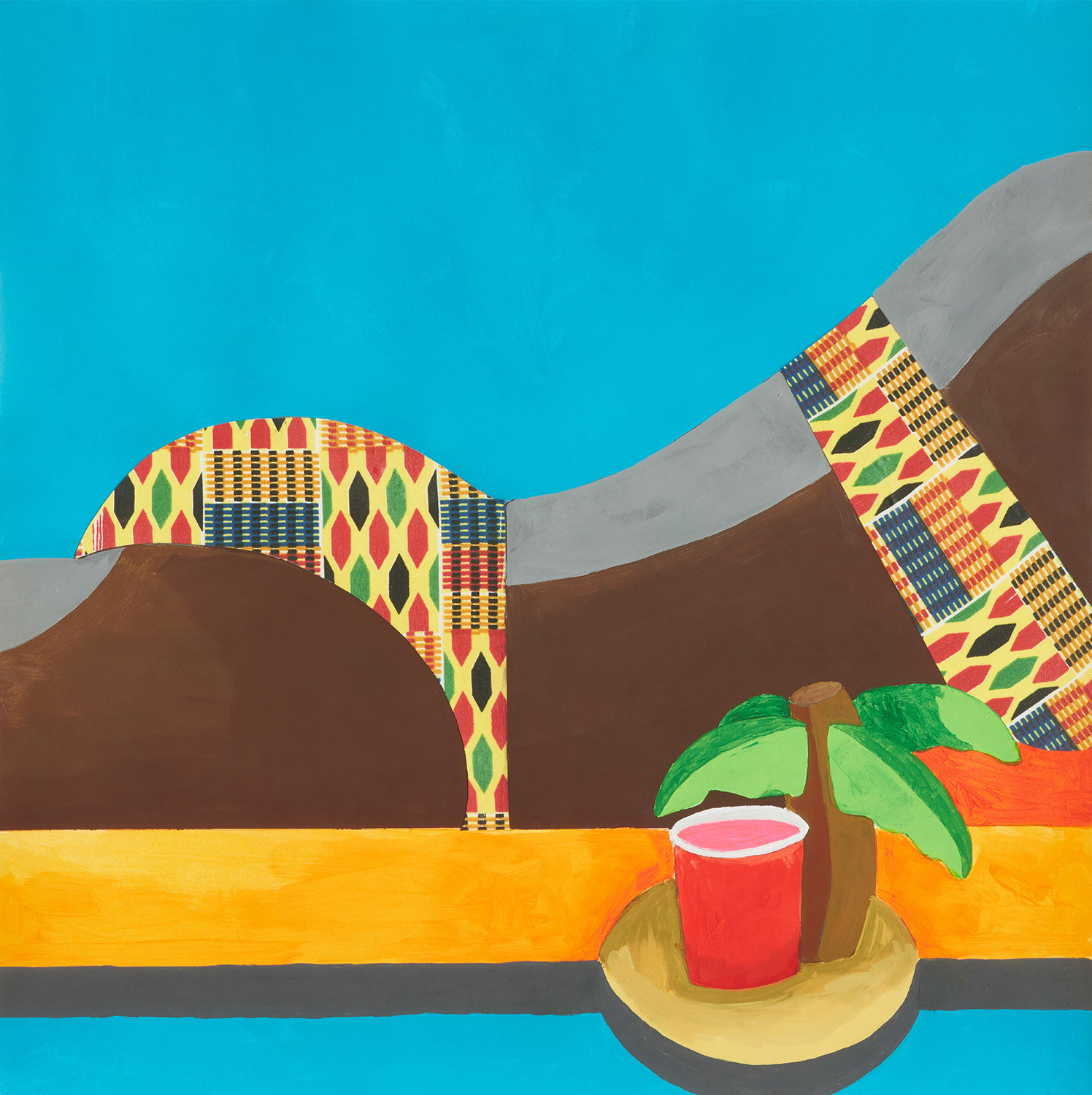
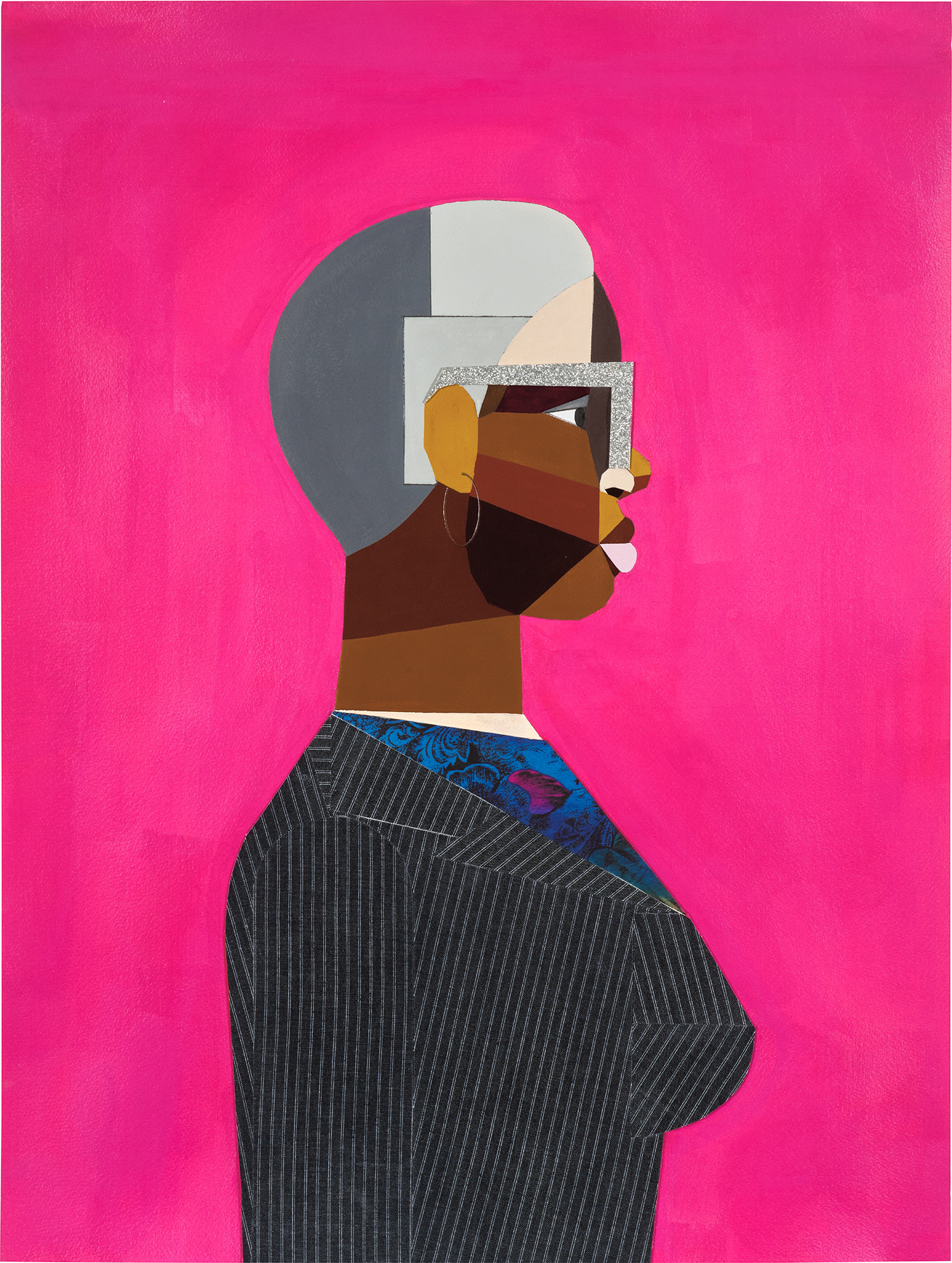
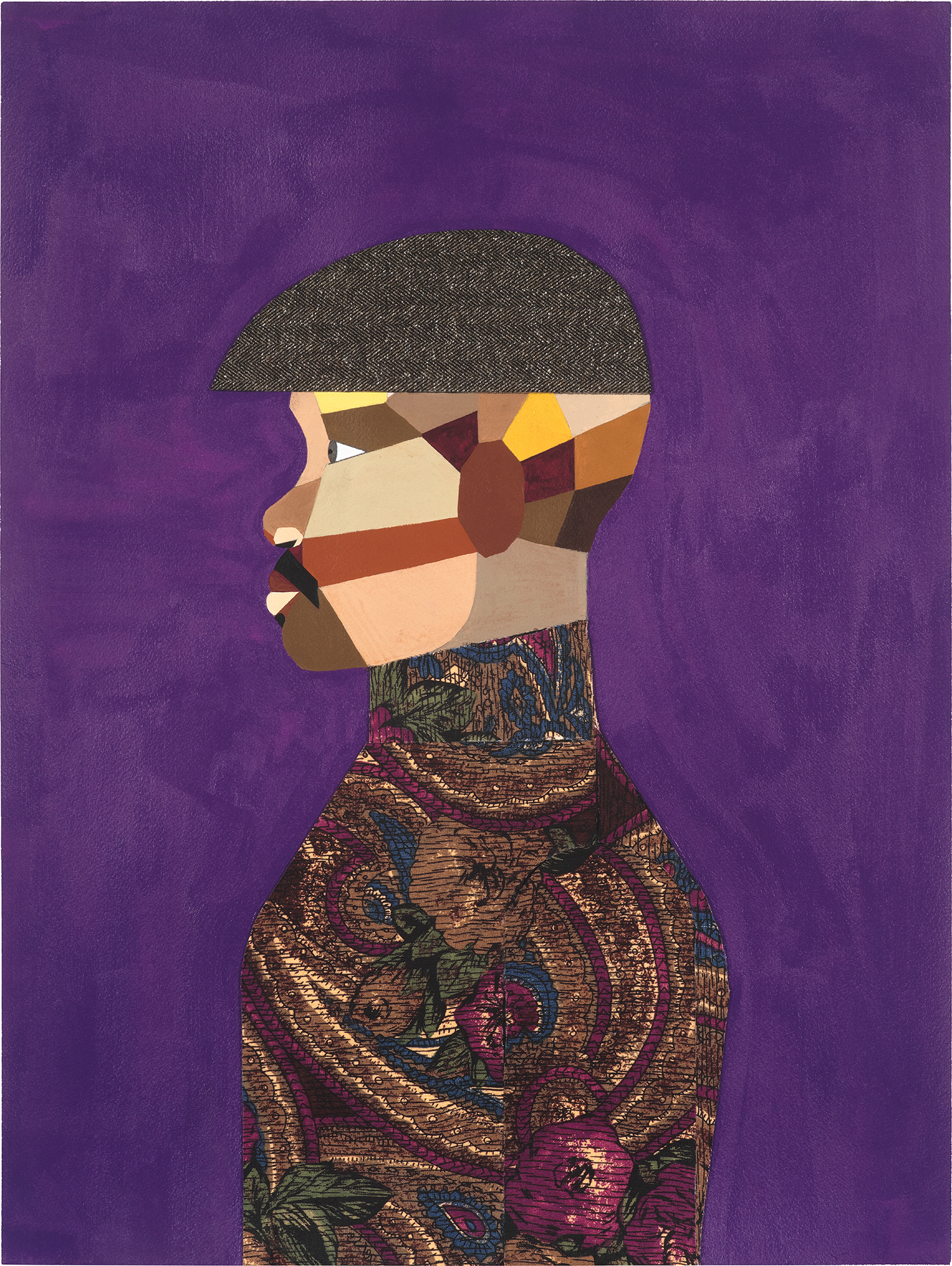
In the summer of 2023, the Baltimore Museum of Art mounted a significant presentation of Derrick Adams's work that drew sustained critical attention to a practice already humming with cultural urgency. That same year, his pieces continued to appear at major auction houses and in the collections of discerning institutions, confirming what the art world had been quietly acknowledging for nearly a decade: Adams is one of the most important American painters working today. His canvases do not simply depict Black life. They insist upon it, celebrate it, and demand that it be seen on its own luminous terms. Adams was born in Baltimore in 1970, and the city left a lasting imprint on his visual imagination. Baltimore in the 1970s and 1980s carried the full texture of urban Black American life, its church culture, its block parties, its television sets glowing in living rooms, its particular mixture of aspiration and community. Adams has spoken about growing up surrounded by images and objects that were rich with meaning, and that early education in the semiotics of everyday Black culture became the foundation for everything that followed. He went on to study at Pratt Institute in Brooklyn, earning his BFA, and later completed his MFA at Columbia University, where he absorbed the conceptual frameworks that would give his intuitive, image driven sensibility its intellectual architecture. The move to Brooklyn after graduate school was not merely geographic. It placed Adams at the center of a generational cohort of Black artists who were renegotiating the terms of representation in American art. His early practice was restless and expansive, moving across painting, collage, sculpture, installation, and performance with a curiosity that resisted easy categorization. He was drawn to Cubism's fracturing of the figure, to the flat graphic energy of pop art, and to the rich tradition of African American visual culture stretching from Romare Bearden to Jacob Lawrence. What emerged from these influences was a pictorial language entirely his own: geometric, collaged, layered, and absolutely joyful. The series that brought Adams to wide public attention is Floater, an ongoing body of work begun around 2015 depicting Black figures at leisure in swimming pools. The pools glow in saturated blues and greens. The figures float on inflatable toys, their bodies rendered in Adams's signature patchwork of geometric shapes and bold color fields, sun hats tilted, limbs relaxed, expressions serene. The work carries historical weight without being weighted down by it. Swimming pools in America carry a painful history of segregation and exclusion, and Adams is fully aware of that history. But Floater does not dwell in that pain. It claims the space of leisure, of pleasure, of rest, as a political act in itself. Works like Petite Floater 26, a 2020 piece in ink, watercolor, graphite, and printed vinyl collage on paper, show Adams working across multiple materials with extraordinary facility, building images that feel simultaneously spontaneous and architecturally precise. Beyond Floater, Adams has consistently explored the figure in urban and domestic environments. Figure in the Urban Landscape, a series of works from around 2019 executed in acrylic, ink, fabric, grip tape, and model cars on panel, places his geometric figures in the texture of city life, incorporating actual materials from the street into the painted surface. These works feel like maps of a lived world, physical and conceptual at once. Works from his Party Guest series, like Party Guest 1 from the We Came to Party and Plan Series of 2020, demonstrate his fluency in printmaking and collage, building images through the accumulation of screenprinted layers and cut paper with an energy that feels festive and purposeful. His Colorbar Constellation series, which incorporates TV antennas, aluminum foil, and pigment printed canvas alongside paint, takes on specific touchstones of Black television culture, with works referencing shows like Sanford and Son, finding in those cultural artifacts a rich vein of collective memory and identity formation. For collectors, Adams represents a genuinely compelling proposition at multiple levels. His works on paper and prints, including editions produced in collaboration with institutions like the Lower East Side Printshop in New York, offer entry points for collectors building a practice with care and intention. The Lower East Side Printshop editions, produced with the printshop's characteristic rigor and bearing their blindstamp, are among the more sought after of his works on paper, produced in small editions and artist's proofs that reward close attention. His larger panel works and collages on fabric backed vinyl carry the full ambition of his practice and have attracted serious institutional and private collector interest. The market for Adams has shown consistent strength, with secondary market appearances at Sotheby's, Christie's, and Phillips reflecting growing demand from collectors who recognize both his art historical significance and the particular emotional intelligence his work brings to the current cultural conversation. Placing Adams in art historical context enriches the experience of his work considerably. He sits in productive dialogue with the legacy of Romare Bearden, whose collage practice transformed the representation of Black life in American art, and with the pop sensibility of artists like Stuart Davis and Jasper Johns, who understood that American vernacular culture was worthy of serious formal attention. Among his contemporaries, his work resonates alongside that of Njideka Akunyili Crosby, whose layered, collage inflected paintings also explore identity and belonging across complex visual registers, and Kehinde Wiley, whose monumental figurative work similarly insists on the dignity and grandeur of Black subjects. Adams occupies a distinct position within this company, one defined by his commitment to the everyday rather than the monumental, to leisure and play as categories deserving of the same aesthetic attention we give to history and heroism. What makes Derrick Adams matter today, and what will continue to make him matter, is the quality of his conviction. His work proceeds from the belief that Black joy is not a footnote to Black struggle but a full and primary subject for art. That conviction produces paintings and collages and prints of remarkable warmth, works that hold the viewer in their glow and ask, gently and firmly, that this glow be recognized as real. The figures in his pools and at his parties and on his city streets are not symbols or arguments. They are people, rendered with love and formal intelligence, living their lives at full volume. In an art world that sometimes mistakes difficulty for depth, Adams offers something rarer: work that is both serious and genuinely pleasurable, built to last and built to be loved.