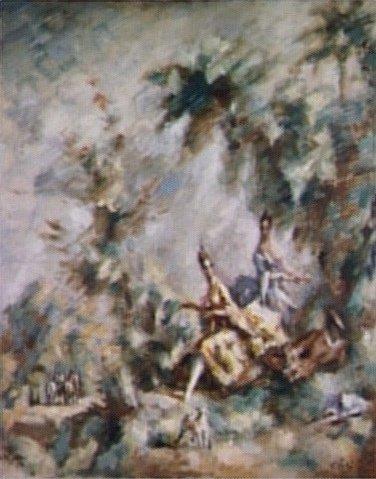
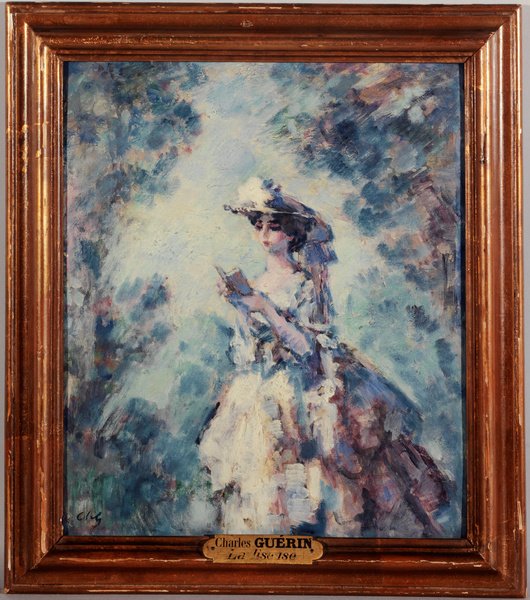
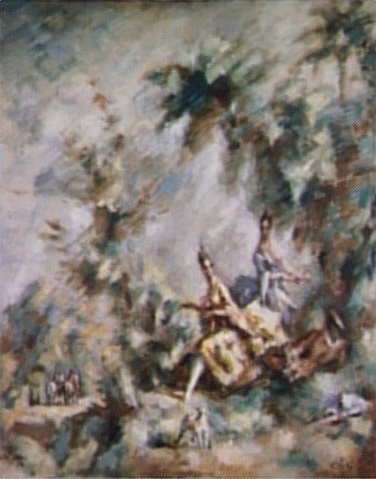
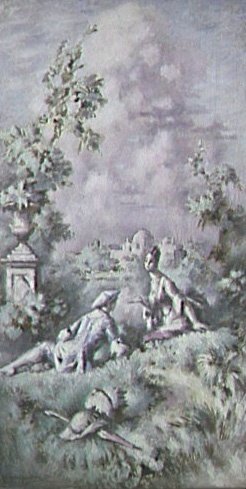
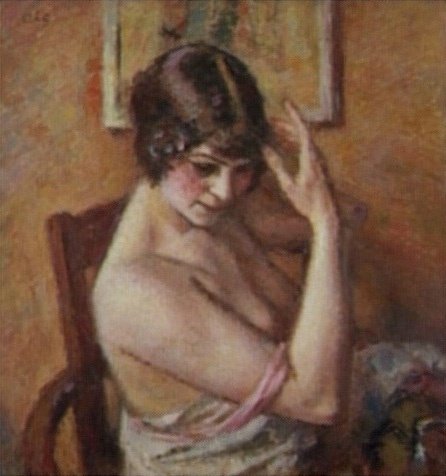
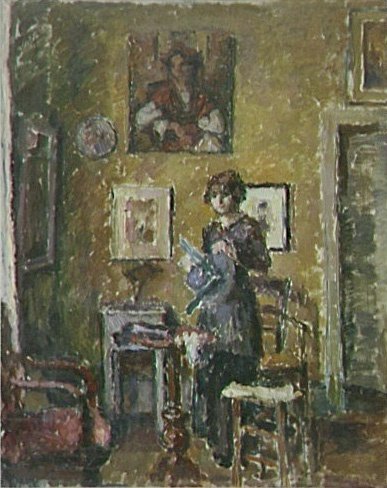
Picture a sun warmed Parisian interior somewhere in the early years of the twentieth century. A woman reads by a window, her form dissolving softly into the ambient light. Fabric pools luxuriously around her, and the room itself seems to hum with quiet contentment. This is the world of Charles Guérin, a painter of rare sensibility whose canvases offer something increasingly precious in our distracted age: the gift of sustained, attentive pleasure. As collectors and institutions across Europe and beyond have returned their gaze to the rich terrain of French Post Impressionism, Guérin has emerged as one of its most rewarding and underappreciated figures, a painter whose work rewards close looking with a depth that purely decorative first impressions only begin to suggest. Charles Guérin was born in Lunéville, in the Lorraine region of northeastern France, in 1875. The region, with its long tradition of fine craft and decorative arts, left a permanent impression on his visual sensibility. He came of age during one of the most fertile periods in the history of French painting, arriving in Paris as Post Impressionism was reshaping what a picture could do and mean. He studied under Gustave Moreau at the École des Beaux Arts, joining a legendary atelier that simultaneously nurtured Henri Matisse, Georges Rouault, and Albert Marquet, among others. This context is essential: Guérin was shaped not by provincial isolation but by the very crucible of modernist reinvention, even as he chose a path more lyrical and intimate than many of his contemporaries. The influence of Paul Cézanne is unmistakable in Guérin's work, particularly in his structural approach to color and his insistence that a picture hold together as a total chromatic architecture rather than a collection of observed details. Yet Guérin tempered Cézanne's austerity with the warm sensuality of Pierre Auguste Renoir, whose celebration of femininity and domestic ease ran through French painting like a golden thread. Guérin absorbed both impulses and synthesized them into something distinctly his own: a mode of painting that was simultaneously rigorous and voluptuous, ordered and alive with feeling. By the first decade of the twentieth century, he had developed a signature approach marked by rich, layered color, confident drawing, and a decorative instinct that never tipped into mere ornamentation. His subject matter was intimate and consistent across his long career. Nudes, interiors, women at their toilette, pastoral landscapes, and arrangements of flowers and objects recur across his canvases in endless, pleasurable variation. Works such as "La coiffure" from 1922 and "La liseuse" place the female figure within domestic settings rendered with the same tender attention as the figures themselves: the room is not a backdrop but a collaborator, suffused with color that breathes and vibrates. "Idylle" from 1923 and "Pastorale" from 1925 extend this sensibility into the open air, where figures move through verdant, light filled landscapes with a grace that owes something to the classical tradition while remaining firmly, warmly modern. "Intérieur" from 1900, one of his earlier major works, shows the foundations of this vision already fully in place, with a compositional confidence that belies his relative youth at the time of its creation. What makes Guérin's work so compelling to collectors today is precisely this combination of formal intelligence and emotional generosity. His pictures do not demand, they invite. They create spaces of comfort and beauty that are nonetheless underpinned by serious pictorial thinking. The color in a Guérin canvas is never accidental: those rich carmines and warm ochres, the pearly flesh tones set against saturated backgrounds, are the result of careful orchestration. A collector who lives with a Guérin quickly discovers that the picture changes with the light, deepening in the afternoon, glowing softly in the evening, always finding something new to offer. This quality of sustained visual richness is among the most sought after attributes in the secondary market for early twentieth century French painting, and Guérin delivers it consistently. In the broader context of French art history, Guérin occupies a position that deserves more sustained critical attention than it has traditionally received. He was a close contemporary and in some cases an acquaintance of artists who would go on to occupy larger places in the canonical narrative: Matisse, with his own decorative ambitions; Maurice Denis, who shared Guérin's interest in the figure within an interior; and Édouard Vuillard, whose intimate domestic canvases pursued comparable emotional territory through very different formal means. Understanding Guérin enriches one's understanding of all of them, illuminating the shared preoccupations and divergent solutions of a generation that inherited Impressionism and sought to build something more enduring upon its foundations. He belongs to that essential middle ground of French modernism, neither revolutionary nor reactionary, but deeply committed to painting as a craft of feeling. The market for Guérin has historically been strongest in France, where his reputation has always carried a warmth that English language art history has been slower to recognize. His works appear at auction in Paris with some regularity, and private collections in France and Belgium have long counted his canvases among their treasures. For the international collector approaching his work now, the opportunity is a real one: here is an artist of genuine quality, with a coherent and beautiful body of work, whose name recognition outside France does not yet reflect the caliber of what he produced. Collectors who have discovered Guérin through his paintings rather than through his reputation often report a similar experience: an immediate sense of pleasure followed by a growing conviction that this is something serious and lasting. Charles Guérin died in 1929, having spent the better part of five decades in devoted service to a vision of painting as sensory and emotional fulfillment. His legacy is the legacy of a particular French ideal: that art should enrich daily life, that beauty is a form of knowledge, and that the pleasures of color and form are not trivial but profoundly human. In a collecting landscape that often prizes novelty and provocation, Guérin stands as a reminder of what painting at its most committed and most generous can achieve. To own a Guérin is to understand that some of the most radical acts in art are also the quietest ones.