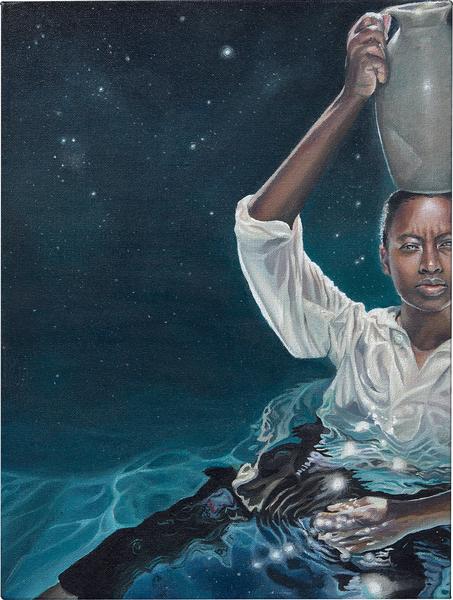
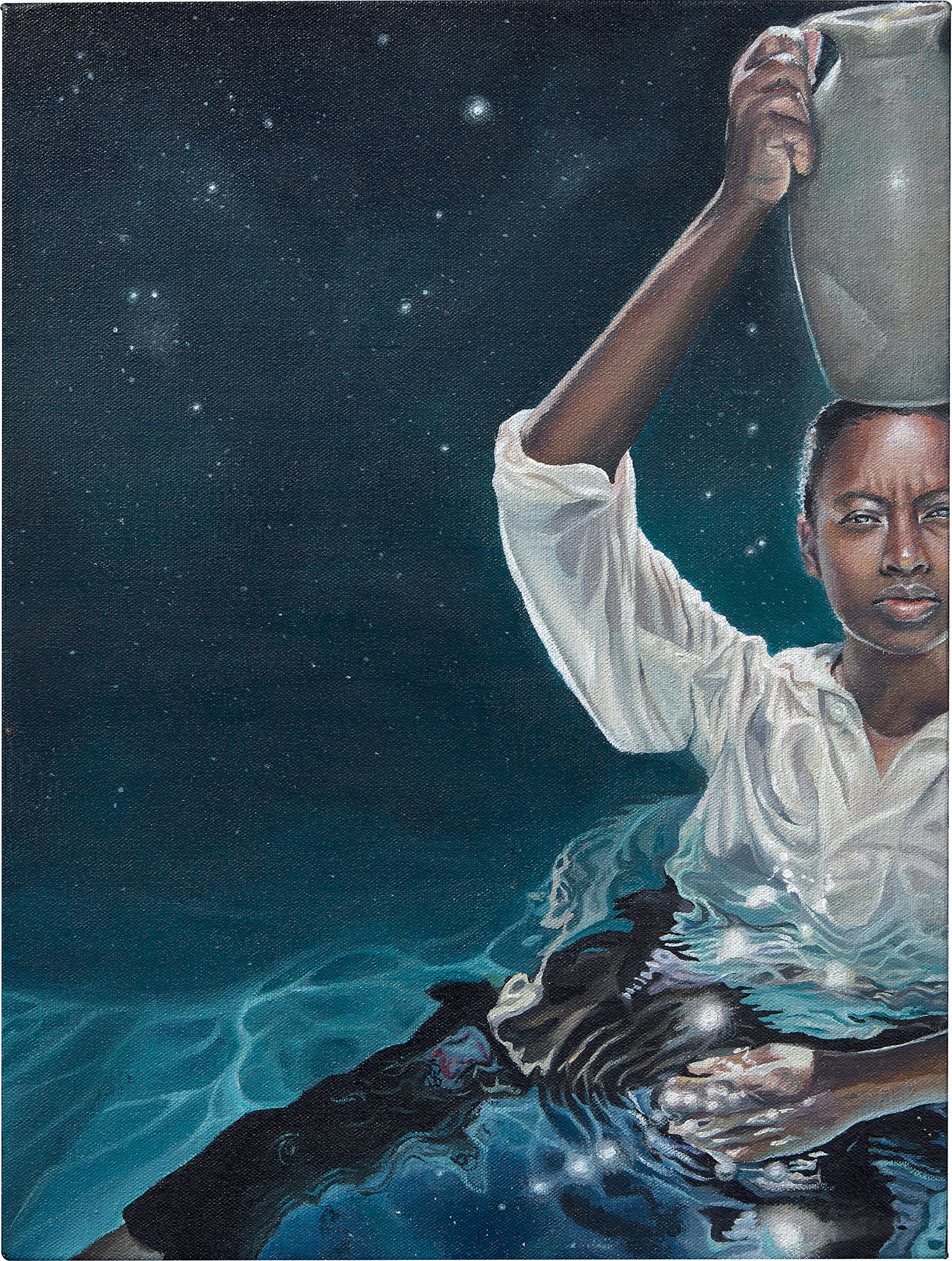
When the Museum of Art and History in Lancaster, California presented a significant survey of Calida Rawles's work, something remarkable happened: visitors lingered. They stood before her large canvases depicting Black figures suspended in luminous, aqueous light and simply refused to leave quickly. That quality of arrested attention is not accidental. Rawles paints with a precision and an emotional intelligence that transforms acrylic on canvas into something closer to a reckoning, an invitation to see Black life with a tenderness and complexity it is so rarely afforded in the history of Western painting. Rawles was born in 1969 and grew up in the United States at a moment when the promises and fractures of the civil rights era were both vivid and unresolved. Raised in a context where questions of identity, belonging, and freedom were not abstract philosophical concerns but daily lived realities, she came to painting through a process of searching rather than prescription. She studied at the Art Center College of Design in Pasadena, California, an institution known for its rigorous technical training, and that foundation is visible in every square inch of her canvases. The draftsmanship is exquisite, the observation of light on water and skin rendered with a patience that honors its subjects absolutely. Her path to her signature subject matter was not linear. Like many painters who eventually find an iconic visual language, Rawles spent years working through portraiture, figuration, and questions of representation before water became her element. Los Angeles, the city where she has long been based, offered its own particular relationship to water: the pool as aspirational symbol, as site of leisure historically denied to Black Americans, as both sanctuary and contested space. Rawles absorbed all of these associations and transformed them into something that transcends regional specificity. Her pools and waters are universal, metaphysical almost, even as they are grounded in the specific and the political. The work that brought Rawles to widespread critical and cultural attention arrived through an unexpected collaboration. When the celebrated author Ta Nehisi Coates was developing his novel The Water Dancer, published in 2019, he turned to Rawles's paintings as a visual companion to his exploration of slavery, memory, and the supernatural possibilities of water. The connection between their visions was profound and reciprocal. Coates's novel traces a young enslaved man whose extraordinary gift is bound up in water and memory, and Rawles's imagery, with its floating, dreaming, transcendent Black figures, provided a visual grammar for those themes that felt inevitable. The association brought her work to an enormous new audience and cemented her reputation as one of the most important figurative painters working in America today. Her painting Pillar, completed in 2018 and executed in acrylic on canvas, stands as one of the defining works of her practice from this pivotal period. Like the best of her canvases, it places a Black figure in relationship to water in a way that refuses easy categorization. The figure is neither drowning nor simply swimming. There is agency, grace, and a quality of spiritual suspension that the artist achieves through her extraordinary command of reflected and refracted light. Rawles paints water better than almost any contemporary artist working today. The shimmer, the distortion, the way light fractures across a submerged body and reassembles it into something both familiar and transformed: these are techniques she has mastered through years of dedicated observation and practice. For collectors, Rawles represents one of the most compelling opportunities in contemporary American painting. Her market has grown substantially as museum attention and critical recognition have accelerated, and works from the years surrounding The Water Dancer collaboration are particularly sought after as historically significant objects. What draws serious collectors to her work is not simply its visual beauty, though that beauty is undeniable and immediate. It is the sense that these paintings are doing necessary cultural work, that they are contributing to a revised and more honest visual history of Black American experience. Collectors who hold her work are holding a meaningful piece of that revision. The paintings also have a quality that sophisticated buyers prize above almost everything else: they reward sustained looking. Details emerge over time. The emotional register deepens the more familiar you become with the surface. Rawles belongs to a broader conversation in contemporary American painting that includes artists such as Kerry James Marshall, whose monumental commitment to placing Black figures at the center of art historical traditions has reshaped what figurative painting can mean, and Amy Sherald, whose cooled tonal palette and psychologically complex portrayals of Black Americans share with Rawles a commitment to dignity and interiority. One might also think of the way Lynette Yiadom Boakye constructs imagined Black subjects with a specificity that feels like memory, and how Rawles similarly insists on the full humanity of her subjects even as she places them in a symbolic and somewhat abstracted environment. These artists are not a movement in any formal sense but they constitute something real: a generation of painters who have permanently altered the terms on which Black figures appear in contemporary Western art. What Rawles has achieved, and what her legacy will rest on, is the creation of a visual language for freedom that is rooted in the specific historical experience of Black Americans without being confined by it. Water in her work is memory, danger, and liberation simultaneously. It is the Middle Passage and the baptismal font. It is the neighborhood pool that kept Black children out and the private water in which Black subjects now float sovereign and serene. She holds all of these meanings in suspension, the way water holds light, and she does it with a painterly skill that places her in conversation with the great figurative traditions while remaining unmistakably, urgently contemporary. To collect Calida Rawles is to recognize that you are in the presence of an artist working at the height of her powers, making paintings that will matter for a very long time.