Join The Collection to save, track, and explore works like this.

Art Institute of Chicago

Spotted

Unknown Artist — Cabinet

Unknown Artist

Cabinet

1640

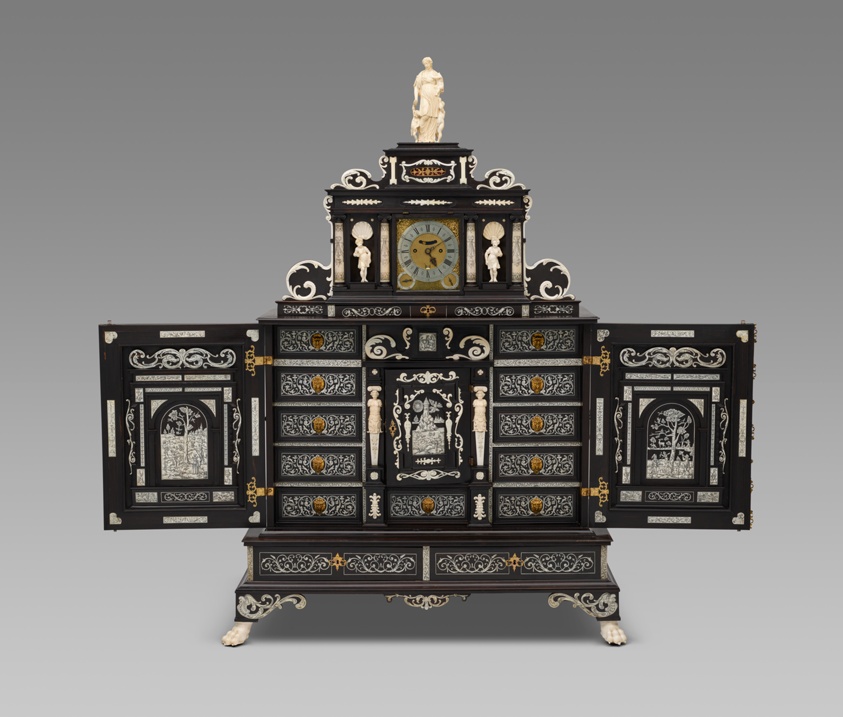
This cabinet, with its architectural design evoking a tabletop palace, is among the largest of its kind. Its ornate decoration combines ebony wood and elephant ivory brought to Germany from Africa. So scarce and valuable were these materials in Europe that here only a thin veneer of ebony covers a carcass of locally sourced pine. This sophisticated method of veneering was perfected in the economic hub of Augsburg, where cabinetmakers worked closely with metalsmiths to develop tempered-steel saws that were both durable and precise enough for their work. The technique was quickly adopted by furniture makers throughout Europe. The many compartments of this cabinet concealed all manner of precious objects. It acted as a luxurious vanity for the elite merchant or member of the nobility who owned it, a place where they could compose letters, maintain personal hygiene, and store treasured possessions. The lower drawers held writing materials, while the upper-right side still contains portions of an apothecary set. The objects displayed here include scalpels, a spoon, a strainer, an ear-and-fingernail scoop, a beaker, an enema syringe, a tongue scraper, medicine canisters, scissors, a mortar and pestle, a sand caster, and pen knives. The owner evidently used these instruments: Red sealing wax, for instance, speckles the mortar and pestle.

Medium
Ebony, ivory, pine, oak, fruitwood, walnut, iron, steel, silver, brass, gilded brass, tinned brass, glass, paper, silk textile, and bone
Dimensions

Start the Discussion

Request access to join the discussion

About this work

Unknown Artist, Cabinet, 1640

This cabinet, with its architectural design evoking a tabletop palace, is among the largest of its kind. Its ornate decoration combines ebony wood and elephant ivory brought to Germany from Africa. So scarce and valuable were these materials in Europe that here only a thin veneer of ebony covers a carcass of locally sourced pine. This sophisticated method of veneering was perfected in the economic hub of Augsburg, where cabinetmakers worked closely with metalsmiths to develop tempered-steel saws that were both durable and precise enough for their work. The technique was quickly adopted by furniture makers throughout Europe. The many compartments of this cabinet concealed all manner of precious objects. It acted as a luxurious vanity for the elite merchant or member of the nobility who owned it, a place where they could compose letters, maintain personal hygiene, and store treasured possessions. The lower drawers held writing materials, while the upper-right side still contains portions of an apothecary set. The objects displayed here include scalpels, a spoon, a strainer, an ear-and-fingernail scoop, a beaker, an enema syringe, a tongue scraper, medicine canisters, scissors, a mortar and pestle, a sand caster, and pen knives. The owner evidently used these instruments: Red sealing wax, for instance, speckles the mortar and pestle.

Medium
Ebony, ivory, pine, oak, fruitwood, walnut, iron, steel, silver, brass, gilded brass, tinned brass, glass, paper, silk textile, and bone
Dimensions
179.8 x 60.4 cm
Year
1640
Seen at
Art Institute of Chicago, Chicago, IL

Related themes

Steel, Glass, Wood, Sculpture, Works on Paper, Unique Work, Large Scale

More works by Unknown Artist

Collected by

Cleveland Museum of Art, Art Institute of Chicago