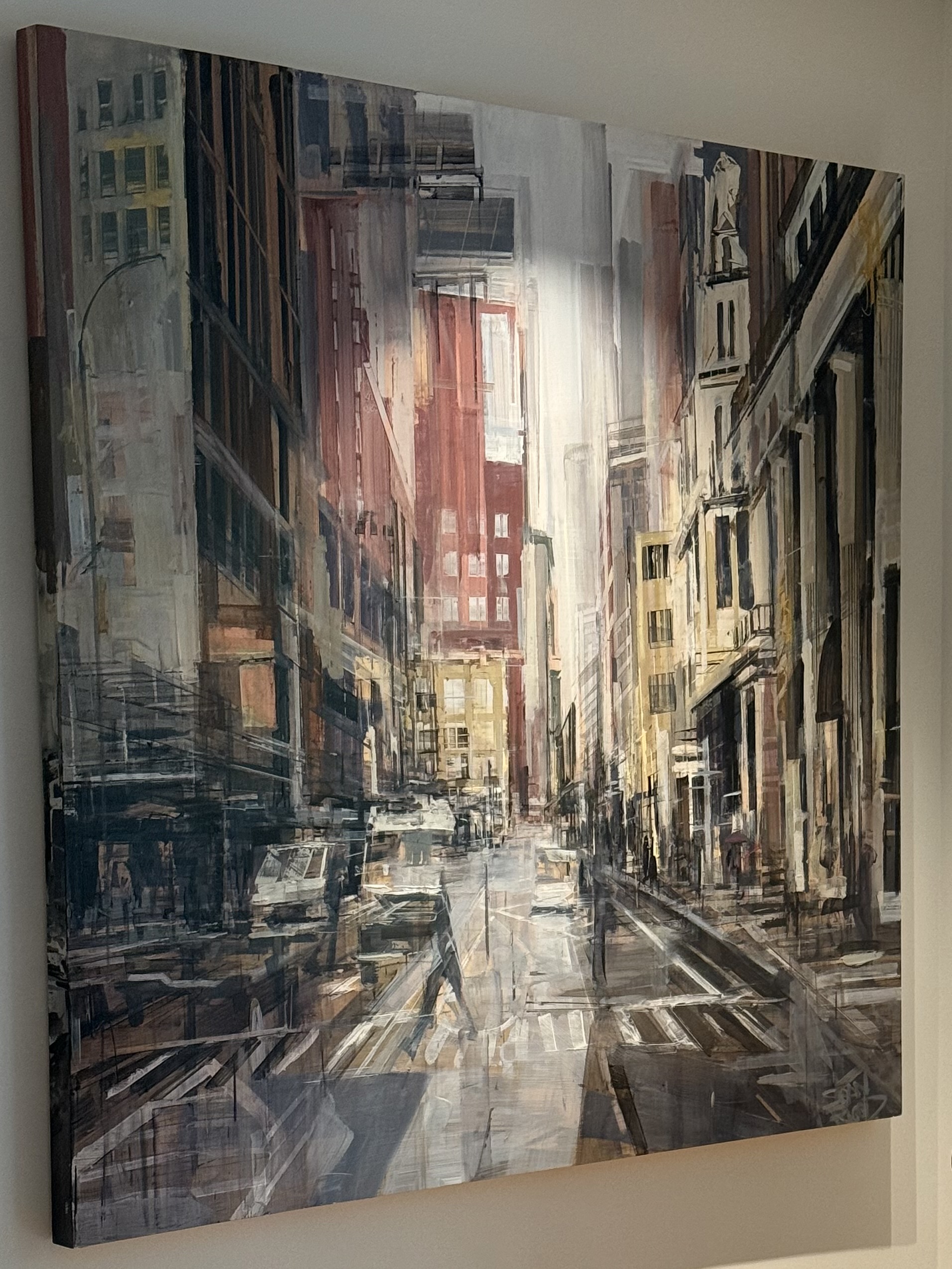
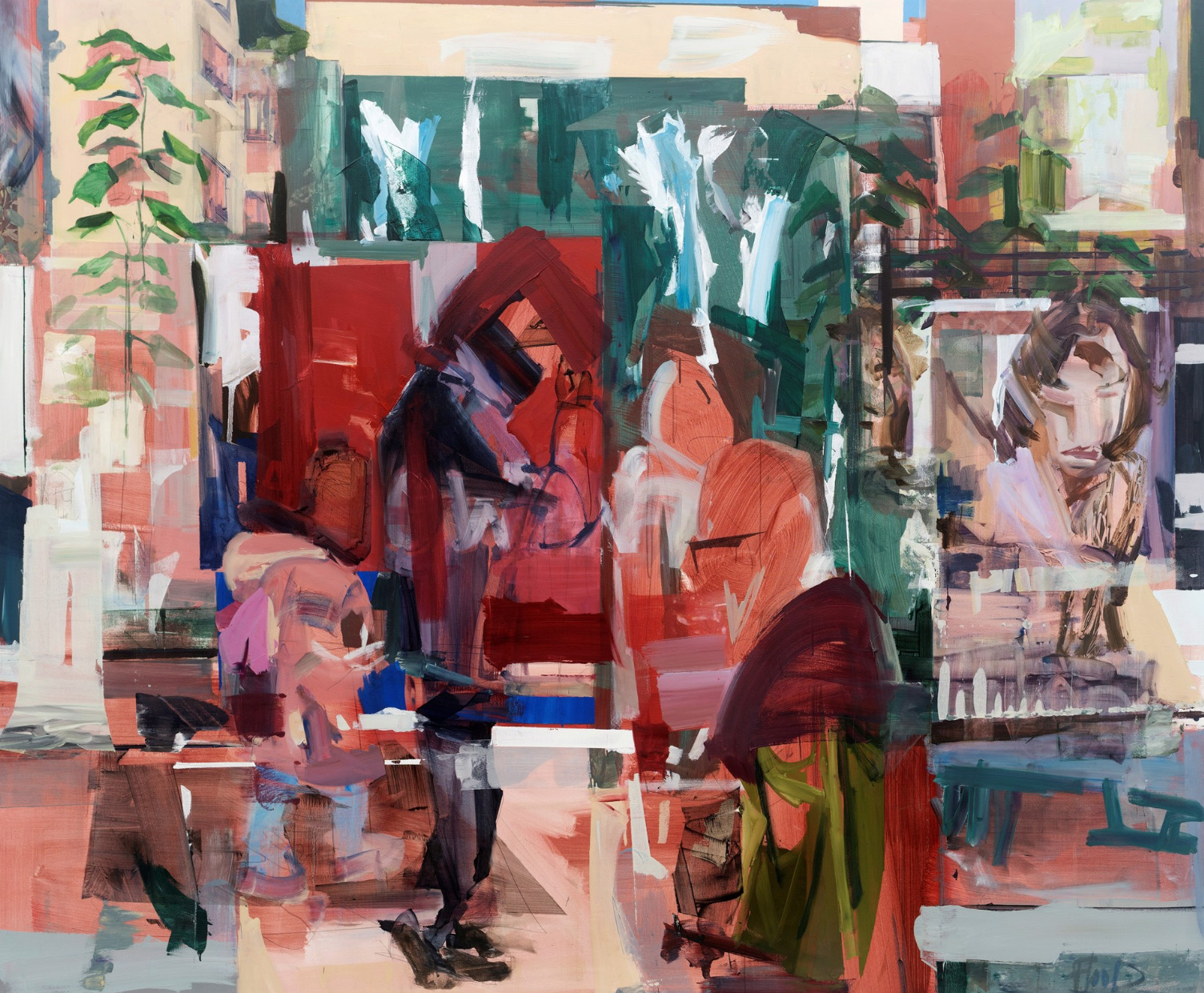
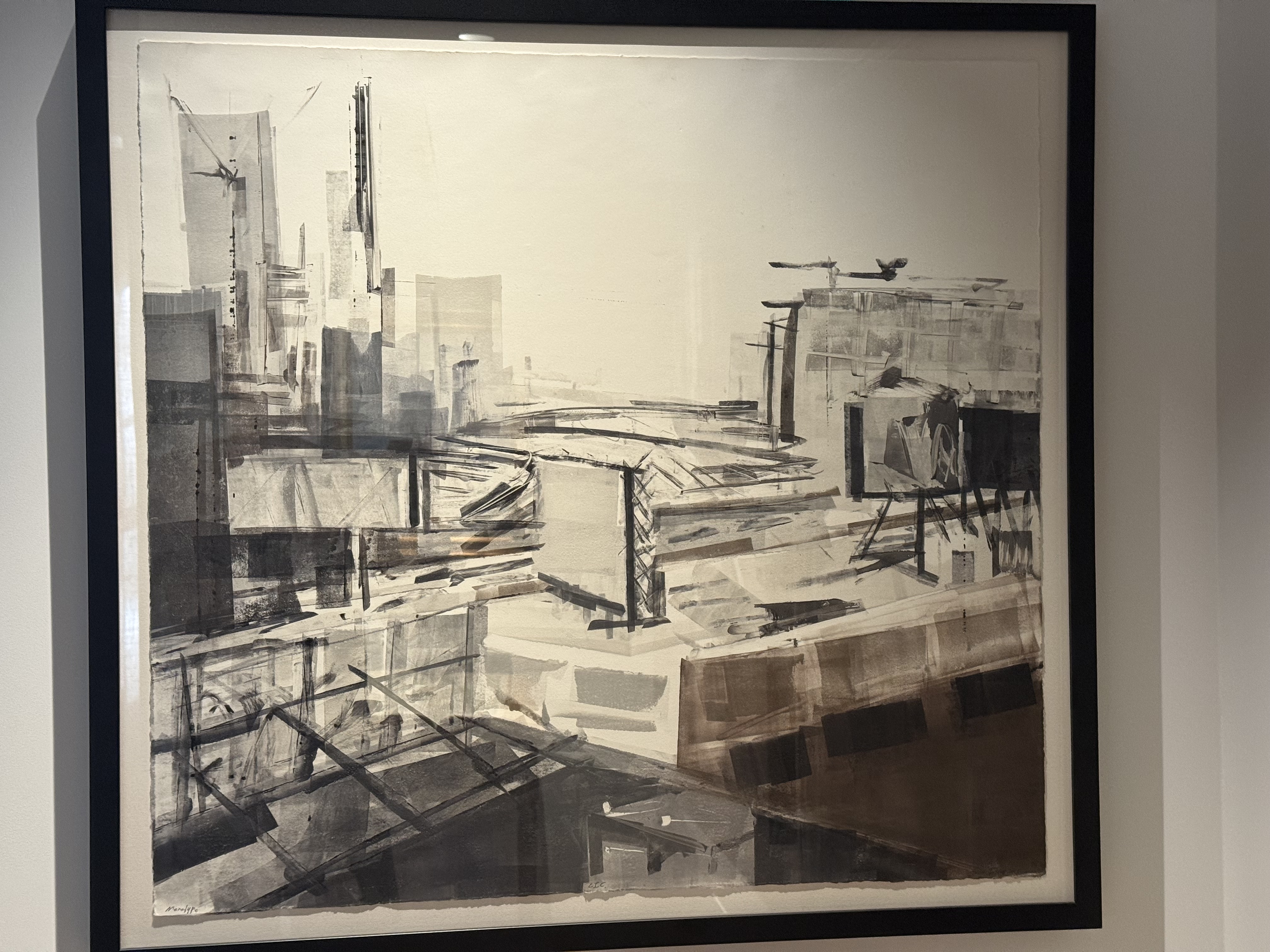
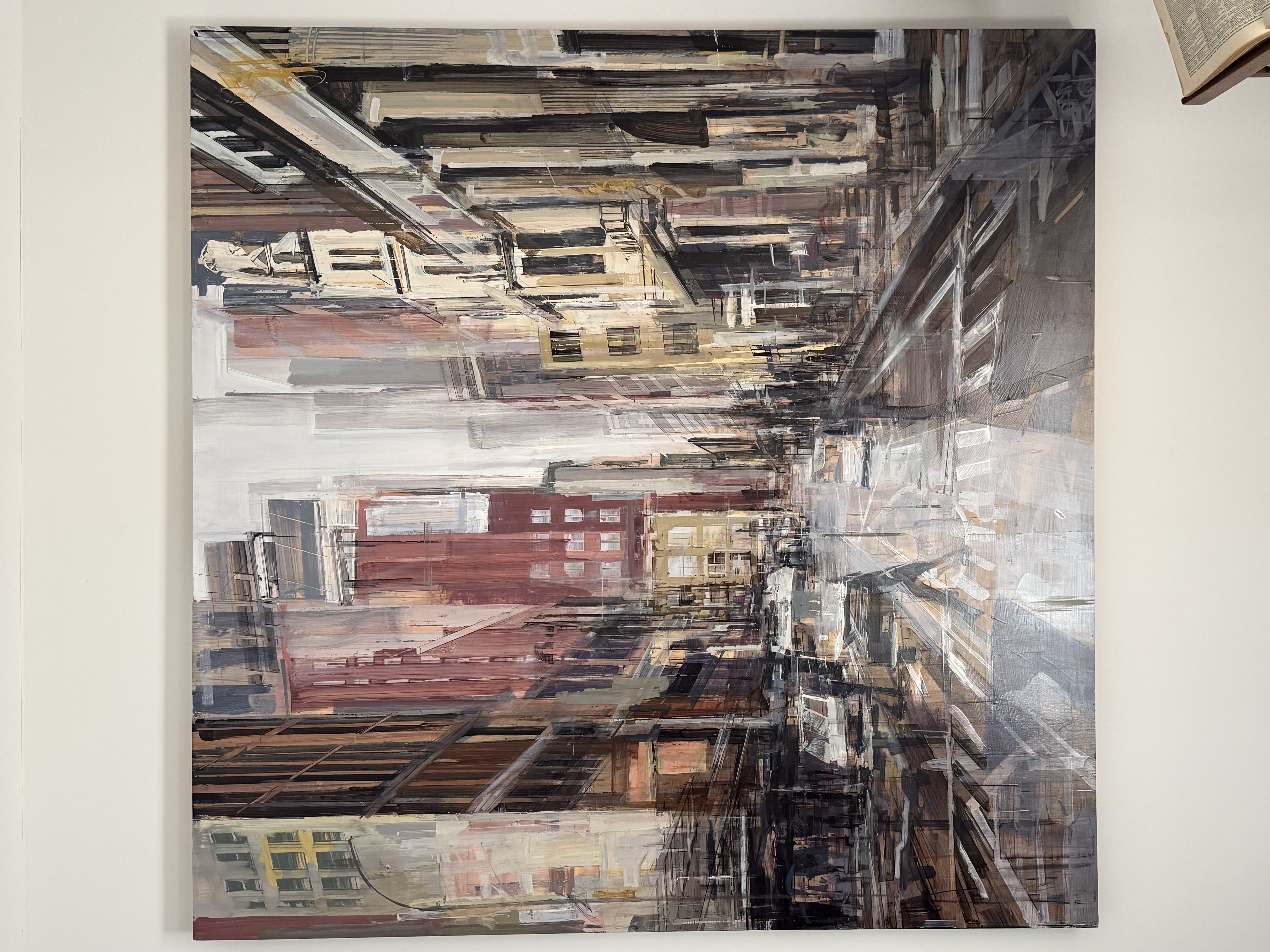
Something quietly extraordinary is happening in Sean Flood's studio. His most recent oil on canvas, 'Secret Garden,' completed in 2025, signals a deepening of a practice that has long rewarded patient, attentive looking. Where earlier works navigated the charged textures of urban life, this new painting turns inward, toward enclosure and bloom, toward the kind of sheltered beauty that feels hard earned rather than simply discovered. It is the work of an artist who has been building toward something, and who has arrived. Flood's painterly sensibility reads as distinctly American in its affection for the city as subject and the street as stage. There is a lineage here that connects his work to the great tradition of painters who found the metropolis worthy of sustained attention, not as mere backdrop but as the primary drama of modern life. His 2016 painting 'Broadway in the Rain' situates itself within this tradition with confidence and with feeling. Rain on a city street is one of the oldest devices in the art of the urban sublime, and yet Flood makes it feel like something glimpsed for the first time. 'Broadway in the Rain' rewards extended looking. The title alone carries a kind of cinematic weight, evoking the shimmer of headlights on wet asphalt, the way a familiar thoroughfare becomes briefly strange when weather intervenes. Flood understands that rain does not simply fall on a city; it transforms it, doubling and dissolving its surfaces, turning Broadway into a mirror of itself. The painting sits within a rich conversation that includes Edward Hopper's atmospheric urban solitudes, Charles Burchfield's weather haunted streetscapes, and even the lyrical observations of the New York School painters who found poetry in the incidental details of city life. Two years after 'Broadway in the Rain,' Flood produced 'LIC,' a monotype on paper dated 2018. Long Island City has itself become one of the more closely watched neighborhoods in contemporary American art geography, home to institutions and studios that have drawn a generation of working artists across the East River from Manhattan. That Flood chose LIC as his subject at this particular moment reflects both a practical and an imaginative attunement to where art lives and grows. The monotype as a medium is particularly well suited to this kind of subject: the process is immediate, irreversible, and singular, producing an image that carries the physical evidence of its own making. There is something fitting about using a medium of singular impression to capture a neighborhood defined by transformation and by the unrepeatable energy of a particular cultural moment. The monotype also reveals something important about Flood's sensibility as an artist. He is not a painter who relies on the slow accumulation of glazes and corrections, even when he works in oil. There is a directness to his mark making, an appetite for the gesture that commits. This quality connects his work to a lineage of American painters and printmakers who have valued the evidence of process, the visible trace of a decision made in real time. Artists like Jasper Johns, whose monotypes opened up new possibilities for the form in the late twentieth century, and Nathan Oliveira, whose intense figurative monotypes brought the medium new critical seriousness, provide useful points of reference for understanding what Flood is doing with the form and why it matters. 'Secret Garden,' the 2025 oil on canvas, represents a meaningful pivot in Flood's practice. The garden as subject has one of the longest and most layered histories in Western art, from the hortus conclusus of medieval painting through Monet's Giverny series, which remains one of the most sustained meditations on a single place in the history of art. To enter this conversation is to accept a formidable inheritance. What makes the garden compelling as a subject for a painter of Flood's generation is precisely the tension between the controlled and the wild, between the space that has been shaped by human intention and the life that overflows it. If 'Broadway in the Rain' finds Flood in the city's open flow, 'Secret Garden' finds him in a protected interior, attentive to what grows in sheltered places. For collectors, Flood's work presents a genuinely attractive opportunity. He is an artist whose practice spans media, whose body of work is cohesive without being repetitive, and whose subject matter connects to some of the deepest currents in American painting. Works like 'Broadway in the Rain' and 'LIC' already feel like important documents of a specific time and place, and 'Secret Garden' suggests that the ambition of his practice is only expanding. Collectors who have been drawn to artists working at the intersection of place and feeling, who admire the work of painters like Jane Freilicher, Rackstraw Downes, or Wolf Kahn, will find in Flood a sensibility that is alert to the same frequencies, though entirely his own. What Flood offers, ultimately, is a form of witness. His paintings and prints ask us to look again at what we have seen a thousand times, at the rain soaked avenue, the working neighborhood, the garden held apart from the city's noise, and to find in that second looking something we missed on the first pass. This is what the best art of place has always done: it makes the familiar strange enough to be seen. In an art world that often prizes the conceptually elaborate over the perceptually acute, Flood's commitment to the act of looking feels not merely valuable but necessary. His work reminds us that painting can still be a form of sustained attention, and that sustained attention is itself a kind of gift.