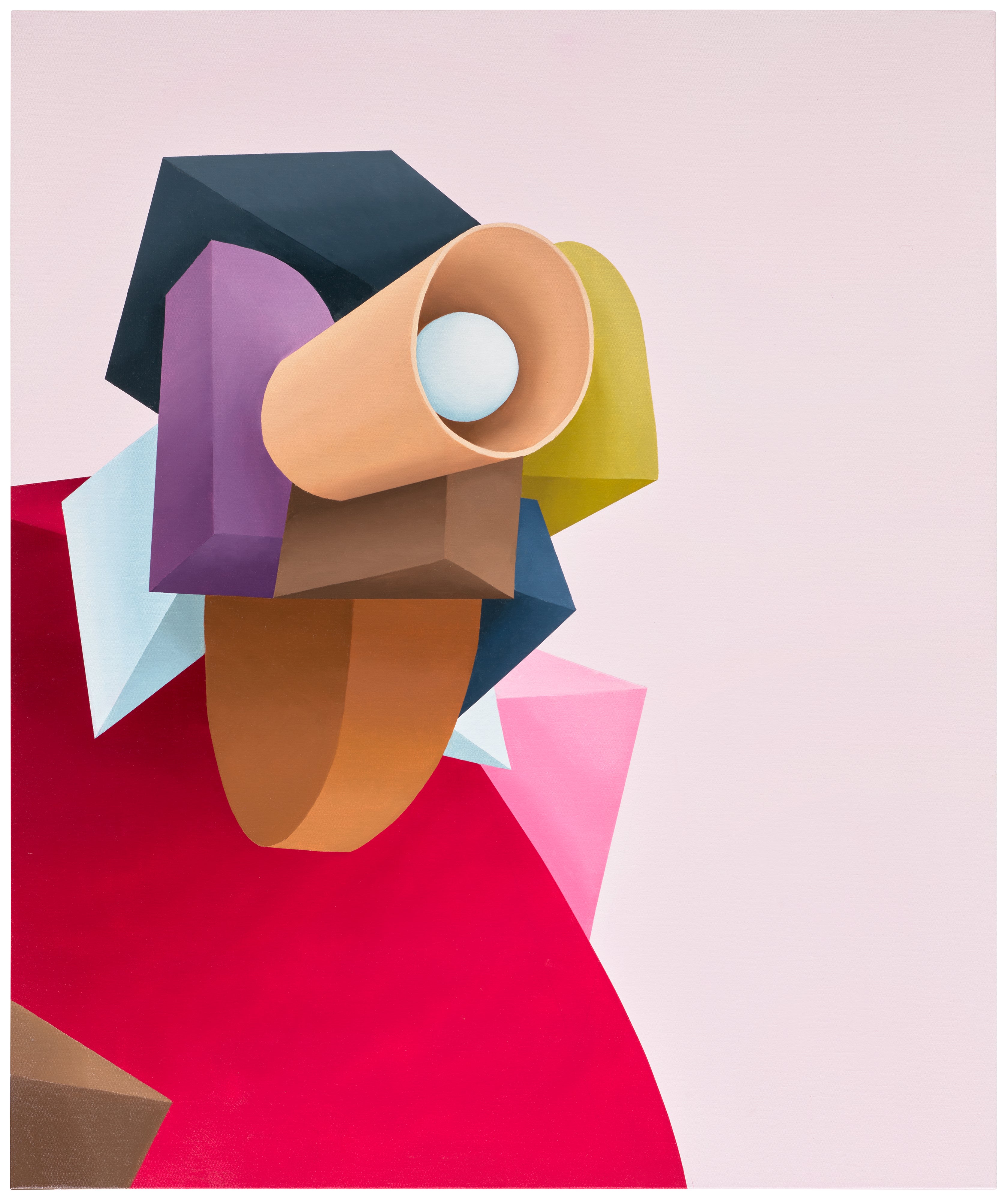
There is a moment, standing before a Jason Boyd Kinsella portrait, when the painting looks back. Those eyes, vast and luminous and somehow achingly familiar, hold you in place with a stillness that feels less like an artistic device and more like an honest reckoning. In recent years, Kinsella has moved steadily from the periphery of contemporary portraiture toward something approaching its center, with collectors in Europe, North America, and beyond acquiring his work with growing urgency. His 2023 diptych "Sheilah and Chris" represents perhaps the most ambitious single statement of his career to date, a paired meditation on companionship and the private languages that exist between two people who have chosen each other. Kinsella was born in 1980 in Canada, a country whose vast interior and particular quality of light have shaped more than a few artists of serious standing. The Canadian tradition of portraiture and landscape painting provided a cultural backdrop against which Kinsella would eventually chart his own unmistakable course, though the influences he absorbed were international in scope from early on. He came of age at a moment when the boundaries between fine art portraiture and popular visual culture were being renegotiated in real time, and he absorbed those conversations with the attentiveness of someone who understood that the most interesting territory often lies precisely at the border between categories. His formal training gave him a rigorous technical foundation, and that foundation is visible in every canvas he has produced. Oil on canvas and oil on linen remain his preferred materials for the works that have earned him the most sustained critical attention, and the surfaces of those paintings reward close looking with a richness of handling that situates Kinsella firmly within a long tradition of craft conscious portraiture. What he brought to that tradition, and what distinguishes him from painters who simply execute technically accomplished likenesses, is a willingness to push the formal elements of the face into a register that is simultaneously artificial and profoundly true. The enlarged eyes that define his signature style are not a gimmick or a borrowed vocabulary from illustration. They are, instead, a philosophical argument about what portraits are actually for. The argument goes something like this: if a portrait's deepest purpose is not documentation but empathy, not record but recognition, then the realistic proportions of the human face may in fact be an obstacle rather than a vehicle. By expanding the eyes and organizing the rest of the composition around their emotional weight, Kinsella creates figures that communicate interiority with an immediacy that conventionally proportioned portraiture rarely achieves. The effect recalls, without directly imitating, the emotional amplification strategies of artists like Margaret Keane, whose large eyed figures became cultural touchstones in the 1960s, as well as the cool psychological intensity of Alex Katz, who also understood that stylization could be a path toward truth rather than away from it. Kinsella's work sits comfortably in conversation with both while remaining entirely its own proposition. The body of work he has built across the 2020s demonstrates a consistent deepening of this proposition. Works such as "Penelope" from 2021, rendered in oil on linen, and "Nick" and "Albert" from 2020, both on canvas, show an artist in full command of his register, capable of producing portraits that feel simultaneously like specific individuals and like something closer to archetypes. The single name titles are not accidental. They create an intimacy without biography, inviting the viewer to project their own sense of knowing onto figures who are at once particular and open. "Sverre," "Lars," and "Jonathan" extend this logic across different media and supports, with "Jonathan" rendered in acrylic on wood, a choice that gives that work a slightly different surface energy and demonstrates Kinsella's willingness to let material decisions carry meaning. "Study XIX" from 2021 reveals the importance of an ongoing working process to his practice, the sense that individual finished paintings emerge from a sustained inquiry rather than arriving fully formed. The study as a form has a distinguished history in Western art, from the preparatory sketches of the Old Masters to the serialized investigations of contemporary painters like Luc Tuymans, and Kinsella's engagement with the format suggests an artist who takes seriously the idea that painting is a discipline of looking as much as a discipline of making. "Thaws" from 2020 and "Summers (the elder)" from 2021 introduce a more evocative, almost literary dimension to the titling practice, gesturing toward season and time and generational passage in ways that enrich the emotional texture of the image without overdetermining it. For collectors approaching Kinsella's work for the first time, several considerations are worth holding in mind. His diptych format, of which "Sheilah and Chris" is the most significant recent example, represents a particular category of ambition within the practice and commands corresponding attention. Single figure works on linen tend to have a warmth of surface that distinguishes them from the canvas works, and both formats have attracted serious buyers. The consistent use of oil as his primary medium for the most substantial works speaks to a commitment to permanence and to the long history of the painted portrait that collectors with a view toward legacy acquisition will find reassuring. Kinsella's prices remain accessible relative to peers with comparable critical profiles, which means the current moment represents a genuine opportunity for collectors who move with discernment. The broader context in which Kinsella operates is one of renewed seriousness around portraiture as a genre. After decades during which figurative painting was treated with some suspicion by the institutional art world, the past fifteen years have seen a dramatic reassessment, driven in part by artists like Kehinde Wiley, Jordan Casteel, and Lynette Yiadom Boakye, all of whom have demonstrated that the portrait can carry the full weight of contemporary concern. Kinsella's contribution to this reassessment is distinctive because his approach to stylization opens a different set of questions than the social and political interrogations that have driven much of the figurative revival. He is asking, at his most essential, what it means to truly see another person, and he is asking it with paint. That question feels more urgent, not less, as the world in which his work circulates becomes increasingly mediated by screens and filters and algorithmically optimized images of faces that have been smoothed and adjusted beyond recognition. Kinsella's portraits, with their gorgeous, unnerving directness, offer something that the image economy cannot produce: the sense of being genuinely met. That is not a small thing to offer. It is, in fact, exactly what the best portraits have always offered, and it is why Jason Boyd Kinsella's work deserves the sustained attention of everyone who cares about where painting is going.