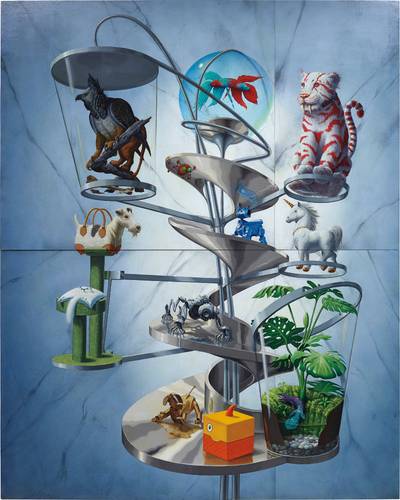
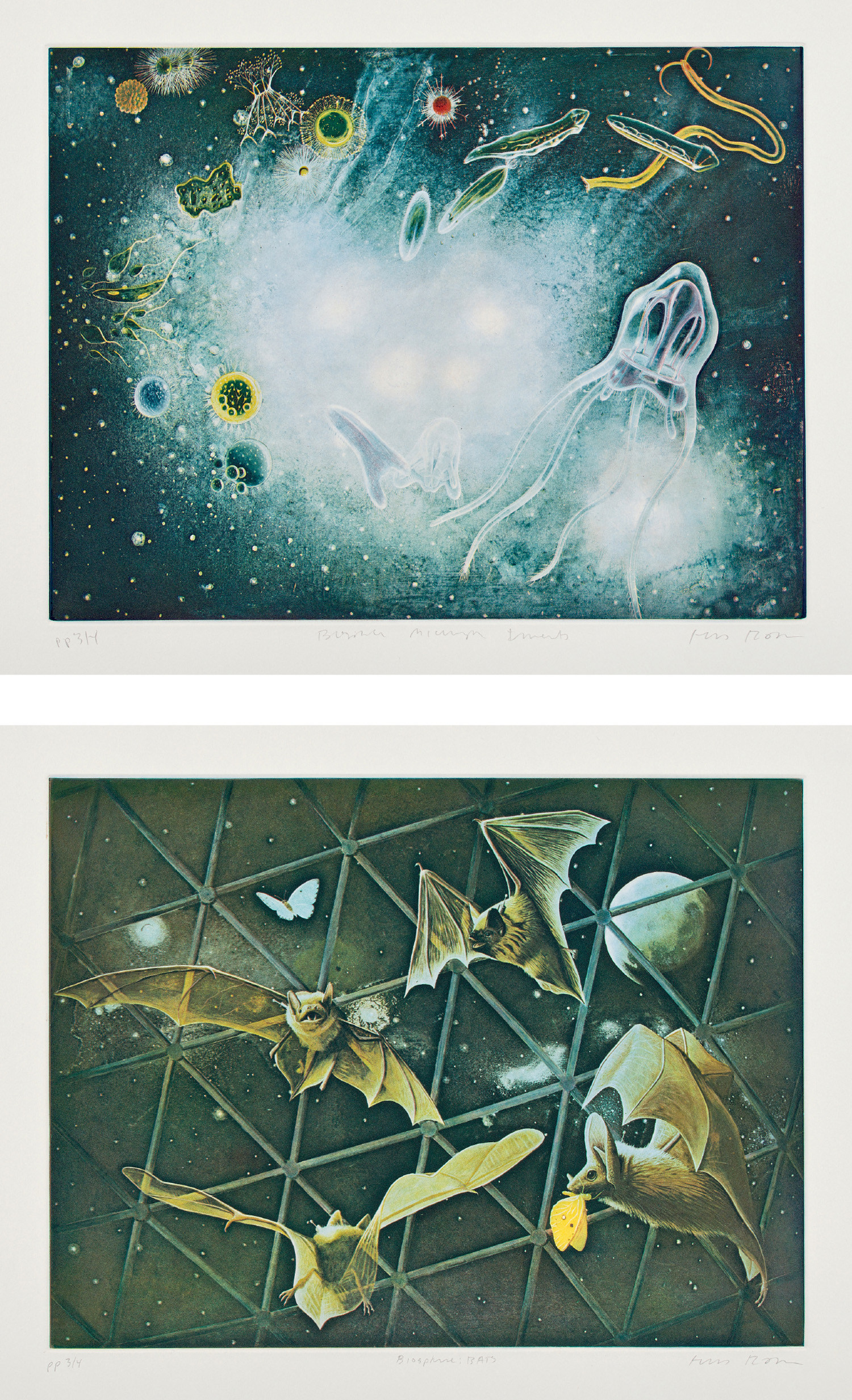
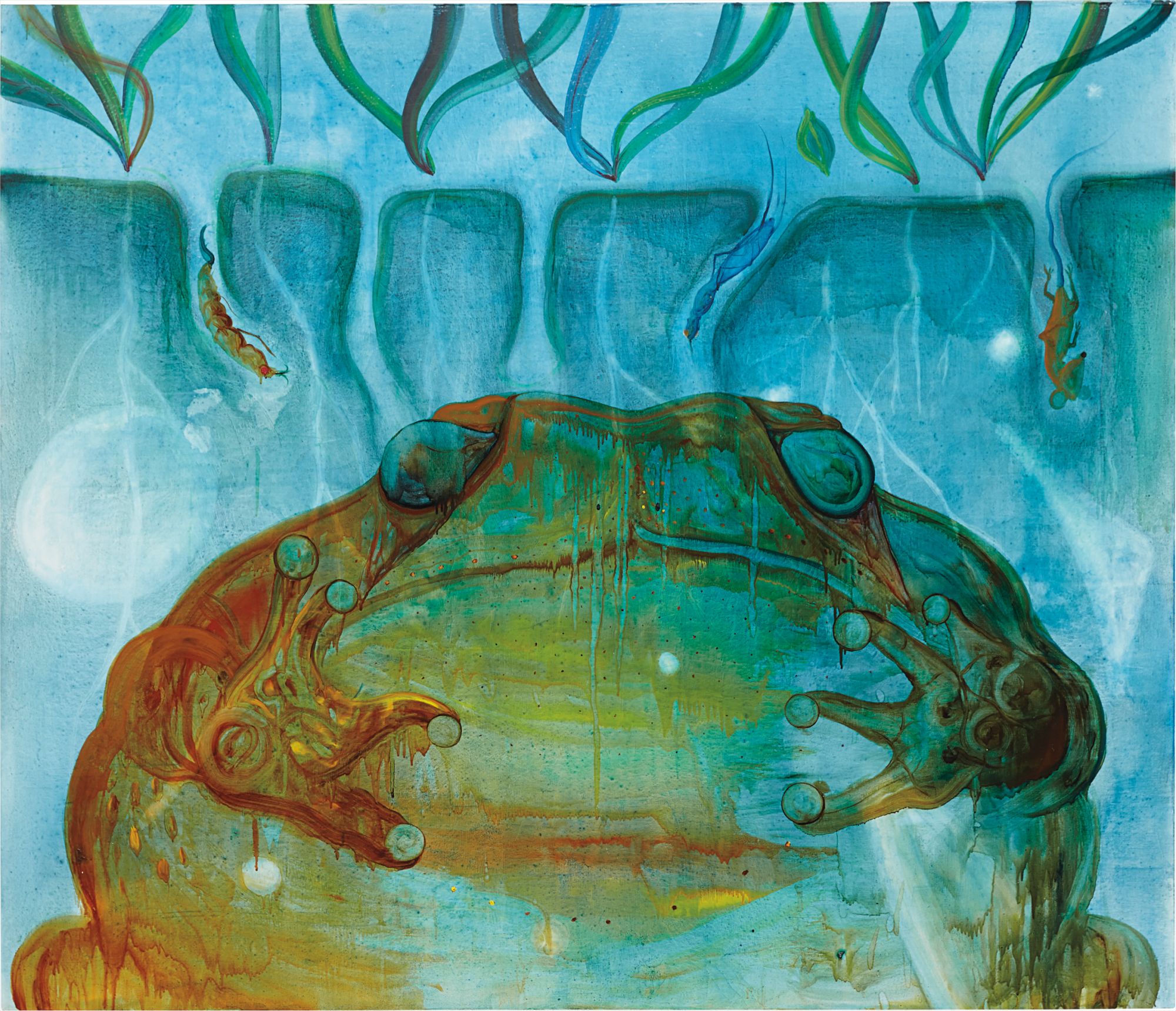
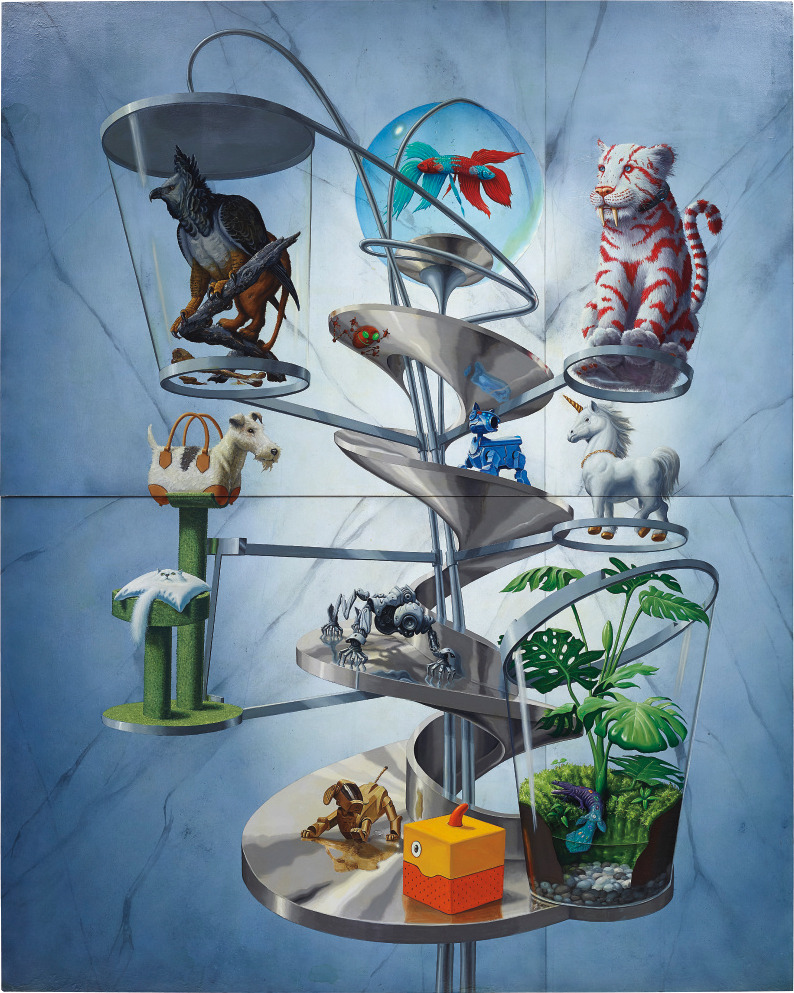
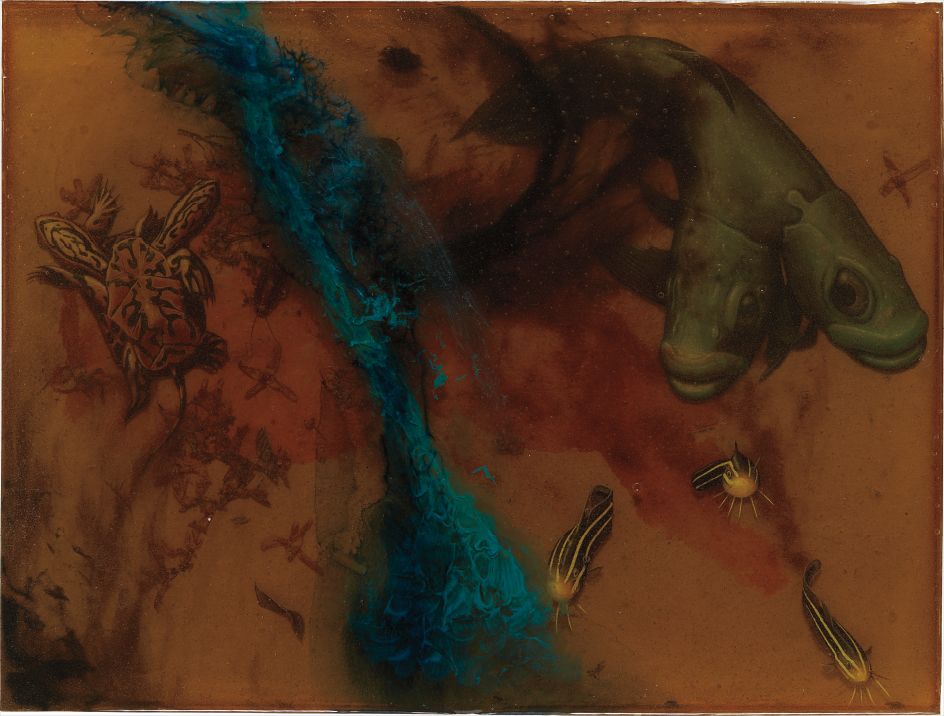
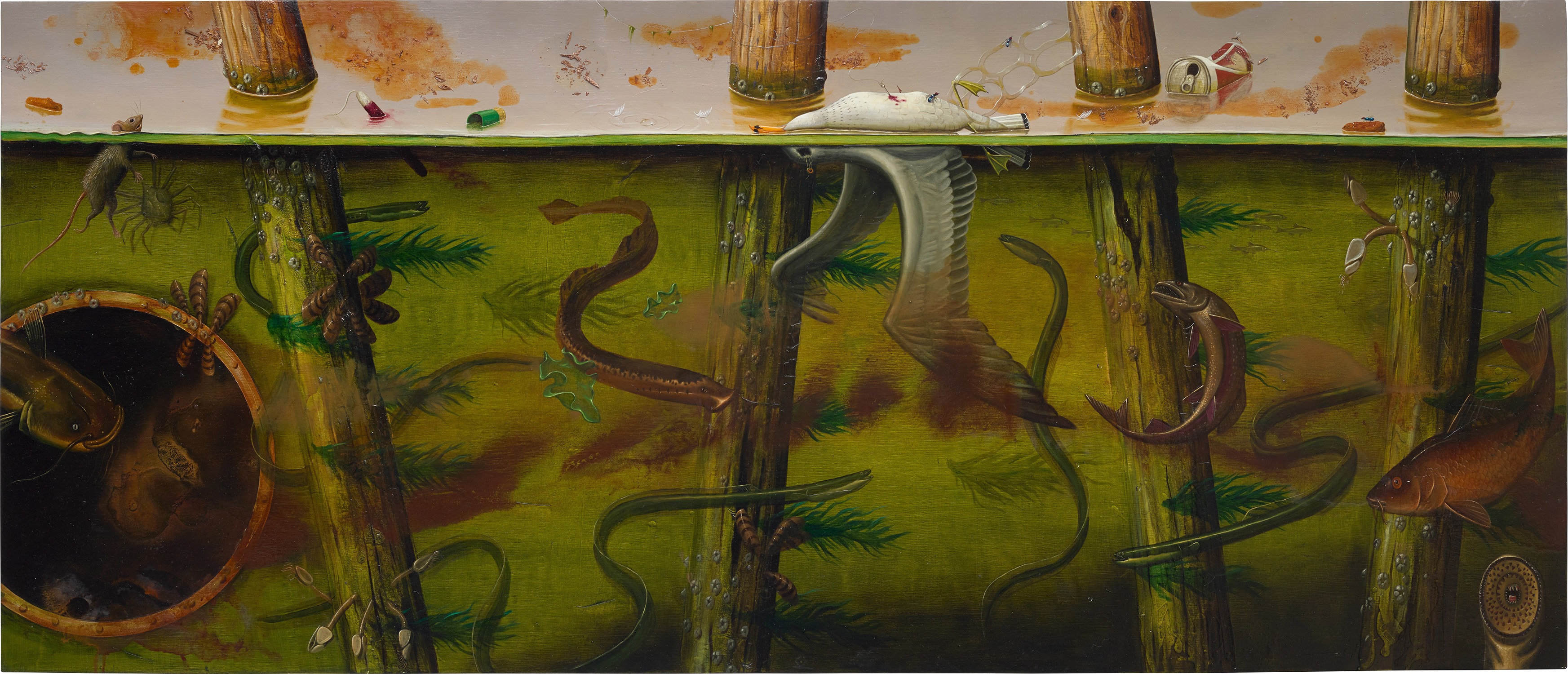
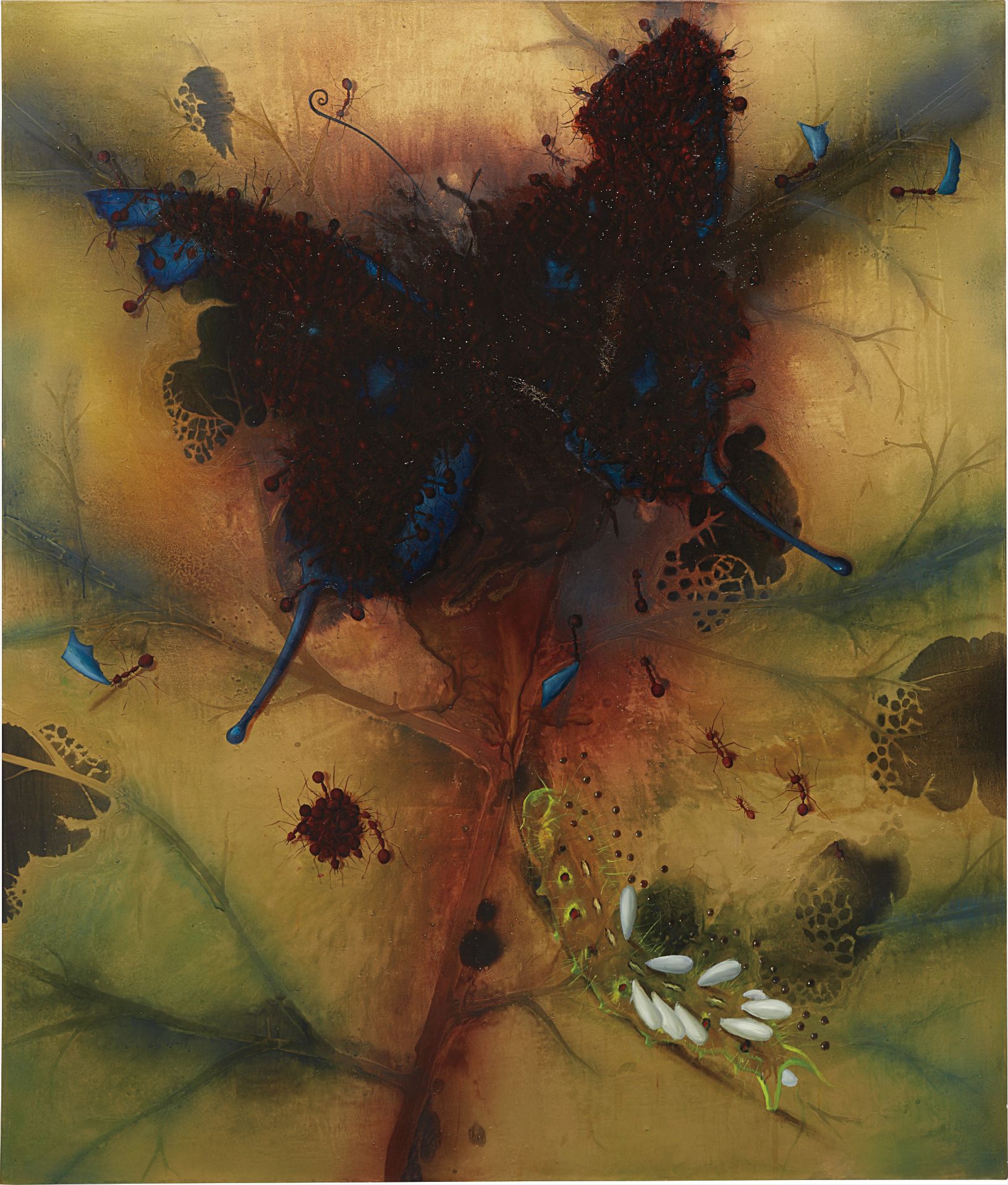
When the Smithsonian American Art Museum mounted a major survey of painting addressing ecological crisis, Alexis Rockman's name appeared with the authority of an artist who had been working these themes long before they became urgent cultural conversation. His canvases, vast and hallucinatory, feel less like warnings than like love letters to a natural world in transformation. In an era when environmental painting risks tipping into didacticism, Rockman has sustained, across four decades, a practice of genuine pictorial ambition and intellectual seriousness that sets him apart from every contemporary working in this territory. Rockman was born in New York City in 1962 and grew up with unusual access to the collections and study halls of the American Museum of Natural History, where his mother worked. That proximity to dioramas, taxidermied fauna, geological specimens, and the great spectacle of natural history display shaped his imagination at its root. He studied at the Rhode Island School of Design and later at the School of Visual Arts in New York, where he absorbed the downtown art scene of the 1980s alongside its fierce theoretical energies, without ever losing his attachment to the biological and the organic. The combination proved generative in ways that have only deepened over time. His early paintings from the late 1980s, including The Dynamics of Power from 1989, already announced an artist with a fully formed sensibility. Working in oil on canvas, Rockman brought together the compositional grandeur of nineteenth century academic painting with subject matter drawn from evolutionary biology, predation, and ecological succession. There was something genuinely strange about these pictures: they looked like natural history illustration elevated to the scale of history painting, filtered through a sensibility equally at home with science fiction paperback covers and the Hudson River School. By the early 1990s, works like Concrete Jungle IV from 1992 pushed further into the zone where the wild and the urban interpenetrate, painting nature not as a refuge from civilization but as something civilization is continuously making and unmaking. The mid 1990s brought a period of concentrated formal experimentation. Benjamin Moore Blue Number 7 from 1996 exemplifies the adventurousness of this moment: the work incorporates Envirotex resin, sand, flowers, oil based clay, and oil paint on wood, building a surface that is as much sculptural as pictorial. Rockman was thinking about the membrane between the painted image and the physical world, about how materials themselves could carry ecological meaning. This was not decoration but genuine inquiry into what painting could hold. His print work, including the signed and numbered editions published by Tomoko Liguori Editions in New York such as The Biosphere series depicting micro organisms and bats, extended his reach into the collector community and demonstrated his facility across media. The print editions, produced in runs of fifty with additional artist proofs, brought his imagery into collections that might not have had access to his larger panel and canvas works. The painting that cemented Rockman's place in the American art historical conversation was Manifest Destiny, completed in 2004 after years of research and preparation. The work, measuring approximately eight by twenty four feet, depicts a flooded Brooklyn four hundred years into a climate altered future, with the familiar streets of the borough submerged beneath rising seas and populated by evolved and mutated species. It was shown at the Brooklyn Museum and provoked serious critical engagement. The ambition of the picture, its synthesis of scientific research and painterly bravura, its willingness to occupy the full space of historical painting while speaking directly to the present, established Rockman as something rare: a politically engaged painter who was also a formally rigorous one. Pet Store from 2003, oil and acrylic on panel in two parts, shows the intimacy and precise observation that balances the epic ambition of works like Manifest Destiny, his attention to individual organisms as compelling as his vision of entire ecosystems. For collectors, Rockman's work offers a remarkable range of entry points. His works on paper and print editions have historically offered access to his imagery at approachable price points, while his panel paintings and large canvases represent the kind of sustained commitment that serious collections are built around. Bufo, his painting in oil and acrylic on canvas focused on toad species, exemplifies the quality that distinguishes his best work: the combination of scientific specificity with genuine painterly feeling. Collectors drawn to artists who sit at the intersection of aesthetic ambition and intellectual substance consistently find Rockman rewarding. His market has been steady and his critical reputation has only grown as environmental concerns have moved from the margin to the center of cultural life. Within the broader context of American art, Rockman occupies a position that connects multiple lineages. He shares with the Hudson River School painters, particularly Frederic Edwin Church, a belief that landscape painting can carry the full weight of a civilization's relationship to the natural world. He is in conversation with the visionary biology of Ernst Haeckel, whose illustrated natural history volumes Rockman has cited as a formative influence. Among his contemporaries, artists such as Mark Dion, who approaches ecology through the lens of institutional critique, and Matthew Barney, who similarly draws on natural history as a source of imagery and myth, provide useful points of comparison, though Rockman's commitment to the painted surface remains distinctly his own. His work also resonates with that of Peter Doig in its willingness to take landscape painting seriously as a vehicle for meaning in an era that has often been skeptical of the genre. What makes Rockman matter today, and what will ensure his place in the history of American painting, is not simply the prescience of his subject matter but the quality of his commitment. He has spent four decades looking carefully at the natural world, at the science that describes it, at the history of its representation, and at the forces that are reshaping it. The result is a body of work that rewards sustained engagement in the way that only genuinely ambitious painting does. To spend time with a Rockman canvas is to be reminded that painting, at its best, is a form of thinking, and that thinking carefully about the world we share is among the most generous things an artist can do.