Join The Collection to save, track, and explore works like this.

Art Institute of Chicago

Spotted

Claude Monet — Arrival of the Normandy Train, Gare Saint-Lazare
Claude Monet

Arrival of the Normandy Train, Gare Saint-Lazare

1877

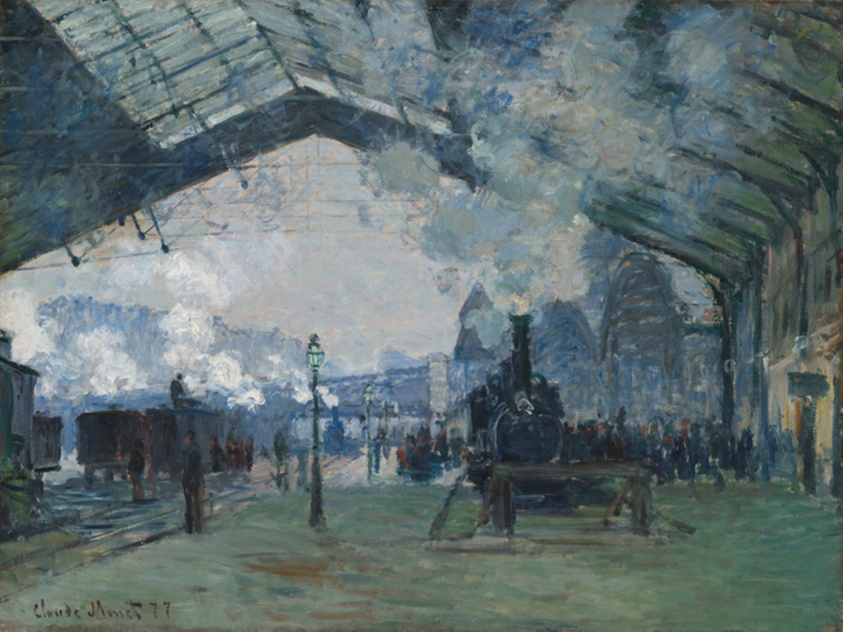
One of the most avant-garde aspects of the Impressionists was their choice of subject matter, which frequently included scenes derived from modern, industrial Paris, from iron bridges to exhibition halls to train sheds. The train station at Saint-Lazare would have been a familiar, meaningful sight to Claude Monet in the 1870s. The terminal linked Paris to Normandy, where the artist developed his technique of painting outdoors in the 1860s. It was also the point of departure for the towns and villages west and north of Paris that the Impressionists frequently visited. Monet completed eight of his twelve known paintings of the Gare Saint-Lazare in time for the third Impressionist exhibition, in 1877, probably displaying them in the same gallery. Monet chose to focus his attention here on the glass-and-iron train shed, where he found an appealing combination of artifi cial and natural effects—the rising steam of locomotives trapped within the structure and the daylight penetrating large, glazed sections of the roof, for instance. Monet’s depictions of the station inaugurated what was to become for him an established pattern of painting a specific motif repeatedly in order to capture subtle and temporal atmospheric changes, as in his famous series of stacks of wheat. But the Saint-Lazare paintings also represented his last attempt to capture urban life: from this point on in his career, Monet largely devoted himself to landscapes.

Medium
Oil on canvas
Dimensions

Start the Discussion

Request access to join the discussion

About this work

Claude Monet, Arrival of the Normandy Train, Gare Saint-Lazare, 1877

One of the most avant-garde aspects of the Impressionists was their choice of subject matter, which frequently included scenes derived from modern, industrial Paris, from iron bridges to exhibition halls to train sheds. The train station at Saint-Lazare would have been a familiar, meaningful sight to Claude Monet in the 1870s. The terminal linked Paris to Normandy, where the artist developed his technique of painting outdoors in the 1860s. It was also the point of departure for the towns and villages west and north of Paris that the Impressionists frequently visited. Monet completed eight of his twelve known paintings of the Gare Saint-Lazare in time for the third Impressionist exhibition, in 1877, probably displaying them in the same gallery. Monet chose to focus his attention here on the glass-and-iron train shed, where he found an appealing combination of artifi cial and natural effects—the rising steam of locomotives trapped within the structure and the daylight penetrating large, glazed sections of the roof, for instance. Monet’s depictions of the station inaugurated what was to become for him an established pattern of painting a specific motif repeatedly in order to capture subtle and temporal atmospheric changes, as in his famous series of stacks of wheat. But the Saint-Lazare paintings also represented his last attempt to capture urban life: from this point on in his career, Monet largely devoted himself to landscapes.

Medium
Oil on canvas
Dimensions
60.3 x 80.2 cm
Year
1877
Seen at
Art Institute of Chicago, Chicago, IL

Related themes

Modern, Unique Work, Painting, Oil on Canvas

More works by Claude Monet

Collected by

Sebastián In Situ, Art Institute of Chicago, Harvard Art Museums, Cleveland Museum of Art, Alex Capecelatro, Sebastián Naranjo