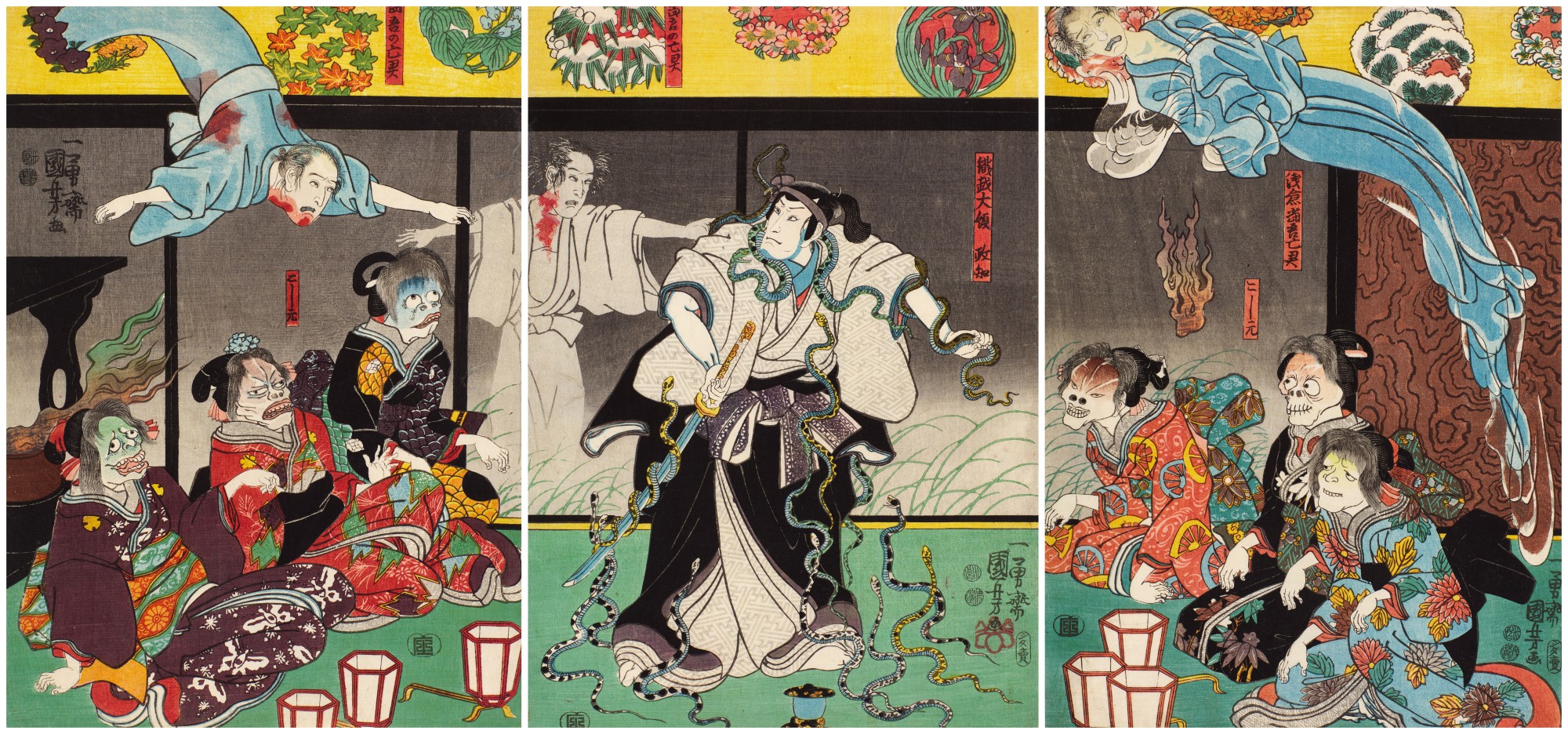
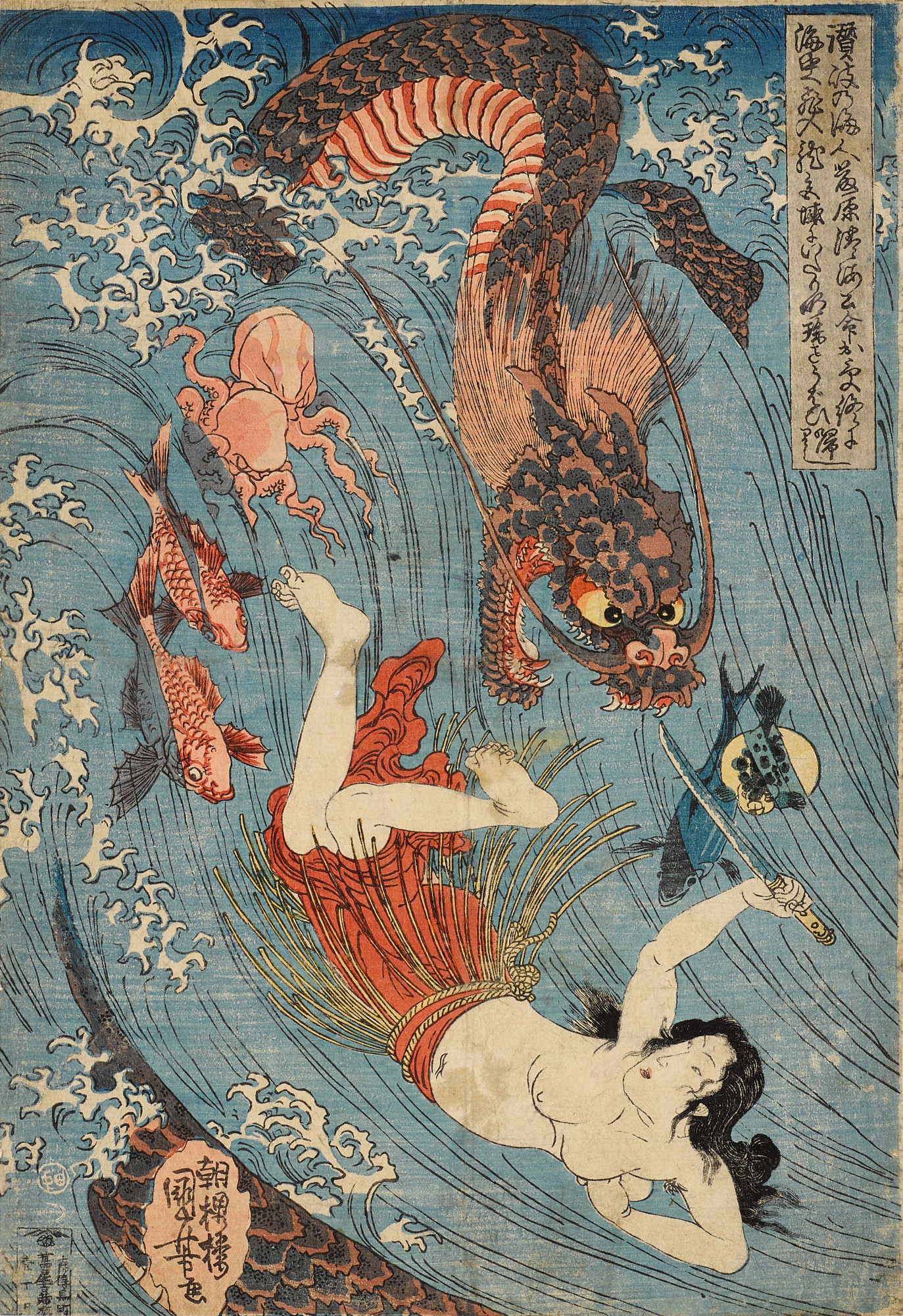
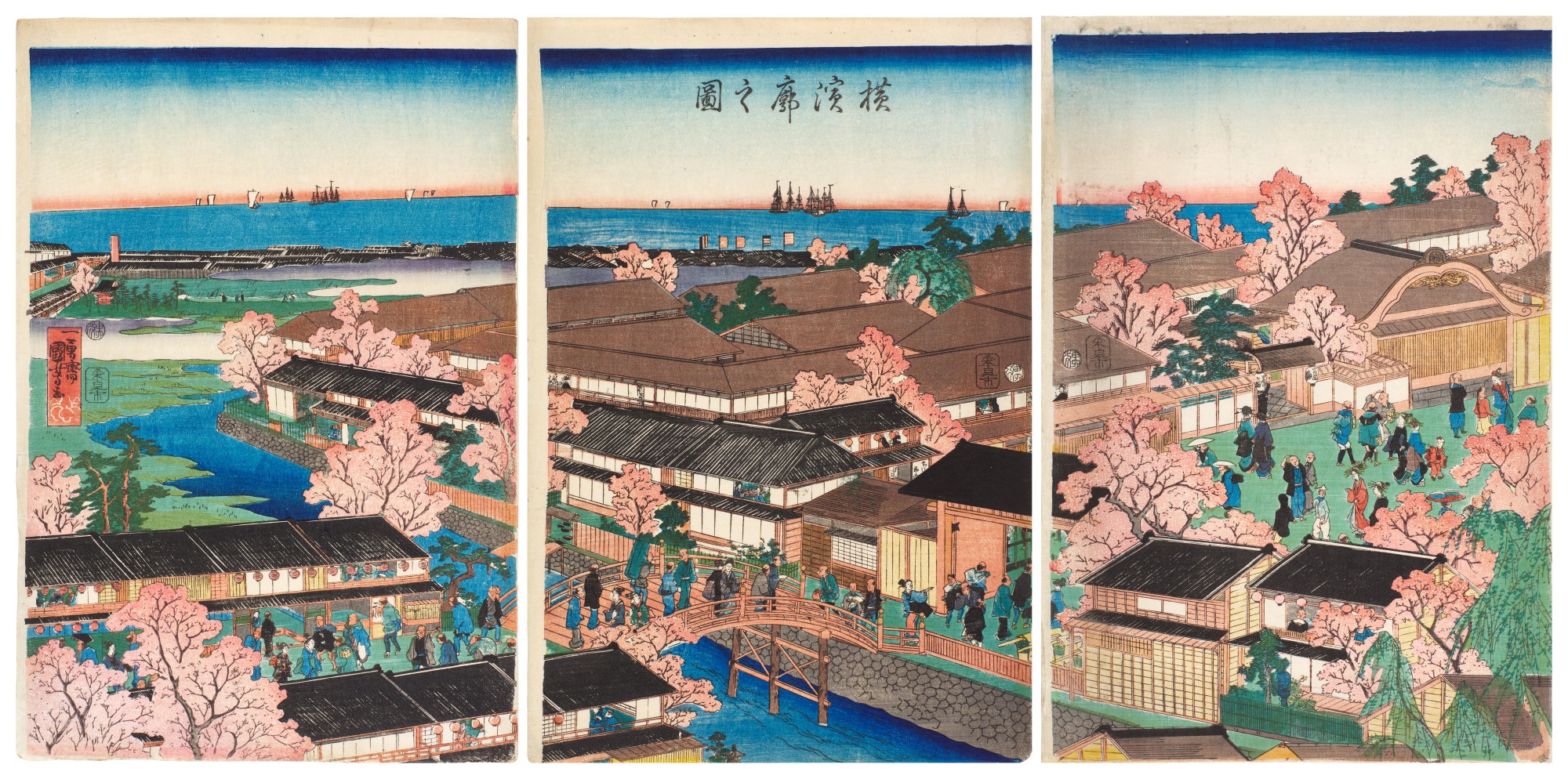
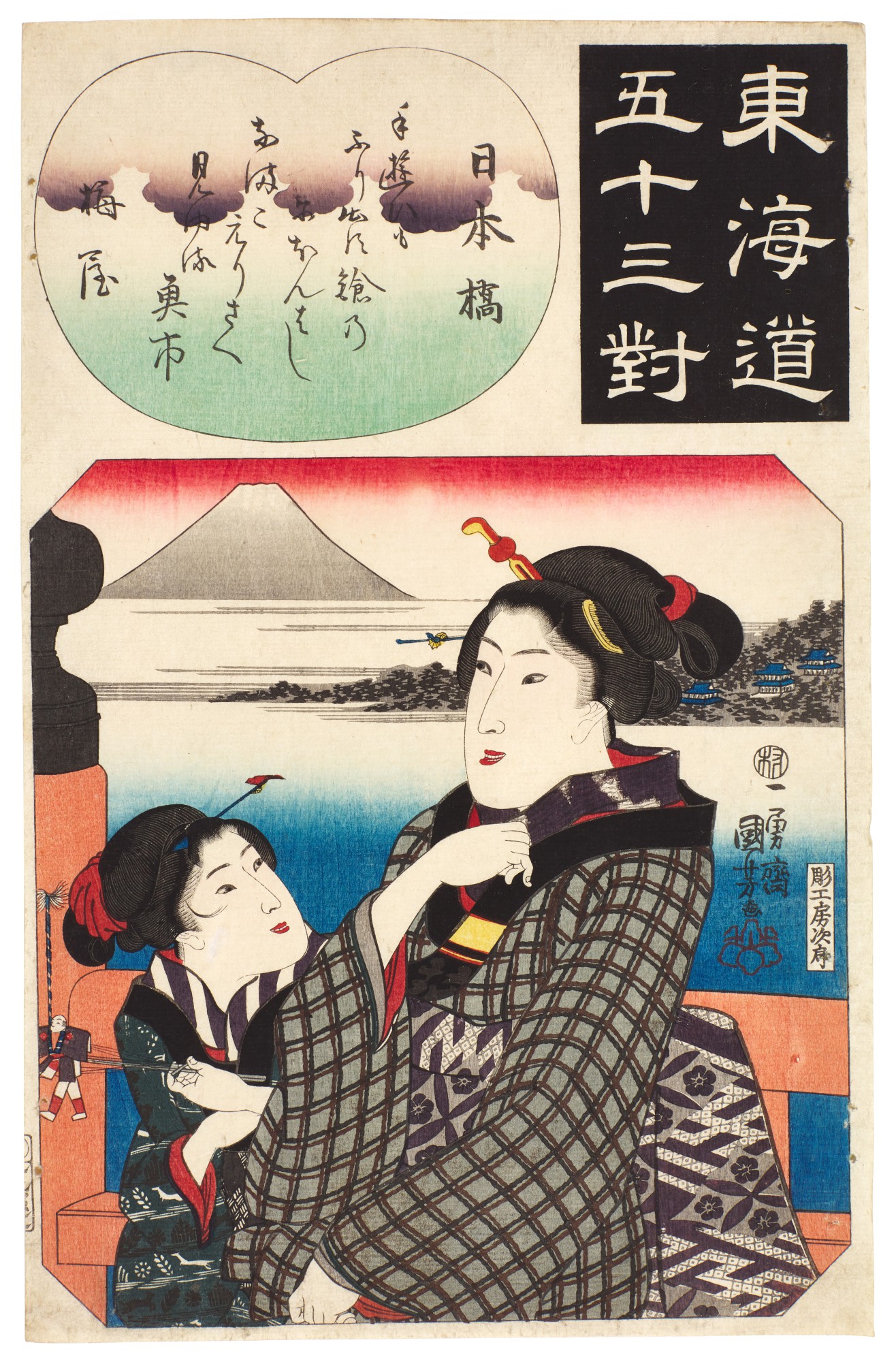
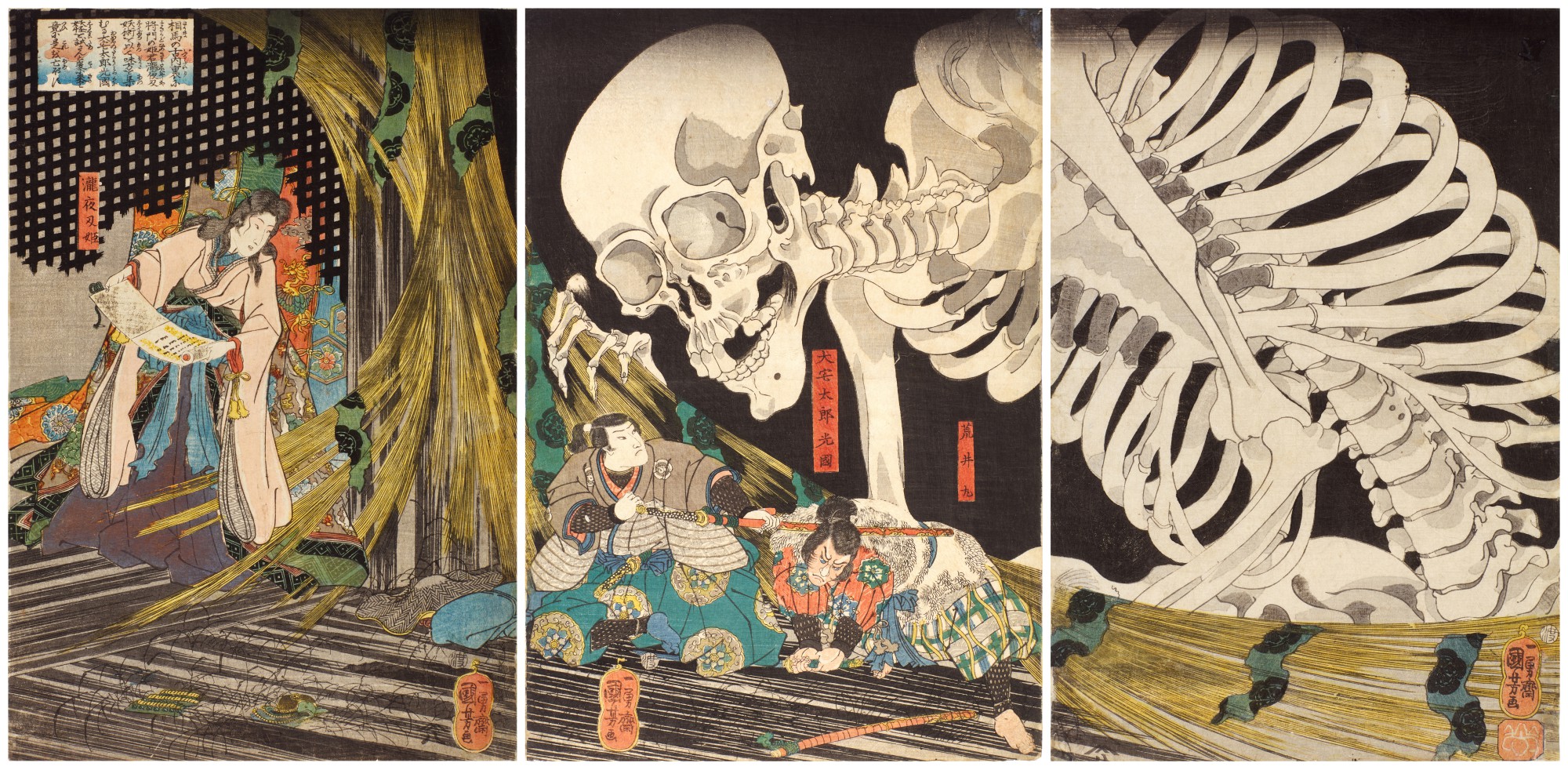
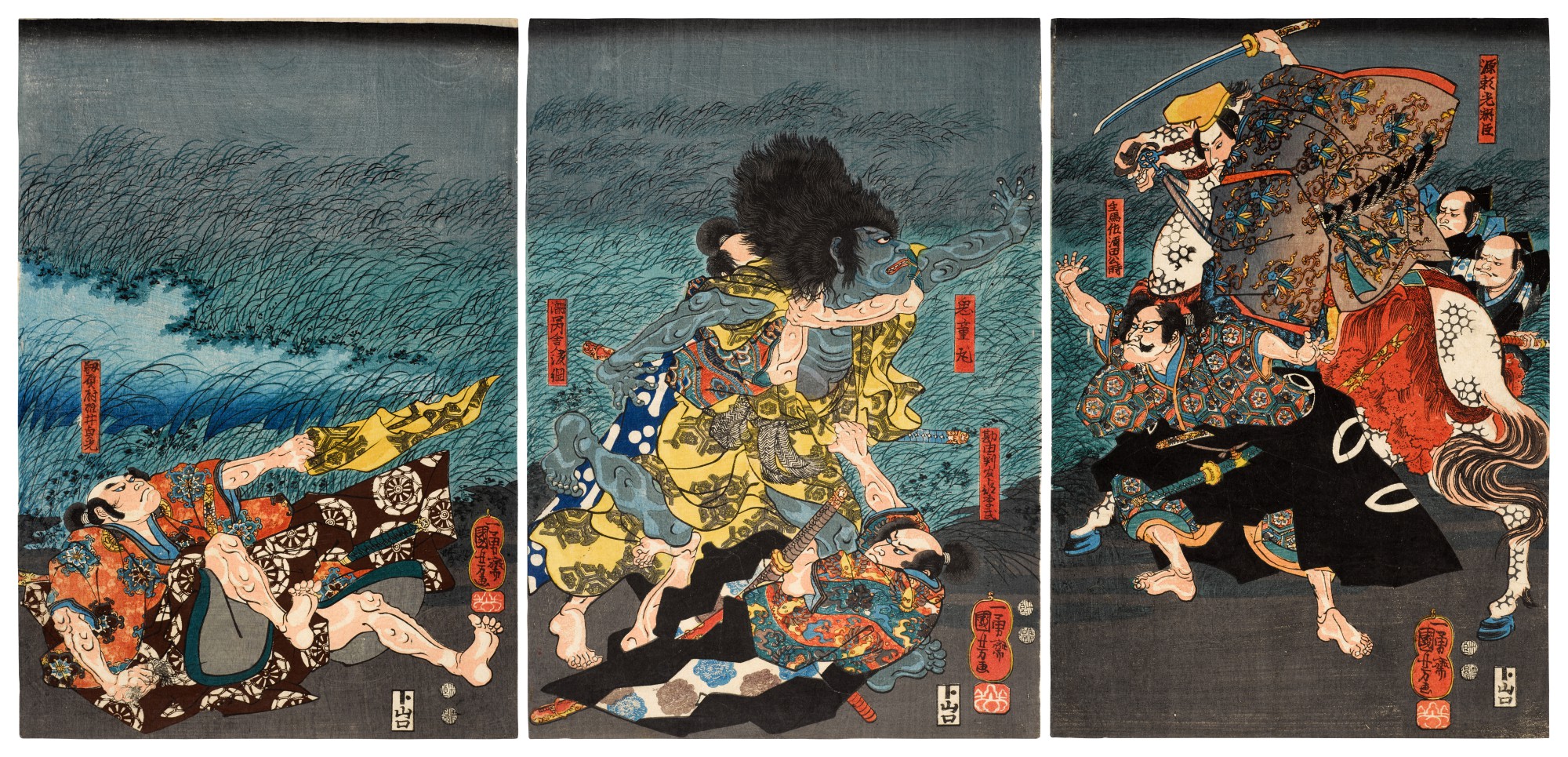
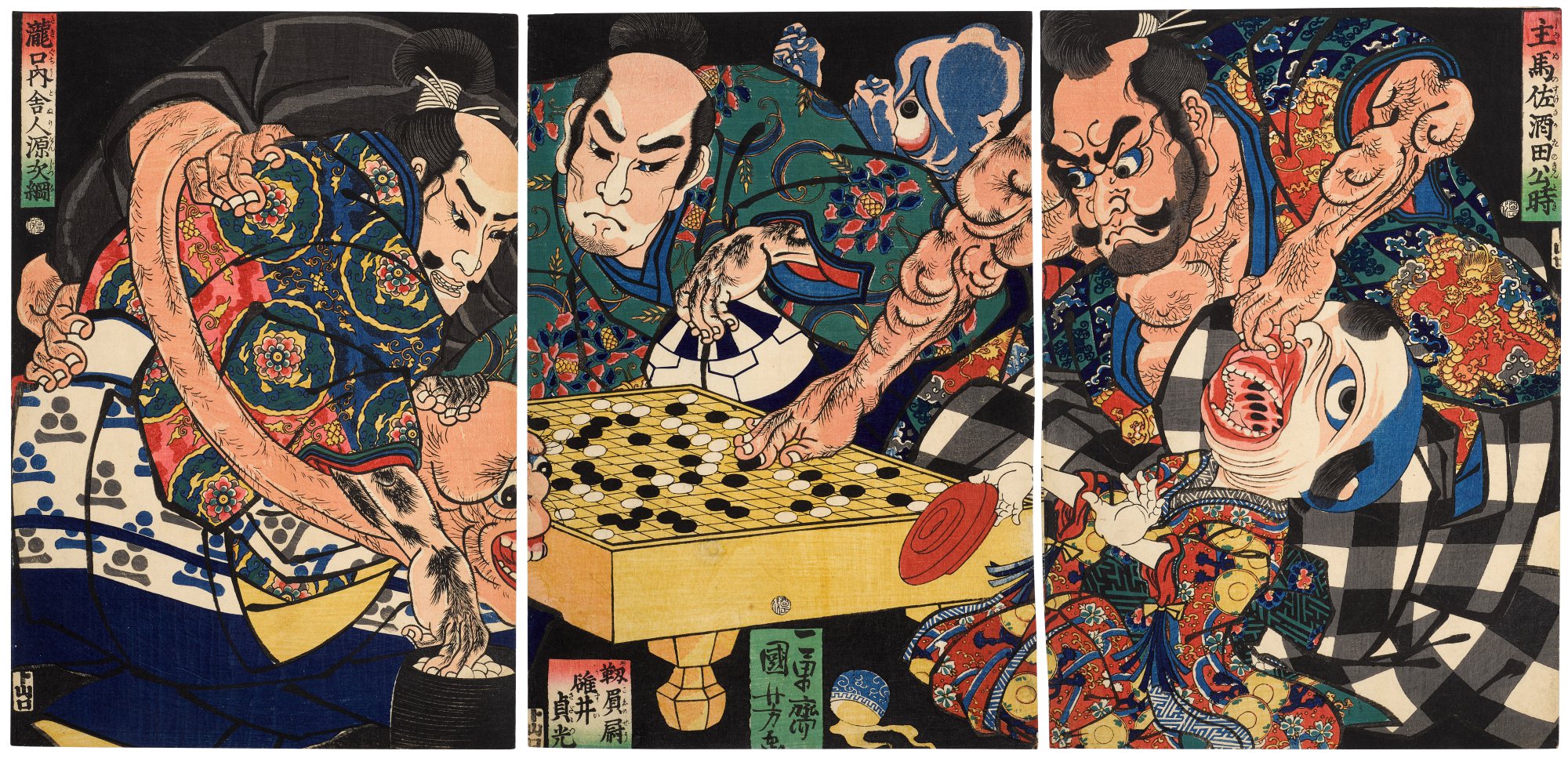
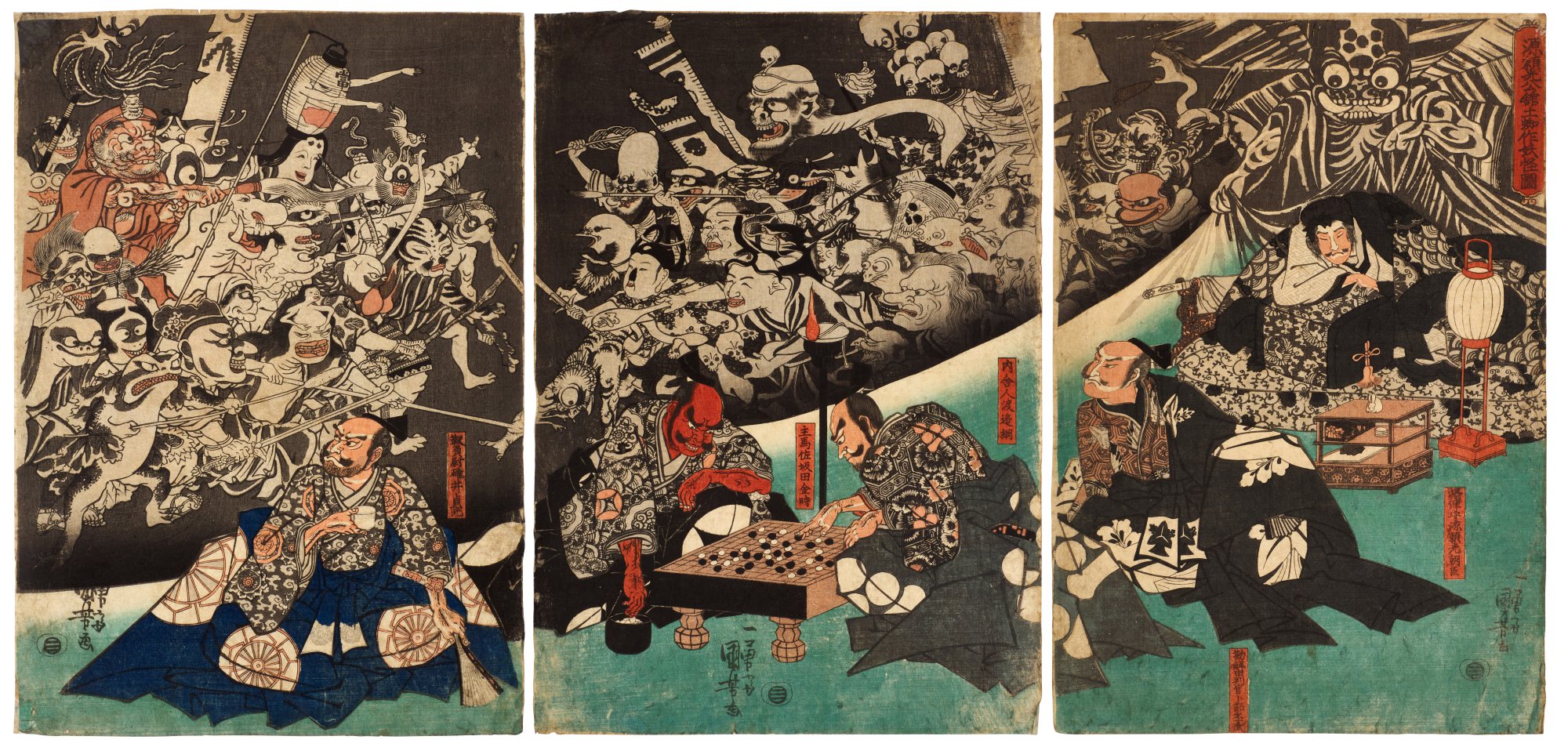
Imagine standing before a woodblock print in which a colossal skeleton, luminous and terrible, rears up against a moonlit sky while a fearless warrior holds his ground below. This is the world of Utagawa Kuniyoshi, and it is a world that continues to electrify viewers nearly two centuries after it was made. The British Museum's landmark retrospective in 2009, "Kuniyoshi: From the Arthur R. Miller Collection," brought together over 100 of his works and reminded Western audiences why this artist remains one of the most viscerally compelling figures in the entire history of printmaking. Since then, scholarly and collector appetite for Kuniyoshi has only intensified, with major institutions from the Museum of Fine Arts Boston to the Art Institute of Chicago holding significant examples of his work. Kuniyoshi was born in Edo, the city we now call Tokyo, in 1797, the son of a dyer named Yanagiya Kichiyemon. His father's profession was not incidental: the dyeing trade gave the young Kuniyoshi an early and intimate education in color, pattern, and the visual language of cloth and surface. By the age of twelve he had entered the studio of Toyokuni I, the reigning master of the Utagawa school, one of the most influential printmaking dynasties of the Edo period. Training under Toyokuni meant absorbing a rigorous tradition while also existing within the lively, commercially driven world of popular print culture, where images of actors, beautiful women, and legendary warriors poured from the presses to satisfy an insatiable public. His early career was not an immediate triumph. Through his twenties Kuniyoshi struggled to distinguish himself within a crowded field, producing competent but unremarkable work. The turning point came around 1827 and 1828, when he released his series "108 Heroes of the Popular Water Margin" based on the Chinese novel Suikoden. These prints were a sensation. The heroes Kuniyoshi depicted were not the elegant, refined figures typical of the period but muscular, tattooed warriors rendered with extraordinary dynamism and anatomical invention. Kuniyoshi had taught himself to incorporate influences from European engravings and Chinese illustrated books, and the result was a new kind of pictorial energy that the Japanese print world had not seen before. The series made his reputation overnight. What followed was one of the most prolific and inventive careers in the history of Japanese art. Kuniyoshi worked across an astonishing range of subjects and formats. His warrior prints, known as musha e, brought legendary heroes and supernatural battles to life with a compositional boldness that anticipates the graphic storytelling of cinema. Works such as "Mitsukuni Defying the Skeleton Spectre Conjured Up by Princess Takiyasha" demonstrate his extraordinary ability to orchestrate terror and beauty simultaneously. The towering skeleton that dominates that triptych is not merely frightening; it is aesthetically magnificent, a feat of design as much as imagination. Similarly, "The Earth Spider Generates Monsters at the Mansion of Lord Minamoto Yorimitsu" reveals his gift for dense, layered narrative, filling the picture plane with grotesque creatures while never losing compositional clarity. Beyond the supernatural, Kuniyoshi proved himself equally masterful in quieter modes. His landscapes, including the luminous triptych "Splendid View at Futamigaura Bay" from 1854, show a painter's sensitivity to atmosphere and light. His contribution to the collaborative series "The Complete Set of Fifty three Pairings for the Tokaido," created alongside the great Utagawa Hiroshige and Utagawa Kunisada, stands as a monument of Edo period printmaking and an object lesson in how three distinct artistic personalities can illuminate a shared subject from profoundly different angles. His series "The Complete Set of Twenty four Paragons of Filial Piety in China" demonstrates yet another register: moral narrative rendered with genuine warmth and illustrative precision. Kuniyoshi was also a supremely inventive humorist, producing prints in which cats assemble themselves into human figures or playfully parody the conventions of the very medium in which he worked. For collectors, Kuniyoshi occupies a particularly compelling position in the market for Japanese prints. He is simultaneously accessible and inexhaustible. Unlike some masters of the form whose reputations rest on a narrow category of subject matter, Kuniyoshi's range means that a serious collection can be built around multiple thematic threads: the supernatural, the heroic, the lyrical, the comic. Fine impressions of his major triptychs have achieved significant results at auction at Christie's, Sotheby's, and Bonhams over the past two decades, with rare early printings of the "Water Margin" heroes commanding particular attention. Collectors are advised to look closely at impression quality and color, since Kuniyoshi's work was often reprinted over long periods and later impressions can differ substantially from the originals in their tonal richness. To understand Kuniyoshi fully it is essential to place him within the broader landscape of the Utagawa school and the ukiyo e tradition. His great contemporary Utagawa Hiroshige pursued an entirely different emotional register, one of melancholy transience and atmospheric subtlety, most famously in his "Fifty three Stations of the Tokaido." Katsushika Hokusai, older and working in a parallel tradition, shared Kuniyoshi's appetite for the dramatic and the strange, and the two artists clearly influenced each other in their respective treatments of marine imagery and mythological subjects. Where Hokusai often feels cosmic and philosophical, Kuniyoshi feels immediate and kinetic, closer in spirit to the storyteller than the sage. Later Western artists who encountered Japanese prints through the phenomenon of Japonisme, including Vincent van Gogh and Henri de Toulouse Lautrec, responded to the tradition as a whole, but it is Kuniyoshi's dynamism and his bold manipulation of line and color that feel most prophetic of twentieth century graphic art. Kuniyoshi died in Edo in 1861, at the very threshold of the Meiji Restoration that would transform Japan almost beyond recognition. He did not live to see Western modernism, but in many ways Western modernism came, eventually, to him. The compression of space, the expressive distortion of the figure, the willingness to use the flat picture plane as a field of pure visual energy: these are qualities that link Kuniyoshi to the most vital currents of modern and contemporary art. He remains an artist of genuine surprise, one whose work rewards sustained looking and continued discovery. To encounter his prints is to be reminded of what images, at their most powerful, are capable of.