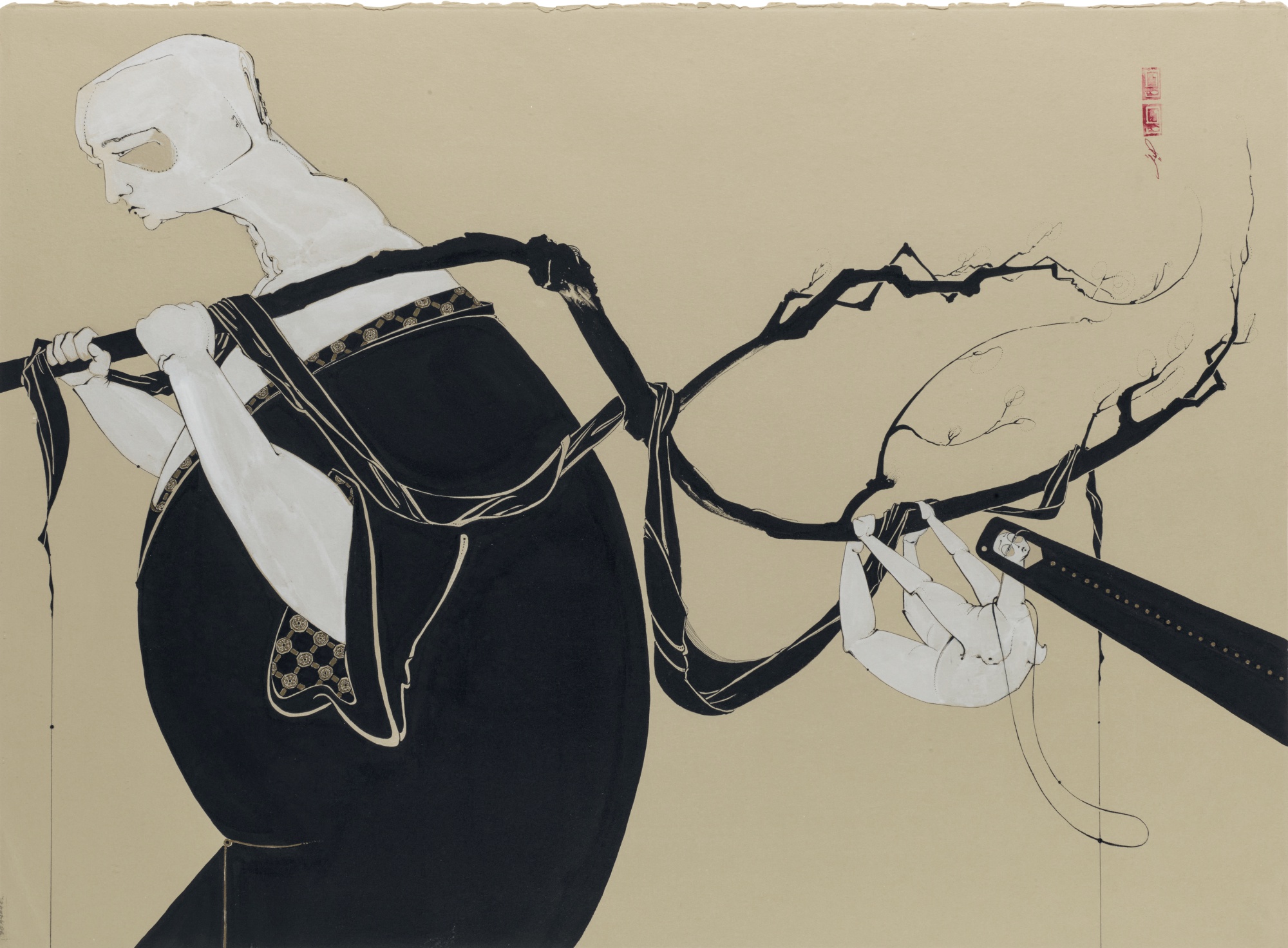
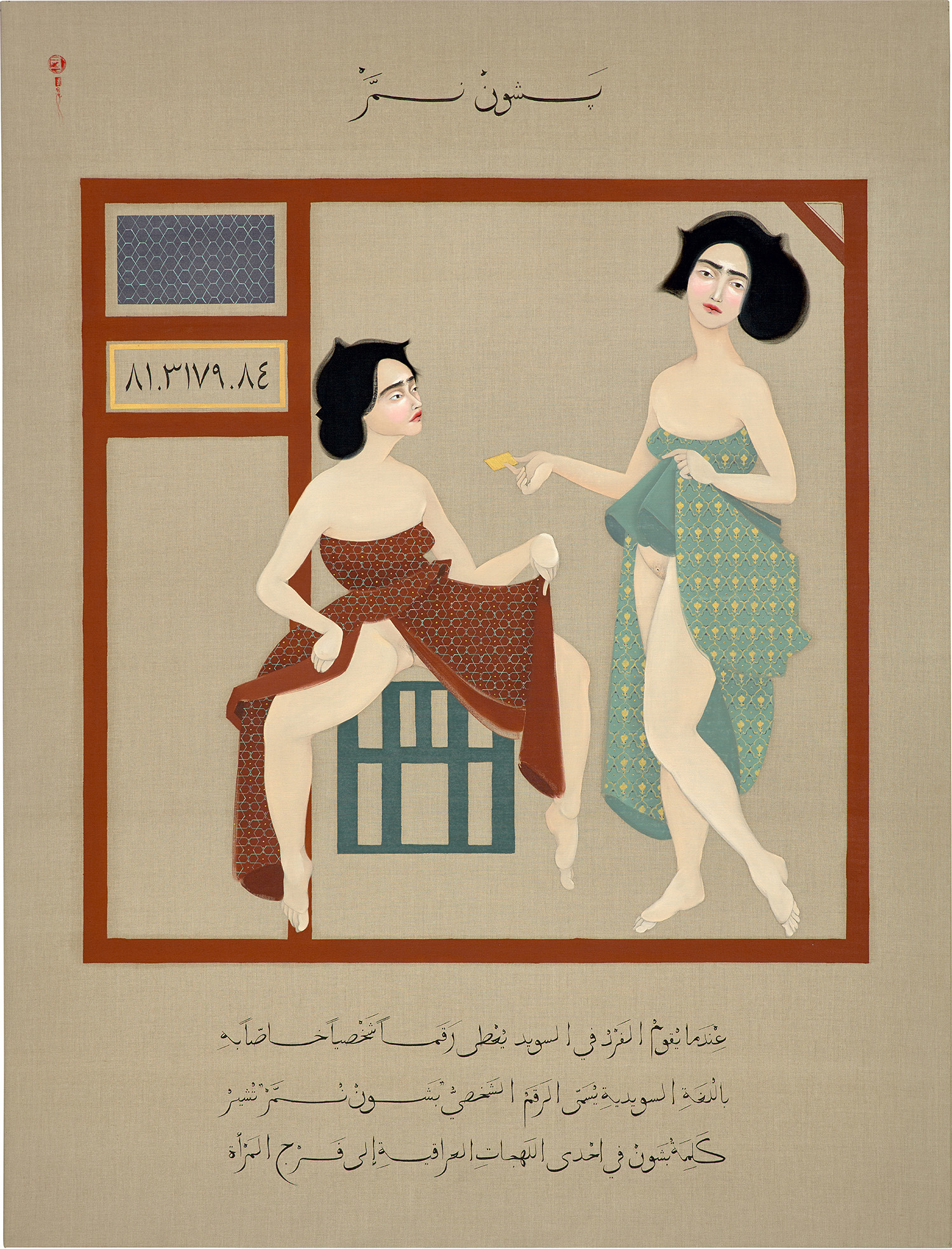
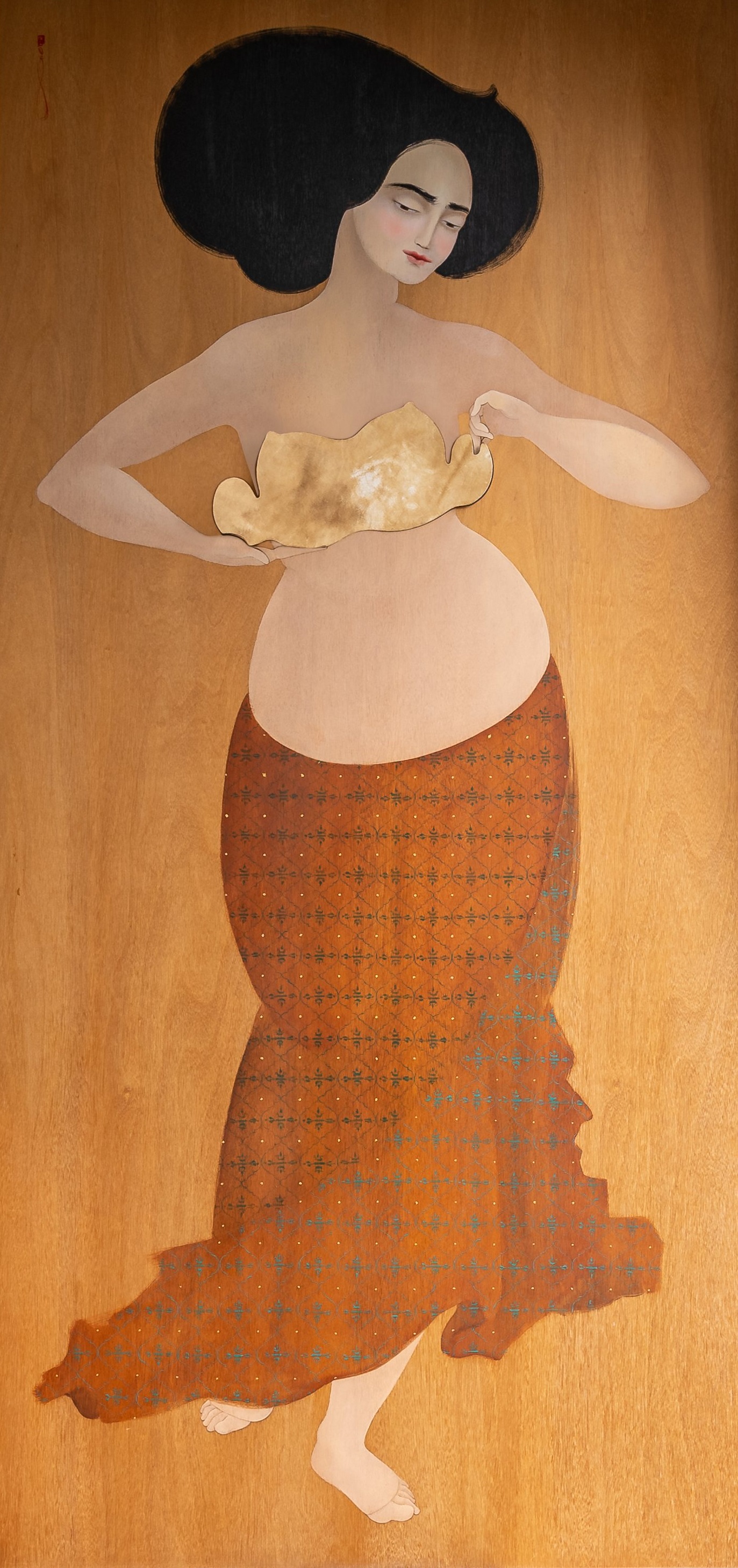
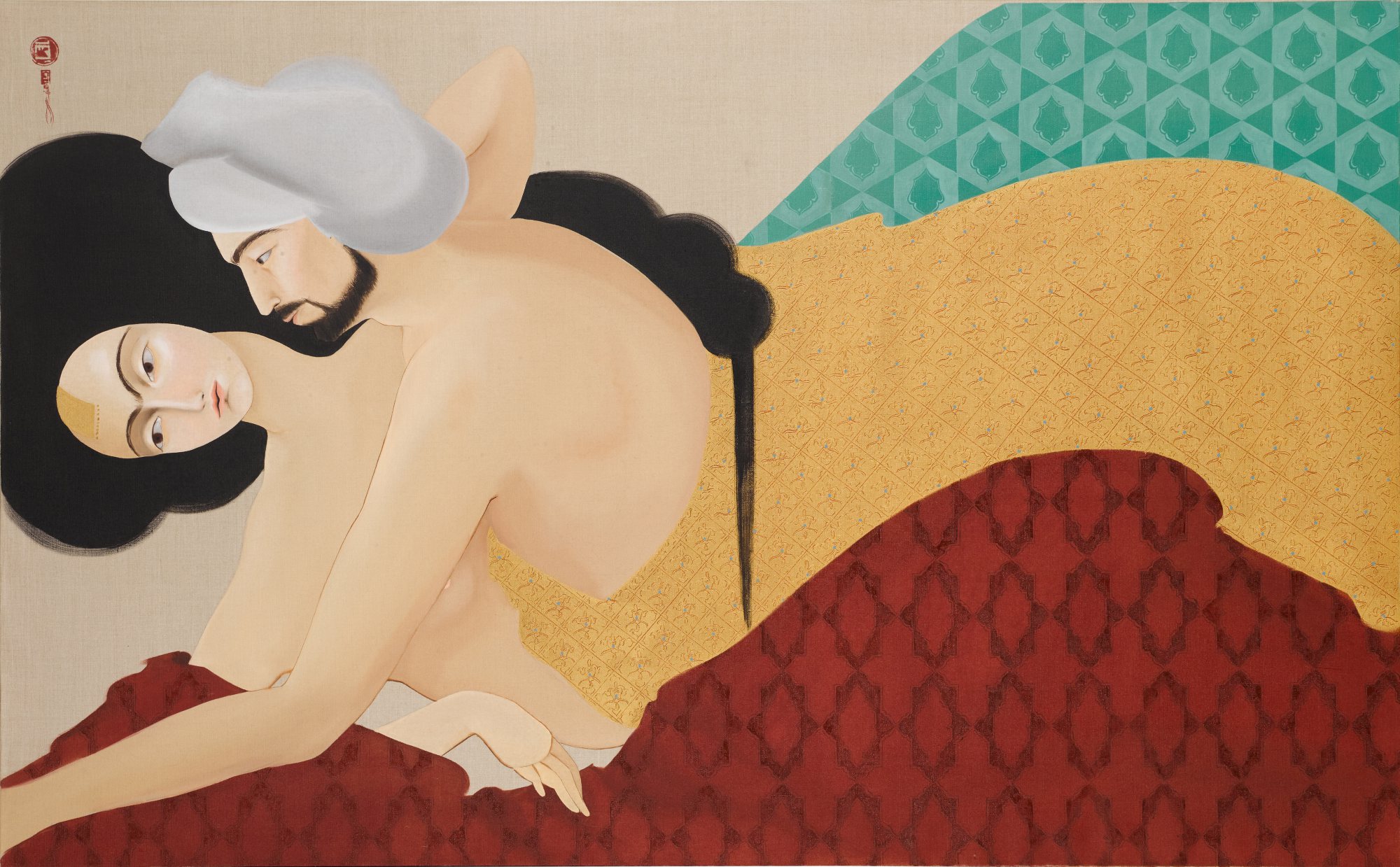
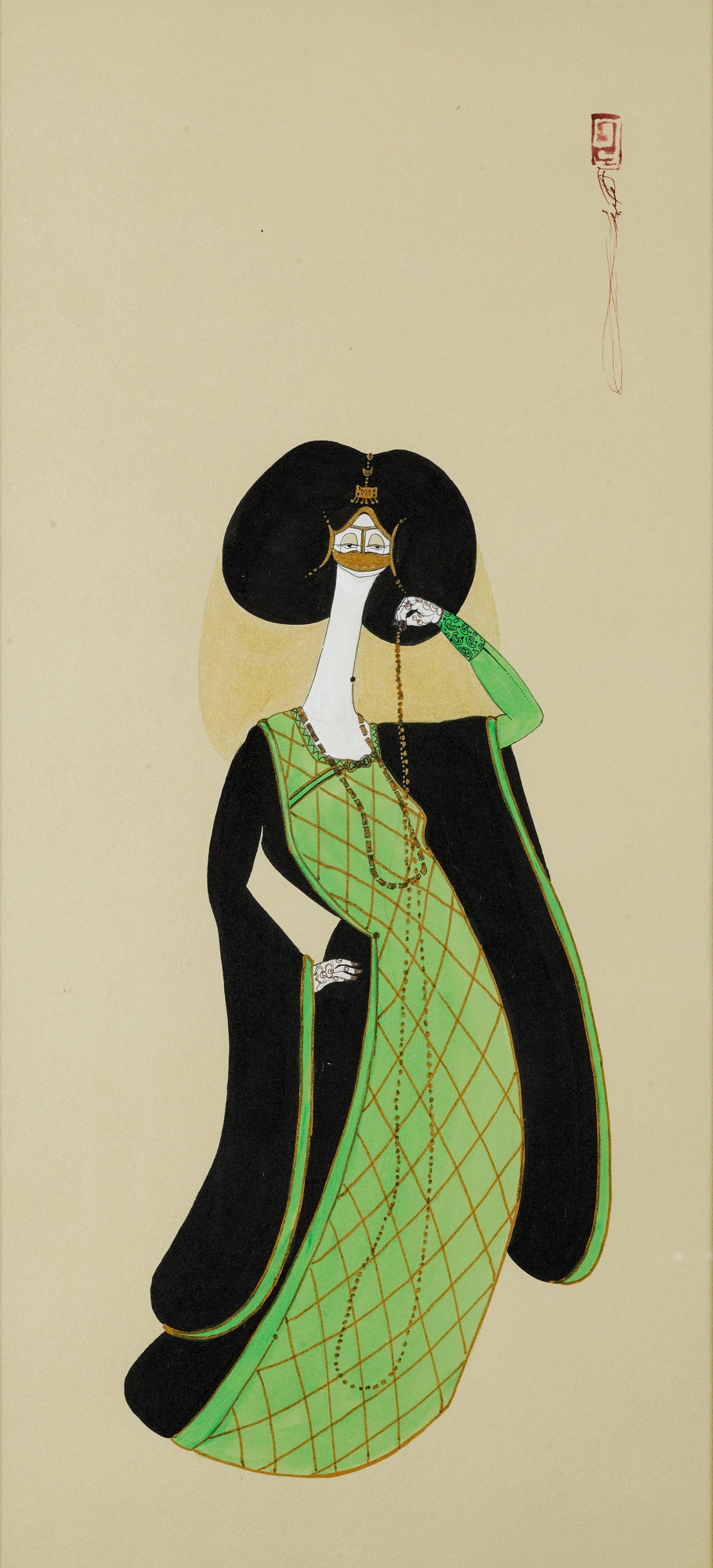
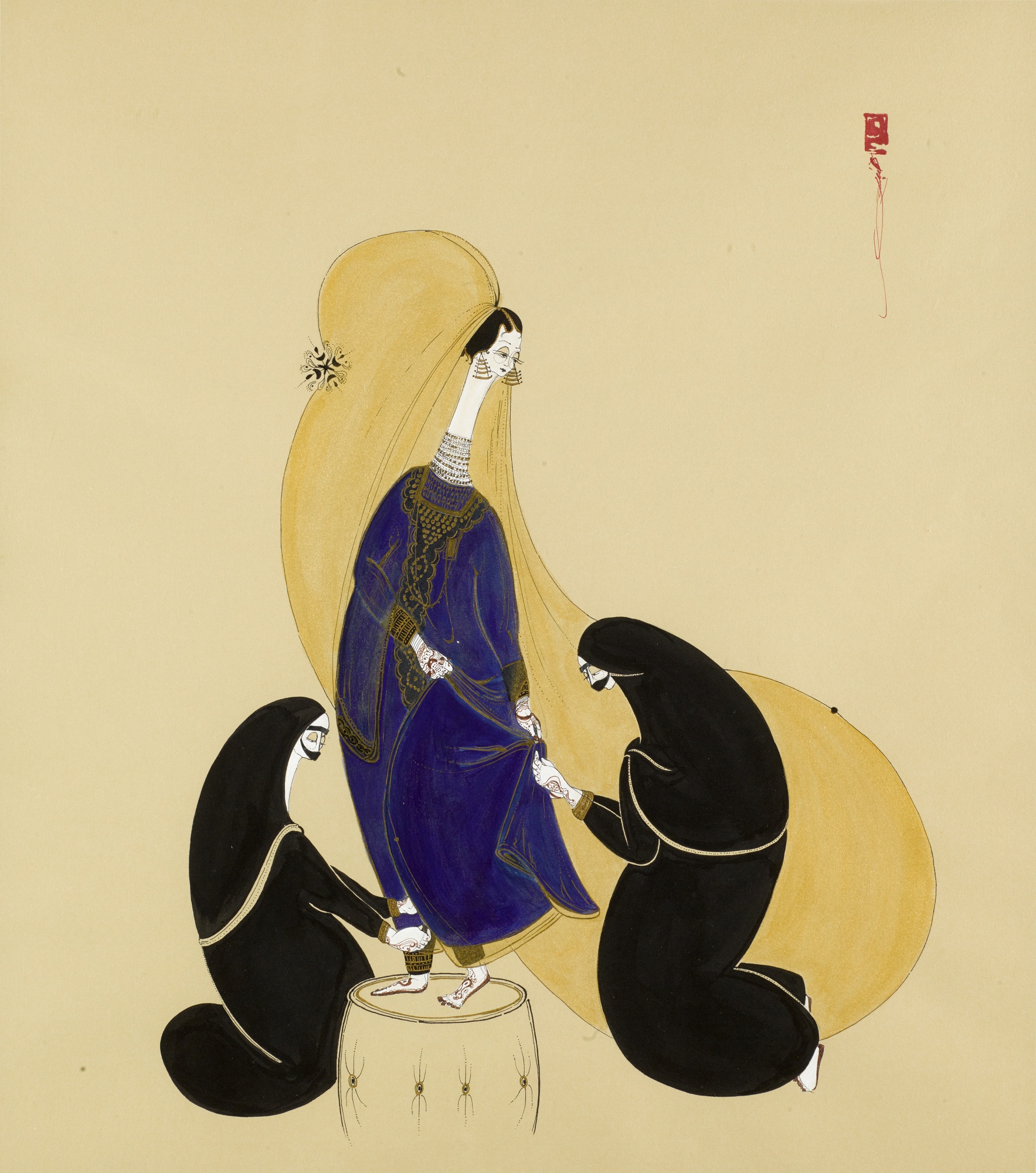
In the years since her arrival on the international contemporary art scene, Hayv Kahraman has emerged as one of the most quietly essential painters working today. Her solo exhibition at the Ruya Foundation and her sustained presence in major institutional collections across the United States and Europe have confirmed what attentive collectors have long sensed: that Kahraman is building a body of work of rare intellectual and emotional density. Her paintings do not simply depict women. They theorize them, mourn them, celebrate them, and ultimately refuse to let them be forgotten. Kahraman was born in Baghdad in 1981, and her early years were shaped by the particular texture of life in Iraq during a period of political turbulence and cultural isolation. She left Iraq as a teenager, eventually settling in Sweden, where she trained as a graphic designer and began developing the visual instincts that would later define her paintings. The experience of displacement, of moving between languages, bureaucracies, and cultural expectations, would become not merely a biographical footnote but the generative engine of her entire practice. Sweden gave her formal rigor and an outsider vantage point. Later, she would relocate to the United States, adding yet another layer to a life lived across borders and identities. Her artistic formation drew on an unlikely but deeply coherent set of influences. The elongated, flattened figures of Persian and Iraqi miniature painting provided her with a formal vocabulary that felt both ancestral and radical in a contemporary Western context. She studied these traditions seriously, absorbing their compositional logic, their relationship between figure and ground, their preference for symbolic color over illusionistic space. At the same time, she engaged with feminist theory, postcolonial scholarship, and the writing of thinkers who interrogated the politics of the body and the gaze. This combination of art historical depth and theoretical rigor is what separates Kahraman from painters who merely reference non Western traditions decoratively. For her, the miniature is not an aesthetic choice. It is a political one. The works she produced in the mid 2000s announced her voice with remarkable confidence. Pieces such as Standing Lady in Green Dress from 2006, rendered in sumi ink and acrylic on paper, introduced the stylized female figure that would become her signature. These women are neither portraits nor archetypes in any conventional sense. They inhabit a space between documentation and imagination, their elongated limbs and tilted heads suggesting both grace and tension. The 2006 work Dress Maker, also in sumi ink and acrylic, carries a similar quiet intensity, the act of making clothing becoming a meditation on labor, femininity, and the transmission of culture across generations. These early works on paper have a lightness to them that belies their conceptual weight, and they remain among the most sought after entry points for collectors approaching her practice. By the late 2000s and into the 2010s, Kahraman had expanded her materials and her ambitions. Untitled (Baggage) from 2007, worked in sumi ink, watercolour, and metallic pigment on paper and mounted on card, signaled her interest in layering both materials and meanings. The title alone does extraordinary work, invoking the literal luggage of migration and the psychic freight that accompanies those who cross borders involuntarily. Persian Couple 2 from 2009, executed in oil on linen, marks her confident transition into painting as a sustained primary medium. The shift to oil allowed her to build surfaces of greater luminosity and complexity, and the figures in these works carry an authority that feels entirely earned. By 2012, with a work like Disembodied 5, an oil on panel incorporating rawhide inlay and polycarbonate, she was pushing into genuinely innovative material territory, the body of the painting itself becoming a site of investigation as much as the figures it contains. The work Person nummer from 2015 deserves particular attention as a marker of Kahraman's ongoing engagement with bureaucratic systems and their violence against displaced people. The title refers to the Swedish personal identification number assigned to residents and citizens, a seemingly neutral administrative fact that carries enormous weight for those who have sought refuge or legal status in a country not their own. The painting transforms this administrative reality into something visceral and deeply human. It is characteristic of Kahraman's method that she can locate the political in the most intimate registers, finding in a bureaucratic number the full complexity of what it means to be counted, categorized, and provisionally accepted. For collectors, Kahraman's work offers something increasingly rare: a genuinely original visual language that has continued to develop across nearly two decades without losing its coherence or its urgency. Her works have entered the permanent collections of major institutions including the Los Angeles County Museum of Art, a fact that reflects both the quality of individual works and the strength of her overall practice. Collectors who have followed her from those early works on paper through to her more recent large scale paintings on linen have been rewarded with a body of work that only deepens in meaning over time. Works from her formative period in the mid 2000s now carry the additional significance of documenting the emergence of a singular voice, while her later paintings demonstrate a mastery of material and concept that places her among the most serious painters of her generation. In the broader context of contemporary painting, Kahraman occupies a position that is both distinct and illuminating. Her engagement with non Western pictorial traditions places her in meaningful conversation with artists who have similarly interrogated the politics of representation and the art historical canon. Her feminist commitments connect her to a lineage of women painters who have insisted on reclaiming the female body from objectification. And her experience of diaspora links her to a global community of artists for whom identity is not a stable inheritance but a continuous negotiation. She is in this sense an artist of our actual historical moment, one who has found in paint and paper a way to hold all of these forces in productive tension. What makes Hayv Kahraman matter today is precisely her refusal to simplify. Her paintings are beautiful, but they are not consoling in any easy sense. They ask the viewer to sit with complexity, to recognize the full humanity of the figures they contain, and to understand that the personal and the political are never truly separate. As her work continues to be exhibited, collected, and studied, it becomes clearer that she is not simply an important artist of her time. She is one of the artists who will help future generations understand what this time actually felt like.