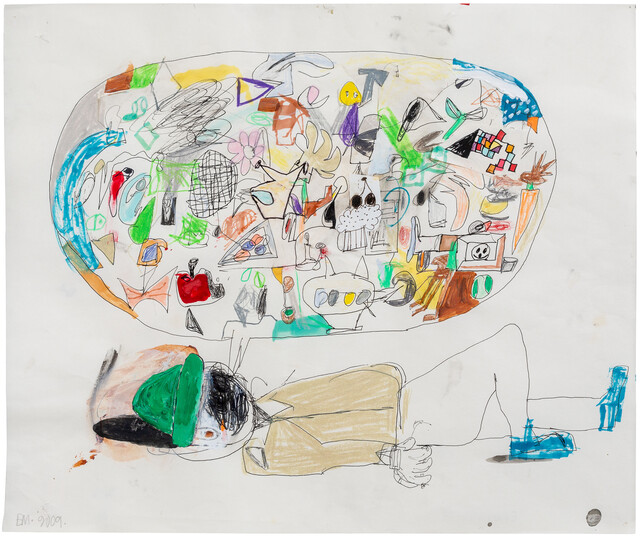
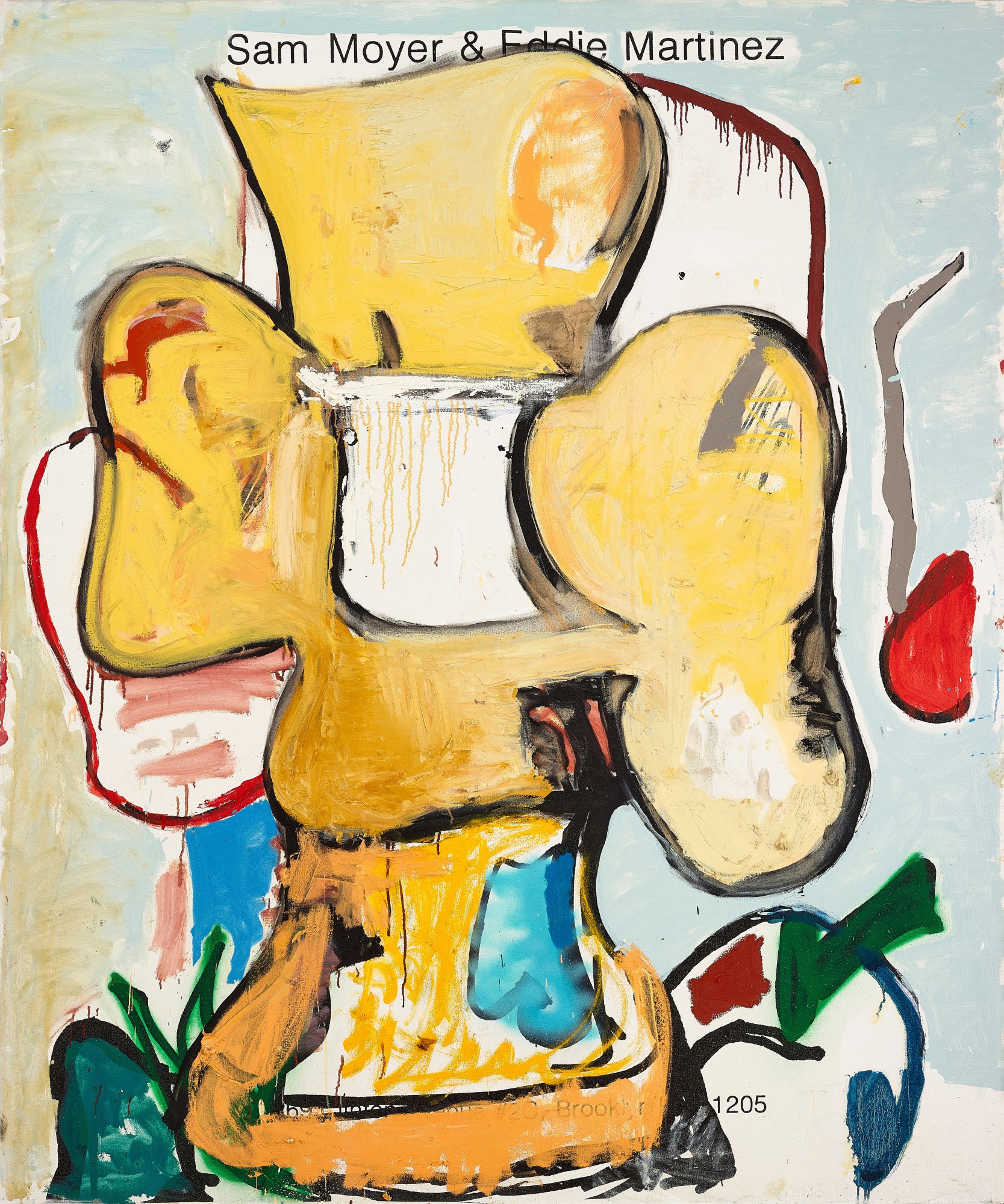
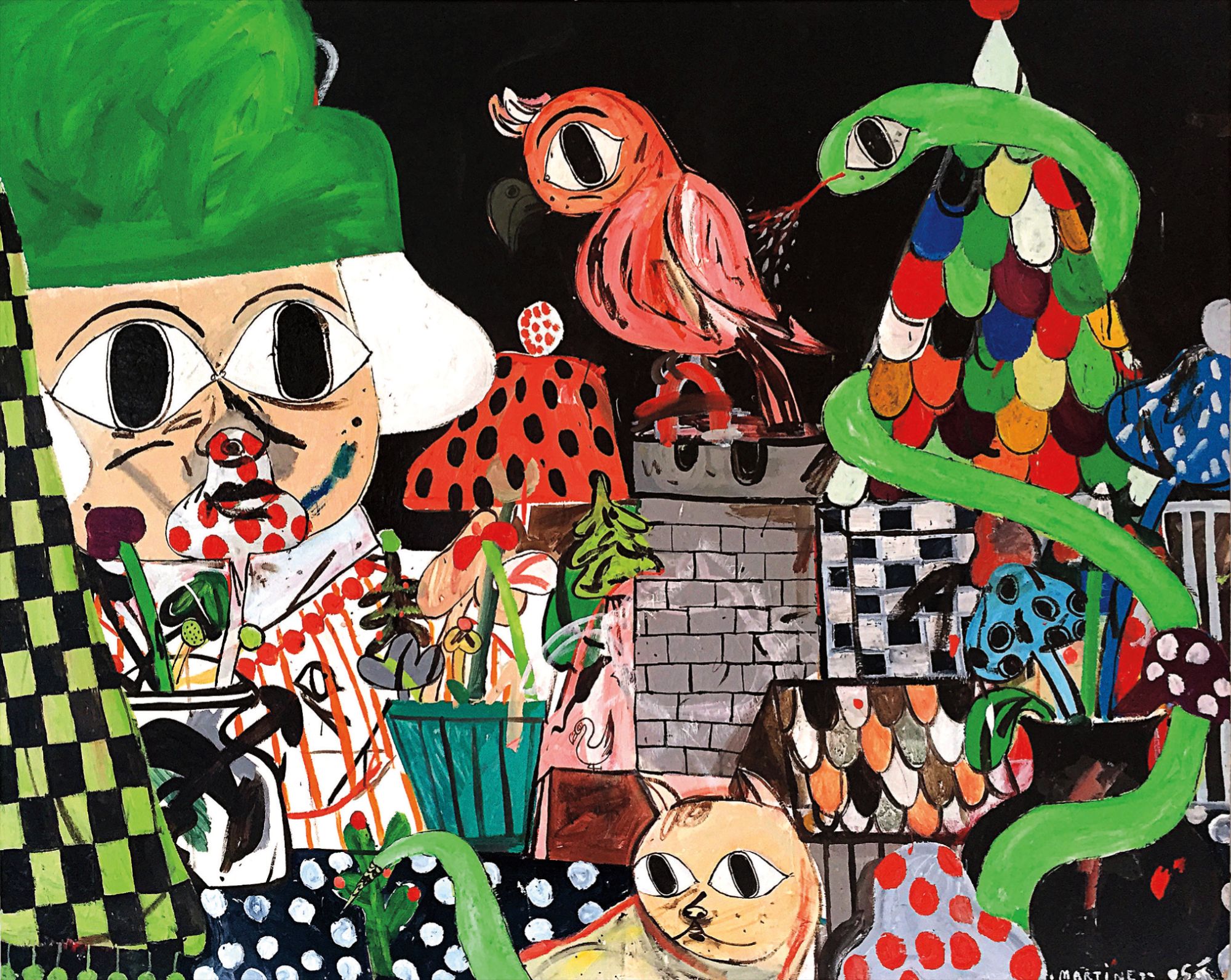
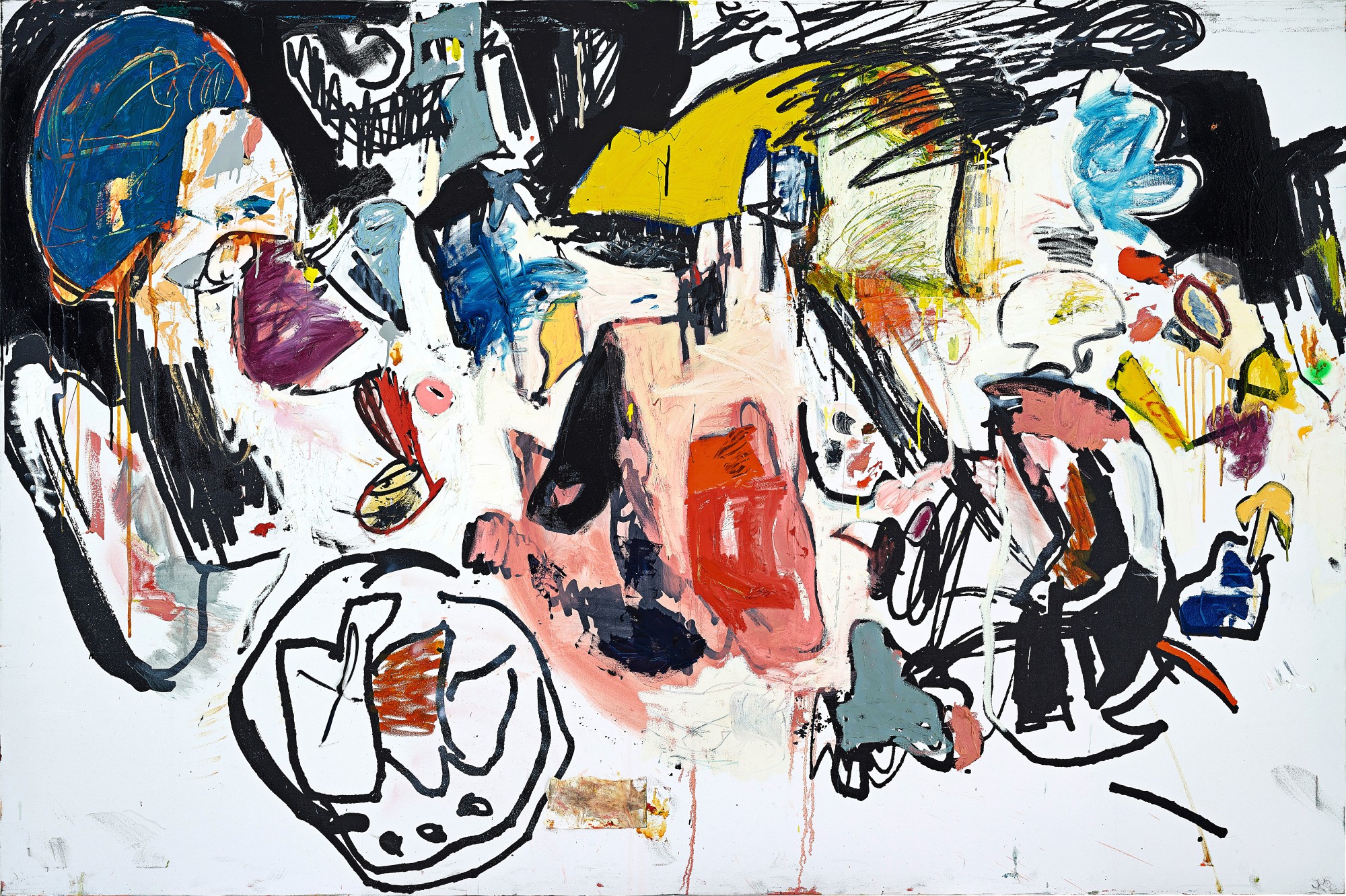
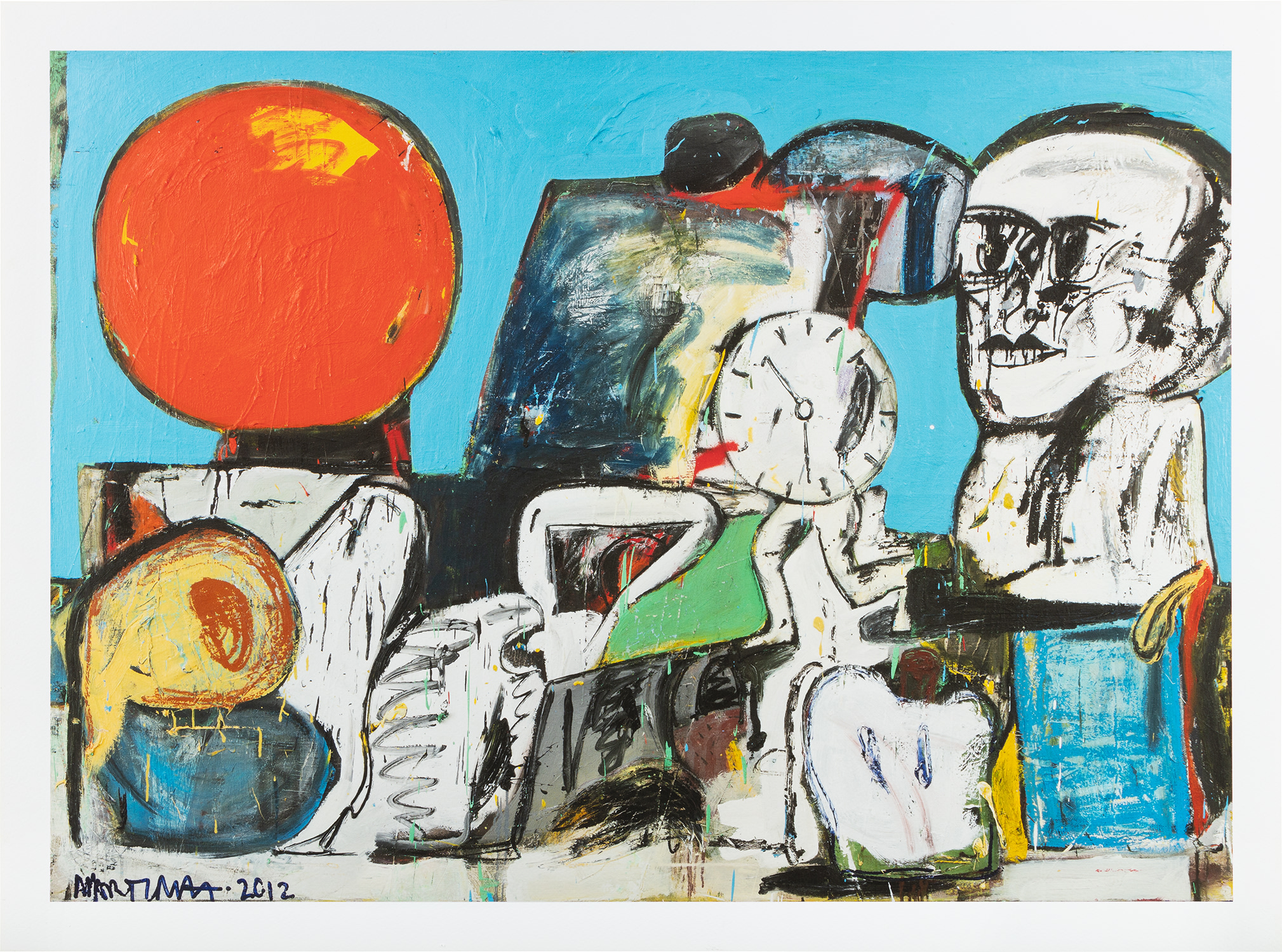
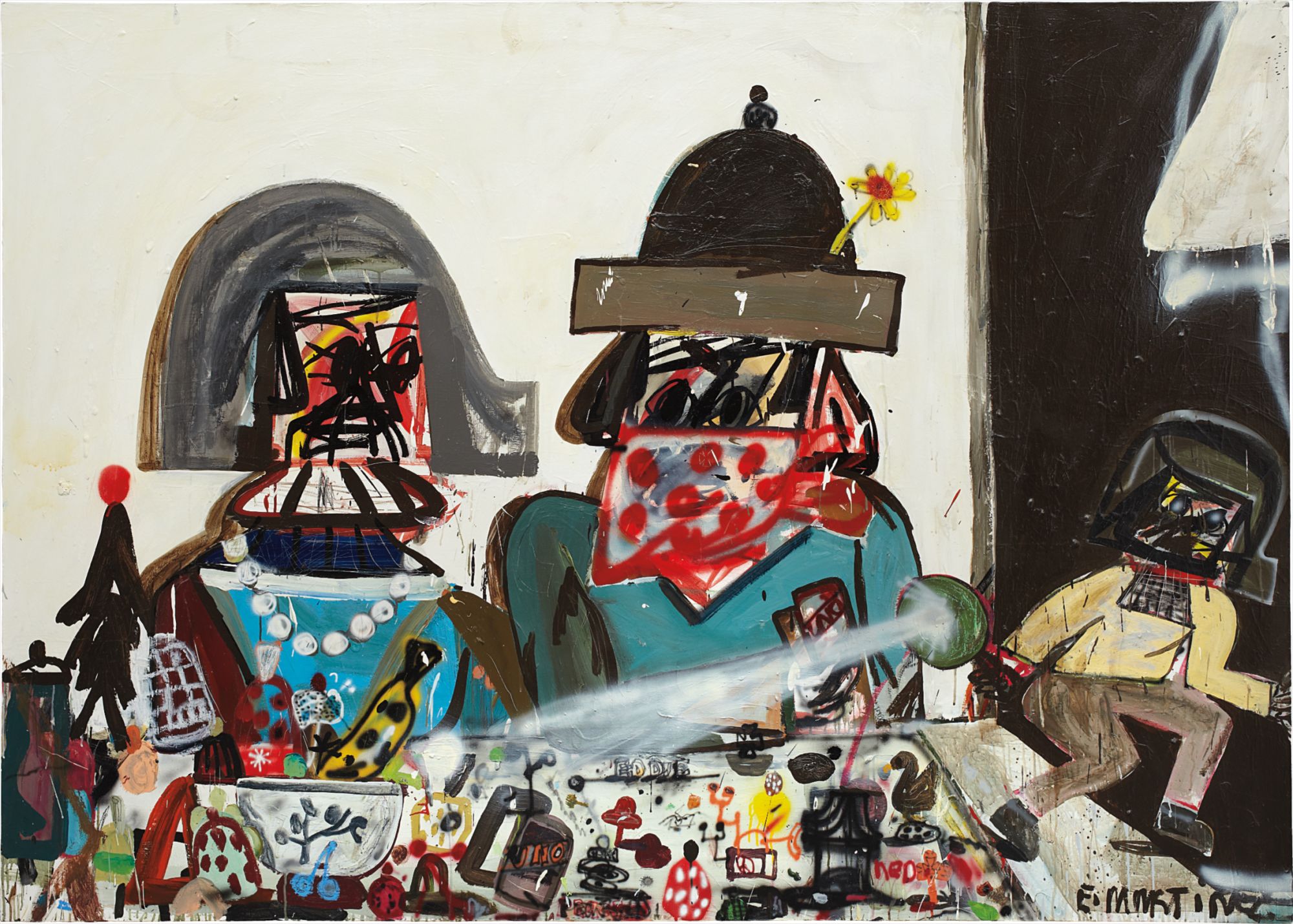
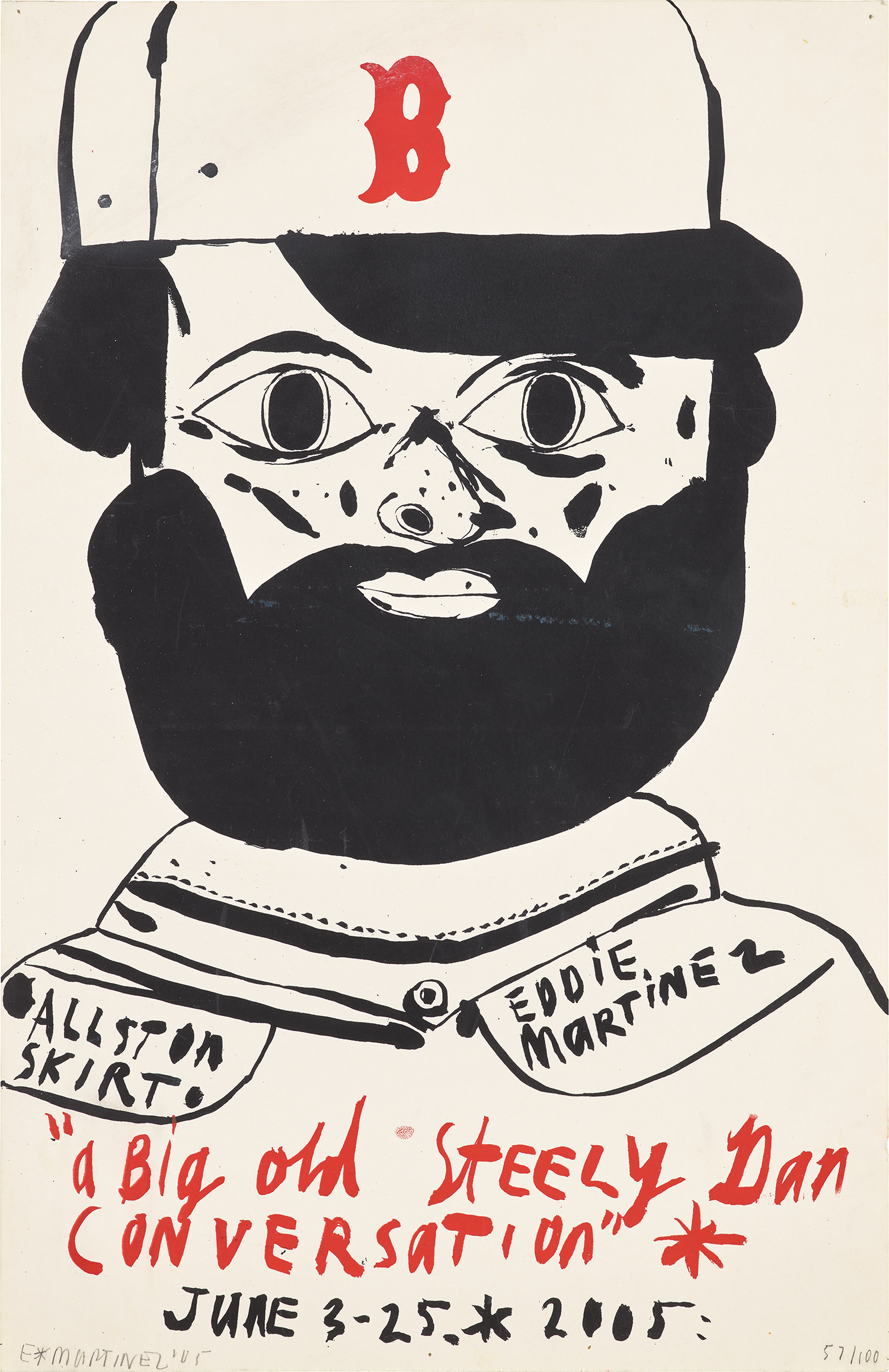
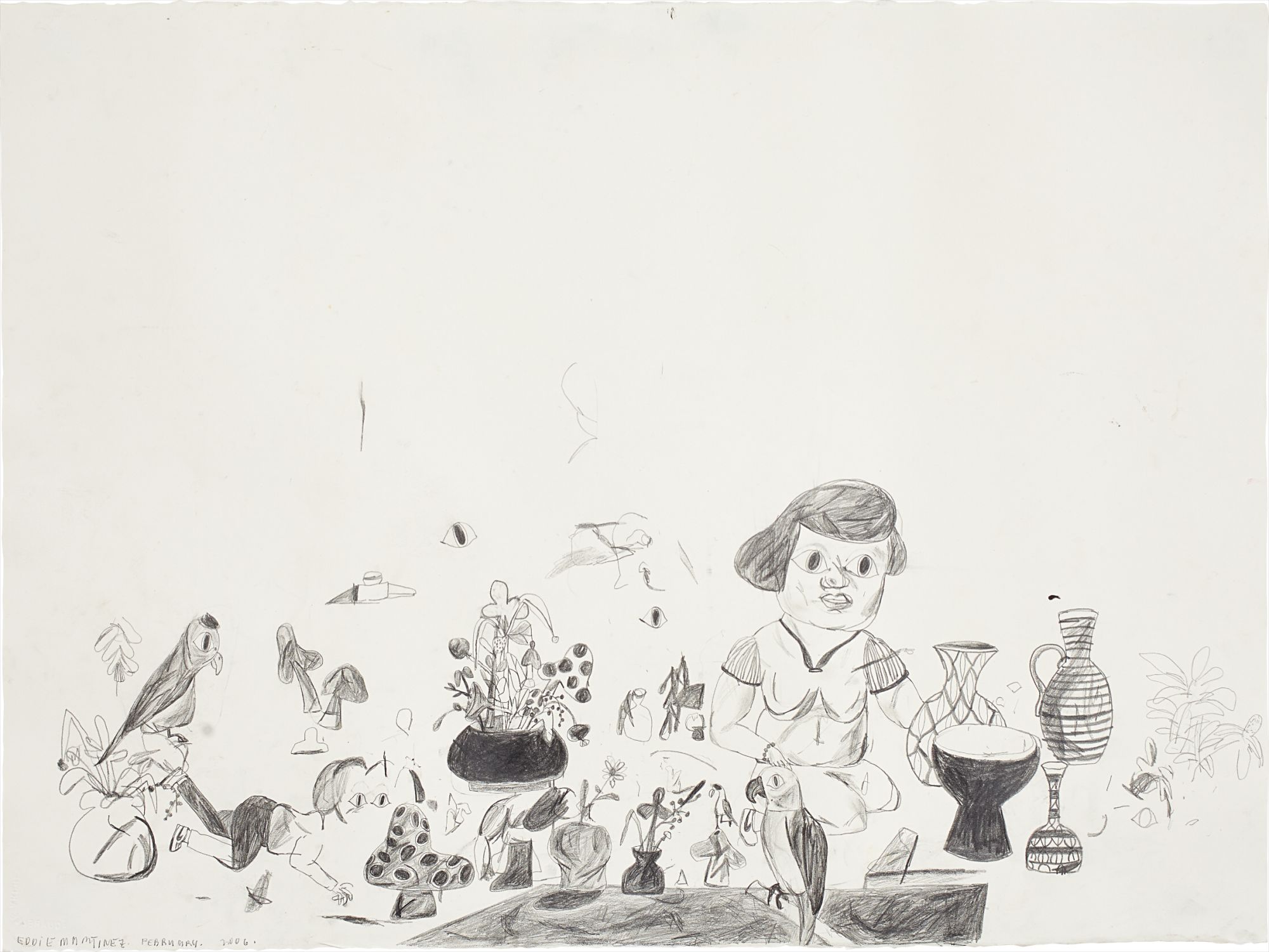
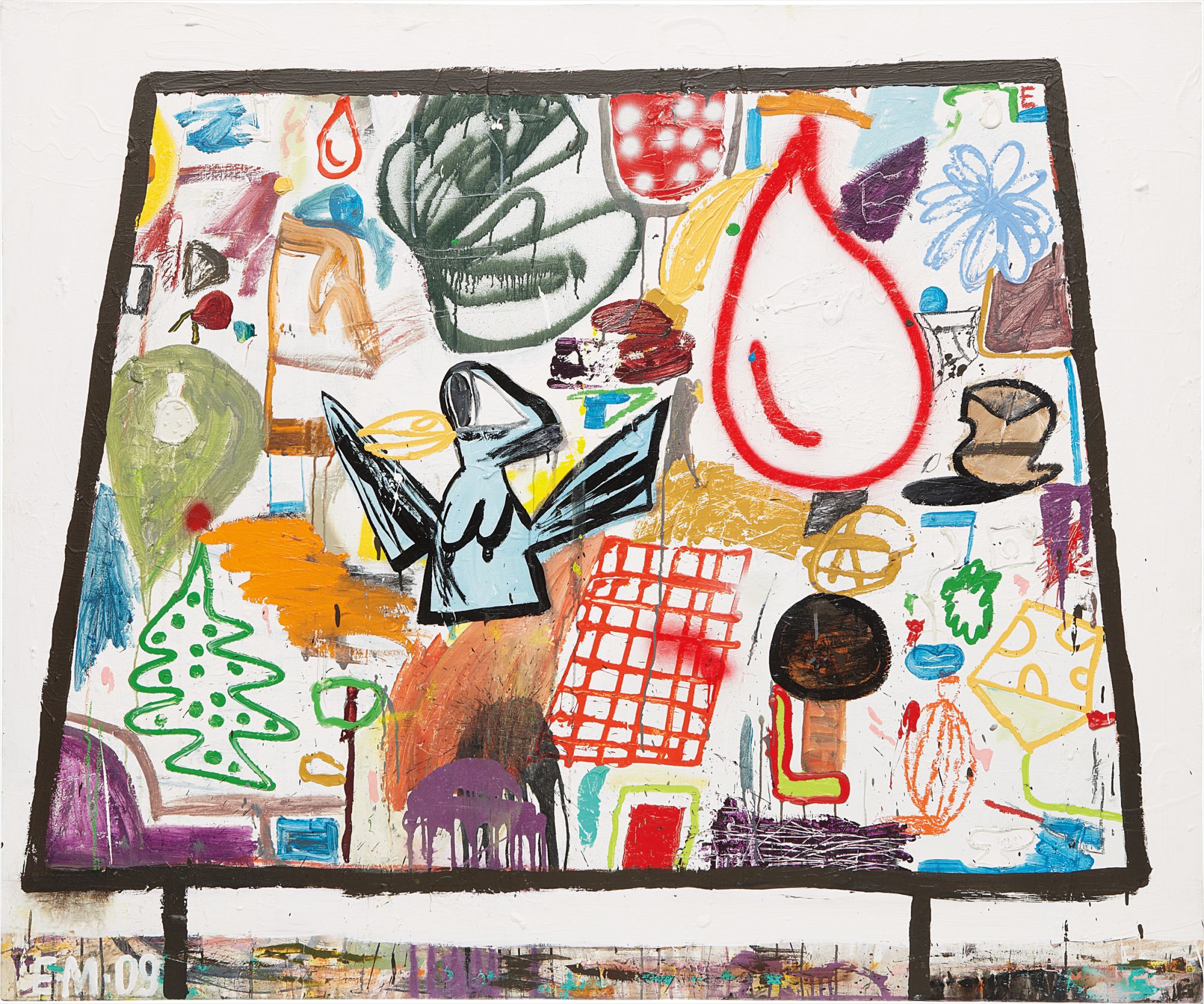
In the spring of 2023, the Museum of Contemporary Art Detroit mounted a significant survey of Eddie Martinez's work, bringing together paintings, works on paper, and sculpture that traced the arc of one of the most vital careers in contemporary American painting. The exhibition confirmed what collectors and curators had been saying quietly for years: Martinez is not merely a painter of tremendous energy, he is a genuinely original thinker whose canvases reward sustained looking in ways that few of his peers can match. To stand in front of his largest works is to feel the full force of a mind that refuses to slow down, a sensibility that finds meaning in accumulation, collision, and joy. Martinez was born in 1977 and grew up in Connecticut before eventually making his way to New York City, the place that would become both his home and his primary creative atmosphere. Like many painters of his generation who came of age in the 1990s, he absorbed the visual language of the street as naturally as he absorbed art history. Comic books, graffiti, skate culture, and the raw graphic energy of urban signage all entered his consciousness alongside the paintings of Philip Guston, Willem de Kooning, and the broader legacy of American Abstract Expressionism. This dual inheritance, the lowbrow and the exalted, became the engine of everything he would go on to make. His early career was marked by a restless hunger to test what painting could hold. Works from the mid 2000s, including the 2007 canvas "I Feel Alright" with its layers of acrylic, spray paint, and oilstick, already announced a painter who was unafraid of mess, who understood that real vitality often lives at the edge of control. Martinez studied at the Maine College of Art and later at the School of Visual Arts in New York, and his formal training gave him a structural intelligence that quietly underlies even his most chaotic surfaces. He knows exactly what he is doing when he appears to be doing everything at once. By the early 2010s, Martinez had developed a fully realized visual vocabulary that was unmistakably his own. His signature characters, bulbous cartoon figures with oversized eyes and expressive limbs, began to populate canvases alongside still life arrangements, abstract mark making, and collaged elements. Works like "Almost Lost No. 4" from 2012 demonstrate how deftly he navigates the space between representation and pure painterly sensation, allowing recognizable forms to dissolve and re emerge within dense, layered compositions. The mid decade years brought further expansion: pieces like "Christmas in July" from 2016 and "Mandala No. 7 (Frankenthaler Wash)" from the same year show Martinez in full command, pulling silkscreen ink, spray paint, thumbtacks, and collaged canvas into unified fields that feel simultaneously planned and discovered. His 2016 and 2017 output in particular, including "Wave Rider" from 2017, confirmed that his ambition was expanding in direct proportion to his technical confidence. What makes Martinez's works on paper equally compelling is the sense of immediacy and risk that he brings to smaller formats. "Untitled (Fine Ants and Study)" from 2018, executed in oil, marker, spray paint, oil crayon, ink, Sharpie, and colored pencil, reads like a condensed version of his entire philosophy: maximum material diversity in service of maximum expressive clarity. His "Trespasser's Williams" from 2015, rendered in ink and marker on paper, shows the same quality, a kind of fearless directness that makes works on paper feel as substantial as his largest canvases. Even his forays into sculpture, including cast bronze works from 2015 finished in enamel and oil paint, carry the same gestural fingerprints that define his paintings. The bronzes feel like three dimensional drawings, objects that still hum with the speed of his hand. For collectors, Martinez represents a compelling proposition both aesthetically and in terms of the broader market. His work has appeared consistently at major auction houses, with strong results reflecting sustained institutional and private demand. Galleries including Mitchell Innes and Nash in New York and Blum and Poe in Los Angeles have championed his work, and his international presence has grown steadily, with exhibitions across Europe and Asia deepening his collector base well beyond the American market. The range of his output, from major oil and mixed media canvases to intimate works on paper and sculpture, means that there are genuine points of entry at various levels of collecting. Works on paper and smaller format pieces offer an opportunity to live with his thinking in an accessible way, while his large canvases represent a more significant commitment and one that serious collectors have consistently been rewarded by. In terms of art historical context, Martinez sits within a compelling lineage while remaining stubbornly difficult to categorize. He shares a generational sensibility with painters like KAWS, Nate Lowman, and Dan Walsh, and his interest in the intersection of popular culture and fine art connects him to the broader post Pop tradition. Yet his commitment to pure painting, to the physical act of building and destroying and rebuilding a surface, aligns him more closely with predecessors like Guston, whose late figuration haunts Martinez's cartoon characters, or Joan Mitchell, whose fearless color and layering feel like genuine ancestors to his own practice. The work of Carroll Dunham and Peter Saul also offer useful reference points, though Martinez has absorbed these influences and metabolized them into something that could only have come from this particular person at this particular moment. What endures about Eddie Martinez is not simply the exuberance of his surfaces, though that exuberance is genuinely infectious. It is the intelligence behind the apparent chaos, the sense that every mark has been weighed and found necessary. His paintings make a generous argument for the continued vitality of the medium, for the idea that painting can still be the place where culture processes itself, where high and low and fast and slow and serious and playful all arrive at the same destination. For collectors who want to be in the presence of that argument every day, there is no more rewarding painter working in America right now.