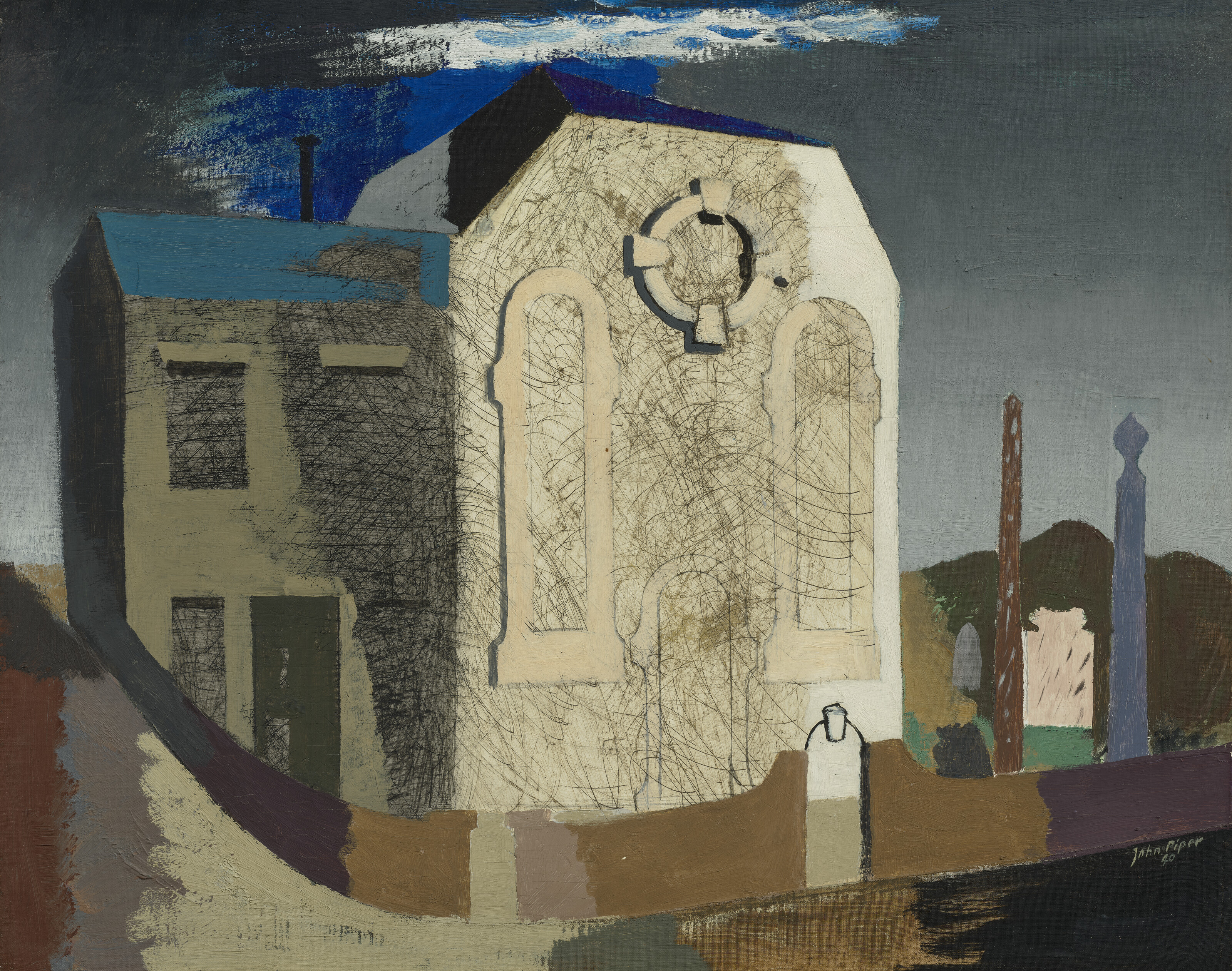
Gethsemane, Cardiganshire
John Piper's "Gethsemane, Cardiganshire" depicts a small Welsh chapel rendered in his characteristic angular, expressionistic style that combines topographical observation with emotional intensity. The work exemplifies Piper's interest in documenting Britain's vernacular religious architecture while using broken forms and dramatic color to convey the spiritual significance of the landscape. Created during the mid twentieth century, the painting reflects his broader artistic preoccupation with the relationship between place, faith, and the visual language of modernism.
- Signed
- Yes
- Spotted At
- Auction House · Christie's
Notes
LITERATURE S.J. Woods (intro.), John Piper: Paintings, Drawings & Theatre Designs 1932-1954, London, 1955, p. 154, no. 56, illustrated. EXHIBITED London, Leicester Galleries, Paintings and Water-colours by John Piper, March 1940, p. 5, no. 28. London, Marlborough Fine Art, John Piper: Retrospective Exhibition, March 1964, no. 38. London, Imperial War Museum, John Piper: The Forties, October 2000 - January 2001, pp. 66, 134, no. 15, illustrated: this exhibition travelled to Swansea, Glynn Vivian Art Gallery, March - May 2001. Conditions of sale Brought to you by Pippa Jacomb Director, Head of Day Sale PJACOMB@CHRISTIES.COM +44 (0) 20 7389 2293 LOT ESSAY During 1939-1940 John Piper’s personal style was evolving rapidly and it is from this period that some of his most distinctive and immediately recognisable paintings emerged, with the current lot being a significant and well-known example. The work displays a collage-style juxtaposition of forms, colours and textures, reminding us that during most of the 1930s Piper, influenced by the modern movement, was a leading British abstract painter. The painting, which is topographical as well as abstract, depicts a chapel in a hamlet called Tredrissi which is a few miles north of Nevern in the Pembrokeshire/Cardiganshire border area in Wales which John Piper and his wife Myfanwy visited during a tour in 1939. The building, now a dwelling, still exists along with the graveyard and its distinctive monuments. At this stage of his career, purchasers of paintings by John Piper, though few in number, were typically highly distinguished figures within the arts establishment. One of them was Sir Michael Sadler (1861-1943), an important and progressive collector of nineteenth and early twentieth century paintings and sculpture. He became known personally to John Piper in the late 1920s. The current lot was purchased directly from John Piper's 1940 show at the Leicester Galleries, not by Sir Michael himself, but by his son, the writer and publisher Michael Sadleir (1888-1957), who had adopted a different spelling of the family name so as to avoid being confused with his father. After his father's death in 1943 at least one other major painting by John Piper came into Sadleir's possession. We are very grateful to Revd Dr Stephen Laird FSA for preparing this catalogue entry.
🔨 Auction Lot
Modern British and Irish Art Day Sale
March 19, 2026
Estimate: $40,000 – $60,000
Sold: $50,800
Lot 104
Start the Discussion
Request access to join the discussion