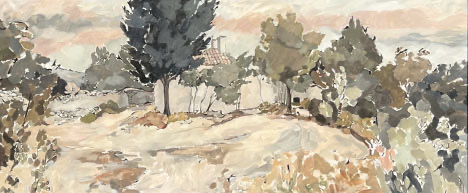
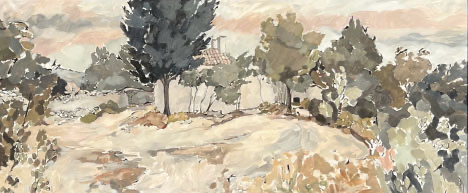
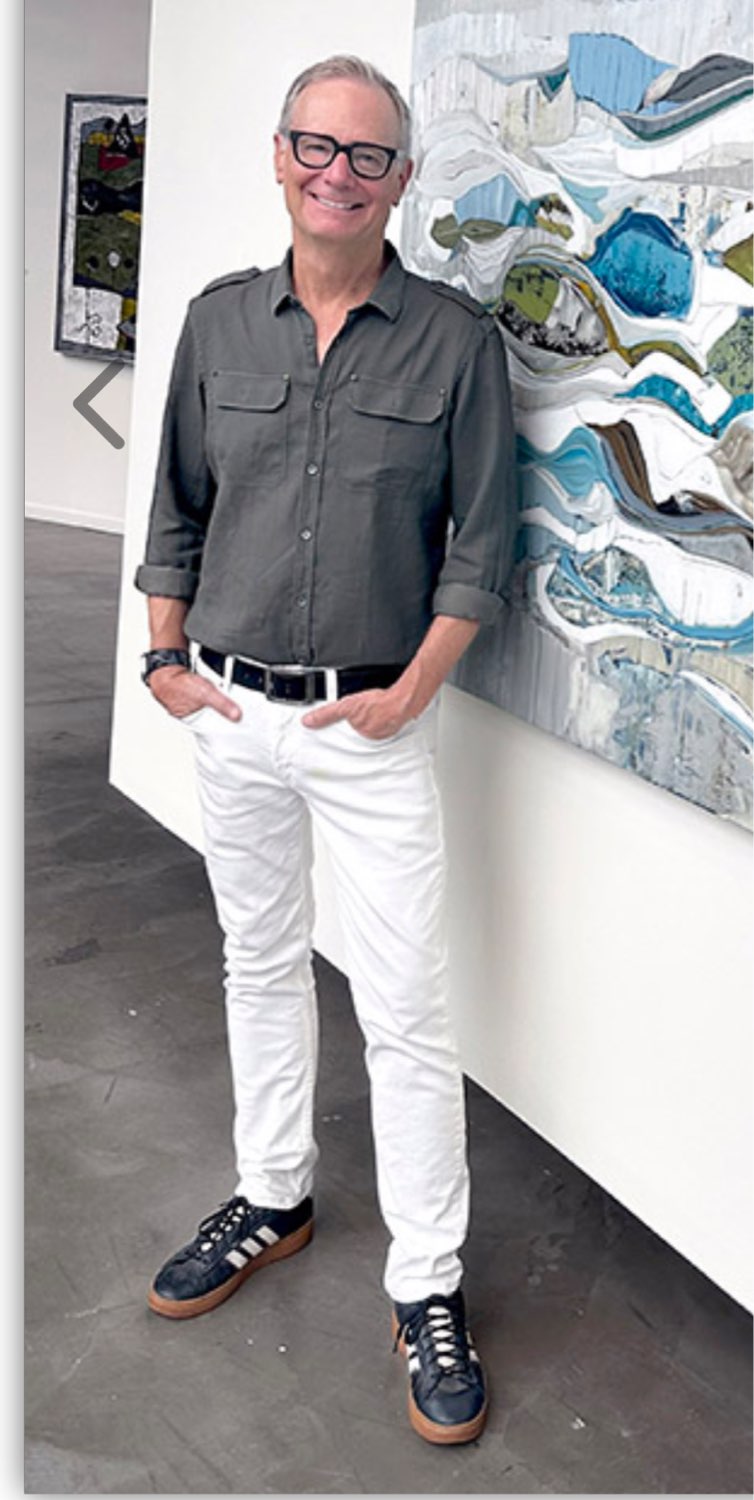
There is a particular kind of artist whose work does not announce itself loudly but instead draws you in slowly, the way good light fills a room at the end of an afternoon. Lucien Rees Roberts is that kind of artist. In recent seasons, collectors and design world insiders have turned their attention with fresh urgency toward his practice, recognizing in it something that feels at once timeless and deeply contemporary: a vision of the world shaped by an exceptional sensitivity to space, material, and the emotional weight of the domestic interior. His 2018 oil on canvas work Chapel stands as a meaningful marker of this recognition, a painting that distills his entire sensibility into a single, luminous object. Born in 1965, Rees Roberts grew up with the eye of someone always looking carefully at the world around him. His American formation gave him access to a broad visual culture, but it was his deepening engagement with photography, design, and the fine art tradition that truly shaped his sensibility. From early in his career he demonstrated an unusually fluid relationship between disciplines, moving between image making, creative direction, and visual art without any apparent seam. This fluidity is not accidental. It reflects a genuinely integrative mind, one that sees no meaningful boundary between a beautifully composed photograph, a thoughtfully appointed room, and a painting made with real conviction. His longtime creative and personal partnership with the celebrated American interior designer Michael S. Smith has been one of the defining professional relationships of his career. Smith, who counts among his clients some of the most distinguished private collectors and institutions in the United States, found in Rees Roberts a collaborator of rare perceptive depth. Together they have shaped interiors that read as total works of art, spaces where furniture, light, art, and object exist in a carefully considered conversation. This collaboration has given Rees Roberts an unusually intimate relationship with the way art actually lives in the world, hung on walls, placed in rooms, encountered in the context of daily life rather than the neutralized space of a white cube gallery. As a visual artist working in fine art photography and painting, Rees Roberts has developed a practice rooted in themes of domesticity, beauty, and the charged stillness of inhabited spaces. His photographs carry the compositional authority of paintings, framing the details of rooms, objects, and environments with the kind of selectivity that reveals a sophisticated understanding of art history. One senses in his image making the influence of artists who understood that the interior is never merely decorative but is instead a psychological and emotional landscape. His turn toward painting, evidenced by Chapel, suggests an artist willing to push his practice into new and demanding territory, trading the precision of the lens for the slower, more physical intelligence of oil on canvas. Chapel, completed in 2018, is a work of quiet power. The title alone signals Rees Roberts's interest in spaces that carry spiritual as well as aesthetic weight, places where the ordinary becomes elevated through attention and light. As an oil on canvas it demonstrates his command of tone and atmosphere, qualities he has cultivated through decades of photographic work and now brings to bear in a medium with its own demanding history. For collectors, it represents an entry point into a practice that is still unfolding and that carries genuine art historical ambition. Works like this one exist at the intersection of contemporary painting and the long tradition of architectural and interior subject matter, a lineage that connects to artists ranging from Vilhelm Hammershoi to Florine Stettheimer to the quieter corners of the American Luminists. From a collecting perspective, Rees Roberts presents a compelling proposition. He occupies a rare position in the contemporary art world: an artist with serious creative credentials in multiple disciplines, a deep connection to the highest levels of design culture, and a body of work that speaks to collectors who care about beauty, craft, and conceptual depth in equal measure. His work appeals to those who understand that the boundaries between fine art, photography, and design have always been more permeable than the market sometimes acknowledges. As his profile continues to grow and his painting practice deepens, early works in any medium are likely to be looked upon as prescient acquisitions. In the broader context of contemporary art, Rees Roberts sits alongside a generation of American artists who have brought rigorous aesthetic intelligence to bear on the spaces and objects of everyday life. His work invites comparison with photographers and painters who similarly collapse the distance between documentation and invention, between the found and the made. Artists working in the tradition of fine art photography and conceptual domesticity, those who find in the interior a site of both personal and cultural meaning, are natural points of reference. Yet Rees Roberts remains distinctly his own voice, shaped by a biography that has moved fluidly between the commercial and the fine art, always in pursuit of something more essential than either category alone can provide. What matters most about Lucien Rees Roberts, looking at his career from the vantage of the present moment, is the sustained quality of attention he brings to everything he touches. In a cultural landscape that frequently rewards noise and speed, his work insists on the value of looking carefully, of finding in a chapel or a corner of a room something worth preserving in paint or light. That insistence feels not only admirable but necessary. For collectors, for institutions, and for anyone who cares about where art is going, Rees Roberts is an artist whose full measure has perhaps not yet been taken. That, for those paying attention now, is precisely the point.