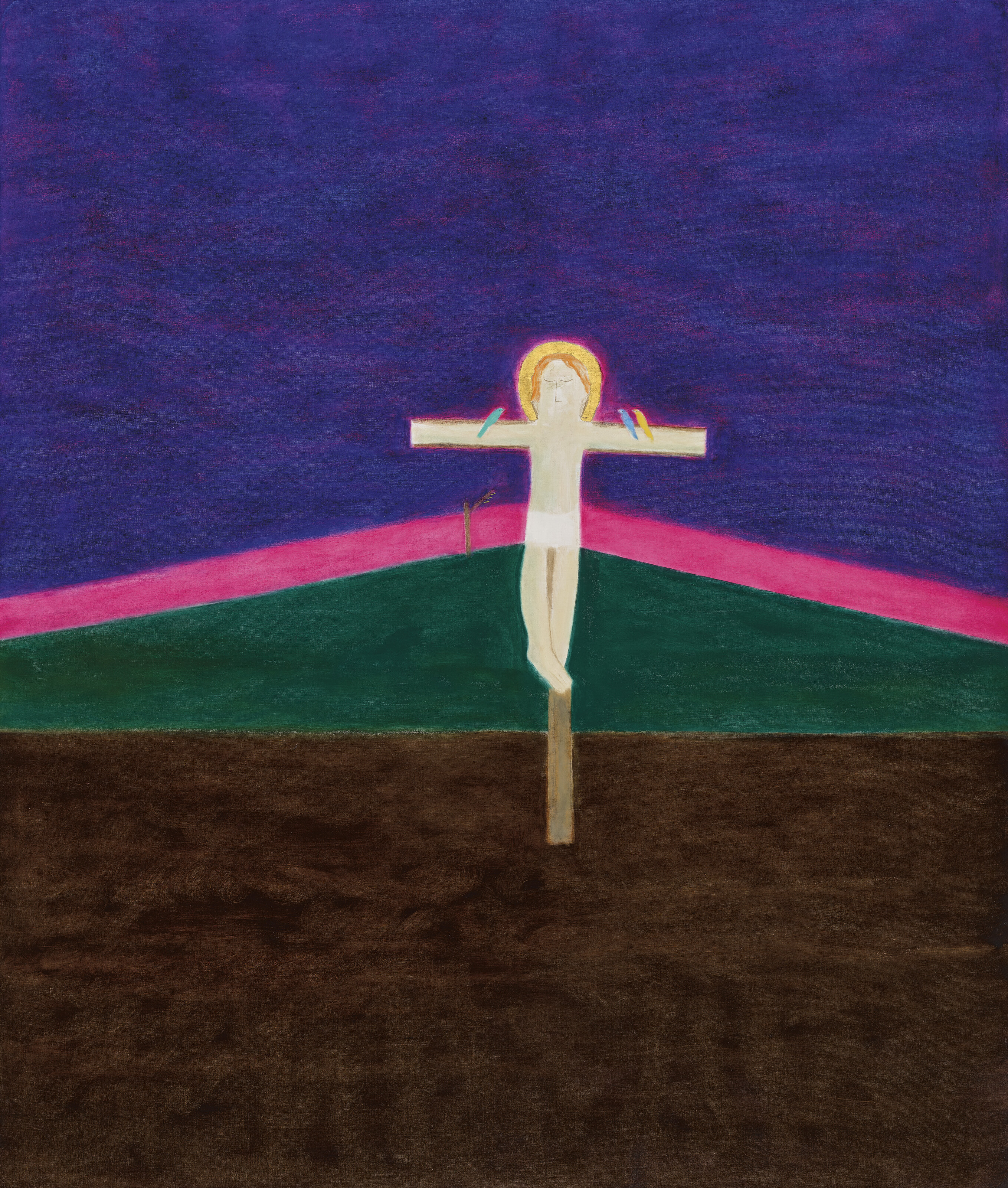
Crucifixion 8
Craigie Aitchison's "Crucifixion 8" exemplifies the Scottish painter's distinctive approach to religious imagery through simplified forms and a luminous color palette. The work distills the crucifixion narrative to its essential visual elements, employing flat planes of color and a modernist sensibility that distances it from traditional representational treatments. Aitchison's repeated series of crucifixion paintings demonstrate his lifelong engagement with spiritual themes while maintaining a contemporary aesthetic rooted in abstraction and emotional restraint.
- Spotted At
- Auction House · Christie's
Notes
LITERATURE A. Lambirth, 'Craigie Aitchison', The Artist's and illustrator's Magazine, December 1998, p. 15, illustrated. A. Gibbon Williams, The Art of Craigie Aitchison, Edinburgh, 1996, pp. 114-115, pl. 79. EXHIBITED London, Albemarle Gallery, Craigie Aitchison: Paintings, April - May 1987, no. 29. London, Piano Nobile, Craigie Aitchison and the Beaux Arts Generation, November 2019 - January 2020, no. 25. Salisbury, Salisbury Cathedral, Celebrating 800 Years of Spirit & Endeavour, April 2020 - April 2021, exhibition not numbered. Conditions of sale Brought to you by Pippa Jacomb Director, Head of Day Sale PJACOMB@CHRISTIES.COM +44 (0) 20 7389 2293 LOT ESSAY This large-scale painting of 1985-86 exemplifies Craigie Aitchison’s most celebrated subject. He first painted the crucifixion when he was a student at the Slade School of Art, and the subject reoccurs throughout his oeuvre. He recognised it as one of the most significant of human events, and one which leant itself to the theatricality of his compositions. An early influence on him was Salvador Dali’s painting Christ of St John of the Cross, which he saw at the Kelvingrove Art Gallery soon after their acquisition of the painting in 1952. The extraordinary image of Christ suspended over the bay at Port Lligat in Catalonia made a strong impression on the young artist: 'I remember going to see it and being absolutely amazed the way cross completely went into the canvas, like an illusion'. As in the present work, Aitchison's own crucifixion paintings are often set against the backdrop of a triangular hill, which he identified as Goat Fell on the Isle of Arran. As a child he frequented the village of Lamlash on Arran, which held a continuing significance for him as this was where his parents' ashes were scattered. Mary Sara describes the importance of this imagery, 'The triangular mass of Goat Fell ... is a leitmotif throughout Aitchison's entire oeuvre and a setting for Crucifixions and pure landscapes ... Even given its autobiographical role as a symbol of childhood happiness, adult aspiration and mourning for the past, ... it is there primarily because each painting in which it appears demands its presence as a form. This is not to deny its objective reality, but to confirm it as an indelible part of his personal, subjective vocabulary' (M. Sara, exhibition catalogue, Spirit of Lamlash: The Paintings of Craigie Aitchison 1954–1994, Leeds, Harewood Terrace Gallery, 1994, p. 7). The presence of Goat Fell is particularly dominant in Crucifixion 8, highlighted as it is by a vivid pink line that shimmers like Christ's halo. In April 1987, Crucifixion 8 was exhibited at Albemarle Gallery alongside eight other paintings of this subject. It was the largest of the group, and included Crucifixion 9, in the collection of Tate, London. READ MORE
🔨 Auction Lot
Modern British and Irish Art Day Sale
March 19, 2026
Estimate: $60,000 – $80,000
Sold: $69,850
Lot 144
Start the Discussion
Request access to join the discussion