Join The Collection to save, track, and explore works like this.

Cleveland Museum of Art

Spotted

Thomas Moran — Smelting Works at Denver
Thomas Moran

Smelting Works at Denver

1892

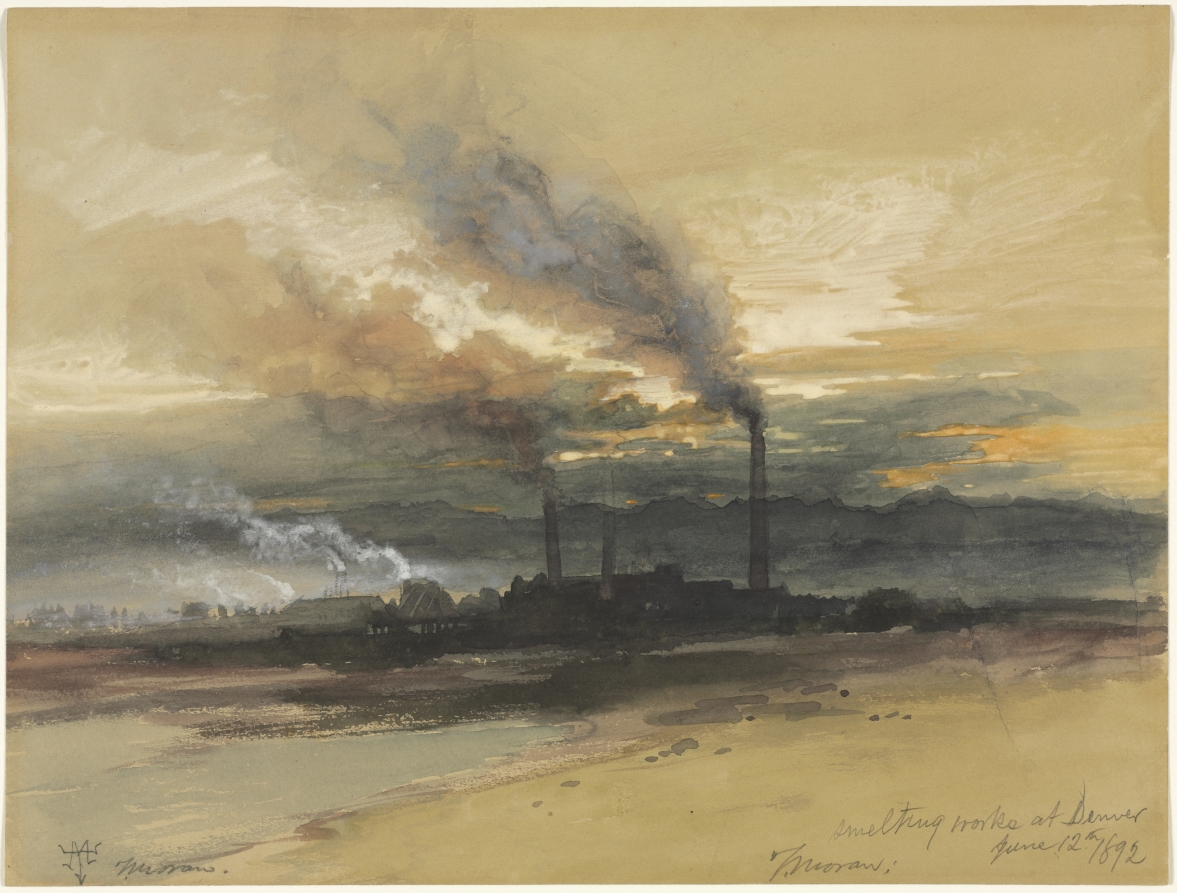
For today's viewers of Thomas Moran’s watercolor, the sight of factory smoke pouring into pristine mountain air might prophesy environmental ruin. Yet within the context of America’s western expansion, the imagery of factories was more ambiguous. Some in Moran's time regarded the factories as a force of destruction, while others interpreted them as symbols of progress. Moran himself viewed Denver’s budding industry with enthusiasm, writing positively to his wife about the city’s growth since he first visited while part of a government survey in 1873. Two decades later, when Moran returned to Denver to paint advertisements for the Santa Fe Railroad, smelting—the extraction of metal from heated rock—had transformed the city into an industrial hub. Although the brooding tone of this watercolor is unlike the artist’s bright, misty-eyed paintings of Edenic splendor, his depiction of the west’s emerging industrial landscape reinforces the same myth of manifest destiny—the belief that settler conquest of Native American lands was inevitable and justified—by illustrating the land’s richness in natural resources. Like the English Romantic painter J. M. W. Turner, whose style he emulated, Moran was primarily interested in the pictorial possibilities of industry. In this impressionistic study, Moran manipulates gray wash and white gouache to capture the vaporous quality of smoke and clouds as the two substances, industrial and natural, dissipate into the yellow atmosphere.

Medium
watercolor and gouache

Start the Discussion

Request access to join the discussion

About this work

Thomas Moran, Smelting Works at Denver, 1892

For today's viewers of Thomas Moran’s watercolor, the sight of factory smoke pouring into pristine mountain air might prophesy environmental ruin. Yet within the context of America’s western expansion, the imagery of factories was more ambiguous. Some in Moran's time regarded the factories as a force of destruction, while others interpreted them as symbols of progress. Moran himself viewed Denver’s budding industry with enthusiasm, writing positively to his wife about the city’s growth since he first visited while part of a government survey in 1873. Two decades later, when Moran returned to Denver to paint advertisements for the Santa Fe Railroad, smelting—the extraction of metal from heated rock—had transformed the city into an industrial hub. Although the brooding tone of this watercolor is unlike the artist’s bright, misty-eyed paintings of Edenic splendor, his depiction of the west’s emerging industrial landscape reinforces the same myth of manifest destiny—the belief that settler conquest of Native American lands was inevitable and justified—by illustrating the land’s richness in natural resources. Like the English Romantic painter J. M. W. Turner, whose style he emulated, Moran was primarily interested in the pictorial possibilities of industry. In this impressionistic study, Moran manipulates gray wash and white gouache to capture the vaporous quality of smoke and clouds as the two substances, industrial and natural, dissipate into the yellow atmosphere.

Medium
watercolor and gouache
Year
1892
Seen at
Cleveland Museum of Art, Cleveland, OH

Related themes

Watercolor, Works on Paper, Modern, Unique Work

More works by Thomas Moran

Collected by

Cleveland Museum of Art, Harvard Art Museums