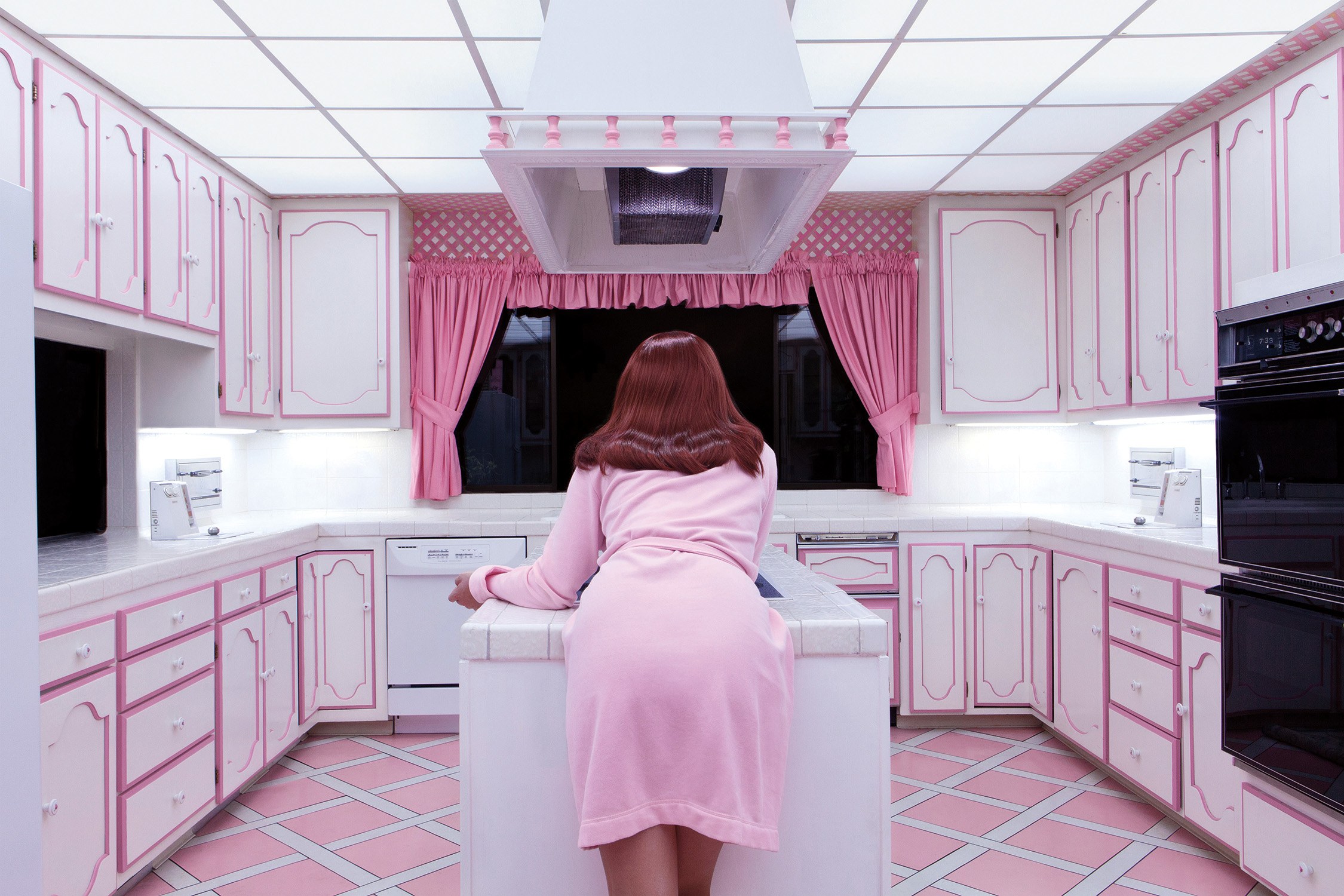
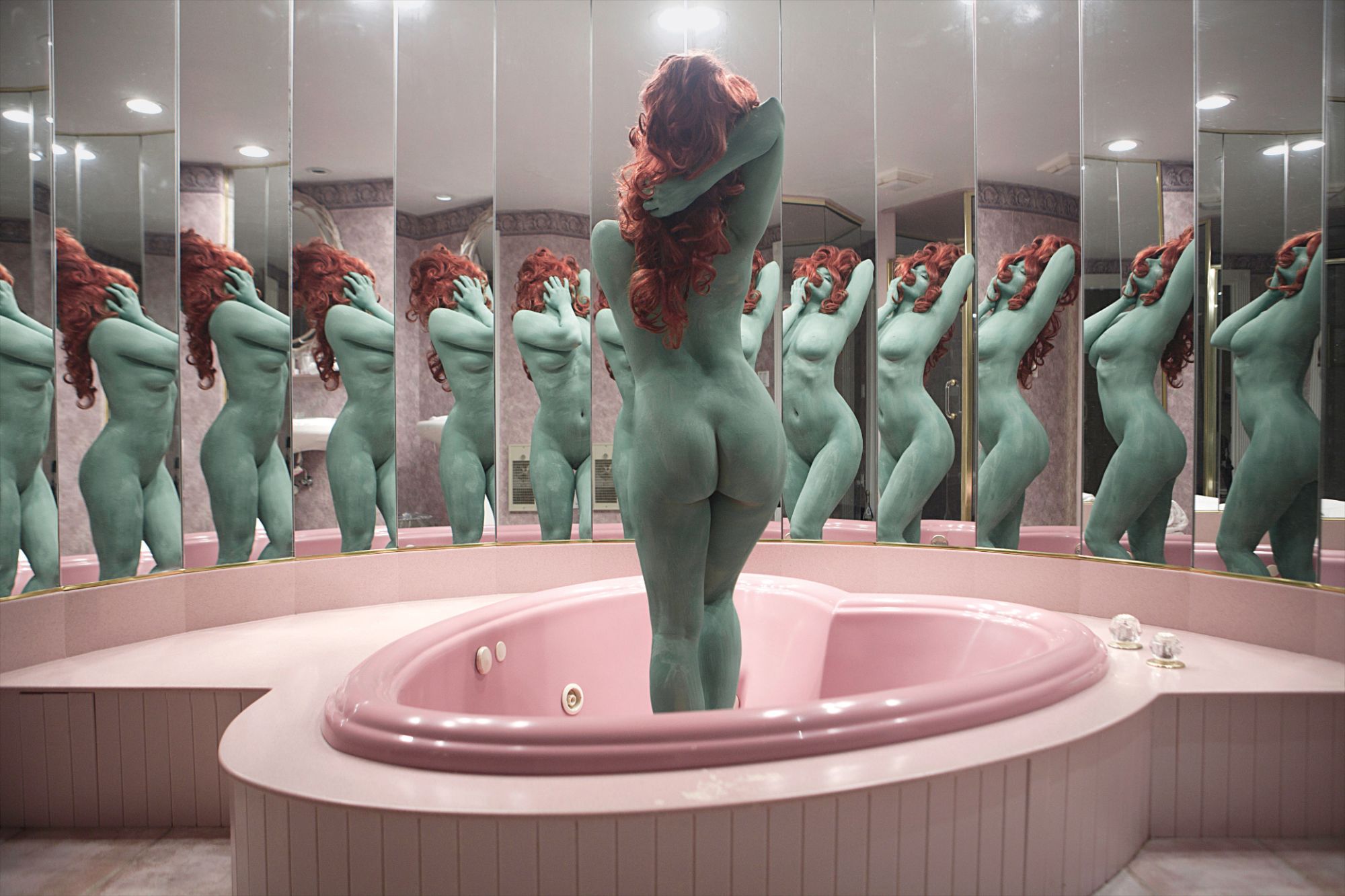
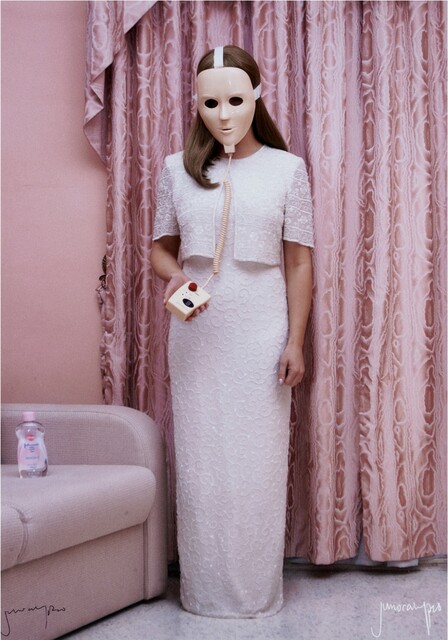
Few photographers working today command a room quite like Juno Calypso. Her large format, vividly saturated images stop viewers in their tracks, drawing them into spaces that feel at once achingly familiar and profoundly strange. In recent years her work has traveled through major institutions across Europe and North America, solidifying her reputation as one of the most compelling voices in contemporary photography. The art world has taken notice with considerable enthusiasm, and collectors who have followed her practice from its earliest iterations are watching with well earned satisfaction as the rest of the world catches up. Calypso was born in 1989 and grew up in the United Kingdom, developing a fascination with the performance of identity that would come to define her entire body of work. She studied photography at the London College of Communication, where she began experimenting with self portraiture as a mode of inquiry rather than autobiography. It was here that she first understood the camera not merely as a recording device but as a stage, a tool for constructing rather than simply capturing reality. That insight has never left her practice, and it distinguishes her approach from the more confessional traditions of self portraiture that preceded her. The fictional alter ego Joyce emerged during Calypso's graduate years and became the central vehicle through which she explores the architecture of femininity. Joyce is not Calypso in any straightforward sense. She is a figure assembled from the residue of popular culture, from the aesthetics of mid century domesticity, beauty advertising, and the aspirational fantasies sold to women through film and television. By inhabiting Joyce so completely that the seams become invisible, Calypso creates images that sit in genuinely uncomfortable territory. The viewer is seduced by the lush color, the cinematic staging, the almost absurdist glamour, and then quietly unsettled by the loneliness and artifice radiating from every frame. Her breakthrough series The Honeymoon Suite, made between 2012 and 2015, announced her as a photographer of real ambition and formal intelligence. For that body of work Calypso spent time alone in a honeymoon suite in Pennsylvania, photographing herself among the pink interiors, heart shaped bathtubs, and mirrored surfaces designed to frame romantic togetherness. The absence of a partner transformed these spaces into something melancholic and faintly absurd, interrogating the rituals of romance and the performative dimension of heterosexual couplehood. Works from this series, including the luminous A Dream in Green, have become touchstones of her practice and remain among the most sought after pieces for collectors entering her world. The flesh toned greens, the theatrical lighting, and the stillness Calypso brings to each image reward extended looking in a way that reproduction simply cannot replicate. If The Honeymoon Suite established the terms of her inquiry, the later series What To Do With A Million Years expanded its scope dramatically. For this project Calypso descended into a Cold War era underground bunker in Pennsylvania that had been converted into a private luxury shelter, a space designed to preserve a select few through civilizational catastrophe while providing every comfort of the domestic sphere above ground. The resulting images are among the most powerful of her career. Subterranean Kitchen is a remarkable example of her ability to locate the political within the domestic, the absurd within the sinister, and the deeply human within the constructed. The bunker setting allowed her to push the themes of consumer culture and femininity to their logical extreme, into a world where those structures persist even at the supposed end of everything. Calypso's photographs function beautifully as objects in their own right. Produced as archival pigment prints and often flush mounted, they carry a physical authority that rewards the kind of sustained attention that only comes with living alongside a work. Her palette is distinctive and immediately recognizable: saturated pinks, deep greens, warm golds, and the particular quality of light that recalls both the Hollywood golden age and the uncanny glow of a shopping mall at closing time. Collectors who have placed her works in domestic settings consistently report how differently the images read in the home compared with the gallery, how much the works expand in private company, how their humor and their unease deepen over time. Within the broader context of contemporary photography and feminist practice, Calypso occupies a genuinely distinctive position. Her work invites comparison with artists such as Cindy Sherman, whose character based self portraiture and interrogation of feminine archetypes clearly formed part of the cultural air that Calypso breathed as a student. One might also think of the staged theatrical sensibility of Gregory Crewdson, or the lush saturated color of Wolfgang Tillmans at his most considered. Yet Calypso synthesizes these influences into something unmistakably her own. Where Sherman tends toward the grotesque and the destabilizing, Calypso maintains an undercurrent of warmth and wit that makes her work genuinely pleasurable even at its most critical. From a collecting perspective, Calypso represents exactly the kind of opportunity that serious collectors recognize and value: an artist with a coherent and evolving body of work, a strong institutional exhibition history, and a critical reputation that has been built steadily and legitimately rather than through market speculation. Her prints are produced in limited editions, and the archival pigment process used ensures their longevity and stability. Those looking to build a considered collection around the themes of femininity, identity, and contemporary culture will find in Calypso's work a genuinely essential voice, one whose intelligence and formal sophistication place her work in conversation with the most important photography of the past half century. Juno Calypso matters today because she takes seriously a set of questions that the culture at large continues to struggle with: how femininity is constructed, consumed, and performed; how domestic spaces encode ideology; and how women navigate a world of images that were never really made for them. She asks these questions with elegance, wit, and extraordinary visual intelligence. To collect her work is to invest in one of the most searching and beautiful conversations happening in photography right now, and to be part of the story of an artist whose significance will only grow with time.