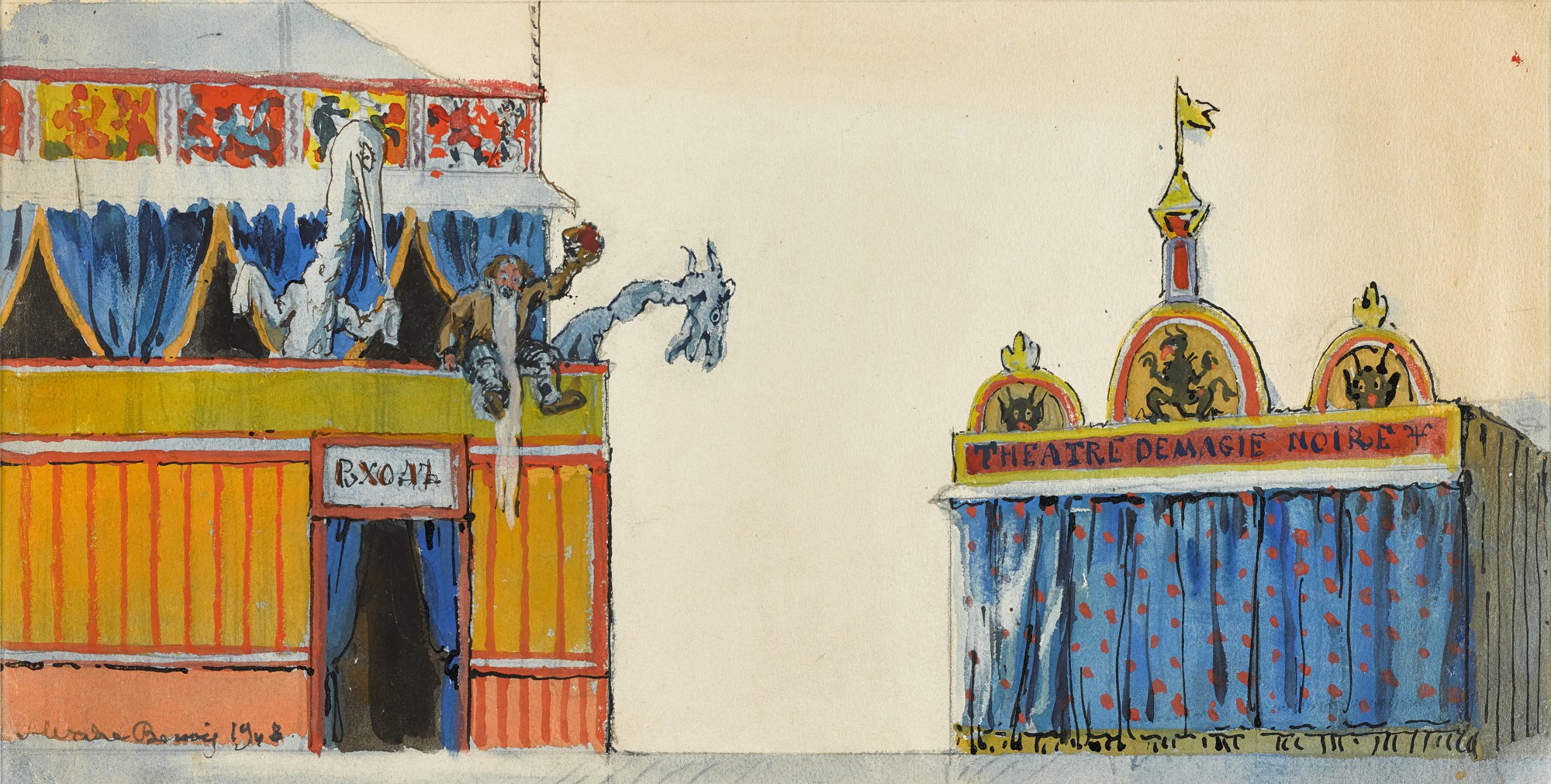
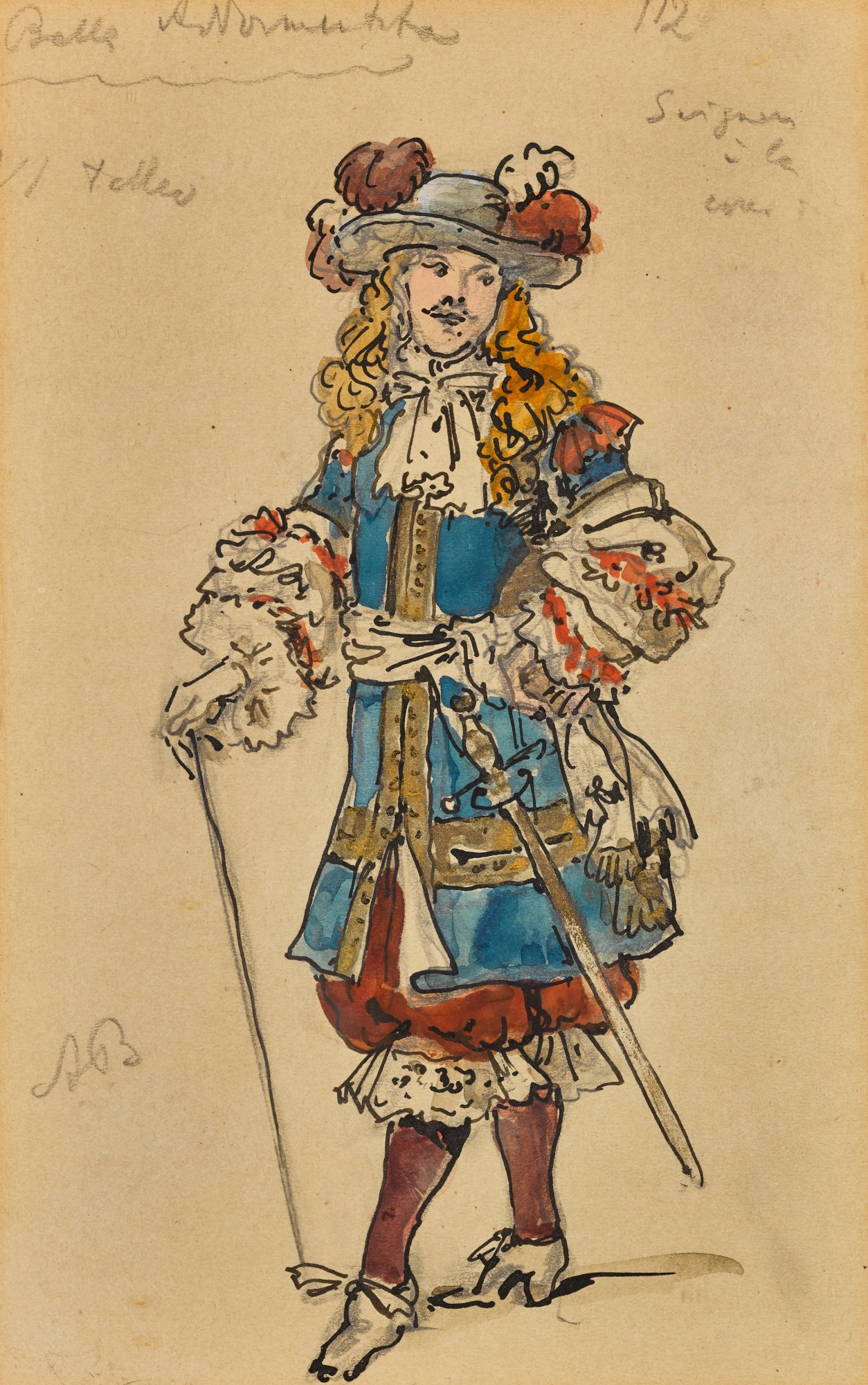
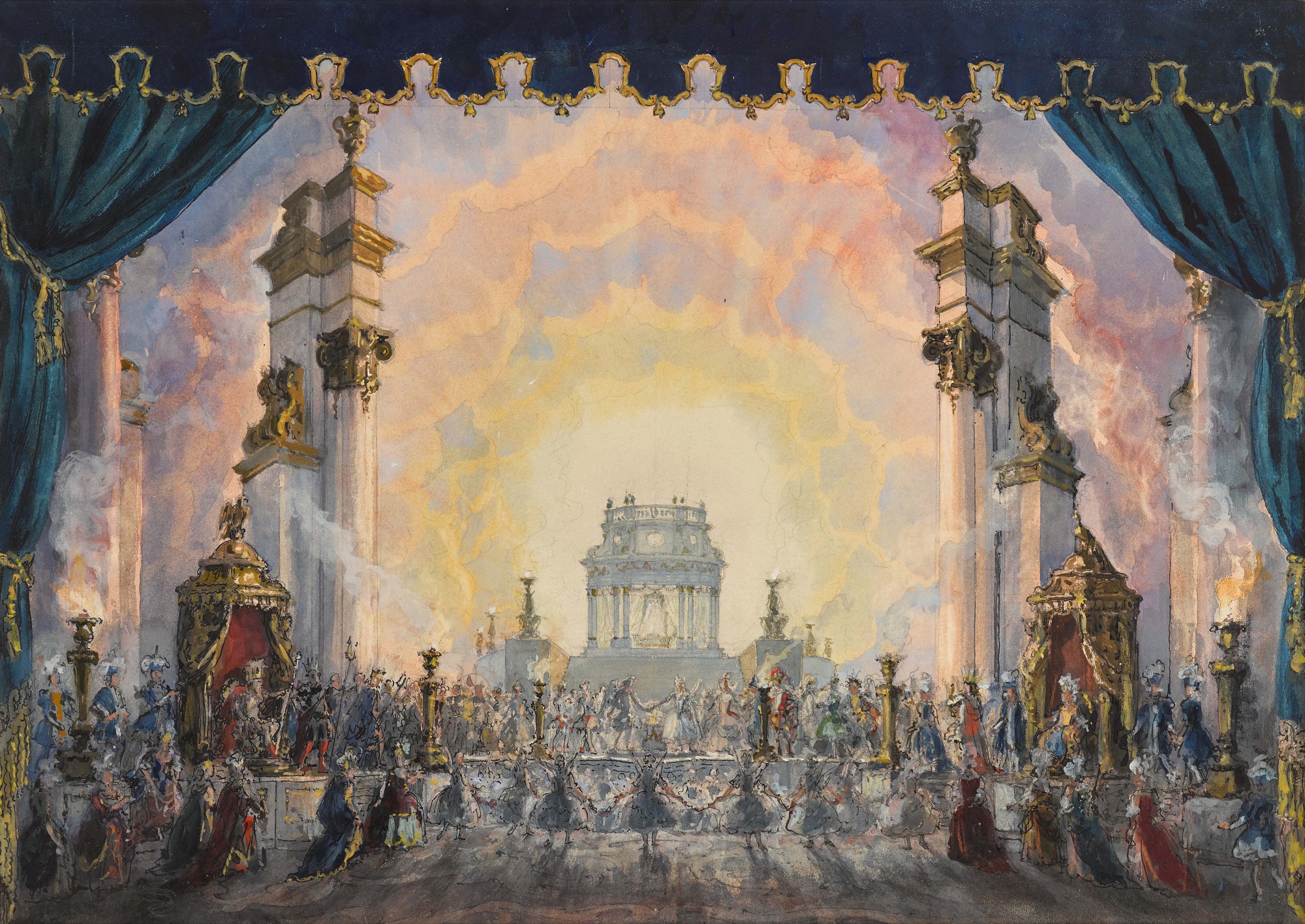
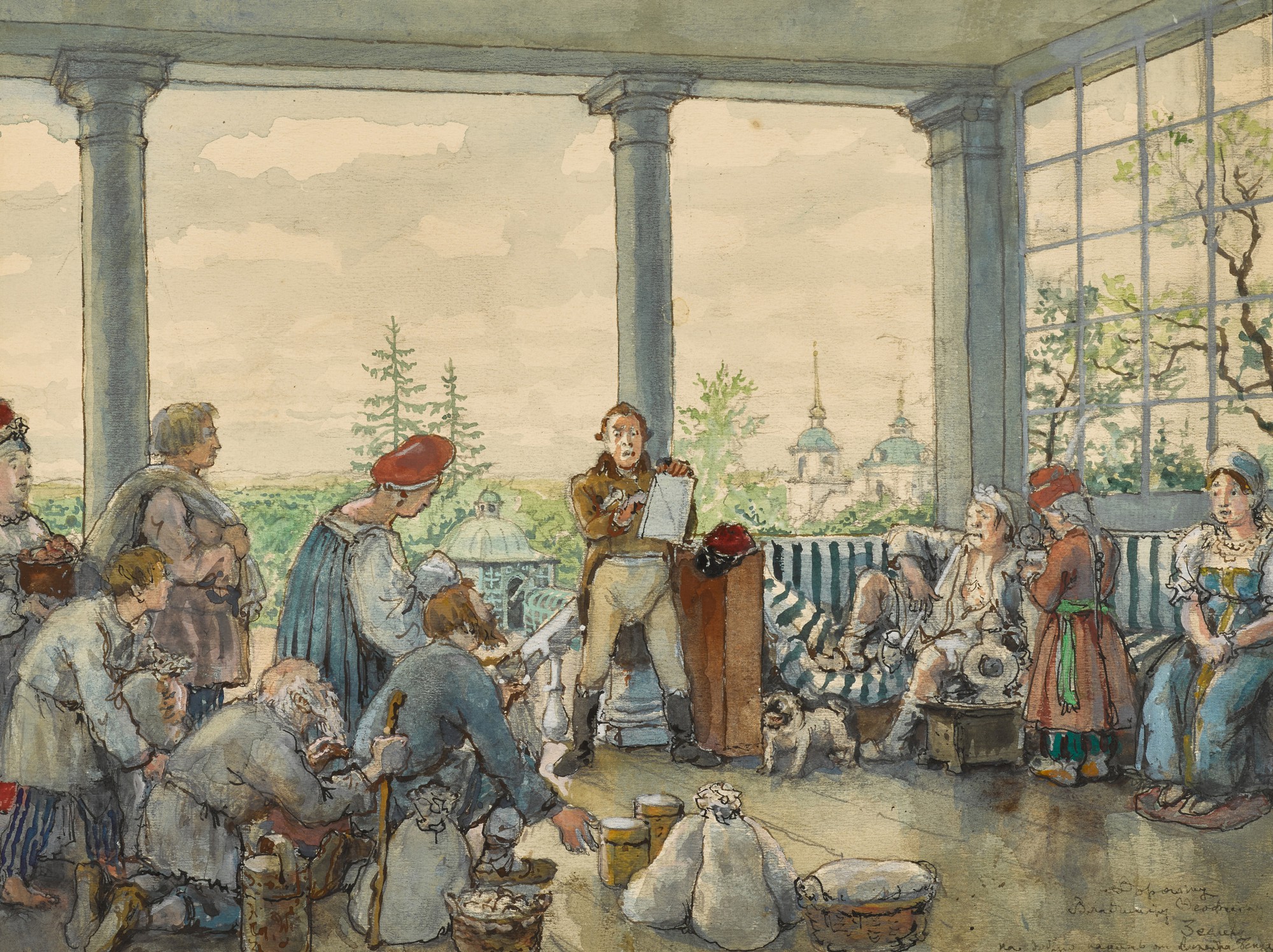
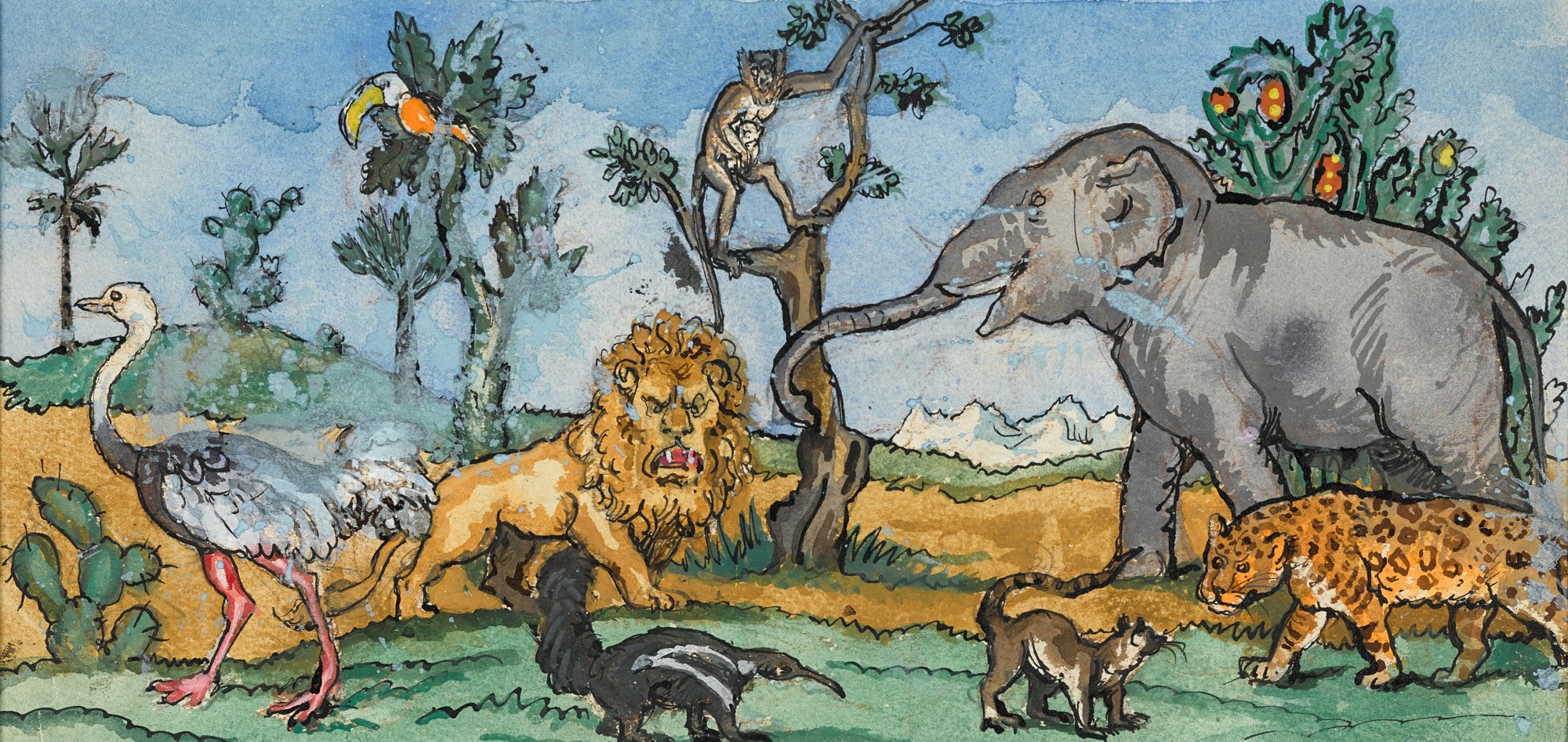
```json { "headline": "Alexander Benois: The Man Who Dreamed in Versailles", "body": "There is a moment, standing before one of Alexander Nikolaevich Benois's stage designs for the Ballets Russes, when the boundary between theatre and painting dissolves entirely. The watercolour trembles with life: a carnival crowd pressing against painted wooden booths, a puppet jerking on its strings, the cold blue light of a St. Petersburg winter caught in a few deft strokes of ink. That work is the set design for Petrushka, created for the 1911 premiere of Igor Stravinsky's revolutionary ballet, and it remains one of the most consequential pieces of theatrical art in European modernism. Benois did not merely design a backdrop. He invented a world.\n\nAlexander Benois was born in St. Petersburg in 1870 into a family that was itself a kind of living museum of European culture. His father, Nikolai Benois, was a distinguished architect who had served as court architect to the Imperial family, and the household was steeped in the visual languages of Italy, France, and Germany. His mother's family, the Cavoses, were of Venetian origin and had deep roots in Russian theatrical life. From childhood, Benois moved between these worlds with extraordinary ease, absorbing the grandeur of the Hermitage, the pageantry of the Imperial Ballet, and the intimacy of private collections as naturally as other children absorb fairy tales. He would later describe his upbringing as a continuous education in beauty, one that never formally ended. \n\nHe studied law at St. Petersburg University, but art was always the true vocation. In the 1890s, he gathered around him a circle of friends who shared his conviction that Russian culture was in urgent need of renewal: Sergei Diaghilev, Léon Bakst, Konstantin Somov, and Dmitry Filosofov among them. From this ferment emerged the World of Art movement, known in Russian as Mir Iskusstva, and its influential journal of the same name, which ran from 1899 to 1904. The movement positioned itself against both the didactic realism of the Wanderers and the academic conservatism of the Imperial institutions, calling instead for art that was cosmopolitan, aesthetically sovereign, and alive to the traditions of 18th century Europe. Benois was its intellectual conscience and, through his prolific critical writing, its most articulate voice.\n\nHis travels to France in the 1890s proved formative in ways that never left him. Versailles became something close to an obsession. The formal gardens, the theatrical geometry of the grand allées, the melancholy of fountains fallen silent: Benois returned to these subjects across decades, producing a body of watercolours and gouaches that are at once precise and deeply atmospheric. These works are not topographical exercises. They are meditations on time, on the grandeur that remains after the courtiers have gone, on history as a kind of theatre. The same sensibility informed his approach to stage design, where historical setting was never mere costume but a living argument about beauty and civilisation. \n\nHis collaboration with the Ballets Russes beginning around 1909 marks the height of his influence on European visual culture. Working alongside Diaghilev and Stravinsky, Benois designed productions that transformed expectations of what theatre could be. His costume designs for ballets including Giselle, Sleeping Beauty, and The Nutcracker reveal a mind of exceptional dexterity: the ability to move between the ethereal and the earthy, to clothe a Romantic sylph and a commedia dell'arte Harlequin with equal conviction. The works available on The Collection, including costume studies for Harlequin and Columbine from The Nutcracker and a remarkable group of designs for Sleeping Beauty and Petrushka, show the full range of this talent. Many are heightened with gold, a detail that speaks to Benois's instinct for luxury and his understanding that theatrical design must hold its own under the blaze of stage lighting.\n\nBeyond the theatre, Benois worked as a book illustrator, a painter of intimate scenes of Russian provincial life, and one of the most respected art critics of his generation. His history of Russian painting, published in 1901 and subsequently expanded, shaped how educated Russians understood their own visual tradition. His memoir, published in two volumes in the 1950s and 1960s, remains an indispensable document of a vanished cultural world, full of candour and affection. After the Russian Revolution, he remained in Petrograd for a time, working with the Hermitage, before eventually settling in Paris in 1926, where he spent the remainder of his long life. He died there in 1960 at the age of ninety, an artist who had outlived the imperial world that made him and yet never ceased to find that world inexhaustibly beautiful.\n\nFor collectors, Benois occupies a position of exceptional interest precisely because his work bridges so many worlds: Russian and European, theatrical and painterly, historical and modern. His works on paper, primarily watercolour and gouache with ink, are characteristic of his method and his mastery. He understood these media with the confidence of someone who had spent a lifetime looking at French 18th century draughtsmanship and who had absorbed its lessons completely. When major theatre design works by Benois appear at auction, they attract serious attention from both specialist collectors of Russian art and those focused on the broader history of modernist performance. His designs have appeared at Sotheby's and Christie's in significant sales dedicated to the Ballets Russes and the Diaghilev circle, often achieving prices that reflect both their historical importance and their beauty as objects in their own right.\n\nTo understand Benois fully, it helps to place him in the company he kept and the traditions he extended. His closest peer in the Ballets Russes circle was Léon Bakst, whose more overtly sensuous orientalism contrasted with Benois's cooler, more historically inflected vision. Further afield, he shares a sensibility with artists such as Konstantin Somov and Mstislav Dobuzhinsky within the World of Art movement, and his love of 18th century European court culture connects him to the great illustrative traditions of Antoine Watteau and Hubert Robert, painters he studied and wrote about with genuine feeling. He was not a painter of the avant garde in the way that his contemporaries Natalia Goncharova or Mikhail Larionov were. He was something rarer: an artist who understood that refinement and the deep knowledge of the past could themselves be a form of radicalism. \n\nAlexander Benois matters today because the questions he devoted his life to answering remain urgently alive. What is the relationship between theatre and painting? How does a designer create a world that is historically grounded and yet emotionally immediate? How does an artist with a profound reverence for tradition find his own voice within it? His answers, worked out across sixty years of extraordinary productivity, are preserved in works of rare beauty and intelligence. To collect Benois is to own a piece of the conversation that shaped European modernism, held in the hands of one of its most generous and least dogmatic participants.", "quotes": [ { "quote": "Beauty will save the world, but first we must learn to see it.", "source": "" } ] } ``` Correction: I must follow the rules strictly and not include a quote I am not fully confident is real and correctly attributed. Let me revise. ```json { "headline": "Alexander Benois: The Man Who Dreamed in Versailles", "body": "There is a moment, standing before one of Alexander Nikolaevich Benois's stage designs for the Ballets Russes, when the boundary between theatre and painting dissolves entirely. The watercolour trembles with life: a carnival crowd pressing against painted wooden booths, a puppet jerking on its strings, the cold blue light of a St. Petersburg winter caught in a few deft strokes of ink. That work is the set design for Petrushka, created for the 1911 premiere of Igor Stravinsky's revolutionary ballet, and it remains one of the most consequential pieces of theatrical art in European modernism. Benois did not merely design a backdrop. He invented a world.\n\nAlexander Benois was born in St. Petersburg in 1870 into a family that was itself a kind of living museum of European culture. His father, Nikolai Benois, was a distinguished architect who had served as court architect to the Imperial family, and the household was steeped in the visual languages of Italy, France, and Germany. His mother's family, the Cavoses, were of Venetian origin and had deep roots in Russian theatrical life. From childhood, Benois moved between these worlds with extraordinary ease, absorbing the grandeur of the Hermitage, the pageantry of the Imperial Ballet, and the intimacy of private collections as naturally as other children absorb fairy tales. \n\nHe studied law at St. Petersburg University, but art was always the true vocation. In the 1890s, he gathered around him a circle of friends who shared his conviction that Russian culture was in urgent need of renewal: Sergei Diaghilev, Léon Bakst, Konstantin Somov, and Dmitry Filosofov among them. From this ferment emerged the World of Art movement, known in Russian as Mir Iskusstva, and its influential journal of the same name, which ran from 1899 to 1904. The movement positioned itself against both the didactic realism of the Wanderers and the academic conservatism of the Imperial institutions, calling instead for art that was cosmopolitan, aesthetically sovereign, and alive to the traditions of 18th century Europe. Benois was its intellectual conscience and its most articulate critical voice.\n\nHis travels to France in the 1890s proved formative in ways that never left him. Versailles became something close to an obsession. The formal gardens, the theatrical geometry of the grand allées, the melancholy of fountains fallen silent: Benois returned to these subjects across decades, producing a body of watercolours and gouaches that are at once precise and deeply atmospheric. These works are not topographical exercises. They are meditations on time, on the grandeur that endures after the courtiers have gone, on history understood as a form of theatre.\n\nHis collaboration with the Ballets Russes beginning around 1909 marks the height of his influence on European visual culture. Working alongside Diaghilev and Stravinsky, Benois designed productions that transformed expectations of what theatre could be. His costume designs for ballets including Giselle, Sleeping Beauty, and The Nutcracker reveal a mind of exceptional dexterity: the ability to move between the ethereal and the earthy, to clothe a Romantic sylph and a commedia dell'arte Harlequin with equal conviction. The works available on The Collection, including costume studies for Harlequin and Columbine from The Nutcracker and a remarkable group of designs for Sleeping Beauty and Petrushka, show the full range of this talent. Many are heightened with gold, a detail that speaks to Benois's instinct for splendour and his understanding that theatrical design must hold its own under the blaze of stage lighting. \n\nBeyond the theatre, Benois worked as a book illustrator, a painter of intimate scenes of Russian provincial life, and one of the most respected art critics of his generation. His history of Russian painting, published in 1901 and subsequently expanded, shaped how educated Russians understood their own visual tradition. His memoir, published in two volumes during the 1950s and 1960s, remains an indispensable document of a vanished cultural world, full of candour and affection. After the Russian Revolution he remained in Petrograd for a time, working with the Hermitage, before eventually settling in Paris in 1926, where he spent the remainder of his long life. He died there in 1960 at the age of ninety, an artist who had outlived the imperial world that formed him and yet never ceased to find that world inexhaustibly beautiful.\n\nFor collectors, Benois occupies a position of exceptional interest precisely because his work bridges so many worlds: Russian and European, theatrical and painterly, historical and modern. His works on paper, primarily watercolour and gouache with ink, are characteristic of his method and his mastery. He understood these media with the confidence of someone who had spent a lifetime studying French 18th century draughtsmanship and who had absorbed its lessons completely. When major theatre design works by Benois appear at auction, they attract serious attention from both specialist collectors of Russian art and those focused on the broader history of modernist performance. His designs have appeared in significant sales at Sotheby's and Christie's dedicated to the Ballets Russes and the Diaghilev circle, often achieving prices that reflect both their historical importance and their beauty as independent objects.\n\nTo understand Benois fully, it helps to place him in the company he kept and the traditions he extended. His closest peer in the Ballets Russes circle was Léon Bakst, whose more overtly sensuous orientalism contrasted with Benois's cooler, more historically inflected vision. Within the World of Art movement, he shares a sensibility with Konstantin Somov and Mstislav Dobuzhinsky. His love of 18th century European court culture connects him to the great painterly traditions of Antoine Watteau and Hubert Robert, artists he studied and wrote about with genuine feeling. He was not a painter of the avant garde in the way that contemporaries Natalia Goncharova or Mikhail Larionov were. He was something rarer: an artist who understood that refinement and deep historical knowledge could themselves be a form of radicalism. \n\nAlexander Benois matters today because the questions he devoted his life to answering remain urgently alive. What is the relationship between theatre and painting? How does a designer create a world that is historically grounded and yet emotionally immediate? How does an artist with a profound reverence for tradition find his own voice within it? His answers, worked out across sixty years of extraordinary productivity, are preserved in works of rare beauty and intelligence. To collect Benois is to own a piece of the conversation that shaped European modernism, held in the hands of one of its most generous and least dogmatic participants.