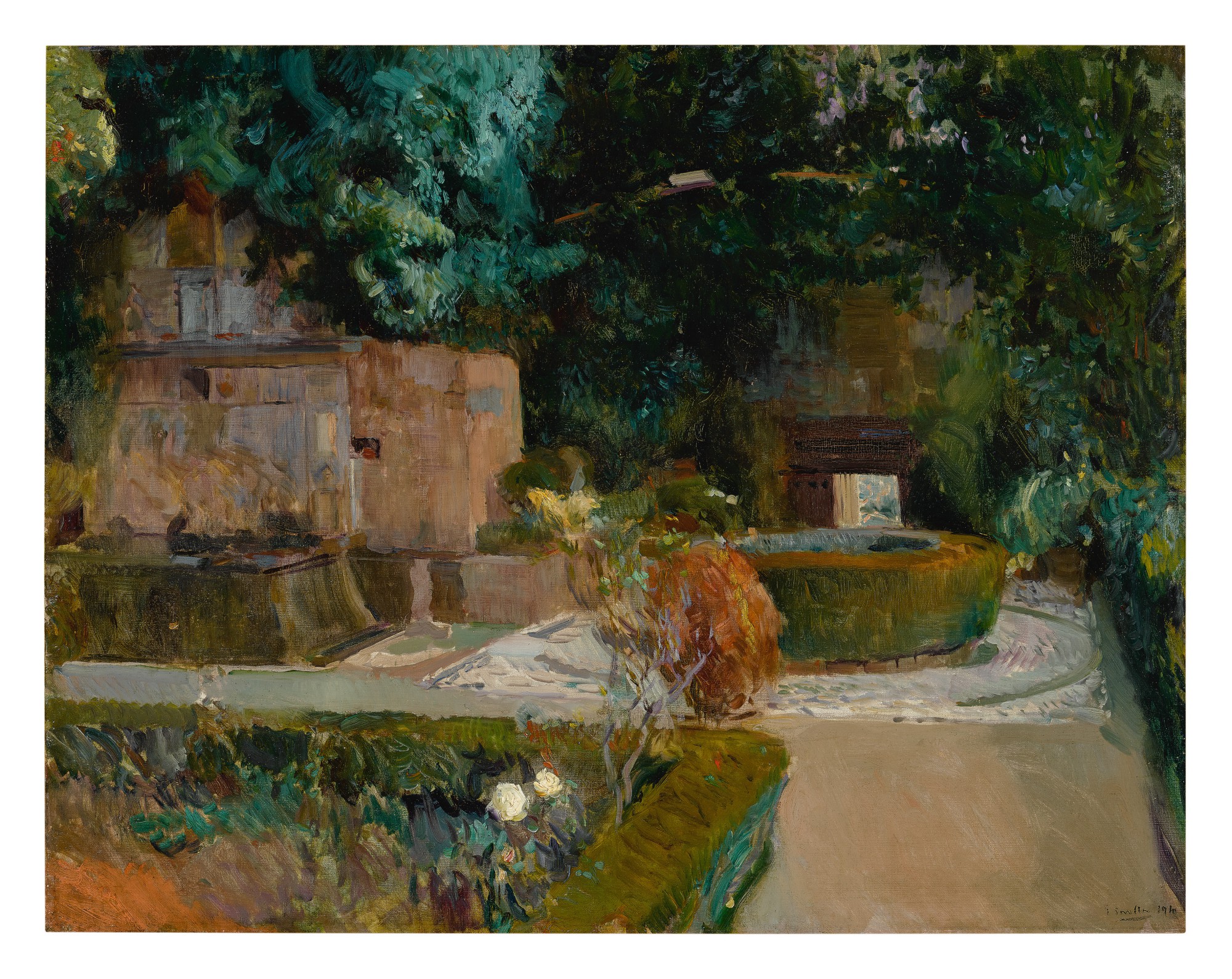
Stand before one of Joaquin Sorolla y Bastida's great beach canvases and something remarkable happens. The light does not merely suggest warmth; it insists upon it. Visitors to the Museo Sorolla in Madrid, the artist's former home and studio preserved much as he left it, consistently describe the same sensation: a feeling that the Mediterranean itself has entered the room. That institution, celebrating its centenary of public life in recent years, has helped fuel a sustained international reappraisal of Sorolla's achievement, with major loans traveling to institutions across Europe and North America and auction results at Christie's, Sotheby's, and Bonhams confirming that the market for his work has never been stronger or more attentive. Joaquin Sorolla y Bastida was born in Valencia in 1863, into a city that would shape everything about how he understood color and atmosphere. Orphaned at the age of two following his parents' deaths during a cholera outbreak, he was raised by his maternal aunt and uncle. His uncle, a locksmith, encouraged his early drawing, and by his teenage years Sorolla was enrolled at the Escuela de Bellas Artes de San Carlos in Valencia. The city's luminous Mediterranean light, its proximity to the sea, and its tradition of craft and color were absorbed early and would never fully leave his palette, no matter where his career took him. A scholarship from the Diputación Provincial de Valencia brought Sorolla to Rome in 1885, where he immersed himself in the Italian Old Masters and in the emerging currents of naturalism that were reshaping European painting. He spent time in Paris, where he encountered the work of Jules Bastien Lepage and absorbed the lesson that outdoor observation, painted with directness and honesty, could carry as much dignity as history painting. A period of ambitious studio works followed, including large canvases on social themes such as Triste herencia, painted in 1899, which depicted disabled children bathing at Valencia's shore under the supervision of a monk and which won a grand prize at the Paris Exposition Universelle of 1900. These early works show a painter of serious ambition, but they are not yet fully Sorolla in the sense we now cherish him. The breakthrough into his mature style came as Sorolla turned more completely toward the celebration of Mediterranean life as a subject worthy of sustained, joyful attention. Through the first decade of the twentieth century he refined what became his signature approach: broad, confident brushwork applied in thick, creamy strokes, a palette of whites so varied they seem to contain entire spectrums, and a command of reflected light on moving water that remains technically astonishing to painters who study it today. His beach scenes at Valencia, Javea, and Biarritz, often featuring his wife Clotilde and their three children, achieved a quality of sunlit immediacy that felt thrillingly modern. He was not painting nostalgia; he was painting the present moment in all its fleeting brilliance. Sorolla achieved international celebrity in his own lifetime on a scale that few painters of any era have matched. His exhibition at the Hispanic Society of America in New York in 1909 drew more than 160,000 visitors in the space of a few weeks, an extraordinary figure for the period, and made him a sensation in the United States. Archer Milton Huntington, the founder of the Hispanic Society, became a dedicated supporter and patron, and it was through this relationship that Sorolla undertook the most ambitious commission of his career: a vast cycle of fourteen monumental panels titled Visión de España, depicting the regions and peoples of Spain. Painted between 1911 and 1919, these panels now line the walls of the Hispanic Society's library in New York and represent one of the great mural achievements of twentieth century painting, a work of staggering physical and imaginative scale. Among the works that reveal the full range of Sorolla's sensibility, Jardín de los Adarves, Alhambra, Granada holds a particularly honored place. Painted during one of his visits to the southern city, the canvas demonstrates that Sorolla's gifts were never confined to the coast. Here the subject is the Alhambra's gardens, and Sorolla applies to the shade, the water channels, the flowering hedges, and the filtered Andalusian light the same vibrating attention he brought to waves and wet sand. The painting shows how completely his vision was about the experience of being in a particular place at a particular moment, about translating sensation into pigment with an authority that makes the viewer feel present. For collectors, Sorolla occupies a position that is both secure and still, in certain respects, undervalued relative to his true historical importance. His works appear regularly at the major auction houses, and prices for significant oils on canvas have reached into the millions of euros, with continued upward momentum in recent years as Spanish Impressionism and related movements attract growing international interest. Smaller works on panel, studies, and garden subjects offer points of entry at a range of price levels, and all carry the same unmistakable quality of observation. Collectors drawn to the Impressionist tradition but seeking something beyond the most familiar French names consistently find in Sorolla a painter of equivalent mastery with a distinct and irreplaceable vision. In the context of art history, Sorolla occupies a fascinating position that connects several traditions without being entirely captured by any one of them. He is often discussed alongside his contemporaries John Singer Sargent and Anders Zorn, painters who shared his facility with light and his commitment to brilliant, rapid execution, and who also achieved international reputations that crossed national boundaries. Like Sargent, Sorolla was a virtuoso portraitist as well as a painter of outdoor scenes. Like Zorn, he brought a Northern European seriousness of purpose to subjects that might otherwise have remained merely decorative. Yet Sorolla remains distinctly Spanish, rooted in the specific quality of Valencian and Andalusian light in a way that no artist from another country could fully replicate. Sorolla died in 1923, following a stroke he suffered while painting in his Madrid garden two years earlier. His wife Clotilde, understanding the significance of what he had built and the home they had shared, donated the house, the studio, and the works within it to the Spanish state, ensuring that the Museo Sorolla would preserve his legacy. A century after his death, that legacy is not only intact but actively growing. New scholarship, new exhibitions, and new collectors are discovering what those 160,000 New Yorkers understood in 1909: that in front of a great Sorolla, the world becomes warmer, brighter, and more fully alive.