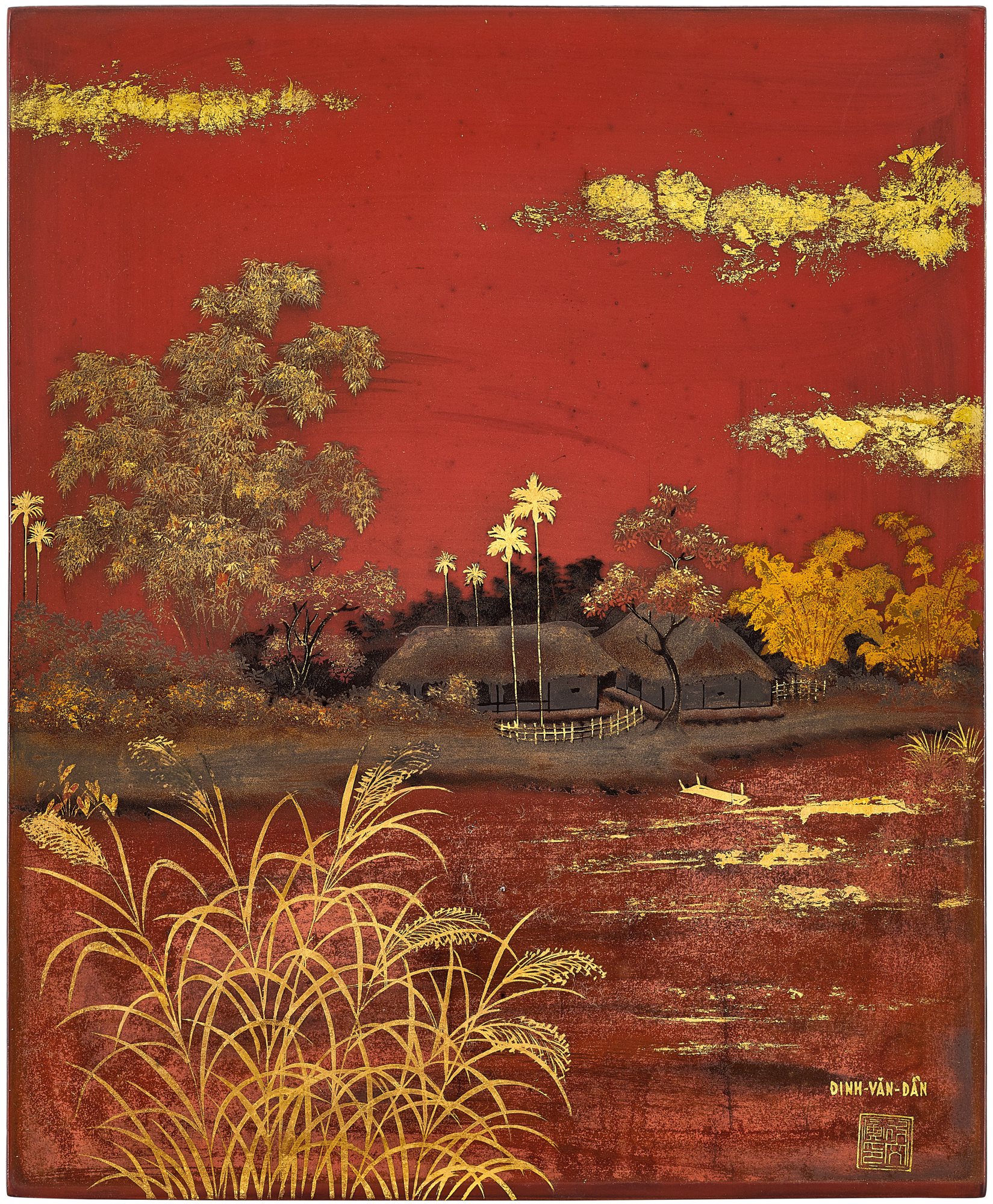
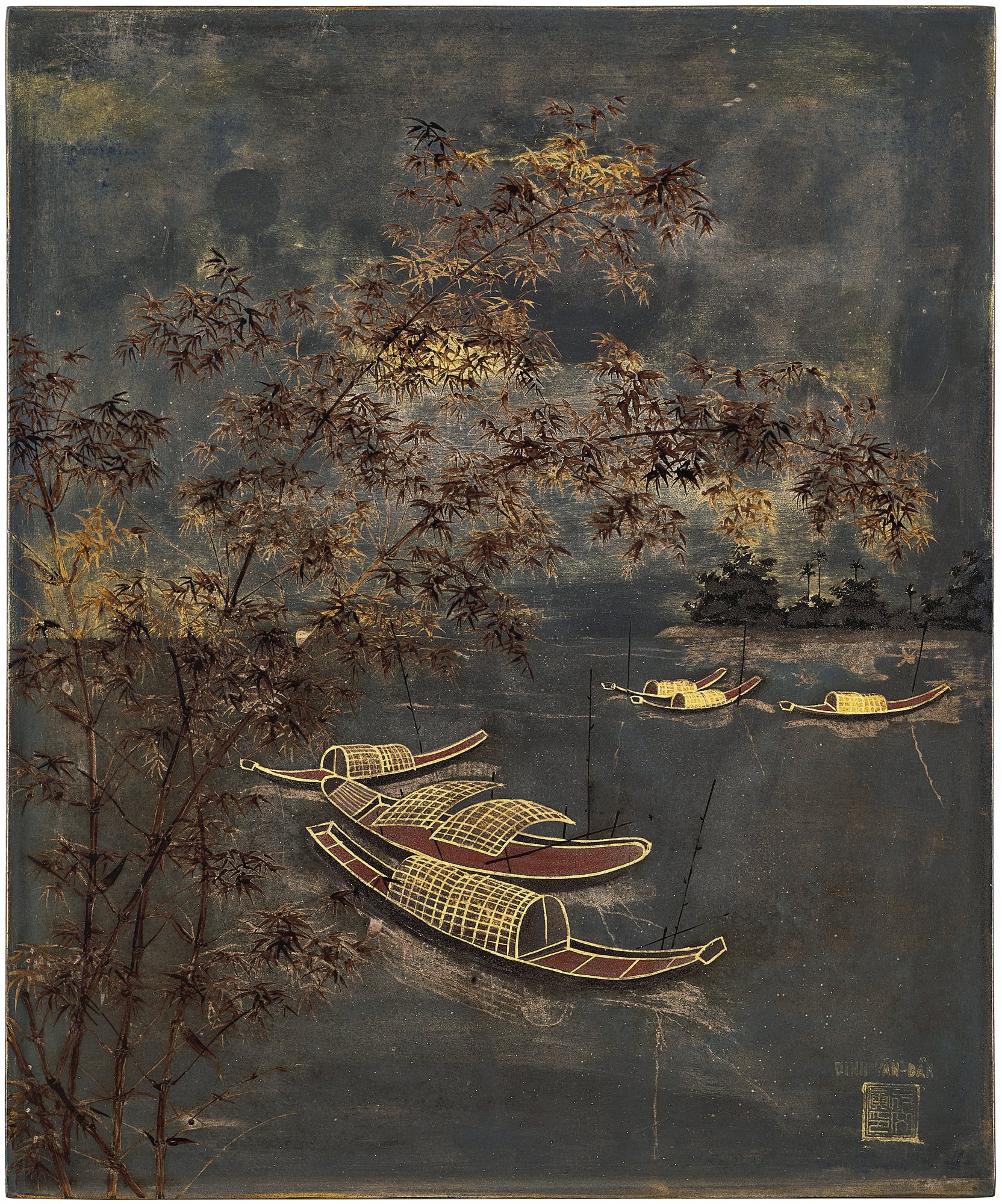
There is a quiet authority to the work of Dinh Van Dan that announces itself slowly, the way morning light moves across still water. His lacquer paintings, built up through layers of resin, pigment, and patience, belong to a tradition that is centuries old and yet feel urgently, unmistakably contemporary. For collectors encountering his work for the first time, the experience is often described as a kind of recognition, as though something long sensed but never quite seen has finally been given form. Dinh Van Dan emerged from the rich and demanding school of Vietnamese lacquer painting, a tradition rooted in the decorative arts of Southeast Asia but transformed in the twentieth century into a serious fine art medium. Vietnam's engagement with lacquer as a vehicle for fine art deepened significantly in the 1930s, when artists at the École des Beaux Arts de l'Indochine in Hanoi began experimenting with son mai, the Vietnamese lacquerwork technique, pushing it beyond craft into the realm of painting. It was within this lineage, and its long aftermath, that Dinh Van Dan came of age as an artist, absorbing both the technical rigors of the form and its profound aesthetic possibilities. The preparation of a lacquer painting is unlike any other medium in the visual arts. Layers of resin derived from the Rhus succedanea tree are applied to a board or panel, each coat requiring days of drying before the next can be laid down. Pigments, including the lustrous cinnabar reds and the deep blacks that define the medium's visual vocabulary, are embedded within these layers rather than sitting atop a surface. The artist then sands and polishes the finished panel, revealing the depth of color and light that has been locked within. For Dinh Van Dan, this process is not merely technical but deeply philosophical, a meditation on time, accumulation, and the slow revelation of meaning. His work titled Landscape, rendered in lacquer on board, exemplifies the extraordinary range of emotional register that the medium can achieve in his hands. The piece carries its dual title, presented in both English and Chinese as Landscape and the character for scenery or view, as a subtle acknowledgment of the layered cultural inheritance that informs his vision. There is something in the composition that speaks both to the Vietnamese tradition of depicting the natural world and to broader East Asian landscape painting, with its understanding that a landscape is never merely a record of terrain but a map of interior states. The work invites sustained looking, rewarding the viewer who spends time with the surface as it shifts and deepens depending on the light. Boats, his other major work available to collectors, brings a different energy while remaining entirely within the same sensibility. Water and vessels have been central motifs throughout Southeast Asian art, freighted with meaning that ranges from the practical to the spiritual. In Dinh Van Dan's hands, the subject becomes an occasion to explore the relationship between movement and stillness, between the transient and the enduring. The lacquer surface gives the boats a solidity that coexists with their apparent readiness to drift, and the play of light across the polished panel creates a sense of atmosphere that transcends mere representation. Within the broader context of Southeast Asian modernism, Dinh Van Dan's practice invites comparison with artists who also worked at the intersection of traditional technique and modern sensibility. The great Vietnamese lacquer painters of the mid twentieth century, figures such as Nguyen Gia Tri and Pham Hau, established the foundational grammar of the form as a fine art vehicle, and their influence is felt in any serious lacquer practice that follows. More recently, artists working across Vietnam, Singapore, and the Vietnamese diaspora have continued to expand what the medium can hold, and Dinh Van Dan belongs to this ongoing and vital conversation. His work also resonates with East Asian ink and wash traditions, sharing with artists in those lineages a commitment to economy of means and depth of feeling. For collectors, lacquer painting presents a distinctive opportunity. The medium has historically been undervalued in the Western market relative to its cultural and aesthetic significance, which means that serious collectors paying attention now are positioned to acquire works of genuine importance at a moment before the broader market fully reflects their worth. Vietnamese lacquer paintings in particular have attracted growing interest from collectors across Asia, Europe, and North America over the past decade, as institutions and galleries have worked to bring greater visibility to the modern and contemporary art of Southeast Asia. Works on board, properly maintained and stored away from extreme humidity and direct sunlight, have proven durable over long periods, making them sound additions to a collection built for the long term. What draws discerning collectors to Dinh Van Dan specifically is the combination of technical mastery and genuine lyrical intelligence. The works do not announce themselves loudly. They operate through accumulation and nuance, through the kind of careful attention to surface and depth that only extended practice can produce. In a collecting landscape often dominated by work that insists on immediate impact, there is something quietly radical about art that rewards patience and return visits. These are paintings that change as the light changes, that reveal new details as one's eye adjusts, that deepen with familiarity rather than becoming exhausted by it. Dinh Van Dan's place in the story of Vietnamese lacquer painting and in the wider history of Southeast Asian modernism is one that deserves fuller recognition and celebration. His landscapes and his water scenes participate in a tradition of representing the natural world that stretches back through centuries of Asian art, while remaining rooted in the specific material and cultural conditions of Vietnamese artistic life. As interest in the art of this region continues to grow among collectors and institutions worldwide, his work stands as a compelling and beautiful example of what that tradition has produced. To own a painting by Dinh Van Dan is to hold a conversation across time, across cultures, and across the luminous, patient layers of lacquer that give his vision its singular form.