Chuck Close
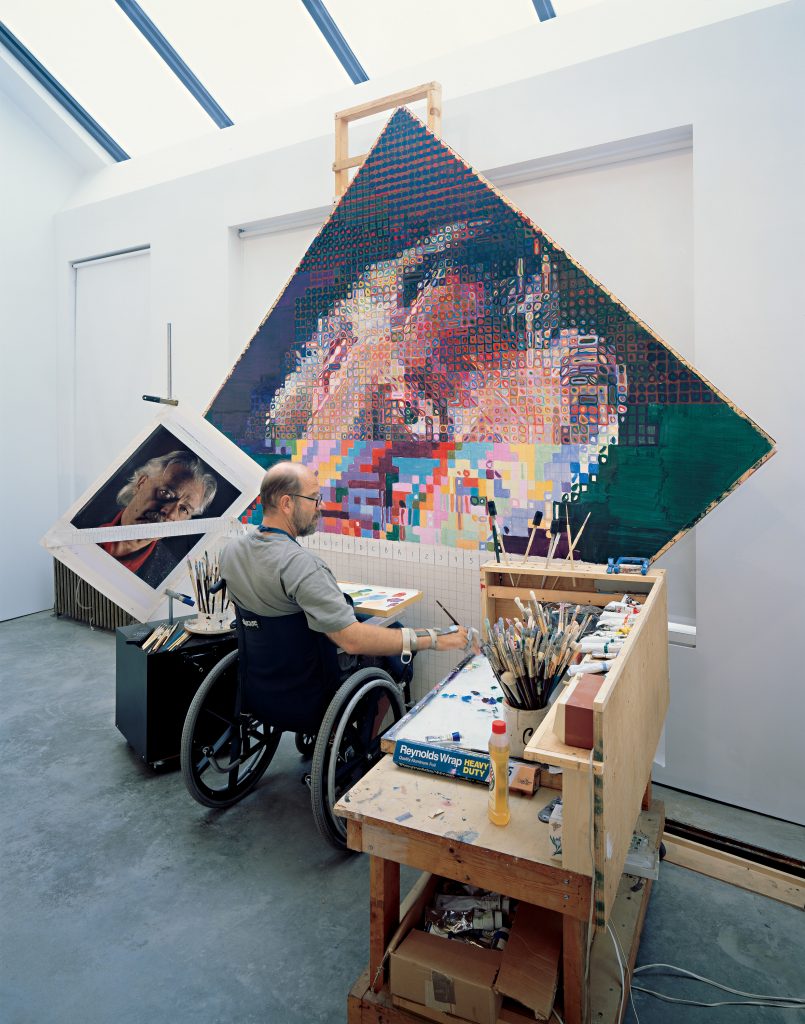
Chuck Close: The Face of American Genius
Artist Spotlight · The Collection Editorial
“The paintings are about how we look at another person, what we do with a face.”
Chuck Close, interview with the New York Times
In the winter of 2022, the Metropolitan Museum of Art quietly extended its display of works from its permanent collection in tribute to Chuck Close, who had passed the previous year at the age of eighty one. Visitors paused longest in front of his enormous canvases, drawn into faces that seemed to breathe with an almost impossible vitality. That gravitational pull, the sensation of standing before a painted face and feeling genuinely seen, is perhaps the most enduring testament to what Close achieved over six extraordinary decades. His legacy is not merely that of a technical virtuoso, though he was certainly that.
Chuck Close
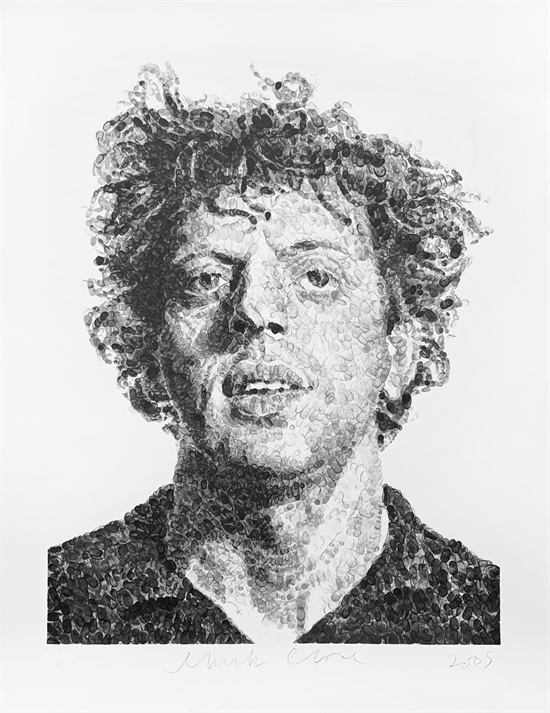
Phil, Fingerprint, 2009
It is the legacy of an artist who transformed the most intimate subject in all of painting, the human face, into a monumental philosophical inquiry. Charles Thomas Close was born in Monroe, Washington, in 1940. His childhood was shaped by genuine adversity. He struggled with a neurological condition called prosopagnosia, or face blindness, a profound irony given that portraiture would become his life's work.
He also contended with dyslexia and a neuromuscular disease that affected his father, leaving the family in difficult circumstances. Yet Close found early refuge in making art, a domain where his particular way of processing the visual world became a strength rather than a limitation. He later described how working from photographs allowed him to anchor his perception, to study a face as a fixed field of information rather than something that slipped away from memory. Close studied at the University of Washington in Seattle before earning his Bachelor of Fine Arts from Yale University School of Art and Architecture in 1964, where he encountered a rigorous intellectual climate and the formidable company of artists like Richard Serra and Brice Marden.
Chuck Close
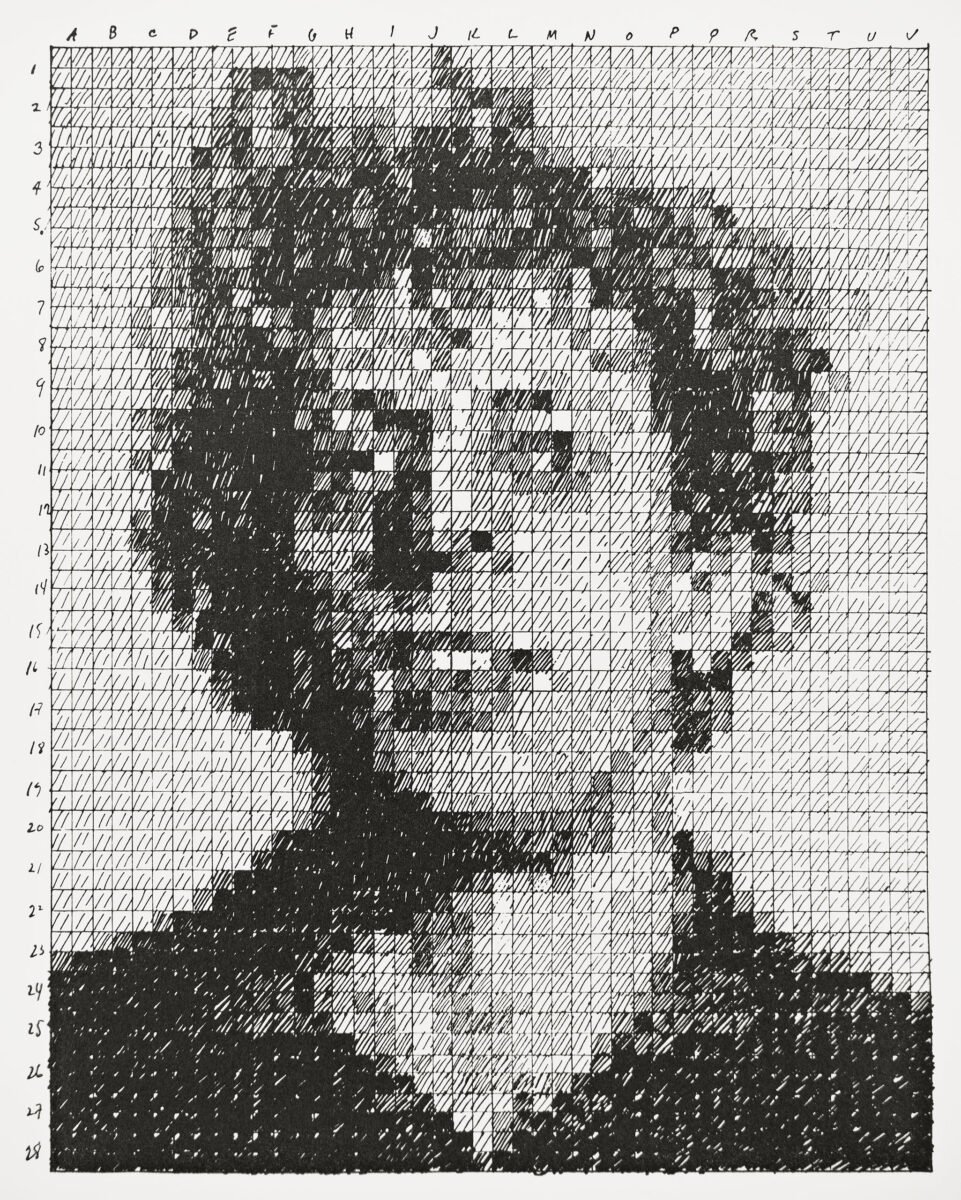
Phil, 1976
He subsequently received a Fulbright scholarship to study in Vienna, an experience that broadened his understanding of European painting traditions before he returned to New York and began developing the breakthrough approach that would define his career. His early professional work in the mid to late 1960s drew from the language of photorealism, yet even then his ambitions exceeded straightforward illusionism. The signature innovation that Close brought to painting was the grid. Working from large format photographs, he divided both the source image and the canvas into a precise matrix of cells, then addressed each cell individually, building a complete image from the accumulation of discrete units of information.
“I wanted to deal with the whole face as an object and not to have some parts more important than others.”
Chuck Close, Museum of Modern Art oral history
The result, at close range, was an almost abstract field of marks. Stepping back, a face emerged with startling clarity and presence. His breakthrough canvases of the late 1960s and 1970s, including the monumental black and white portrait of his friend the composer Philip Glass, established him immediately as one of the most consequential American painters of his generation. These works combined the cool detachment of Conceptual Art with the raw emotional weight of portraiture, a combination that felt entirely new.
Chuck Close
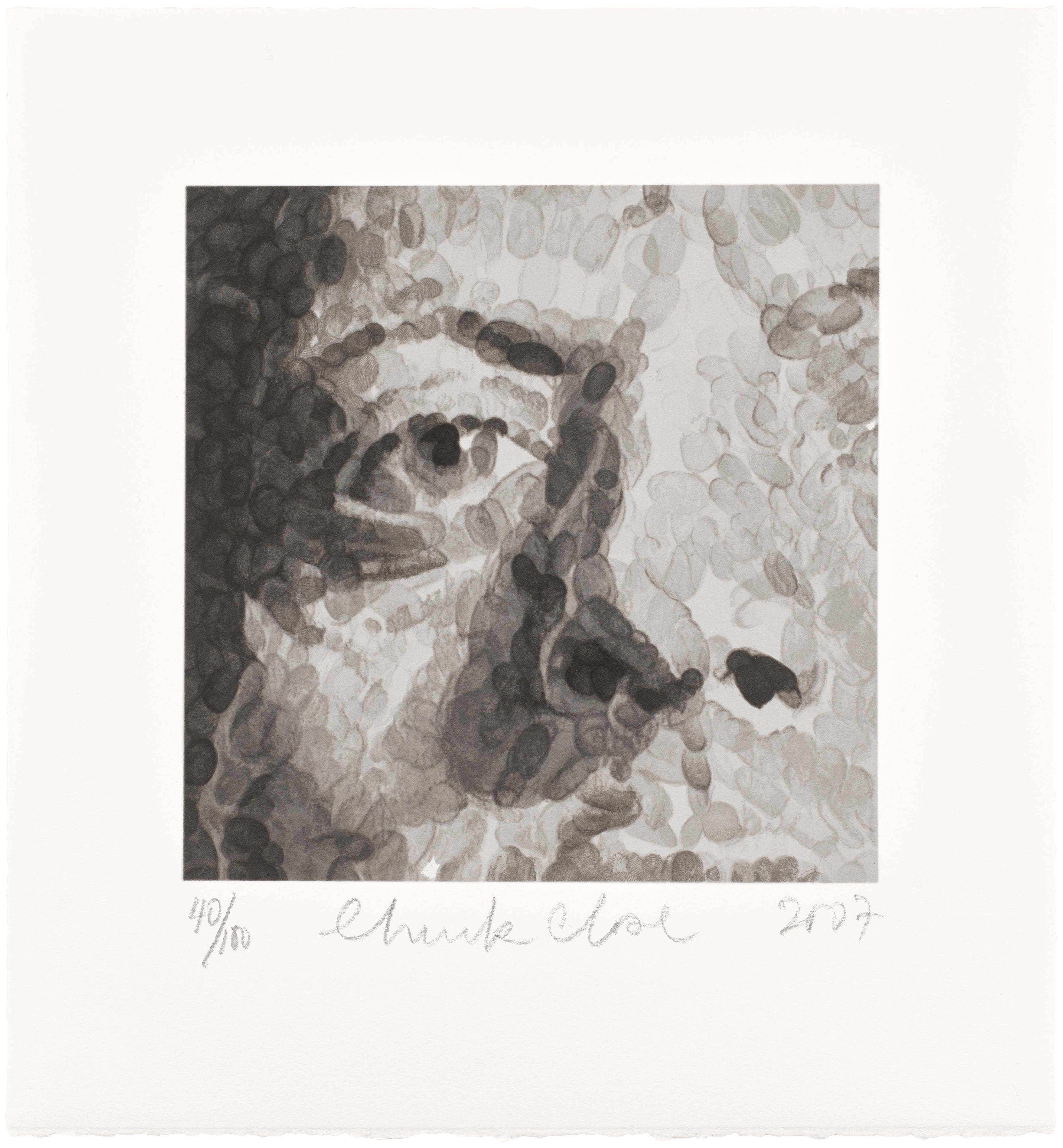
Phil (detail)
Over subsequent decades Close continually reinvented his methods while remaining devoted to the face and the grid. He produced portraits using fingerprints, pulp paper, and daguerreotypes. He embraced printmaking with a seriousness that elevated the medium, collaborating with Pace Editions in New York and Edition Schellmann in Munich to produce prints that were genuine artistic statements rather than reproductions. Works such as Phil Fingerprint from 2009, a screenprint rendered in twenty five colors, and the celebrated Phil from 1976, executed as a rubber stamp print, demonstrate how fully he committed to each medium on its own terms.
His Jacquard tapestries, including the remarkable Kate from 2007, translated his pixelated imagery into woven fiber with astonishing fidelity. In 1988, a spinal artery collapse left Close largely paralyzed, and he subsequently learned to paint with a brush strapped to his wrist. Rather than diminishing his output, this period produced some of his most luminous and celebrated canvases, works of pure chromatic intensity built from small lozenges and diamonds of color. For collectors, Close represents one of the clearest value propositions in postwar American art.
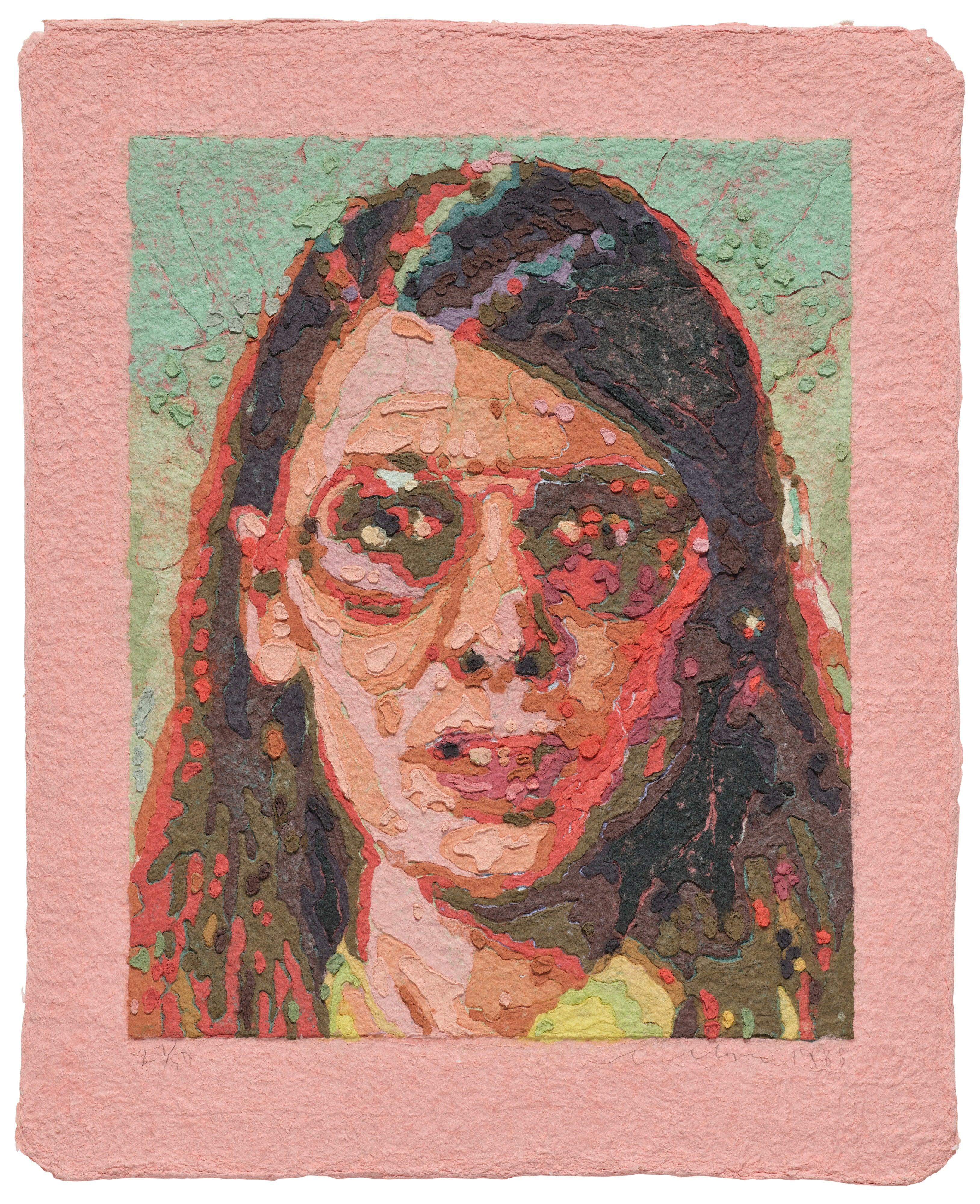
Chuck Close
Susan (B. 50)
His works appear consistently at the major auction houses, Christie's, Sotheby's, and Phillips, where his large scale paintings have achieved prices well into the millions of dollars. His prints and multiples, however, remain among the most intellectually rewarding entry points into his practice. Editions such as the Susan series, the various Phil portraits, and the Leslie woodcut on Echizen Kozo Nimai Suki paper offer the full experience of his grid based logic and formal rigor at a range of price points. Collectors drawn to artists like Gerhard Richter, whose photographic sources and meditations on representation invite direct comparison, or to the Pop inflected portraiture of Andy Warhol, will find in Close a figure whose concerns run equally deep but whose craft operates at a different register of intimacy and labor.
The prints in particular reward close looking, and any Close edition in strong condition and well provenanced carries both cultural and financial weight. Close belongs to a generation that included painters such as Alex Katz, whose flattened portraiture shares Close's commitment to the face as primary subject, and Philip Pearlstein, another rigorous realist working in the same New York milieu. Yet Close ultimately occupies a singular position in art history. His work anticipates the pixel, the digital image, and the contemporary obsession with how screens and grids mediate our perception of faces and identity.
Long before social media rendered every face a grid of compressed data, Close was asking what it means to look at a face, truly look, and what painting could reveal about that act of looking that photography alone could not. The enduring power of Chuck Close's art rests on a paradox that he spent a lifetime exploring. By working from photographs and subjecting them to systematic decomposition, he arrived at something profoundly humanist and alive. His sitters, including Philip Glass, Alex Katz, Lucas Samaras, and repeatedly himself, emerge from their grids not as documents but as presences.
To own a work by Chuck Close is to participate in one of the great ongoing conversations in American art about what it means to see and to be seen. That conversation, now that the artist himself is gone, belongs entirely to the works and to those who live with them.
Explore books about Chuck Close
Chuck Close: A Life
Christopher Fineman
Chuck Close: Works on Paper
Robert Storr
Chuck Close: Process and Collaboration
Robert Storr and PaceWildenstein
Chuck Close: Prints
Ruth E. Fine
Chuck Close: Self-Portraits 1967-2005
Robert Storr
Chuck Close: Photographs
Robert Storr