Landscape With Figures
Unknown
Untitled
Where the Human and the Horizon Meet
There is a reason the landscape with figures has persisted as one of the most enduring and debated genres in Western and Eastern art history alike. It sits at the precise intersection of two ancient questions: what does the world look like, and where do we belong within it? The tension between those two questions has generated some of the most emotionally complex and visually arresting works ever made, from Song dynasty ink scrolls to Flemish village scenes to the swimming pools of suburban California. To look seriously at this genre is to trace nothing less than the story of how human beings have imagined their place in nature across five centuries and several continents.
The genre as a codified form began to crystallize in European painting during the sixteenth century, though its roots reach back further into Flemish manuscript illumination and the backgrounds of Italian Renaissance altarpieces. What we now recognize as landscape with figures gained its fullest early expression in the Netherlandish tradition, where painters increasingly allowed the natural world to expand beyond its supporting role and begin to assert its own presence. Pieter Brueghel the Younger, whose work appears in The Collection, inherited and extended the vocabulary of his father, the elder Bruegel, whose 1565 series of seasonal landscapes set a template that would echo through European painting for generations. In those works, peasants harvest grain, hunters return through snow, and skaters glide across frozen ponds, all rendered with a sociological eye that refused to separate human labor from the land that demanded it.
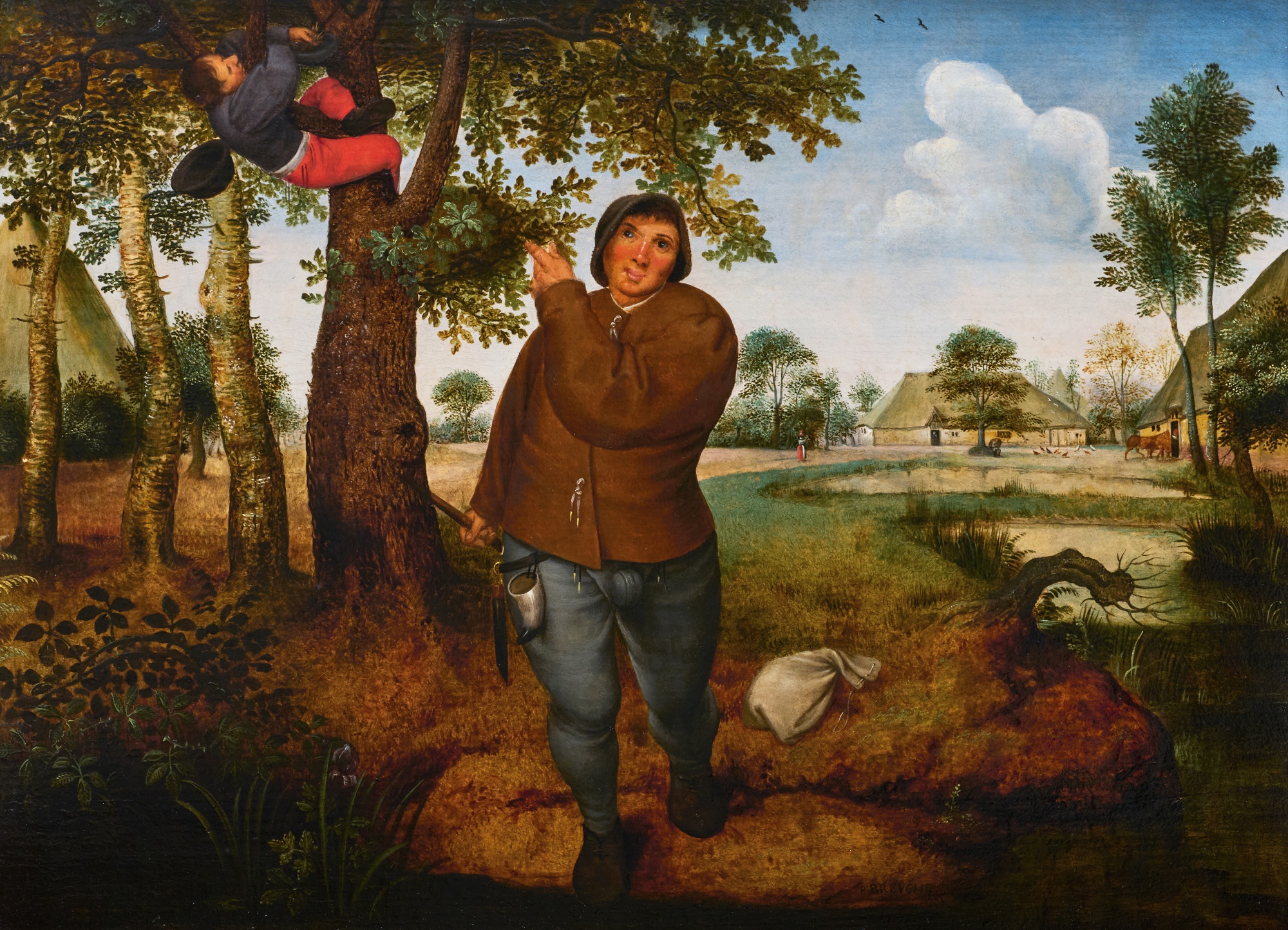
Pieter Brueghel the Younger
The Nest Robber
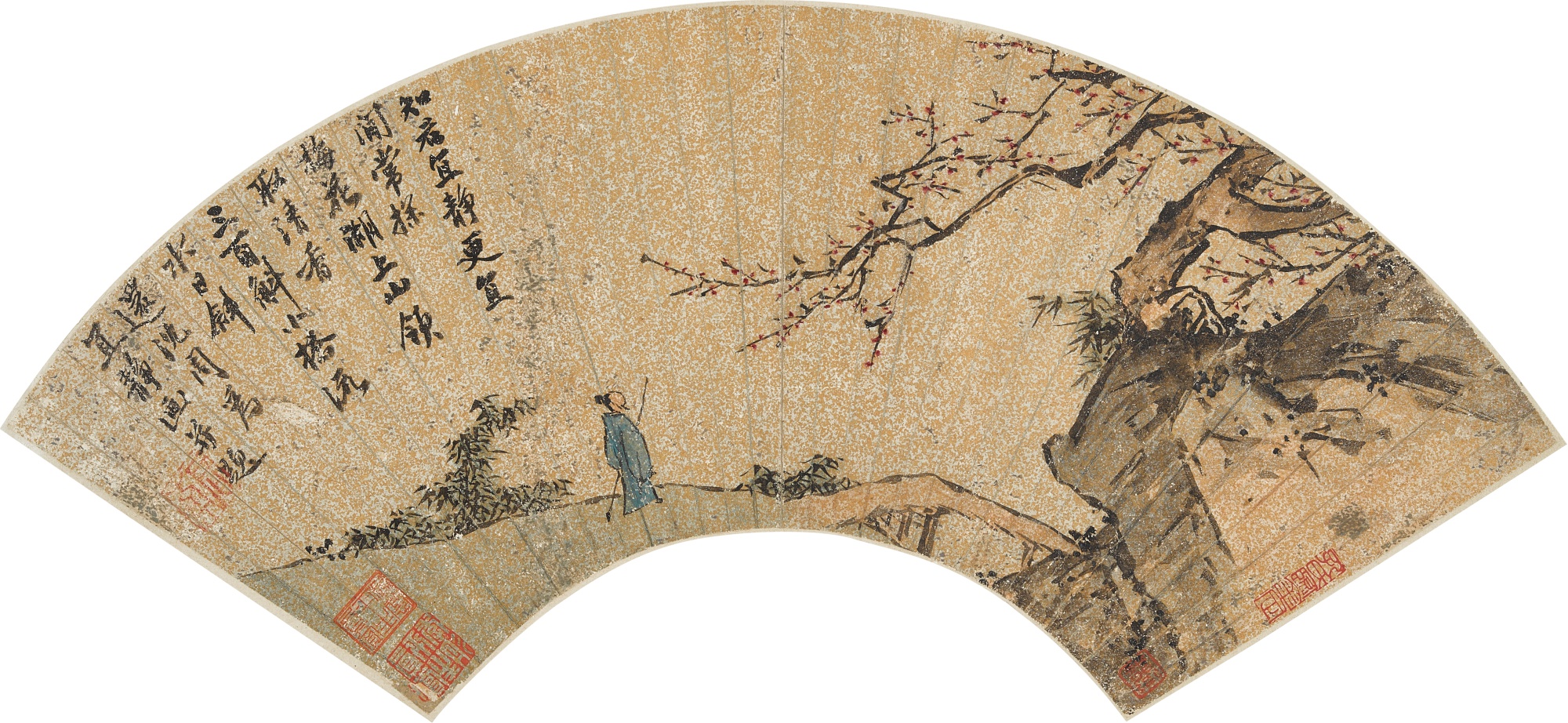
By the seventeenth century, the relationship between figure and landscape had become philosophically charged. In China, the literati painting tradition had long meditated on this same problem from a different angle. Hongren, the reclusive Anhui master who lived from 1610 to 1664, distilled the landscape into austere, angular forms in which tiny human figures appear almost incidentally, perched on cliff edges or crossing narrow bridges. The figures in Hongren's work do not dominate the landscape; they are absorbed by it, made small and contemplative in ways that carry an explicitly philosophical weight rooted in Chan Buddhist thought.
His approach remains one of the most rigorous statements in any tradition about the proper scale of human presence within the natural order. The nineteenth century brought a new urgency to the genre in Europe, as industrialization began to transform the very landscapes painters were trying to document. The Barbizon School, gathering in the forest of Fontainebleau from the 1830s onward, sought to recover a direct and unmediated encounter with nature. Charles François Daubigny, one of the school's most committed figures, spent years painting from a studio boat along the rivers of France, developing a plein air practice that would prove enormously influential on the Impressionists who followed.
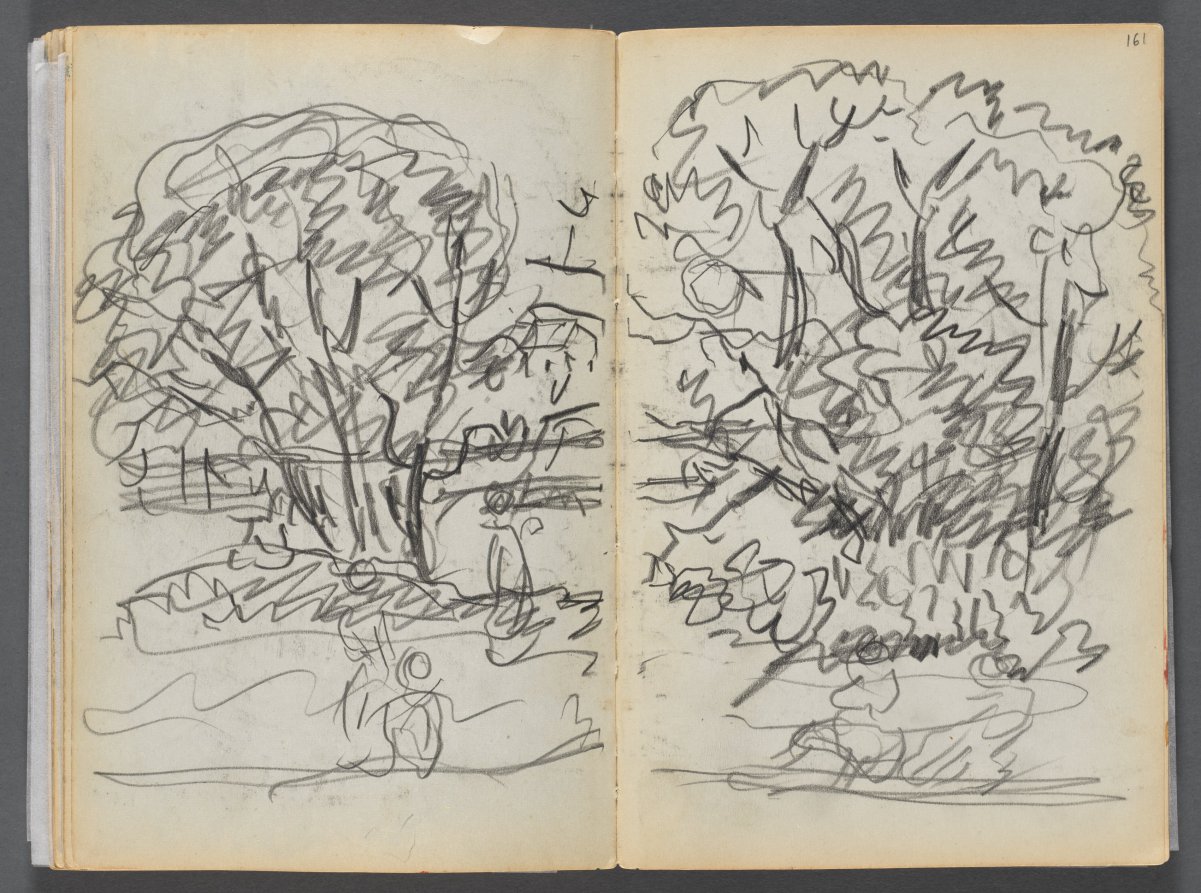
Maurice Prendergast
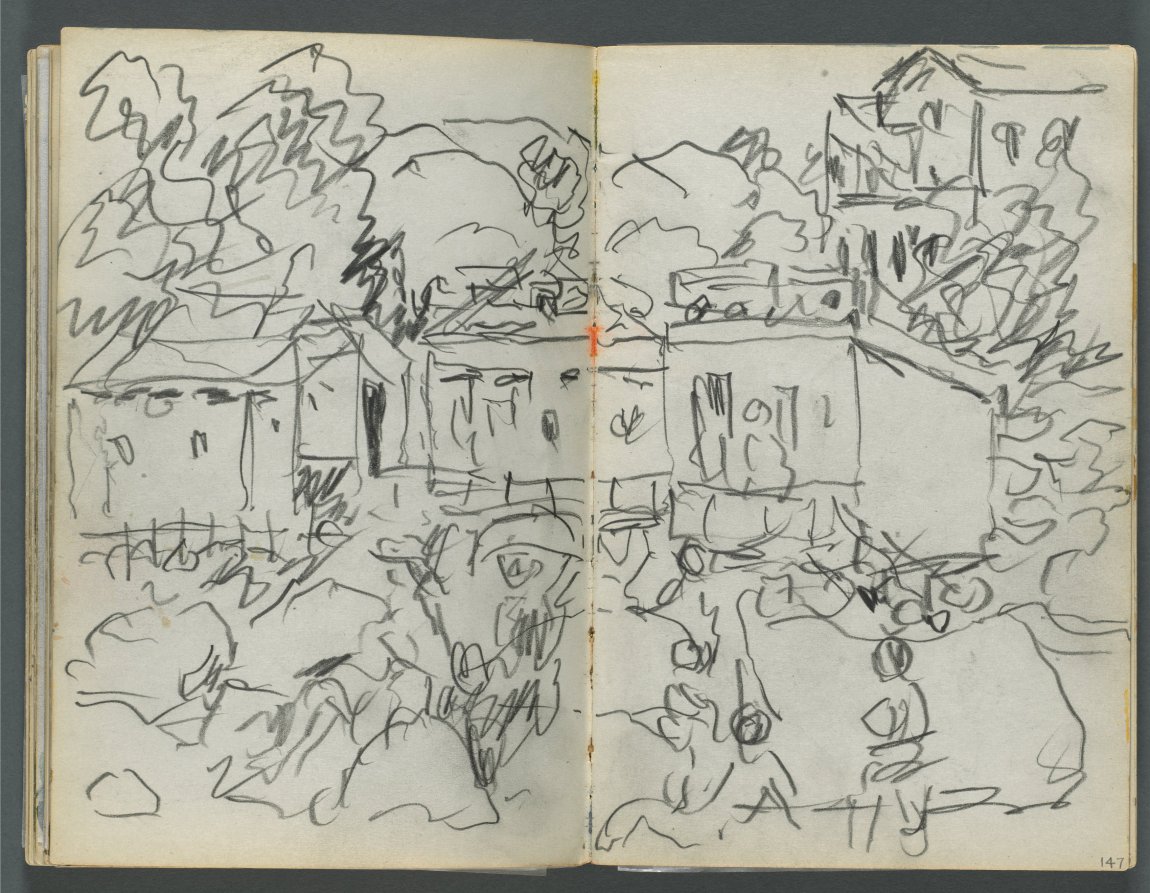
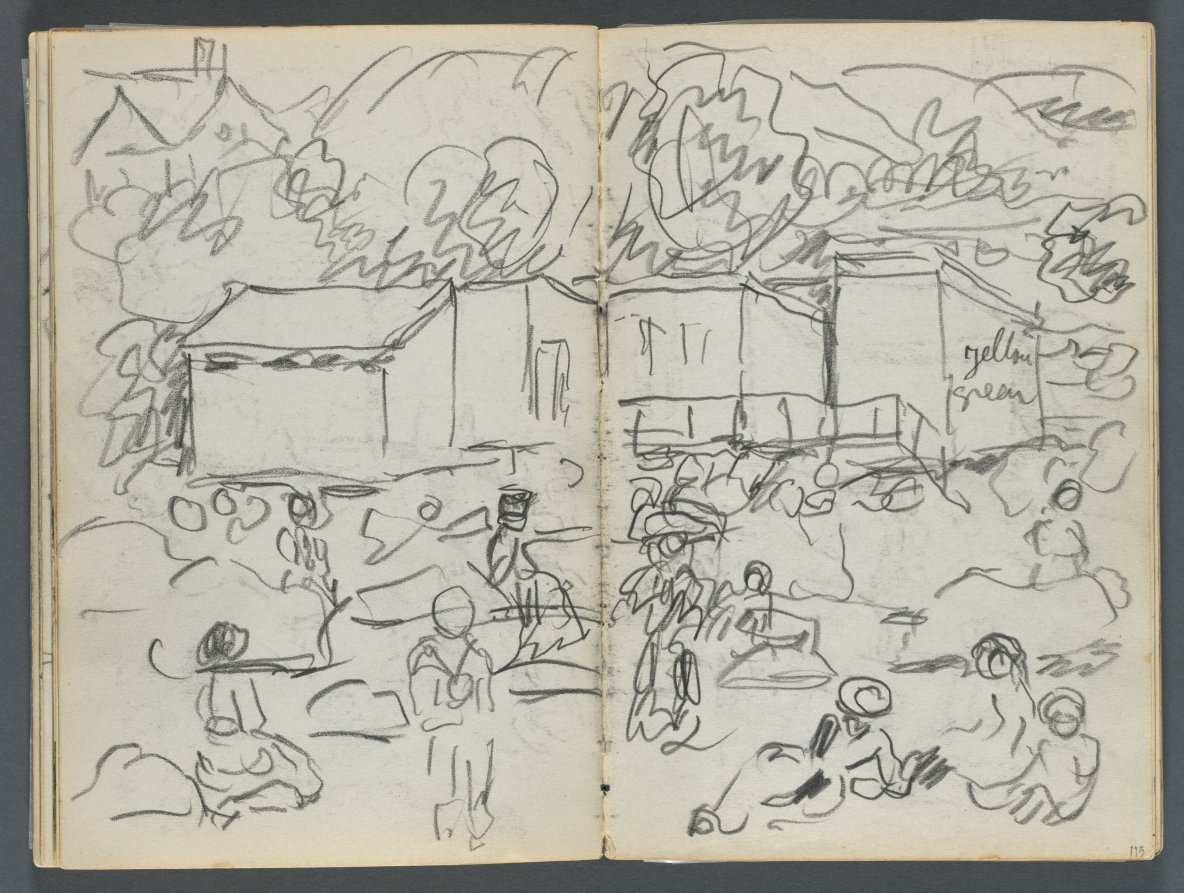
Sketchbook- The Granite Shore Hotel, Rockport, page 160 & 161: Landscape with Figures , 1905
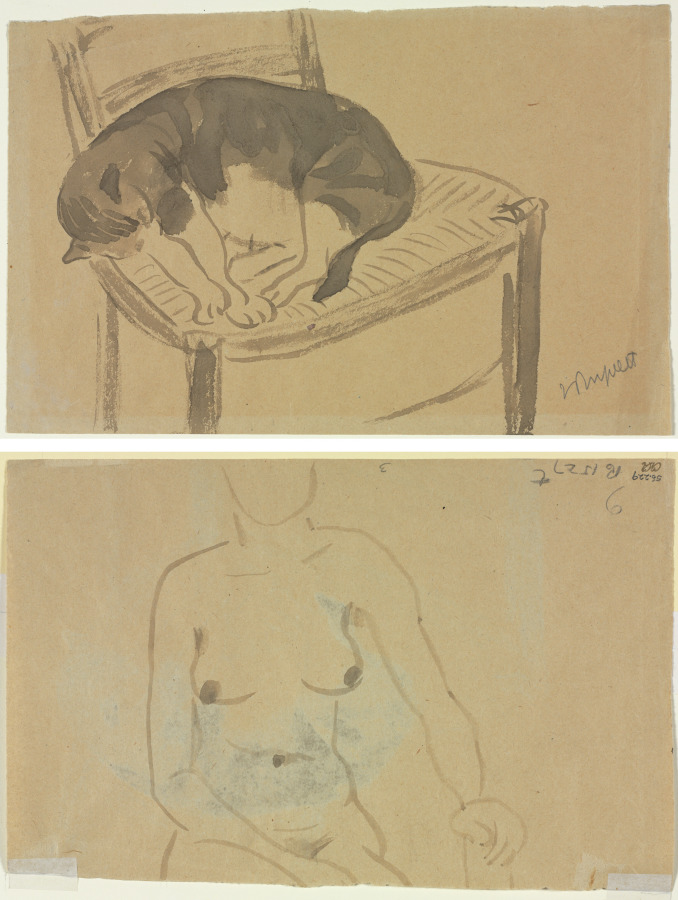
In Daubigny's canvases, figures appear along riverbanks and in open fields with a naturalness that feels observed rather than composed, a quality that felt radical at the time and still reads as fresh today. The Impressionist generation pushed the figure further into the landscape, often dissolving the boundary between person and environment through broken brushwork and high key color. Maurice Prendergast, an American Post Impressionist whose work is well represented on The Collection, took this dissolution to a richly decorative extreme. Working in the early twentieth century, Prendergast populated his beach scenes and parks with crowds of figures that become almost tapestry like in their flatness, the human form absorbed into patterns of color and light.
His work, deeply influenced by Cézanne and the Italian primitives he encountered during his time in Europe, manages to be simultaneously modern in its surface and ancient in its pageantry. When you stand before a Prendergast beach scene, you understand why critics at the time struggled to place him: he was doing something genuinely new with material that stretched back to Bruegel. The twentieth century brought landscape with figures into direct confrontation with the psychological. In France, the Vietnamese born artist Mai Trung Thu brought together the intimacy of the figure tradition he learned at the Hanoi School of Fine Arts with a sensibility shaped by both Matisse and traditional Vietnamese lacquer art.
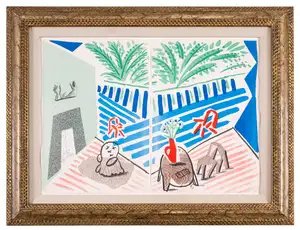
David Hockney
Livingroom and Terrace, July 1986
His figures, often women in ao dai against flattened garden settings, create a dialogue between interiority and environment that feels distinct from anything happening in Paris at the same moment. Across the Channel and later in California, David Hockney was renegotiating the same terms. His swimming pool paintings of the late 1960s and 1970s placed the human figure within landscapes so drenched in synthetic sunlight that the question of where nature ended and artifice began became part of the subject itself. What makes the landscape with figures so inexhaustible as a category is precisely this adaptability.
It can carry the weight of political allegory, as it did for Brueghel in Counter Reformation Flanders. It can be a vehicle for spiritual resignation, as in Hongren's mountain views. It can celebrate leisure and the democratic pleasures of public parks, as Prendergast found in Boston and Venice and Rome. The genre does not belong to any single tradition or period; it belongs to the ongoing human need to negotiate belonging.
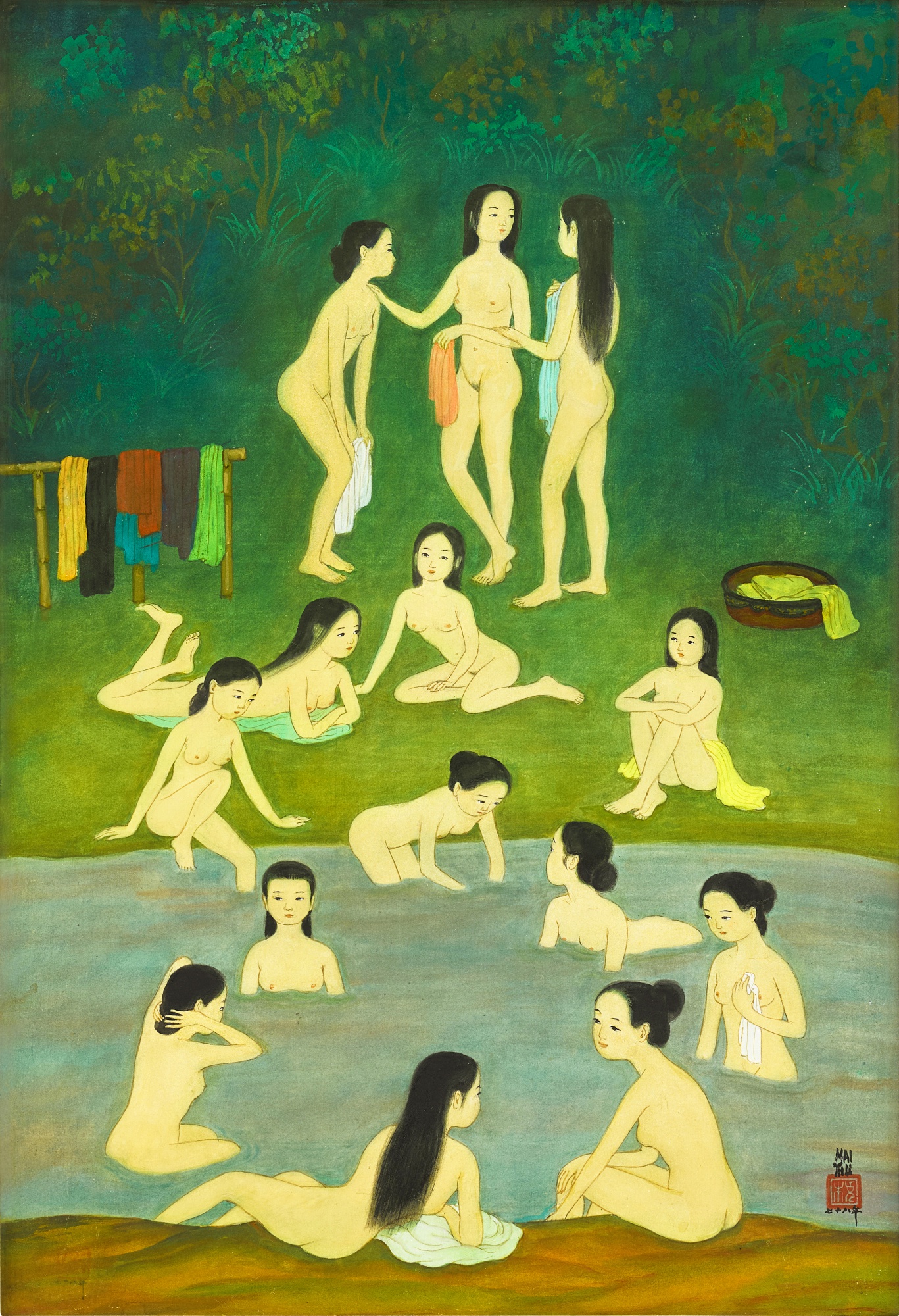
Mai Trung Thu
Mai Trung Thu 枚中栨 (梅忠恕) | Le petit cours d’eau, la baignade 小溪,沐浴, 1978
For collectors, works in this category offer something that pure landscape and pure figurative painting separately cannot: a complete world. There is a figure, there is somewhere for that figure to exist, and in the space between them there is always a question being asked about the nature of that relationship. The best works on The Collection in this genre reward sustained looking, the kind where you find yourself returning again and again to work out exactly what the artist believed about where we stand in relation to the world around us. That is not a small thing to ask of a painting, and it is not a small thing when a painting delivers it.