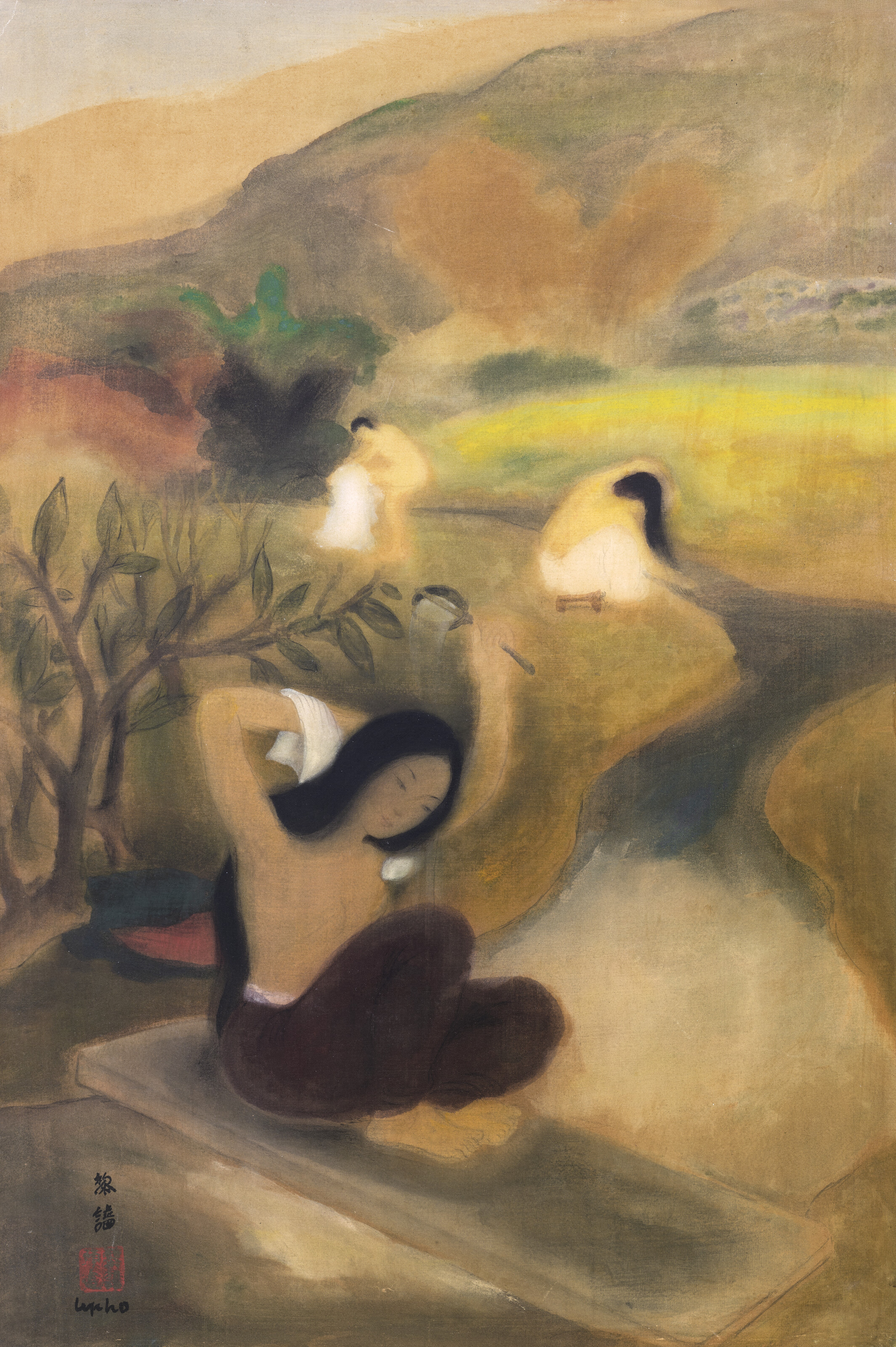
La baignade (Bathing)
"La baignade" by Lê Phổ depicts a serene bathing scene infused with the artist's characteristic blend of Vietnamese and French artistic traditions. The composition features delicate, elongated figures rendered in soft, muted tones that reflect Lê Phổ's mastery of both ink painting and Western perspective. The work exemplifies the artist's poetic approach to everyday moments, transforming a simple bathing scene into an intimate meditation on beauty and tranquility.
- Signed
- Yes
- Spotted At
- Auction House · Christie's
Notes
LITERATURE K. Pho, ‘Jean-François Hubert’, Argument, July/August/September 2024 (illustrated, p. 40). EXHIBITED Paris, Christie's, La colle du phénix et le fil de soie brisé : Oeuvres vietnamiennes majeures de la collection Melchior Dejouany, 8 June - 13 June 2024 FURTHER DETAILS LE PHO, "BATHING", CIRCA 1938, OR THE INFLUENCE OF THE MASTER BONNARD Le Pho (1907–2001) was, from very early on, an unwavering admirer of Bonnard and Matisse. So confident, in fact, that he saw his move to France in 1937 as a mental pilgrimage towards them. A visit to China in 1934 had confirmed to him that, while Chinese painting and the Taoist thought that underpins it deserved his respect, his own approach, instilled by the Beaux-Arts in Hanoi, drew him irrevocably to the West. There, in particular, the works of his two elders, as well as those of the Renaissance, fascinated him. Bathing, a large (46 x 30.5 cm) gouache and ink on silk, may be dated around 1938, or perhaps just after. Unusual in the painter’s corpus, it embodies the notion of shifted observation that underpins all of Bonnard’s art: the observer must adopt a shifting, open-ended perspective in order to apprehend the reality of the painting. He has to capture the bewitching grace of the women—their sensuality within masses built with matte gouache tones—in a deliberate chromatic blur, mountains, rivers and bridges are arranged. The gradual use of ink—from the first woman’s pants to the third’s hair—amplifies the depth of the work. The landscape is universal, neither specifically Asian nor uniquely Western. Only the facial features of the women, at least the first, evoke Asian. This is the work of a deliberate confusion that creates the desired fusion. A fiction that creates fission. All Le Pho’s themes are expressed here, by a painter who, he senses, has already made the choice—which will prove to be definitive—of the West, all in a display of discretion underpinned by an assumed sense of distance. One before, one after. Le Pho also met Matisse in 1943, who advised him to lighten his palette. Then came the Romanet and Findlay periods, with their incomparably rich colour palette and meticulously painted backgrounds. The influence of Bonnard or Matisse would then have to be identified, in other works. Jean-François Hubert Senior Expert, Art of Vietnam Conditions of sale Brought to you by Ziwei Yi AVP, Specialist, Head of 20th Century Day Sale 20th/21st Century Art, Asia Pacific ZIWEIYI@CHRISTIES.COM +852 297 86732
🔨 Auction Lot
20th Century Day Sale
March 28, 2026
Estimate: $1,200,000 – $2,200,000
Sold: $1,397,000
Lot 124
Start the Discussion
Request access to join the discussion