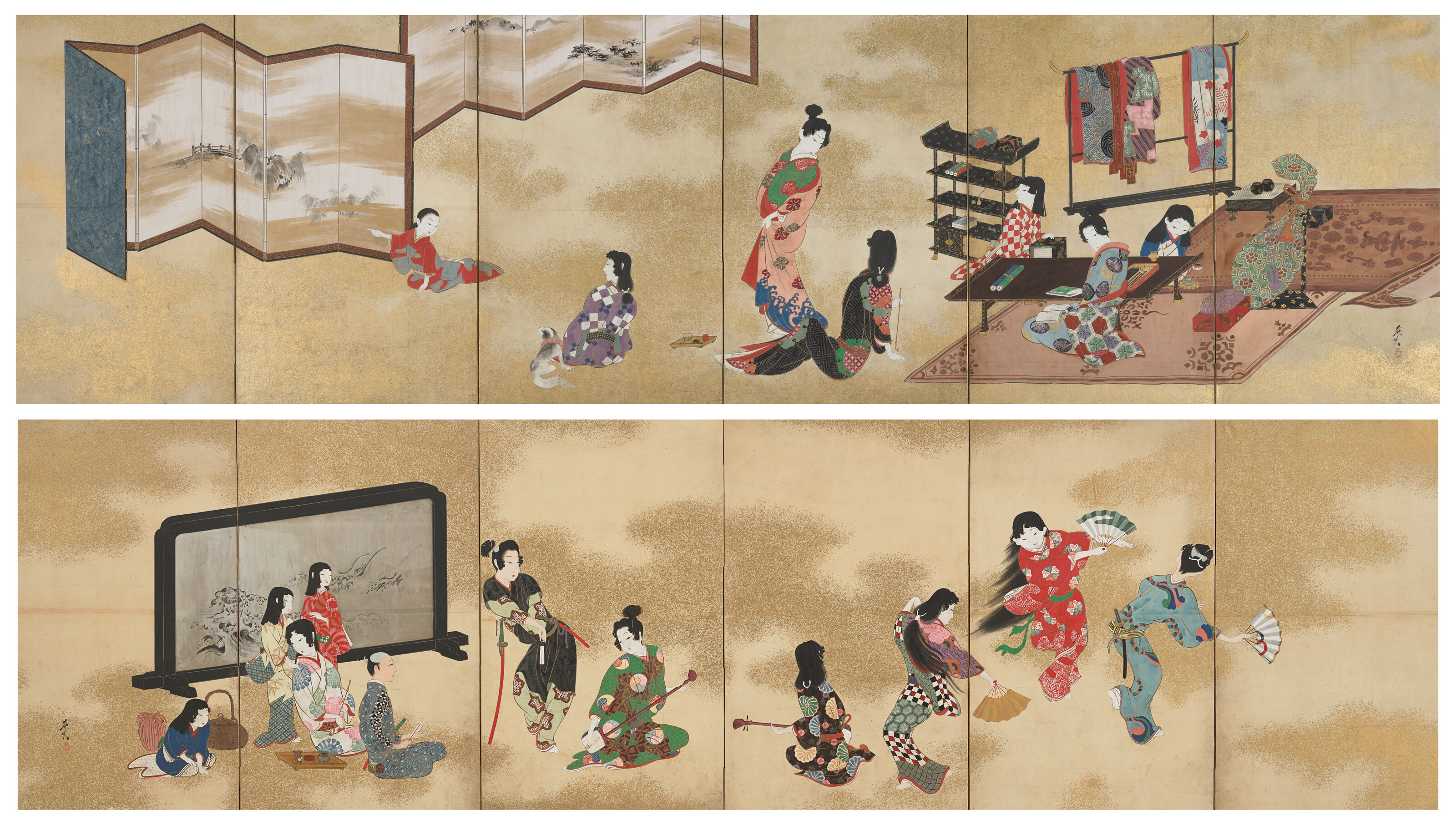
The Four Elegant Pastimes
"The Four Elegant Pastimes" by Shibata Zeshin depicts the traditional Japanese pursuits of calligraphy, painting, music, and the tea ceremony, rendered in his characteristic refined lacquer painting technique known as maki e. Zeshin's composition captures these scholarly and artistic activities with meticulous attention to decorative detail and atmospheric perspective, reflecting Edo period aesthetics and the influence of Chinese literati culture. The work exemplifies Zeshin's mastery of combining naturalistic observation with ornamental surface patterning, demonstrating why he was celebrated as one of Japan's greatest lacquer artists.
- Spotted At
- Auction House · Christie's
Notes
EXHIBITED 'Hikone byobu e no izanai (Allure of the Hikone screen)', Hikone Castle Museum, Hikone, 24 October-23 November, 1998, exh. cat. no. 54 Conditions of sale Brought to you by Takaaki Murakami (村上高明) Vice President, Specialist and Head of Department | Japanese and Korean Art Check the condition report or get in touch for additional information about this TMURAKAMI@CHRISTIES.COM +1 212 636 2160 VIEW CONDITION REPORT LOT ESSAY The theme of the “Four Elegant Pastimes" - calligraphy, painting, music, and the game of go - originated in China, where mastery of these pursuits was regarded as essential to the ideal scholar-gentleman. The concept later entered Japan through the transmission of literati culture. Both the subject and composition of the present screens recall the celebrated Hikone Screen, an early seventeenth-century six-panel screen now designated a National Treasure and widely considered a touchstone of Japanese genre painting. Shibata Zeshin appears to have been particularly drawn to this subject and produced several variations during his career; related examples are today in the collections of the Metropolitan Museum of Art (51.89.1, .2) and the Minneapolis Institute of Art (2013.31.47.2). In Zeshin’s interpretation, however, the refined “pastimes” are subtly transformed. Set against a luminous ground of sprinkled gold, eighteen figures from the pleasure quarters replace the traditional scholar-gentlemen in the Hikone screen. Courtesans practice calligraphy, music, painting, and games amid carefully rendered furnishings, scholar’s implements, and elegant garments. Yet the atmosphere is curiously detached: the figures, though exquisitely detailed, appear absorbed in their own worlds, showing little interaction with one another. A clothing rack draped with women’s kimono, the interior suggested at the far right, and the presence of a male client observing a fan dance all point to the setting of the pleasure quarters. Through this juxtaposition, Zeshin introduces a quiet irony: the cultured pursuits of the literati are performed not by scholars, but by courtesans. The artist’s subtle humor and psychological distance lend the composition a striking modernity. Trained both as a painter and lacquer artist, Zeshin was celebrated for incorporating lacquer into his paintings - sometimes executing entire compositions in lacquer or enriching painted surfaces with lacquer details, as seen in the present screens. Living through Japan’s dramatic nineteenth-century transformation from a closed feudal society to a nation increasingly engaged with the West, Zeshin’s work reflects a complex dialogue between tradition and change. READ MORE
🔨 Auction Lot
Japanese and Korean Art
March 24, 2026
Estimate: $60,000 – $80,000
Lot 40
Spotted works by Shibata Zeshin
Start the Discussion
Request access to join the discussion