Join The Collection to save, track, and explore works like this.

Cleveland Museum of Art

Spotted

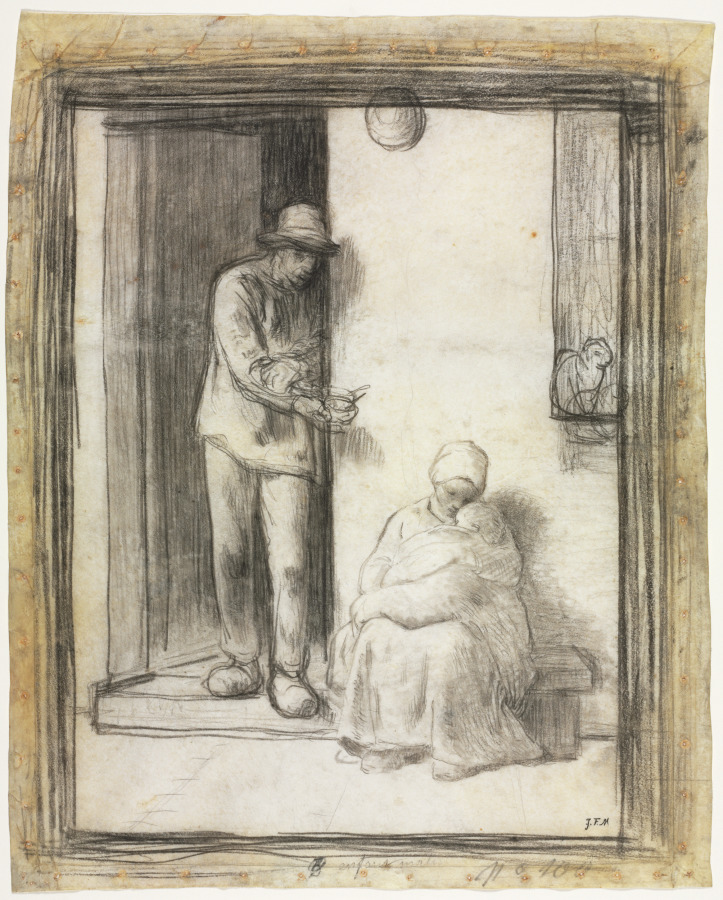
Jean-François Millet — The Sick Child

Jean-François Millet

The Sick Child

1858

Jean-François Millet’s paintings of French rural life, especially those of peasants and farmers in their working environment, redefined the imagery of everyday life in the nineteenth century. Large-scale paintings such as The Gleaners (1857) presented the poorest of laborers with a dignity and nobility informed by classical traditions in French painting. At the same time he was working on major paintings for public exhibitions, Millet was also making smaller-scale drawings. Since drawings were less expensive, there was a much larger market for this type of work, and Millet created finished sheets in both black crayon and pastel as he catered to this demand. The work shown here is the first version of a theme the artist drew again in pastel in a more finished version (now lost). This crayon drawing shows, on the other hand, Millet’s thinking process. We can see him working out the composition because several changes are visible, most notably in the bowl held by the father and the cat in the window. Though taken from everyday life, Millet’s tender treatment of this family group recalls the biblical subject of the Holy Family.

Medium
black crayon; framing lines in black crayon

Start the Discussion

Request access to join the discussion

Spotted works by Jean-François Millet

About this work

Jean-François Millet, The Sick Child, 1858

Jean-François Millet’s paintings of French rural life, especially those of peasants and farmers in their working environment, redefined the imagery of everyday life in the nineteenth century. Large-scale paintings such as The Gleaners (1857) presented the poorest of laborers with a dignity and nobility informed by classical traditions in French painting. At the same time he was working on major paintings for public exhibitions, Millet was also making smaller-scale drawings. Since drawings were less expensive, there was a much larger market for this type of work, and Millet created finished sheets in both black crayon and pastel as he catered to this demand. The work shown here is the first version of a theme the artist drew again in pastel in a more finished version (now lost). This crayon drawing shows, on the other hand, Millet’s thinking process. We can see him working out the composition because several changes are visible, most notably in the bowl held by the father and the cat in the window. Though taken from everyday life, Millet’s tender treatment of this family group recalls the biblical subject of the Holy Family.

Medium
black crayon; framing lines in black crayon
Year
1858
Seen at
Cleveland Museum of Art, Cleveland, OH

Related themes

Drawing, Unique Work

More works by Jean-François Millet

Collected by

Cleveland Museum of Art