Menashe Kadishman

Menashe Kadishman: Steel, Spirit, and Splendor
Artist Spotlight · The Collection Editorial
There is a particular kind of awe that comes from standing beneath a Menashe Kadishman sculpture as it catches the late afternoon light. The oxidized Cor ten steel glows amber and rust, the silhouette of a tree or a suspended disc hovering in the air with an improbable, almost weightless grace. For those who encountered his major public installations during the 1970s and 1980s, whether in Tel Aviv, London, or New York, the experience left something permanent behind. That quality, a sense of the monumental made tender, the industrial made poetic, is why Kadishman remains one of the most beloved and internationally significant figures in Israeli art history.
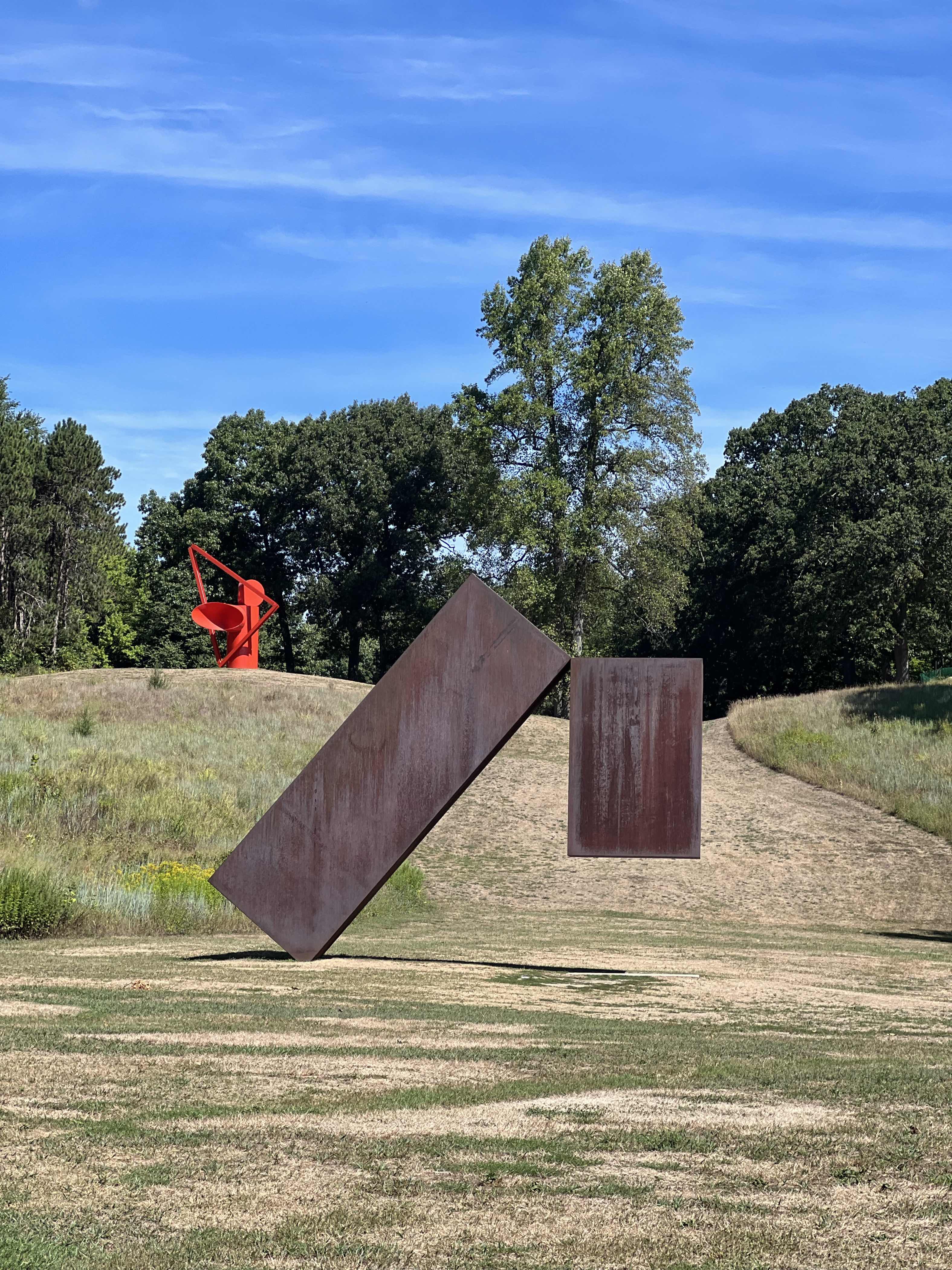
Menashe Kadishman
Suspended, 1977
Menashe Kadishman was born in Tel Aviv in 1932, a city then still forming its own identity within the British Mandate of Palestine. He grew up working as a shepherd in his youth, an experience that would prove foundational rather than incidental. The sheep, the open land, the biblical resonance of pastoral life in that ancient landscape: these were not merely biographical footnotes but the very substance of his artistic imagination. He would return to the image of the sheep again and again across six decades of work, transforming it into one of the most recognizable motifs in contemporary Israeli art.
Kadishman trained first in Israel before traveling to London, where he studied at the Slade School of Fine Art and later at Saint Martin's School of Art during the 1960s. This was a formative period in British sculpture, a moment when artists like Anthony Caro and Phillip King were dismantling the conventions of the pedestal and reimagining what sculpture could be and where it could live. Kadishman absorbed these energies deeply. He became part of the circle around the Rowan Gallery in London, which represented him and helped introduce his work to an international audience at a pivotal moment in his career.
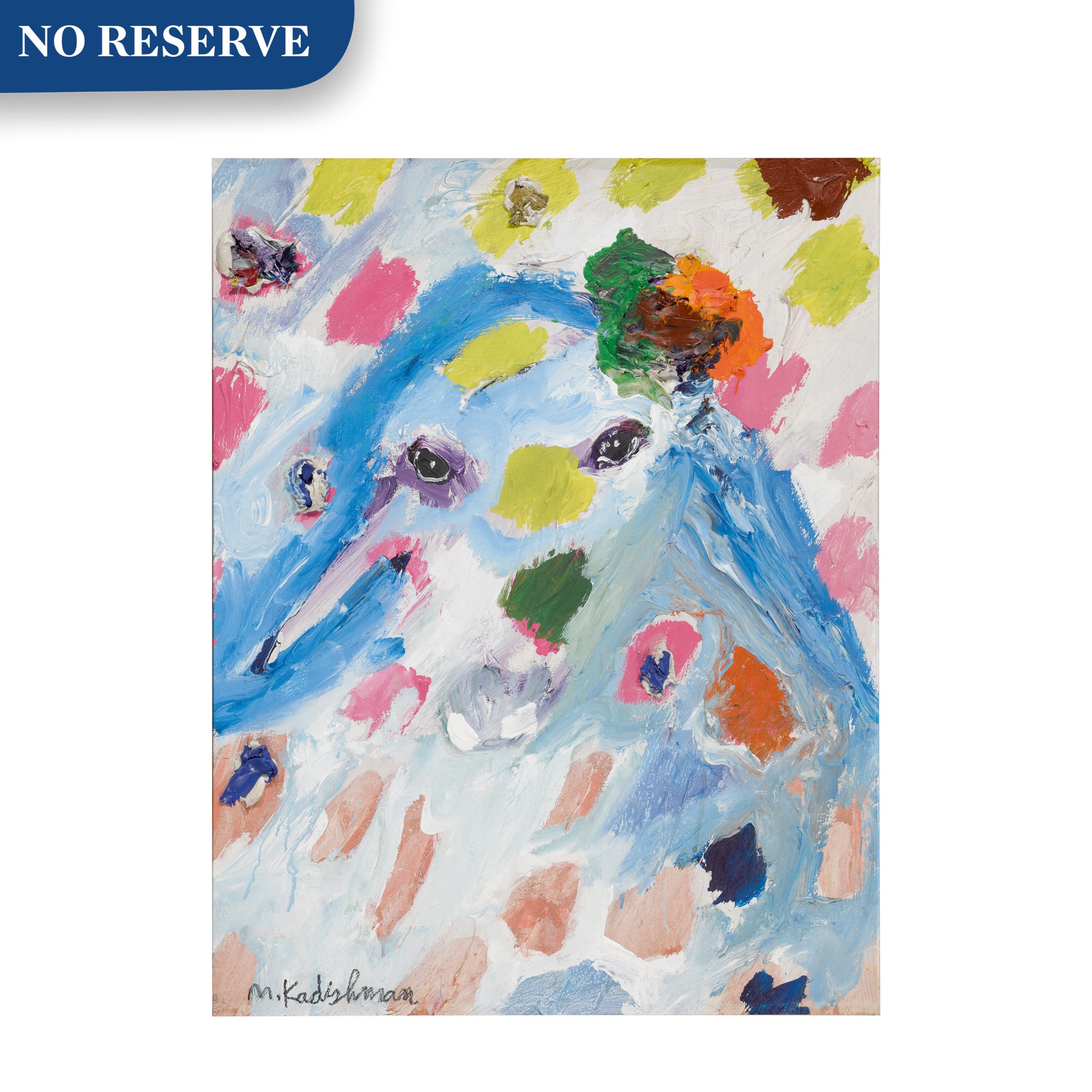
Menashe Kadishman
Head of a Lamb
His early steel constructions showed a confident dialogue with the ideas percolating through British and American minimalism, yet they were never reducible to those movements alone. The work that would define his sculptural legacy emerged most powerfully in the late 1960s and through the 1970s. His suspended steel pieces, in which flat geometric forms appeared to float between thin cables anchored to the ground and sky, became signature achievements. The two works titled Suspended, both from 1977 and rendered in weathering steel and Cor ten steel respectively, exemplify everything extraordinary about this period of his practice.
The material was chosen with great deliberateness: Cor ten steel weathers and oxidizes over time, developing a rich, earthy patina that makes the sculpture appear to be in slow, continuous conversation with the natural world around it. The pieces do not fight their environment. They breathe with it. The visual tension between the apparent weight of steel and the airy impossibility of suspension creates a meditative experience that no photograph fully captures.
Kadishman represented Israel at the Venice Biennale in 1978, an honor that brought his work into one of the most scrutinized arenas of the global contemporary art world. His installation there brought his suspended forms into the unique light and architectural context of the Giardini, and it cemented his reputation as an artist of genuine international stature. Around the same time, his public sculptures were being placed in prominent locations in Israel, the United Kingdom, and the United States, giving him a visibility that few Israeli artists of his generation achieved abroad. His work entered major institutional collections, and his name became reliably present in serious conversations about post war sculpture.
Yet Kadishman was never solely a sculptor. From the late 1970s onward, and with increasing energy through the 1980s and beyond, he pursued painting with the same commitment and originality. His canvases featuring the heads of sheep, rendered in bold gestural strokes against vivid, often electric backgrounds, became iconic in a different register. Head of a Lamb, painted in oil on canvas, is a perfect example of this dimension of his practice.
The image is at once archetypal and immediate, drawing on ancient near eastern symbolism, the sacrificial lamb, the pastoral shepherd, while simultaneously feeling urgent, contemporary, and full of raw painterly life. These works are deeply connected to his Israeli identity and to the universal themes of innocence, sacrifice, and renewal that run beneath so much of the region's cultural history. For collectors, Kadishman's work offers a rare combination: historical importance, aesthetic distinctiveness, and genuine emotional resonance. His sculptures in Cor ten steel are particularly prized, as they exist in limited numbers and their material quality only deepens with time.
Collectors who appreciate the dialogue between minimalism and expressionism, or who are drawn to the intersection of landscape, identity, and abstraction, find his work endlessly rewarding to live with. His paintings, especially the sheep series, have attracted significant attention at auction and in the secondary market, with works appearing at major international houses and continuing to find enthusiastic buyers. The paintings are accessible entry points into his world, while the sculptures represent some of the most distinctive achievements in post war Israeli art. Kadishman belongs naturally in conversation with artists like Anthony Caro, with whom he shared both a moment and a material investigation, as well as with Igael Tumarkin, another major Israeli sculptor who was navigating the space between abstraction and identity during the same decades.
Internationally, comparisons to Richard Serra are useful in terms of scale and the use of industrial steel as a medium of feeling, though Kadishman's sensibility was always warmer, more lyrical, and more deeply rooted in the symbolic than Serra's rigorous formalism. He occupies a genuinely singular position: formed in the crucible of British modernism, nourished by the landscape and mythology of Israel, and speaking ultimately in a language that is entirely his own. Menashe Kadishman passed away in Tel Aviv in 2015, leaving behind a body of work that continues to grow in critical and cultural esteem. His sculptures stand in public spaces across multiple countries, aging beautifully into their surroundings.
His paintings hang in private collections and museums around the world. The shepherd boy from Tel Aviv who learned to look at animals and land with deep, patient attention became one of the twentieth century's most quietly profound artists. To collect his work is to bring something of that quality of attention into one's own life, which is among the finest things that art can offer.
Explore books about Menashe Kadishman
Menashe Kadishman: Sculptures and Drawings
various authors
Menashe Kadishman
Yona Fischer
Kadishman: Sheep and Other Works
Museum of Modern Art Tel Aviv
The Sheep of Menashe Kadishman
Ygal Zalmona