Lawrence Weiner

Lawrence Weiner: Language Itself Is the Art
Artist Spotlight · The Collection Editorial
“Art is not a metaphor upon the relationship of human beings to objects and relations to objects and relations to relations. It is a presentation of fact.”
Lawrence Weiner, Statement, 1968
When the Stedelijk Museum in Amsterdam mounted a major retrospective of Lawrence Weiner's work, visitors encountered something rare in contemporary art: a practice that had remained radically consistent for over five decades while somehow feeling perpetually ahead of its time. Words painted directly onto walls, stenciled onto floors, pressed into enamel and steel, printed on the pages of artist books. Weiner had built one of the most recognizable and philosophically rigorous bodies of work in postwar art, and institutions from the Whitney Museum of American Art to the Kunstmuseum Basel had spent years trying to do it justice. Even now, several years after his passing in 2021, the conversation around his legacy feels not like a closing chapter but like an opening argument.
Lawrence Weiner
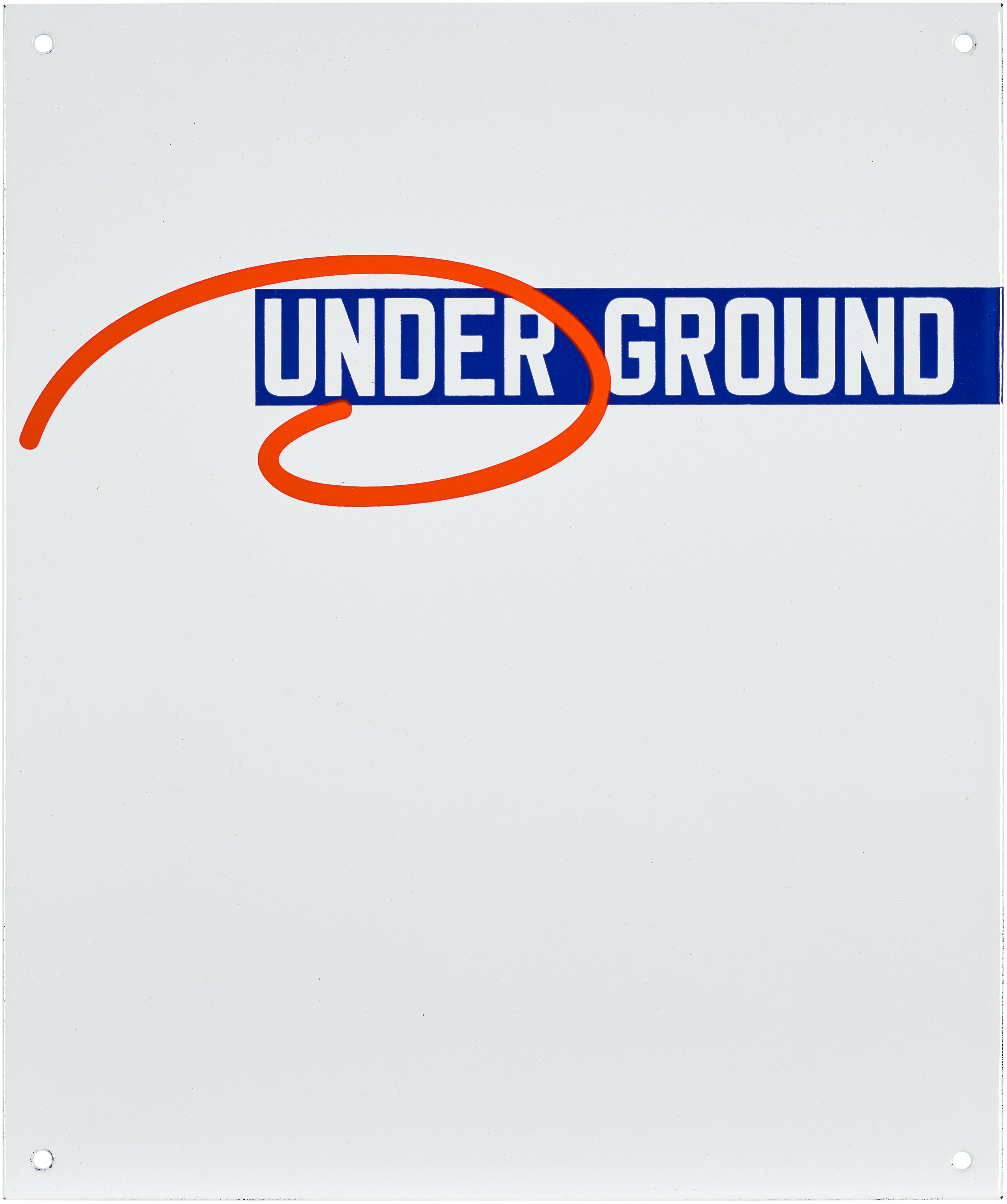
UNDER GROUND, from 15 for 150
Weiner was born in the Bronx, New York, in 1942, and the city shaped him in ways that never left his work. He grew up surrounded by the texture of urban language, the declarative energy of signage, the democratic bluntness of words used to communicate across class and culture. He briefly attended Hunter College but left without completing a degree, preferring to pursue art on his own terms. That independence became foundational.
In the early 1960s he was already experimenting with ideas about dematerialization, famously creating a series of works involving explosions on a lawn in Mill Valley, California, before concluding that the physical act of making was not the point. The idea was the point. The transmission of the idea was the point. By 1968, Weiner had formulated his Declaration of Intent, one of the most consequential statements in conceptual art history.
Lawrence Weiner
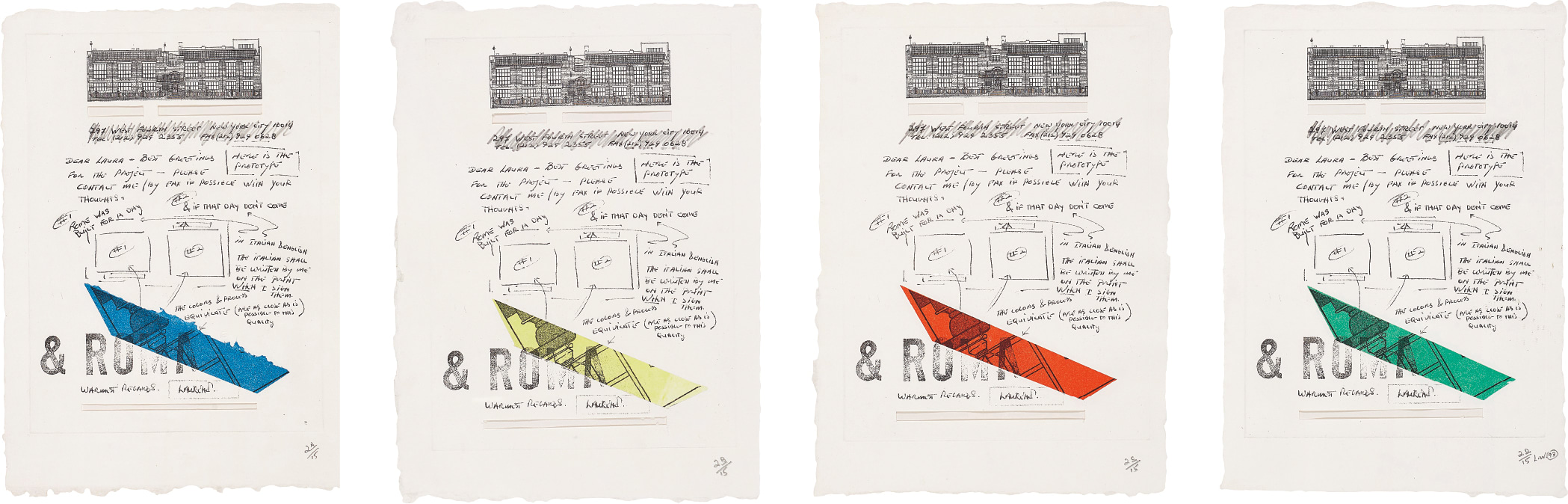
Rome Was Built for a Day & If That Day Don't Come
It read, in part, that a work could be fabricated by the artist, fabricated by someone else, or not fabricated at all, and that all three possibilities were equally valid. This was not a provocation for its own sake. It was a genuine restructuring of the relationship between artist, object, and audience. Weiner was arguing that art lives in the exchange of meaning, not in the precious singularity of a physical object.
“Once you know about a work of mine, you own it. There is no way I can climb inside somebody's head and remove it.”
Lawrence Weiner
This placed him alongside Joseph Kosuth, Sol LeWitt, and Robert Barry in the first wave of conceptual art, though Weiner's sensibility was always more poetic, more bodily, more rooted in the pleasure of language as a material in itself. The works that emerged from this framework are deceptively simple and endlessly resonant. Phrases like UNDER GROUND, MANY COLORED OBJECTS PLACED SIDE BY SIDE TO FORM A ROW OF MANY COLORED OBJECTS, or SMASHED TO PIECES IN THE STILL OF THE NIGHT are not descriptions of actions or objects so much as propositions. They invite the viewer to complete the work in their own imagination, to feel the physical weight of the words, the slight unease or joy that each phrase produces in the body.
Lawrence Weiner
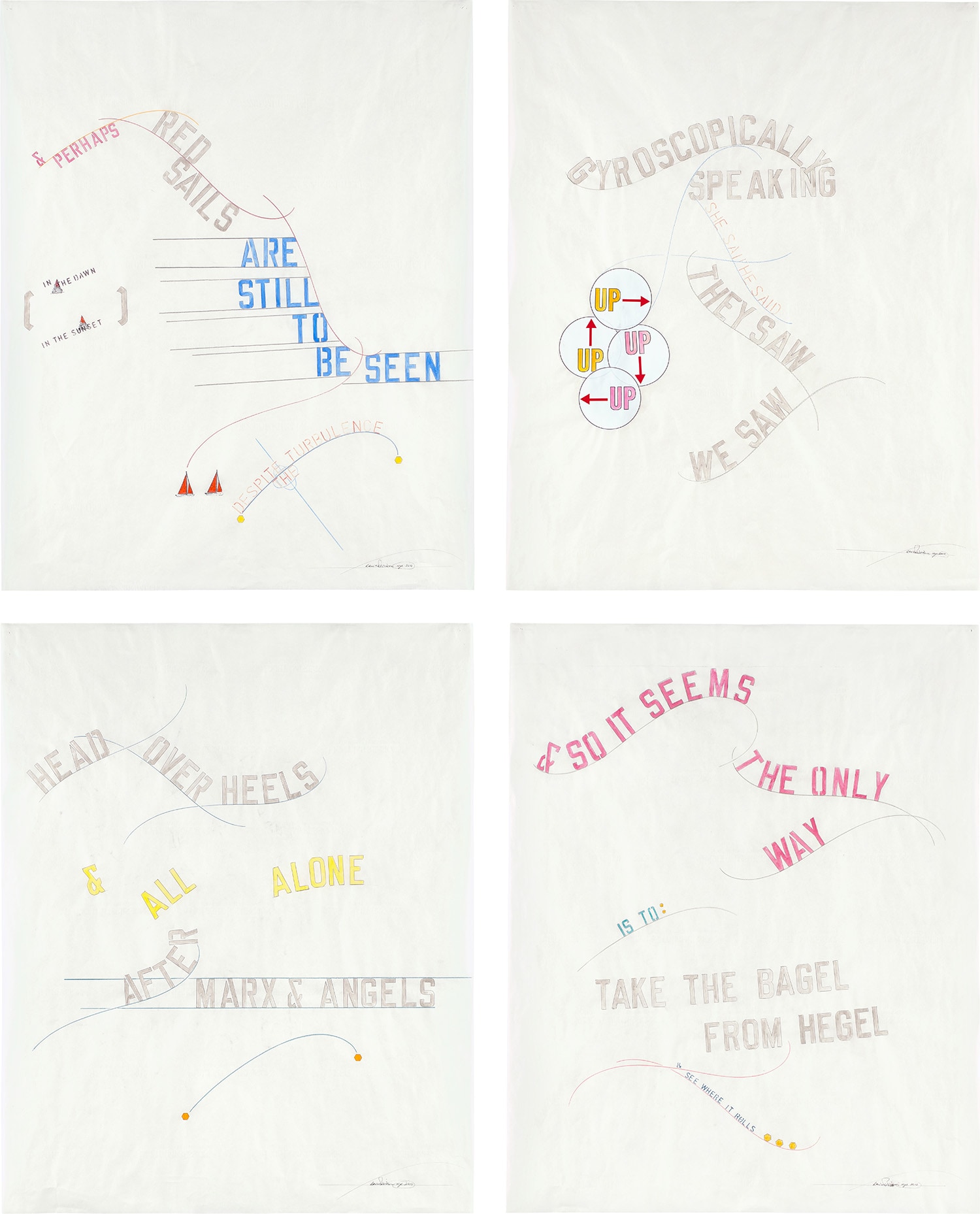
Preparatory Drawings For Gyroscopically Speaking, 2010
The vitreous enamel plaques on which many of these works appear add a further dimension. Enamel is durable, industrial, public in character, like the language of road signs and municipal notices. Weiner borrowed that visual authority and redirected it toward something private, philosophical, and quietly beautiful. For collectors, Weiner's work occupies a genuinely unusual position in the market.
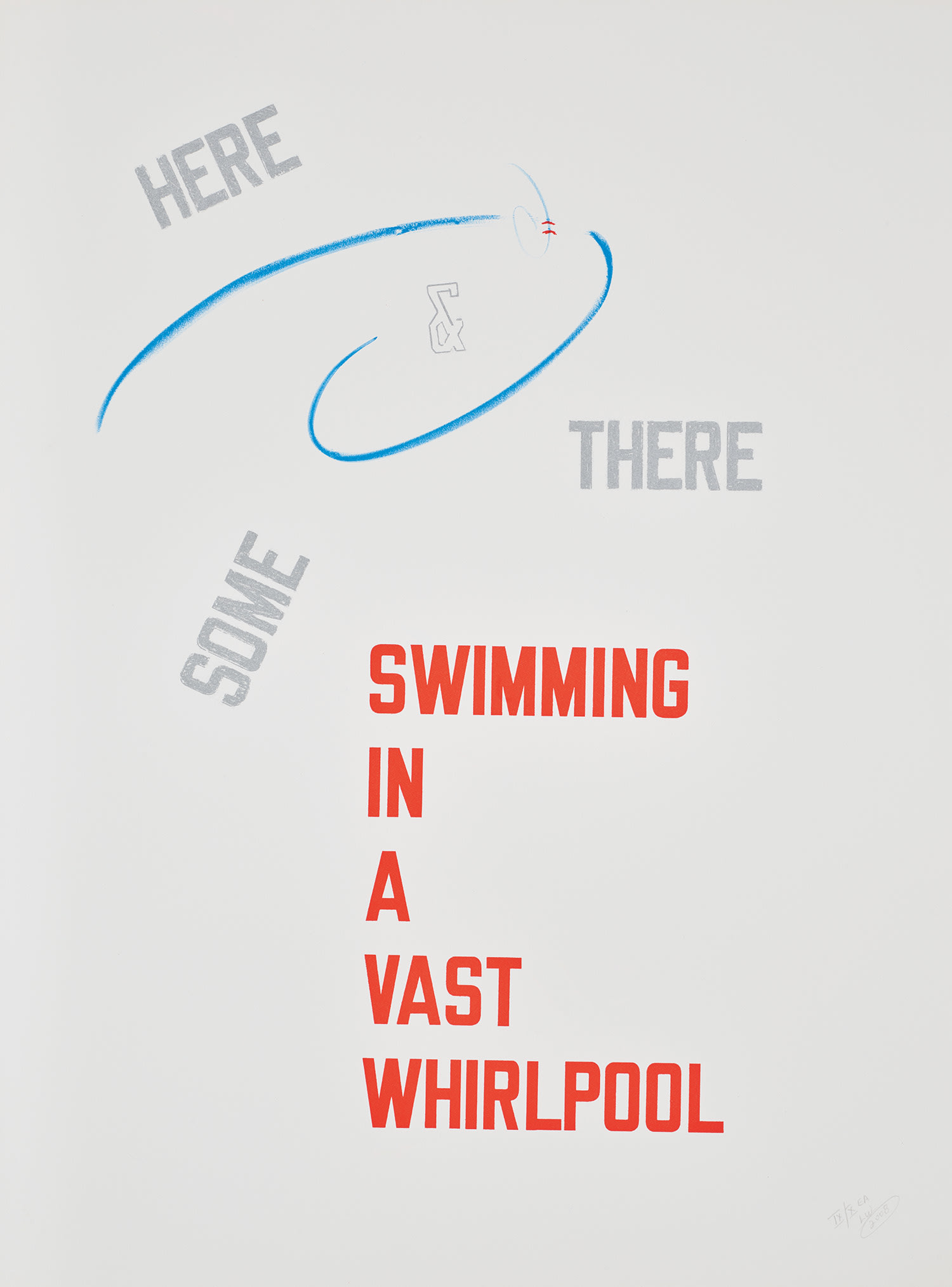
His prints and multiples, including the series of screenprints and baked enamel multiples produced in collaboration with galleries such as Marian Goodman and Yvon Lambert, represent some of the most intellectually satisfying works available at accessible price points. The artist books, produced over decades from 1971 onward, are especially prized by serious collections. They capture Weiner's thinking in concentrated form, with their offset printing, die cut stencils, and spiral binding expressing the same democratizing impulse that ran through all his work. At auction, important installations and unique works on paper have attracted significant institutional and private interest, and the market has shown sustained confidence in the depth and coherence of the practice.
Lawrence Weiner
Swimming in a Vast Whirlpool
Works like the preparatory drawings for Gyroscopically Speaking and the Rome Was Built for a Day etchings reward close looking and offer a more intimate window into his process than the wall installations alone can provide. Within the broader context of art history, Weiner stands at a fascinating intersection. He shares the conceptual rigor of his peer group but draws as readily on the visual traditions of the concrete poets, the Fluxus artists, and even the vernacular graphics of the countercultural press. Artists including Jenny Holzer and Barbara Kruger have cited the precedent he set for text as visual material, and his influence can be felt across a generation of artists who use language not as illustration or caption but as primary substance.
His friendship and dialogue with artists like Dan Graham and Carl Andre deepened his thinking about site, context, and the politics of artistic production, while his collaborations with musicians and filmmakers, particularly in the downtown New York scene of the 1970s and 1980s, gave his practice a social and performative dimension that purely academic readings sometimes miss. The question of legacy is, for Weiner, inseparable from the question of access. He was committed throughout his life to the idea that art should not be the exclusive property of the wealthy or the institutionally initiated. His Declaration of Intent was in this sense a political document as much as an aesthetic one.
By insisting that a work need not be fabricated to exist, he was breaking the chain of ownership that art markets depend upon, at least in spirit, while still producing objects of genuine beauty and craft when the situation called for it. The enamel plaques, the etchings, the books, all exist in the world as physical things that can be held and exchanged and displayed. But they carry within them the memory of a more open proposition. What draws the most discerning collectors to Weiner today is precisely this combination of formal elegance and conceptual depth.
His works look extraordinary in domestic and institutional settings alike, partly because they participate in the architecture of whatever space they inhabit, and partly because they ask something of you every time you encounter them. They do not resolve. They do not explain themselves. They stay open, like a good question asked in good faith, and that quality of sustained openness is, in the end, what marks the work of an artist who genuinely changed the terms of what art could be.
Explore books about Lawrence Weiner
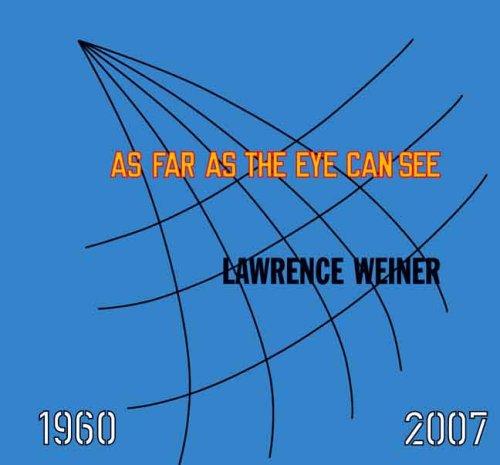
Lawrence Weiner: As Far as the Eye Can See
Lawrence Weiner, Cordy Ryman
Lawrence Weiner: Dia Art Foundation Publication
Lawrence Weiner
Lawrence Weiner: Works and Reconstructions
Benjamin H. D. Buchloh
Lawrence Weiner: In Addition To
Lawrence Weiner
Lawrence Weiner: Books and Things 1965-1974
Lawrence Weiner, others