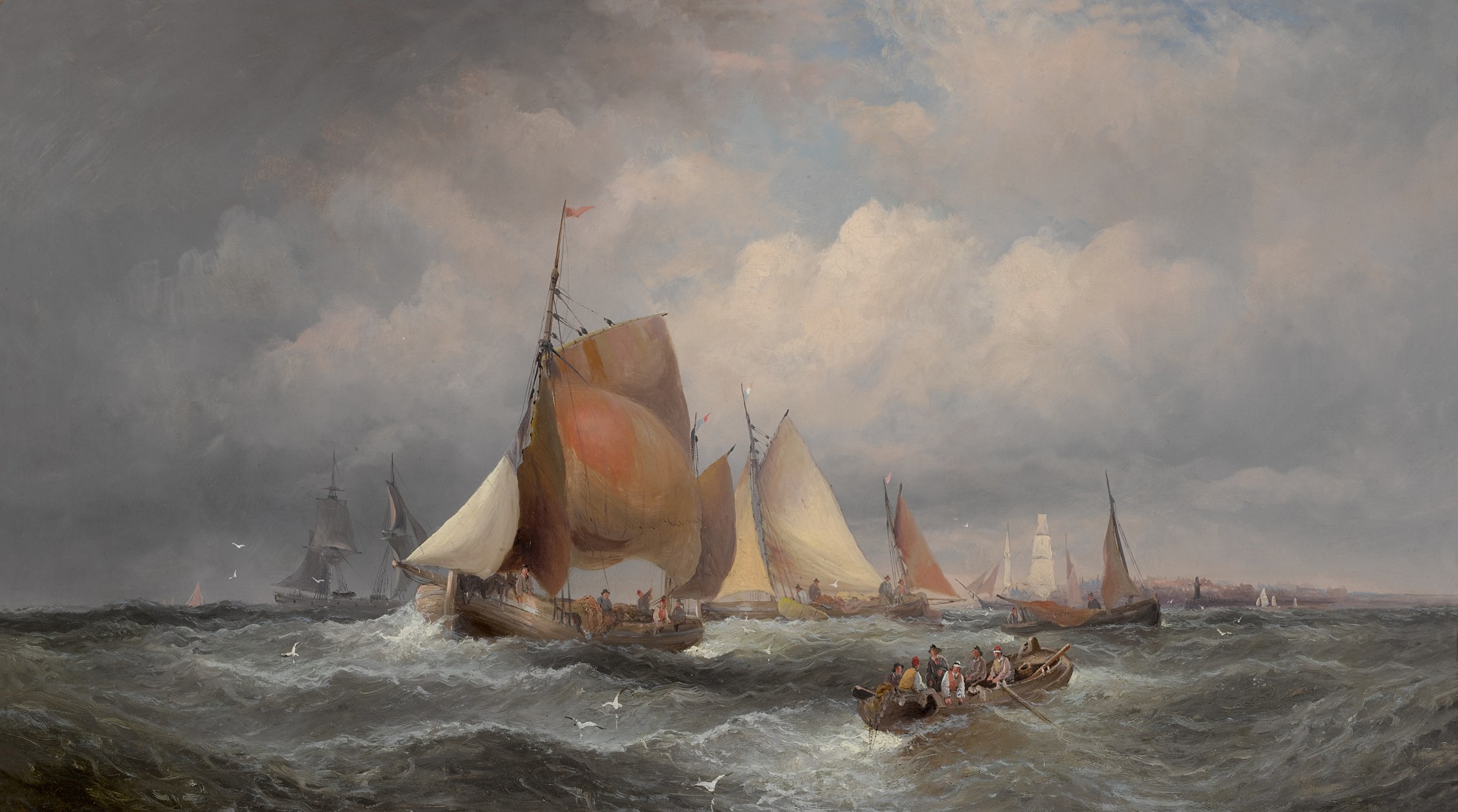
There is a particular quality of silence that settles over a great marine painting, the kind that makes you feel the salt air and hear the creak of timber even within the hush of a gallery. Edward William Cooke understood this silence better than almost any painter of his era. Born in London in 1811, he spent a lifetime chasing the precise moment when water catches the sky, when a vessel leans into the wind, when the atmosphere of a harbour at dusk becomes something close to music. His canvases remain among the most quietly commanding works in the tradition of British marine art, and they continue to draw serious collectors who recognise in them a rare combination of scientific rigour and genuine poetic feeling. Cooke came into the world already surrounded by art and craft. His father, George Cooke, was a distinguished engraver, and the young Edward grew up in an environment where close observation and technical discipline were simply the fabric of daily life. He began his career as an engraver himself, contributing illustrations to botanical and architectural publications, and this early training left permanent marks on his sensibility. The habit of precision, the respect for accurate detail, the understanding that a line must carry meaning, all of these became central to his later painting even as he moved away from the engraver's plate and toward oil and watercolour. He was largely self taught as a painter, which gives his eventual mastery an almost mythological quality, the craftsman who became an artist through sheer devotion to looking. As a young man, Cooke travelled extensively through Europe, and the journeys shaped his vision entirely. The Netherlands held a particular fascination for him. He spent considerable time along the Dutch coast, studying the flat grey light of the North Sea, the heavy working boats of the fishing communities, and the relationship between human industry and natural force that had preoccupied the great Dutch marine painters of the seventeenth century. He was keenly aware of that tradition, of Willem van de Velde the Younger and Jan van de Cappelle, and he positioned himself as a thoughtful inheritor of their legacy rather than a mere imitator. Venice, too, became a recurring subject, its lagoons offering different problems of light and reflection that Cooke pursued across multiple visits with something approaching scientific obsession. His artistic development accelerated through the 1840s and 1850s, the decades in which he established himself as one of the most respected marine painters working in Britain. He was elected a Fellow of the Royal Academy in 1863, a recognition that placed him among the very highest tier of British artistic achievement. What distinguished Cooke from many of his contemporaries was the absolute seriousness with which he approached the representation of vessels. He was not content to suggest a boat; he needed to understand it, to know how it moved, how it was rigged, how its hull sat in the water under specific conditions of wind and tide. This knowledge made his paintings authoritative in a way that purely impressionistic marine work often is not. You trust what you are looking at, and that trust is itself a form of beauty. Among the works that best demonstrate his gifts is French Fishing Boats in the English Channel, an oil on canvas that captures everything essential about his practice. The painting places working vessels in the midst of a Channel crossing, the sea neither calm nor catastrophic but alive with the particular restless energy of that stretch of water. Cooke renders the swell with a technical command that rewards close looking, each wave described with an understanding of how water behaves in volume and light that recalls the discipline of his engraving years. The boats themselves are painted with affectionate specificity, their rigging and hull forms observed rather than invented. Yet for all its precision, the work breathes. The sky and sea feel genuinely atmospheric, and there is real drama in the scene without any resort to theatrical exaggeration. It is the kind of painting that grows in your estimation over years of living with it. For collectors, Cooke represents a particularly satisfying proposition. His works appear regularly at Christie's and Sotheby's, where they have consistently attracted strong attention from buyers who understand the marine tradition and appreciate the combination of historical significance and visual pleasure that his canvases provide. Watercolours and oils alike come to market, and while the oils tend to command the stronger prices, the watercolours offer an opportunity to acquire genuine examples of his draughtsmanship at a more accessible level. When assessing a work, collectors and advisors look for the characteristic qualities: the articulate rendering of water surface, the precise but never pedantic treatment of vessels, and that particular quality of ambient light that seems to exist in its own atmospheric envelope. Condition and provenance matter greatly, as with any nineteenth century British work, and pieces with clear exhibition or collection histories are naturally preferred. To understand Cooke's place in art history is to trace a line through the tradition of marine painting that runs from the Dutch Golden Age through to the most rigorous practitioners of the nineteenth century. He shares sensibility with contemporaries such as Clarkson Stanfield, whose theatrical seascapes brought marine painting to a wide public audience, and with the more intimate harbour studies of Samuel Owen. There are also points of comparison with the later work of Henry Moore, the Victorian marine painter rather than the twentieth century sculptor, whose treatment of coastal light and working boats echoes many of Cooke's own preoccupations. Cooke occupied a singular position within this company, valued for a combination of scientific accuracy and painterly warmth that made his work appealing both to the expert eye and to the general lover of beauty. Cooke died in 1880, leaving behind a body of work that represents one of the most coherent and accomplished achievements in Victorian marine painting. His legacy endures not simply because his paintings are beautiful, though they are, but because they embody a way of looking at the world that feels genuinely rare. He taught himself to see water as it actually is, not as convention suggested it should appear, and the effort of that seeing produced art that remains fresh and alive more than a century after his death. For collectors drawn to the sea, to the tradition of close observation, or simply to the pleasure of a great painting that rewards sustained attention, Edward William Cooke offers something close to irreplaceable.