Barnett Newman
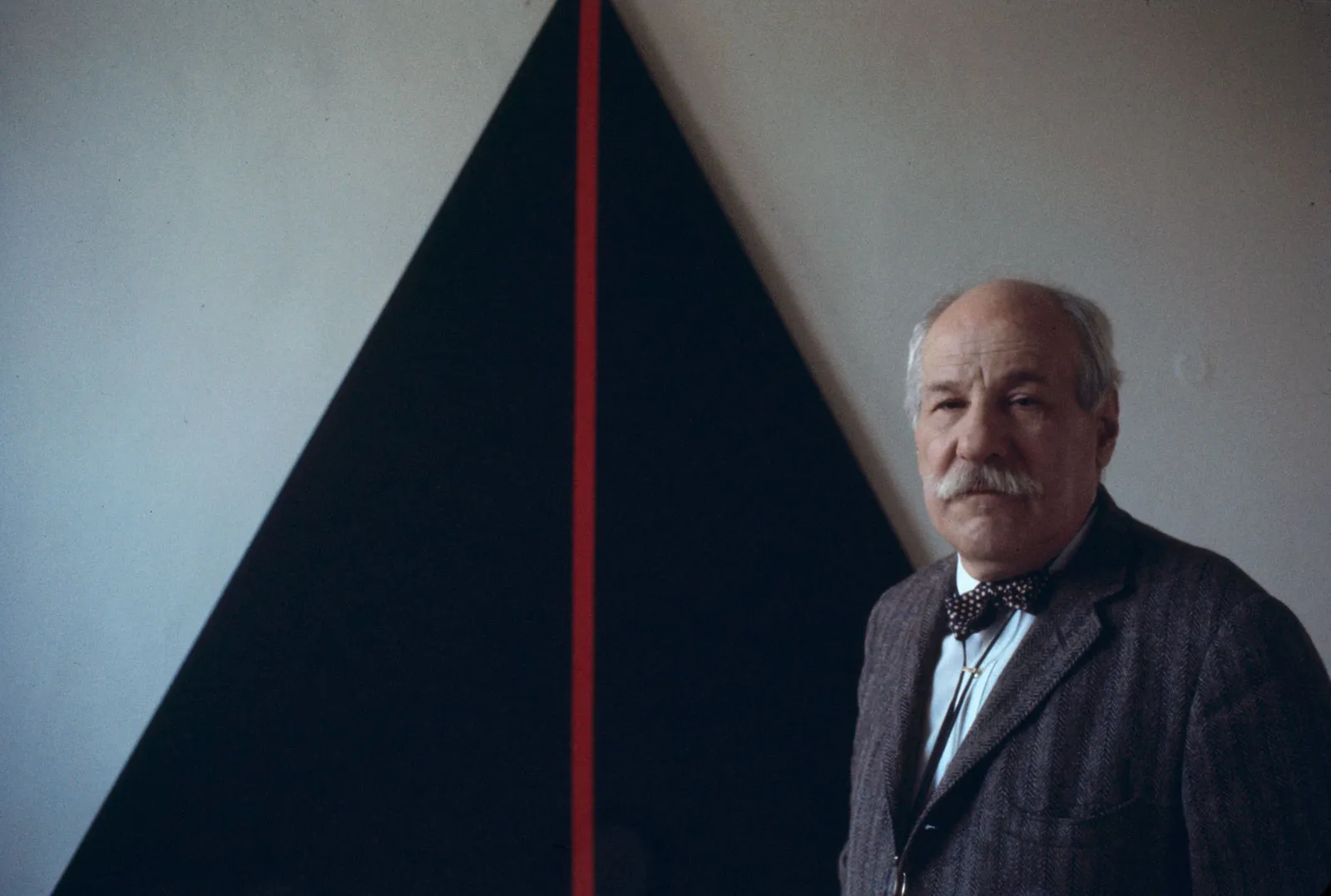
Barnett Newman and the Infinite Line
Artist Spotlight · The Collection Editorial
“I hope that my painting has the impact of giving someone, as it did me, the feeling of his own totality.”
Barnett Newman, statement, 1952
Stand before one of Barnett Newman's monumental canvases and something extraordinary happens. The sheer scale of the work pulls you in, the color surrounds you, and then the zip, that narrow vertical band cutting through fields of pure hue, arrests your gaze entirely. It is not merely a painting you are looking at. It is, as Newman always insisted, an experience of the sublime.
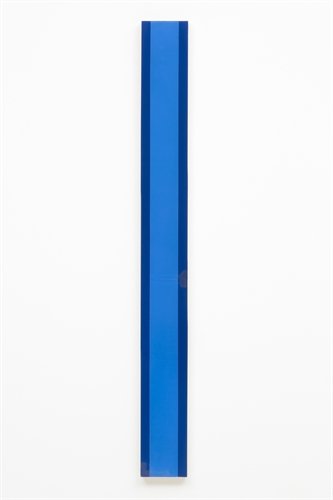
Barnett Newman
The Moment, 1966
Decades after his death in 1970, institutions and collectors alike continue to rediscover the radical depth of his contribution, and his canvases remain among the most emotionally commanding works in any room they occupy. Newman was born in New York City in 1905 to Jewish immigrants from Poland, and the circumstances of his upbringing would quietly inform everything he made. He came of age in a city of density and contradiction, a place where the sacred and the secular existed in constant negotiation. He studied philosophy at the City College of New York and later immersed himself in art history, developing the intellectual frameworks that would eventually give his visual practice its distinctive urgency.
For a period he even ran for mayor of New York, an unlikely episode that nonetheless speaks to his lifelong conviction that art and civic life were not separate concerns. His turn toward painting came in the 1940s, a period of enormous creative ferment in New York as artists on both sides of the Atlantic grappled with the aftermath of catastrophe and the collapse of old certainties. Newman was deeply engaged in these conversations. He wrote criticism, organized exhibitions, and corresponded with peers including Mark Rothko and Clyfford Still, forming part of a loose but consequential circle of painters who believed abstraction could carry genuine philosophical and emotional weight.
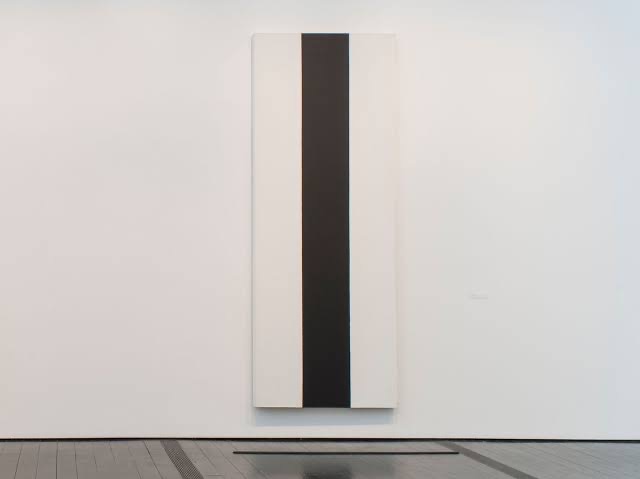
Barnett Newman
Black and Grey
His early works from this period were exploratory, marked by biomorphic shapes and Surrealist influences, but Newman was already searching for something more austere and more direct. The breakthrough came in 1948 with a painting Newman called Onement I, a small but seismic work in cadmium red with a single vertical stripe of lighter red running through its center. Newman reportedly stared at this canvas for months before declaring it finished and, in doing so, understood that he had found his language. The zip, as it came to be known, was not a dividing line but a unifying one.
“The image we produce is the self-evident one of revelation, real and concrete, that can be understood by anyone who will look at it without the nostalgic glasses of history.”
Barnett Newman, The Sublime Is Now, 1948
It created relationship between the fields of color on either side, generating tension and resolution simultaneously. From that moment forward Newman pursued this vocabulary with total commitment, scaling his canvases to monumental proportions and saturating them with color at an intensity that few painters before or since have matched. His series Stations of the Cross, comprising fourteen paintings completed between 1958 and 1966 and first exhibited at the Solomon R. Guggenheim Museum in New York in 1966, represents one of the most sustained meditations on suffering and endurance in postwar art.
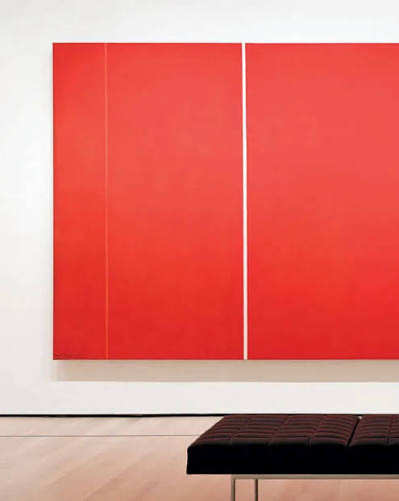
Barnett Newman
Red Square, 1950
Working in raw canvas with black and white acrylic, Newman stripped the work of color to concentrate purely on structure and meaning. The series asked what it meant to bear witness, to lament, and ultimately to find a way forward. It was received with both admiration and controversy, but time has confirmed its status as a defining achievement. Newman was never interested in illustration or narrative.
He believed abstraction could access emotional truths that representational art could only approximate. For collectors, Newman's work presents a compelling and layered field of opportunity. His paintings command extraordinary attention at auction when they appear, but his works on paper and his prints offer equally significant entry points into his thinking. Etchings from his late career, including works completed in 1969, demonstrate the same conceptual precision as his large canvases, with the zip translated into the intimacy of the printed surface with remarkable authority.
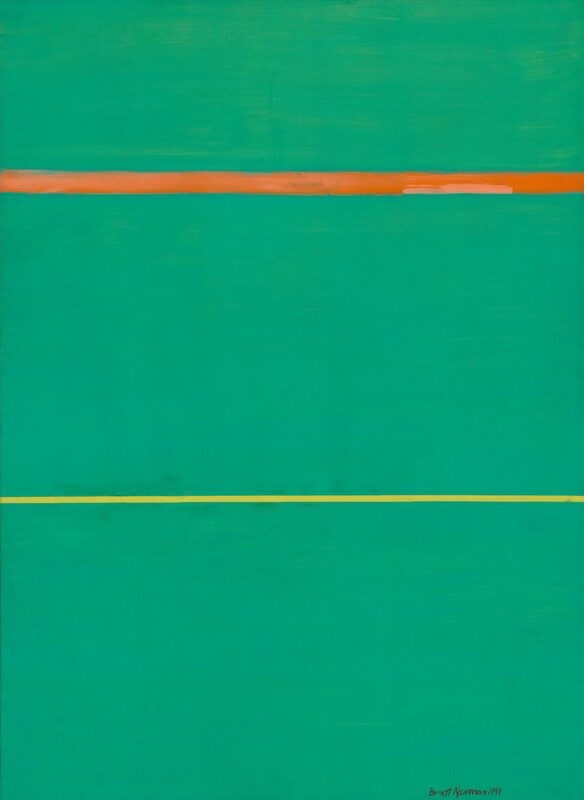
Barnett Newman
Something, 1950
His screenprints on Plexiglas from 1966, produced in an edition for Multiples Press in New York and printed by Knickerbocker Machine and Foundry, represent a fascinating moment of experimentation with material and transparency, bringing his vocabulary into three dimensional space with quietly brilliant results. Collectors who approach Newman through these works often find themselves drawn inexorably toward his larger canvases, understanding how the same thinking operates across scale. Newman belongs to the generation of American artists that also includes Willem de Kooning, Franz Kline, and Ad Reinhardt, but his closest affinities in terms of ambition and metaphysical reach are perhaps with Rothko and Still. Like them, he was preoccupied with what painting could feel like rather than what it could represent.
Yet Newman's visual language is in many ways the most economical of this group, the most committed to reduction. His influence on subsequent generations has been profound and well documented. Donald Judd, Frank Stella, and the broader Minimalist movement all drew on the structural clarity Newman achieved, even as they departed from his insistence on the spiritual dimension of abstract form. The legacy of Barnett Newman is, ultimately, inseparable from the question of what art is for.
He believed with remarkable consistency throughout his career that painting could provide what he called a sense of place, a means by which a viewer could stand in the world and feel its scale and significance. His theoretical writings, which appeared in journals and catalogues throughout the 1940s and 1950s, remain models of rigorous and passionate art criticism. He was a thinker who made visible objects, and a maker who thought with total seriousness. In a moment when the art world is once again asking large questions about meaning, presence, and the relationship between the individual and the infinite, Newman feels not like a historical figure to be revisited but like a contemporary whose urgency has never diminished.
Explore books about Barnett Newman
Barnett Newman: Complete Writings and Interviews
Barnett Newman, edited by John P. O'Neill
Barnett Newman
Thomas B. Hess
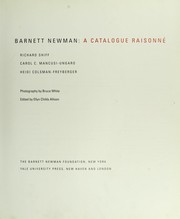
Barnett Newman: A Catalogue Raisonné
Edited by Melissa Ho, curated by Ann Temkin
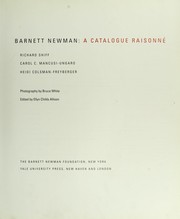
Barnett Newman
Michael Auping
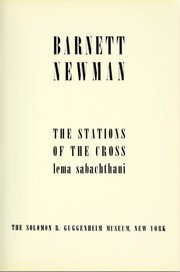
The Stations of the Cross: Lema Sabachthani
Edited by various, essays by Newman scholars
Barnett Newman: Perception and Being
Edited by Amy Newman
Barnett Newman: Selected Writings and Interviews
Edited by Gerhard Richter
Barnett Newman
Kirk Varnedoe