Alma
2005
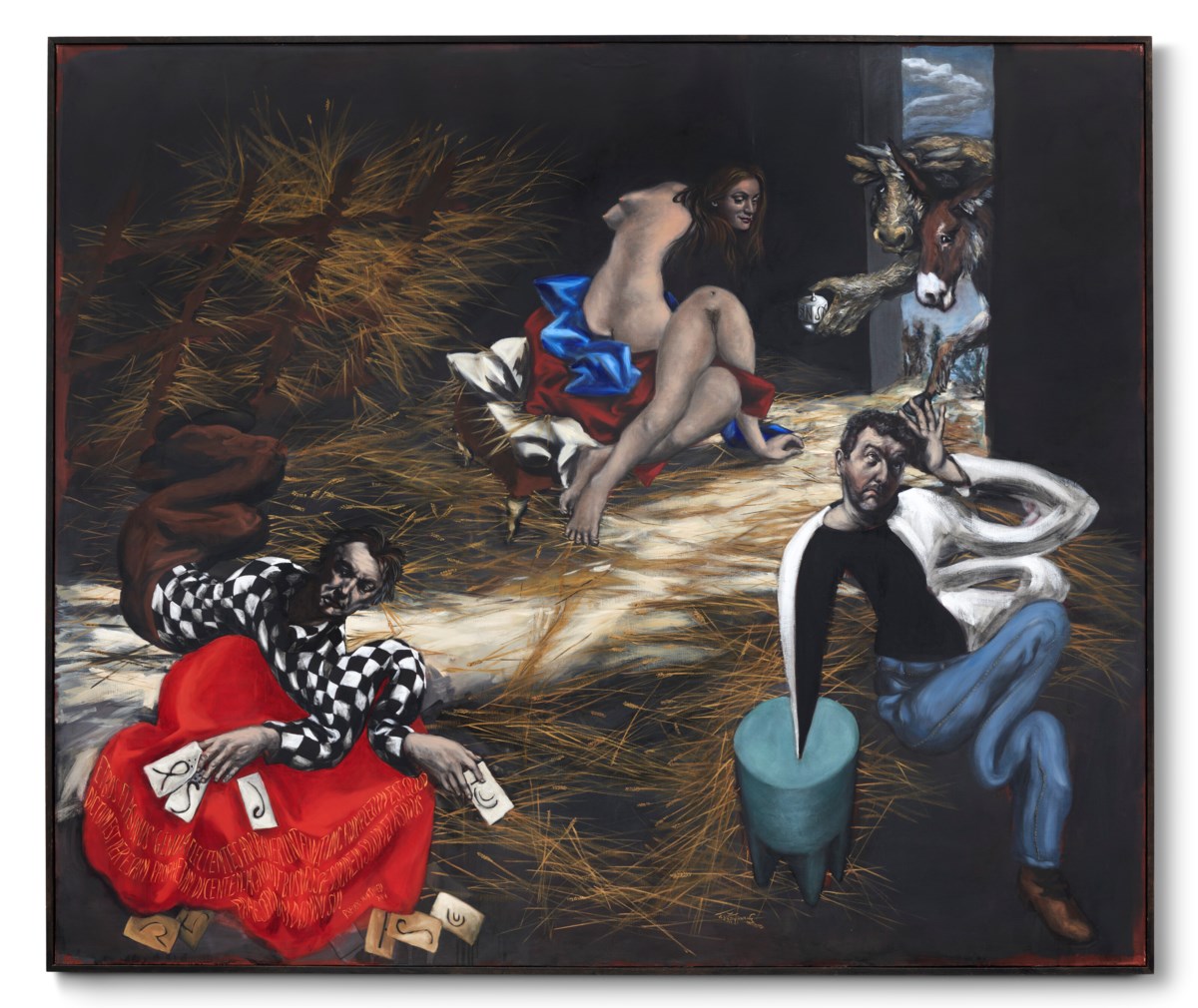
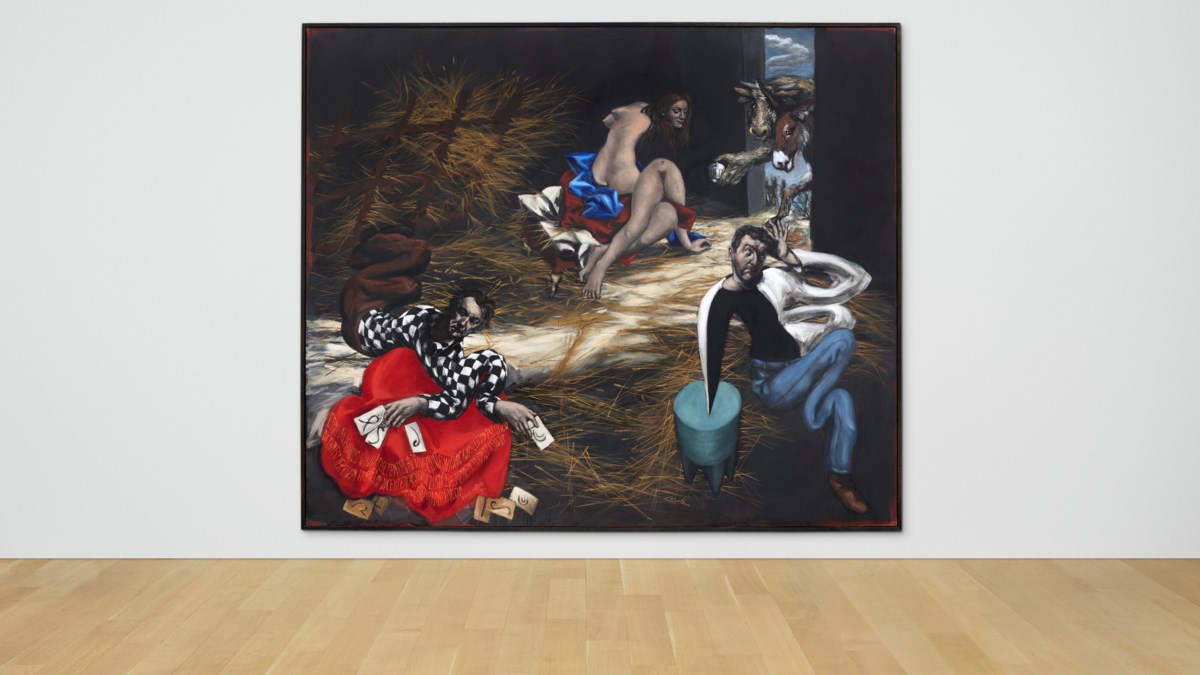
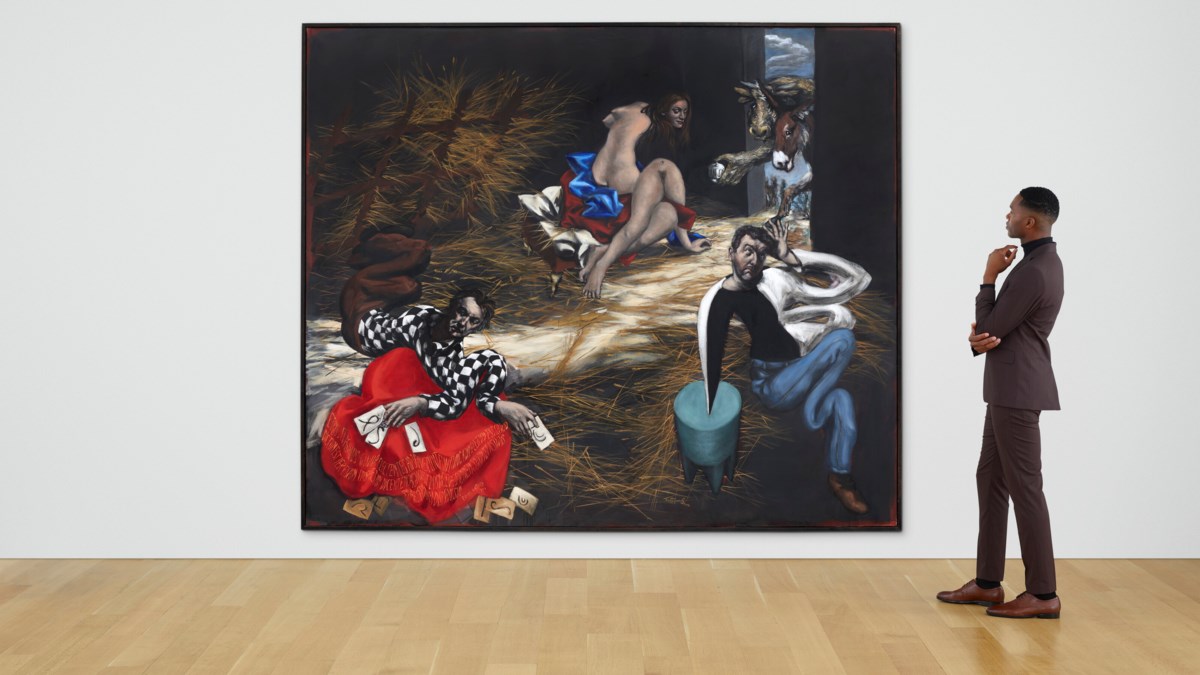
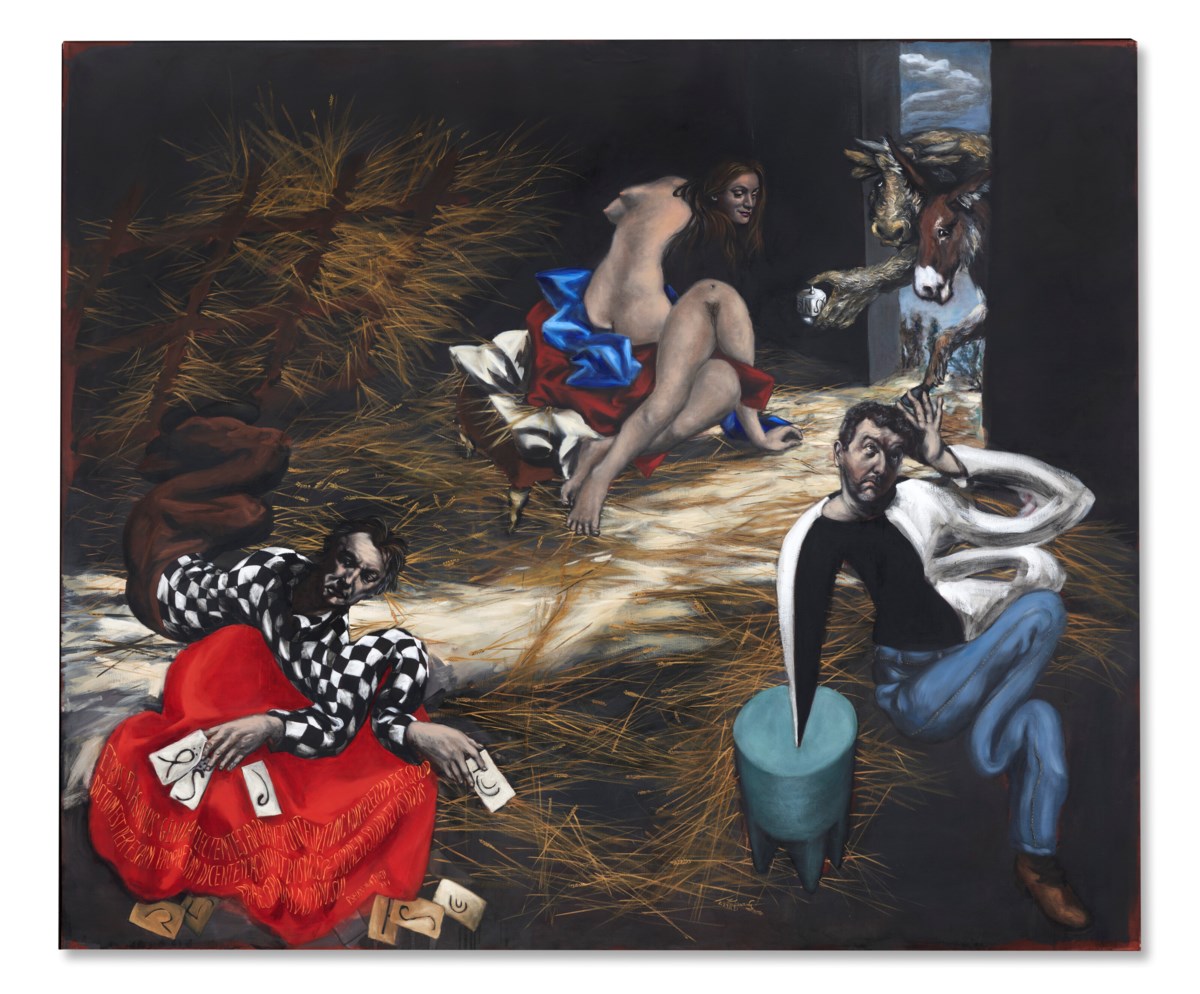
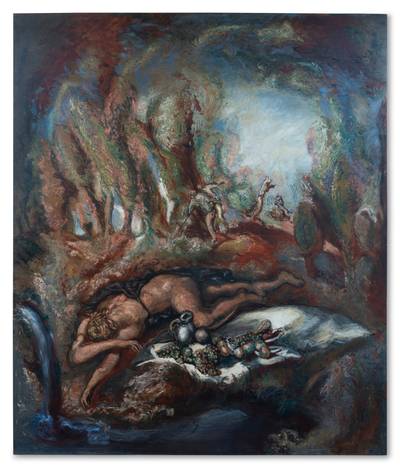
A monumental oil on canvas, *Alma* by Gérard Garouste pulsates with the artist's characteristically raw and expressive brushwork, weaving together mythological and spiritual imagery in a dense, turbulent composition. Rich, earthy tones collide with vivid bursts of color, conjuring figures that seem to emerge from and dissolve into the painted surface itself. True to Garouste's enduring fascination with text, tradition, and the human psyche, the work invites the viewer into a labyrinthine narrative suspended between the sacred and the grotesque.
- Medium
- oil on canvas
- Dimensions
- Signed
- Yes
- Spotted At
- Auction House · Christie's
Notes
LITERATURE M. Onfray, Gérard Garouste, Paris, 2009 (illustré en couleurs pp. 216-217; détails illustrés en couleurs p. 218). Gérard Garouste, En chemin, catalogue d'exposition, Fondation Marguerite et Aimé Maeght, Saint-Paul de Vence, 2015 (illustré en couleurs pp. 200-201). EXHIBITED Paris, Galerie Templon, L'Ânesse et la Figue, janvier-mars 2006, p. 30 (illustré en couleurs au catalogue d'exposition p. 31; détails illustrés en couleurs au catalogue d'exposition pp. 32, 34, 36 et 37). Milan, Fondation Mudima, Gérard Garouste, Les librairies aveugles, mars-avril 2006, p. 44 (illustré en couleurs au catalogue d'exposition p. 45). Paris, Centre Pompidou, Gérard Garouste, septembre 2022-janvier 2023, p. 301 (illustré en couleurs au catalogue d'exposition pp. 163 et 277). Conditions of sale Brought to you by Elisabetta Vitullo Junior Specialist, Head of Day Sale EVITULLO@CHRISTIES.COM +33 (0)1 40 76 85 68 LOT ESSAY Skip to main content FRANÇAIS ENGLISH Il faut qu’on ressente qu’une histoire va se raconter, mais qu’elle se dérobe Gérard Garouste Depuis plusieurs décennies, Gérard Garouste développe une œuvre où la « figuration déformante » devient un langage à part entière. Rien, chez lui, ne se contente de représenter : tout se tord, se fragmente, se recompose. Son univers est un théâtre peuplé de mythes, de légendes, de contes et des grands textes fondateurs, d’Ovide à Kafka, en passant par Rabelais, Cervantès et les Écritures juives auxquelles il s’est converti. Son rapport au dessin, matrice de toute sa peinture, est fondé sur la spontanéité. Lors de son discours pour son entrée officielle à l’Académie des Beaux-Arts en 2019, Garouste confie : « Je dessine ce qui me passe par la tête, cela vient naturellement en dehors de tout contrôle intellectuel. [...] Le principe, c’est de ne pas avoir de règle, sauf celle de ne pas perdre mon carnet ». Cette disponibilité au surgissement fait de chaque œuvre un espace ouvert où le sens se dérobe autant qu’il se construit. Au milieu des années 1990, l’artiste apprend l’hébreu, langue de l’interprétation infinie. Les méthodes exégétiques juives, telles que les jeux de permutations, les explorations des racines, ou encore équivalences numériques, deviennent pour lui une manière d’aborder la peinture. Il tord les figures comme on tord les mots ; il décompose un récit comme on déplie un texte biblique. Ainsi, ses tableaux fonctionnent comme des labyrinthes : leur logique est interne, mouvante, parfois presque onirique, et leur lecture échappe à toute interprétation univoque. Garouste revisite ainsi l’imagerie religieuse, non pour la célébrer, mais pour la retourner, en questionner les fondements culturels et linguistiques. Présentée dans le cadre de la rétrospective Gérard Garouste au Centre Pompidou à Paris de septembre 2022 à janvier 2023, Alma s’inscrit dans cette exploration picturale des récits fondateurs. Cette œuvre monumentale de 270 cm de haut et 320 cm de large, peinte en 2005, fait partie de la série l’Ânesse et la Figue, un ensemble de peintures dédié à cette réflexion autour de la langue hébraïque. Présentée dans le cadre de la rétrospective Gérard Garouste au Centre Pompidou à Paris de septembre 2022 à janvier 2023, Alma s’inscrit dans cette exploration picturale des récits fondateurs. Cette œuvre monumentale de 270 cm de haut et 320 cm de large, peinte en 2005, fait partie de la série l’Ânesse et la Figue, un ensemble de peintures dédié à cette réflexion autour de la langue hébraïque. Cette jeune femme, dépourvue de bras semble mépriser ou interroger cette toupie énigmatique. Le tableau se construit comme un rêve : l’histoire est familière, pourtant le sens nous échappe, lié à l’impression qu’un élément manque. Ce manque fait écho à celui du corps d’Alma, mais aussi à une question théologique ancienne : la traduction du mot hébreu almâ. La tradition chrétienne l’a traduit par « vierge », fondant ainsi le dogme de la naissance virginale du Christ. En revenant au texte hébreu, Garouste remet en question le socle culturel sur lequel repose une grande part de notre imaginaire religieux. Cette réflexion s’inscrit dans la logique du tsérouf (permutation des lettres hébraïques), qui traverse toute la série L’Ânesse et la Figue. En hébreu, il suffit d’inverser deux lettres pour passer du mot « ânesse » à « figue ». De cette proximité naissent des correspondances : l’ânesse devient monture, puis créature hybride, puis animal parlant. Elle circule d’une toile à l’autre comme un motif libre, détaché du récit biblique tout en restant nourri par lui. Alma participe de ce même mouvement : elle met en crise le récit de la Nativité, non pour le nier, mais pour montrer combien son sens est construit, transformé, parfois mal interprété. L’œuvre n’illustre pas : elle interroge. Elle est formée d’associations arbitraires et de réminiscences culturelles qui, comme dans un rêve, composent une image dont la sortie semble hors de portée. Giotto di Bondone, No. 17 Scènes de la vie du Christ: 1. Nativité — Naissance de Jésus. Chapelle Des Scrovegni, Padoue. Photo © Public domain / Wikimedia Commons. Pour saisir visuellement la stratégie de déplacement mise en œuvre par Garouste, la comparaison avec une Nativité médiévale stable, telle que celle de Giotto dans les fresques de la Chapelle Scrovegni, datée d’environ 1305, s’avère particulièrement éclairante. Alors que Giotto ordonne l’espace, hiérarchise les figures et offre une lecture immédiate du récit sacré, Garouste, lui, disperse les signes, introduit des anachronismes et mêle des objets culturels contemporains qui brouillent toute lecture linéaire et transforment l’interprétation en véritable champ de tension. La confrontation des deux œuvres met ainsi en évidence le passage de l’icône explicative à l’image énigmatique. We must feel that a story is going to be told, but that it is elusive Gérard Garouste For several decades, Gérard Garouste has been developing artistic works where “distorted figurative imagery” becomes a language in its own right. Nothing in his work produces content to be represented: everything twists, fragments, recomposes. His universe is a theatre populated with myths, legends, tales and leading founding texts, from Ovid to Kafka, via Rabelais, Cervantes and the Jewish Scriptures to which he converted. His relationship to drawing, the matrix of all his painting, is based on spontaneity. During his speech for his official entry into the Academy of Fine Arts in 2019, Garouste confided: “I draw what goes through my head, it comes naturally outside of any intellectual control. [...] The principle is not to have a rule, except that of not losing my notebook.” This readiness for what may suddenly appear conveys to each work an open space where meaning is as elusive as it is constructed. In the mid-1990s, the artist learned Hebrew, the language of infinite interpretation. Jewish exegetical methods, such as permutation games, root explorations, or numerical equivalences, became a way for him to approach painting. He twists figures as one twists words; he breaks down a story as one unfolds a biblical text. Thus, his paintings function like labyrinths: their logic is internal, moving, sometimes almost dreamlike, and their reading escapes any univocal interpretation. Hence, Garouste revisits religious imagery, not to celebrate it, but to turn it around, questioning its cultural and linguistic foundations. Presented as part of the Gérard Garouste retrospective at the Centre Pompidou in Paris from September 2022 to January 2023, Alma is part of this pictorial exploration of the founding narratives. Painted in 200, this monumental work—270 cm high and 320 cm wide— is part of the series The Donkey and the Fig, a set of paintings dedicated to this reflection on the Hebrew language. In Alma, the artist represents himself alongside the designer Philippe Starck, his long-time friend, leaning on his famous Bubu 1er stool. A naked girl observes them: she is the central figure of this scene, which freely takes up the theme of the Nativity. Through a door, a donkey and an ox enter discreetly. They bring a gift: a Hanukkah spinning top on which is inscribed the word “Alma”, which gives the painting its title. This young woman, devoid of arms, seems to despise or question this enigmatic spinning top. The painting is constructed like a dream: the story is familiar, yet the meaning escapes us, linked to the impression that an element is missing. This lack echoes that of Alma's body, but also an ancient theological question: the translation of the Hebrew word “alma”. The Christian tradition translates it as “virgin”, thus founding the dogma of the virginal birth of Christ. Returning to the Hebrew text, Garouste questions the cultural foundation on which a large part of our religious imagination rests. This reflection is part of the logic of the tserouf (permutation of Hebrew letters), which runs through the whole series L'Ânesse et la Figue (The Donkey and the Fig). In Hebrew, it is enough to reverse two letters to go from the word “donkey” to “fig”. From this proximity, correspondences are born: the donkey becomes a mount, then a hybrid creature, then a talking animal. She moves from one canvas to the other like a free motif, detached from the biblical story while remaining nourished by it. Alma participates in this same movement: it puts the story of the Nativity in crisis, not to deny it, but to show how much its meaning is constructed, transformed, sometimes misinterpreted. The work does not illustrate: it questions. It is formed of arbitrary associations and cultural reminiscences which, as in a dream, compose an image whose exit seems out of reach. Giotto di Bondone, No. 17 Scènes de la vie du Christ: 1. Nativité — Naissance de Jésus. Chapelle Des Scrovegni, Padoue. Photo © Public domain / Wikimedia Commons. To visually grasp the displacement strategy implemented by Garouste, the comparison with a stable medieval Nativity, such as that of Giotto in the frescoes of the Scrovegni Chapel, dated around 1305, is particularly enlightening. While Giotto sets up the order of the space, he empasises the figures and offers an immediate reading of the sacred story, Garouste disperses the signs, introduces anachronisms and mixes contemporary cultural objects that blur any linear reading and transform the interpretation into a real field of tension. The confrontation of the two works thus highlights the passage from an explanatory icon to the enigmatic image. READ MORE OF THE LOT ESSAY
🔨 Auction Lot
Art Contemporain
Lot 280
More by Gérard Garouste
Start the Discussion
Request access to join the discussion