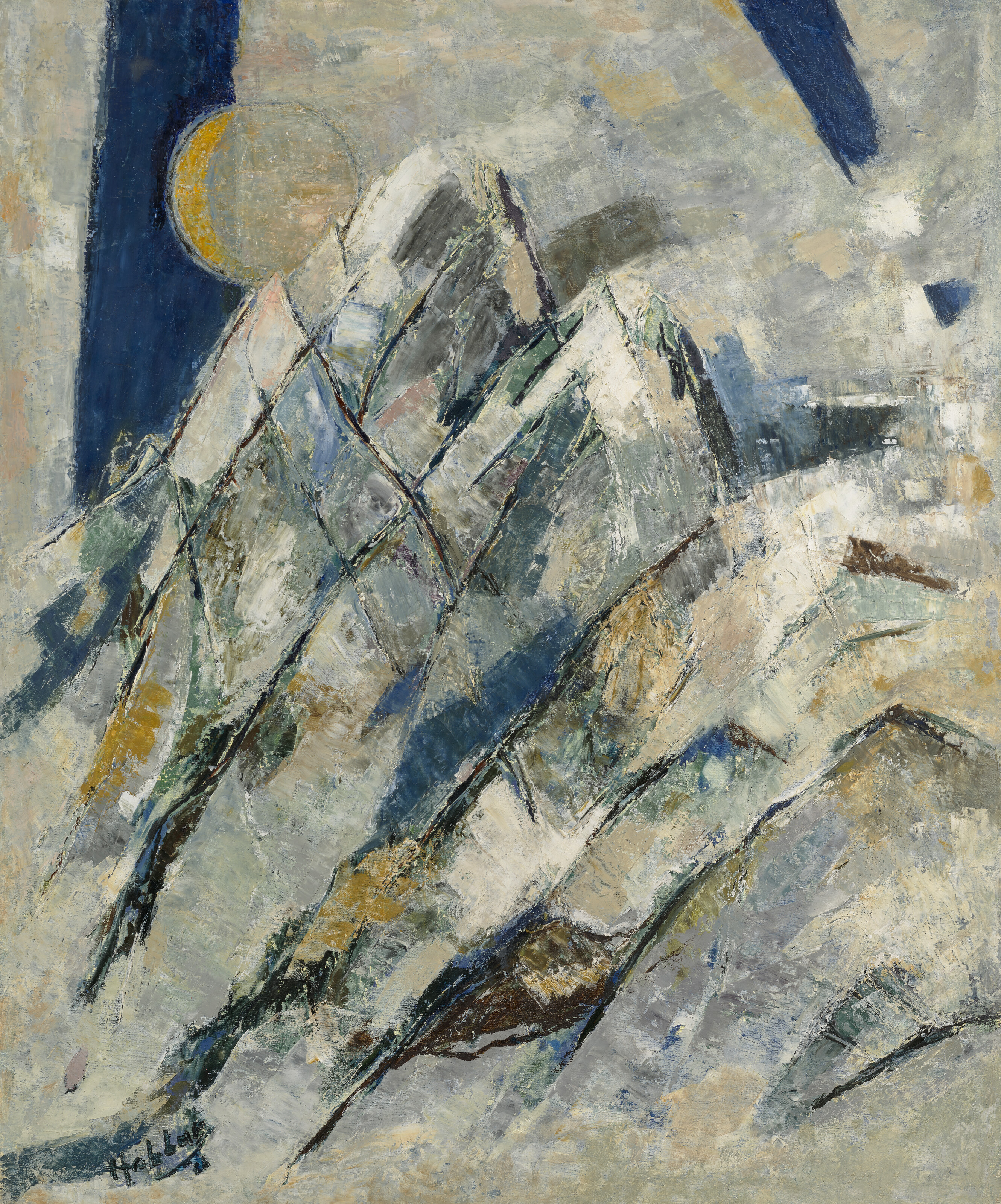
Untitled (Summit)
Kattingeri Krishna Hebbar's "Untitled (Summit)" exemplifies the artist's distinctive approach to modernist abstraction, blending geometric forms with subtle chromatic variations to suggest landscape and spatial depth. The work reflects Hebbar's engagement with both Indian artistic traditions and contemporary international modernism, creating a composition that hovers between representation and abstraction. Through careful layering of color and form, the painting invites contemplation of scale, elevation, and the relationship between figure and environment.
- Signed
- Yes
- Spotted At
- Auction House · Christie's
Notes
LITERATURE Hebbar, exhibition brochure, Bangalore, 1969 (listed) EXHIBITED Bangalore, Mysore State Lalitha Kala Academy at Visvesvaraya Industrial Trade Centre, Hebbar, 1969 Conditions of sale Brought to you by Nishad Avari Specialist, Head of Department NAVARI@CHRISTIES.COM +1 212 636 2190 LOT ESSAY My intention is to integrate the representational, the metaphysical, the suggestive and symbolic in two dimensional images in order to achieve inner satisfaction. - K.K. Hebbar, 1990 Kattingeri Krishna Hebbar, born in Karnataka in 1911, attended the Sir J. J. School of Art in Mumbai, where he later served as an instructor. He subsequently travelled to Paris to study at the Académie Julian. Trained in academic salon style painting, Hebbar began with highly realistic portraits and landscapes, a mode he soon left behind in search of a more vital and individual language. In 1946 Hebbar travelled to Kerala, observing the art, dance and daily life of village communities there. These encounters, which he likened to Paul Gauguin’s engagement with Tahiti, encouraged a turn toward bold color and simplified form rooted in India’s folk and performing arts traditions. While he absorbed aspects of European Impressionism during his time in Paris, he retained a deep engagement with Indian classical and vernacular art forms, from the frescoes of the Ajanta Caves to Mughal, Jain and Rajasthani miniature paintings. Gradually, his work evolved toward a distilled abstraction of all these sources of inspiration that never abandoned figuration but refined it to essential rhythm and design. By the 1960s, Hebbar increasingly turned towards nature, and his landscapes shifted away from naturalism towards a more abstracted visual vocabulary that focused less on physical description and more on psychological and metaphysical resonance. As one critic observed, “Hebbar’s art begins with the visible world of realism and culminates with the ephemeral and intangible world of abstraction. At no point, however, does he completely abandon figuration. Instead his abstraction is distilled from nature into a clarity of form and texture that culminates in a grand simplicity of colour and design. At his peak he mastered the art of separating the superfluous from the essential” (Thimmaiah, K. K. Hebbar: An Artist's Quest, Bangalore, 2011, p. 31). The present lot, titled Summit and painted in 1968, is not rendered as a topographical description of a geographical place but as an abstract construction. Hebbar uses rhythmic intersecting planes and ascending diagonals to draw his viewer’s eye upward to the peaks. Space is flattened and compressed, creating a distilled symbolic image removed from the physicality of any specific place. The large scale of the present work adds gravitas and monumentality to this metaphorical mountain range it portrays. The influence of Ajanta and Indian cave sculpture is evident in Hebbar’s layered application of paint, creating a chalky impasto that recalls stone. Pale blues and earthy tones are lit by a muted golden sun. Here, nature becomes a vehicle for meditation, the summit presented not simply as terrain but as allegorical aspiration. The lyricism of the diagonals, appearing to echo each other in the artist’s repetitive rendering, imbues the canvas with a spiritual and contemplative quality, encouraging the viewer to ascend the many summits they face. Summit was painted at a time when Hebbar had gained wide institutional recognition in India and was serving as Chairman of the Artists’ Centre in Bombay. His focus during this period remained rooted in India, unlike some of his modernist contemporaries who were working abroad. In Summit, earthy and elemental themes are transformed through linear rhythm, spatial harmony and expressive color into an image of psychological depth and spiritual resonance. READ MORE
🔨 Auction Lot
South Asian Modern + Contemporary Art
March 25, 2026
Estimate: $100,000 – $150,000
Lot 313
More by Kattingeri Krishna Hebbar
Start the Discussion
Request access to join the discussion