Vik Muniz

Vik Muniz Transforms the Ordinary Into Wonder
Artist Spotlight · The Collection Editorial
“I use photography to tell the story of things that don't exist without photography.”
Vik Muniz
Few artists working today have captured the world's imagination quite like Vik Muniz, whose retrospective at the Institute of Contemporary Art Miami drew record attendance and reminded a new generation why his work feels as urgent and alive as ever. His photographs have traveled from the Museum of Modern Art in New York to the Grand Palais in Paris, accumulating institutional endorsements that would satisfy any blue chip career. Yet what makes Muniz singular is not the prestige but the persistent, almost mischievous delight he takes in undermining our assumptions about what images are, how they are made, and what they are worth. He is, above all else, an artist who trusts his audience to look twice.
Vik Muniz
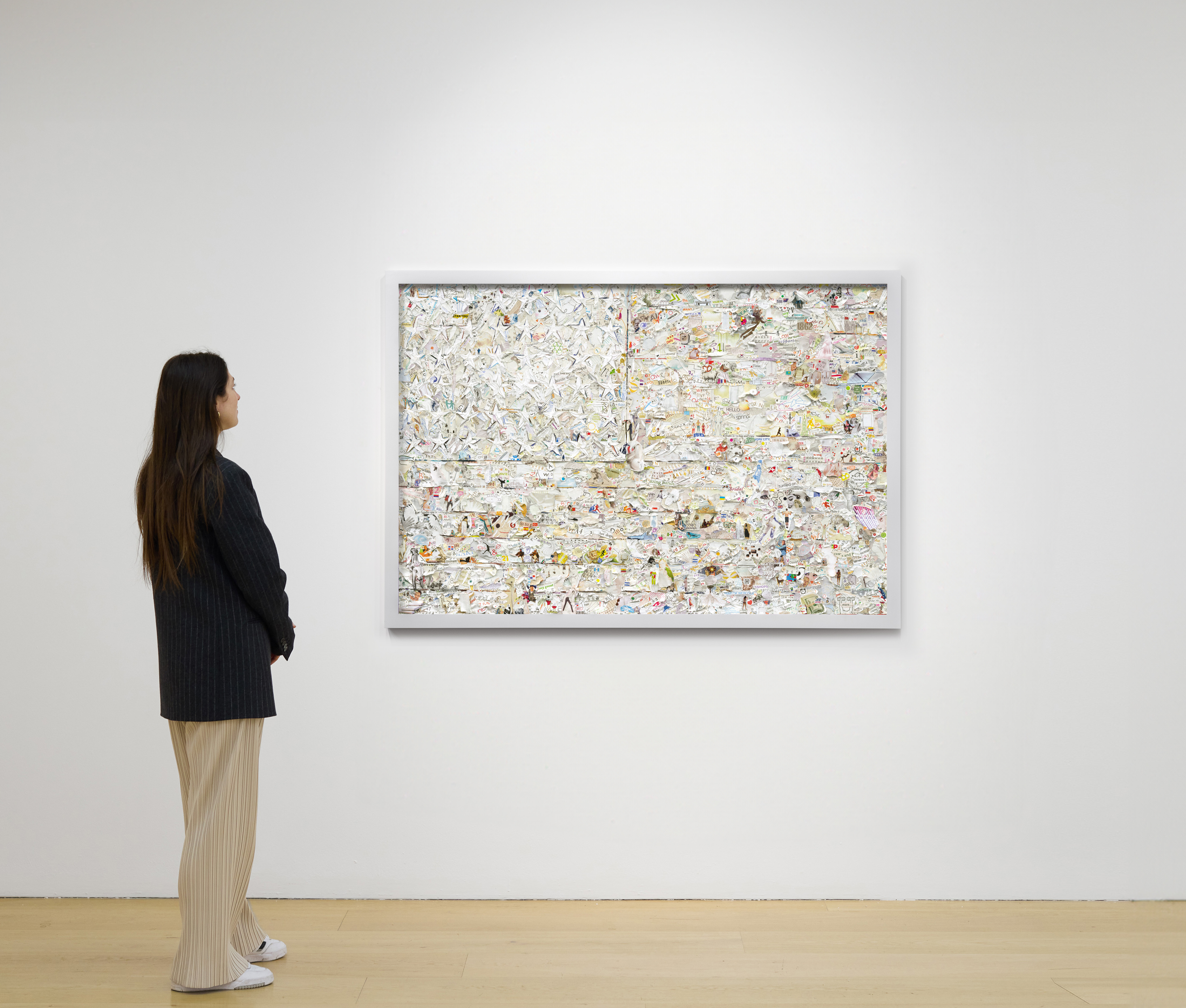
White Flag (After Jasper Johns)
Muniz was born in São Paulo in 1961, growing up in a city of extraordinary contrasts where sprawling cultural ambition existed alongside deep social inequality. He has spoken often about the transformative power of images in that environment, about how a photograph or a reproduction in a magazine could transport you somewhere entirely different. A chance accident in New York in the mid 1980s, in which he received a small settlement after being caught in a dispute between two men, gave him the funds to remain in the United States. He stayed, and art history is richer for it.
New York in that period was a crucible of conceptual experimentation, and Muniz absorbed its energies while remaining grounded in a distinctly Brazilian sensibility, one attuned to ingenuity born of limitation and beauty found in unexpected places. His early work already showed the conceptual clarity that would define his mature practice. Muniz understood from the beginning that photography is not simply a tool for recording the world but a medium freighted with assumptions about truth and representation. By the early 1990s he was constructing images from wire, sugar, and chocolate syrup, photographing the results, and presenting the photograph as the final artwork.
Vik Muniz
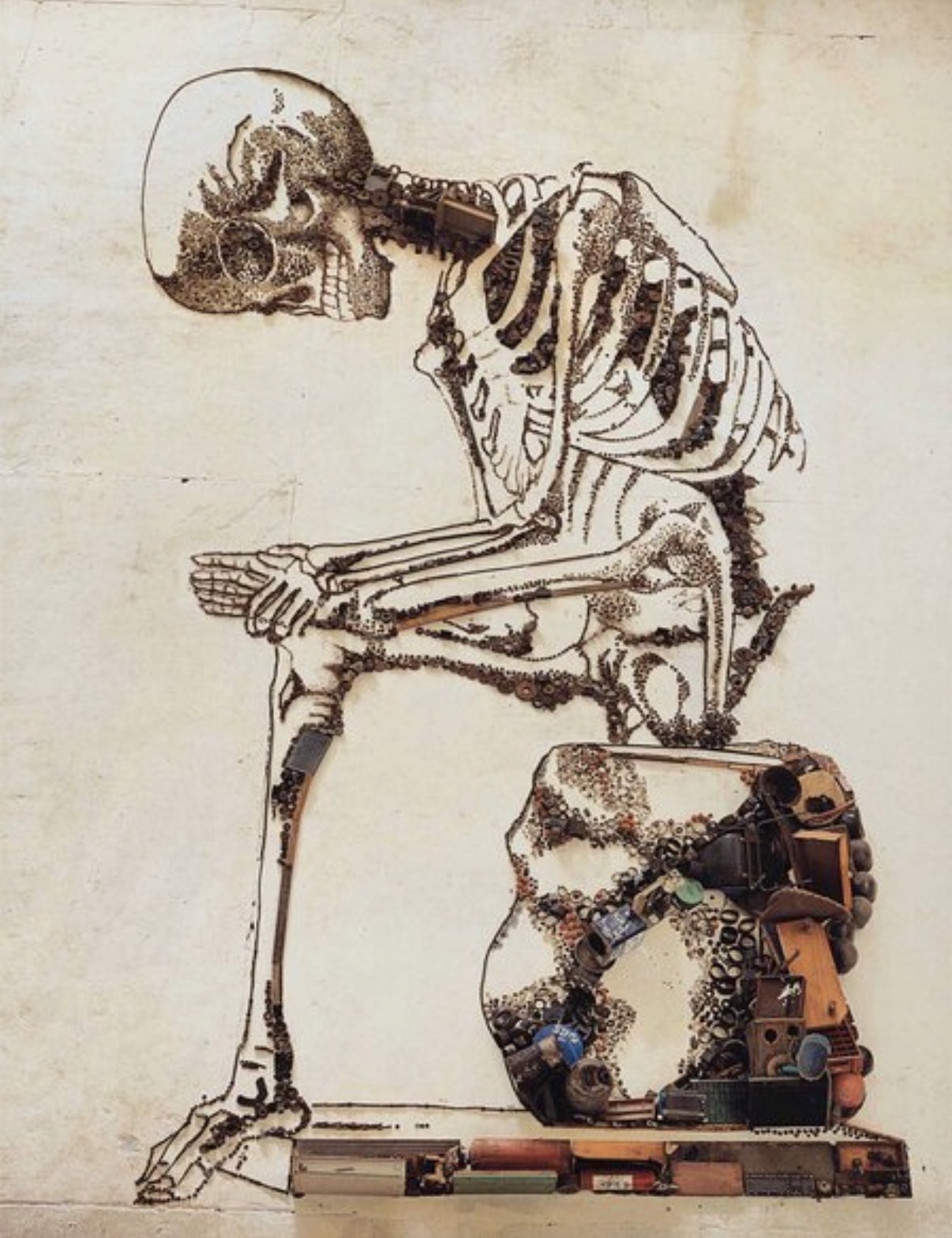
Anatomy, after Francesco Bertinatti (Pictures of Junk), 2009
The original construction, painstaking as it might have been, was dissolved or discarded. What remained was the image, and the image was always a little unstable, a little aware of its own artificiality. This conceptual loop, building something to photograph and then letting the thing itself disappear, became the engine of everything that followed. The series that brought Muniz to wide international attention was Pictures of Junk, developed in the early 2000s at his studio in Brooklyn.
“The best thing about art is that it can change the way you see everything, even art itself.”
Vik Muniz
Working with massive quantities of discarded material collected from junkyards and waste sites, he and a team of collaborators arranged debris into monumental compositions reproducing canonical artworks and figures. The resulting photographs, printed at large scale, reward both the distant view and the close inspection. From across a gallery, you see Jacques Louis David's Napoleon or a Caravaggio; step closer and the image dissolves into hubcaps, crushed cans, and broken electronics. Anatomy, after Francesco Bertinatti from Pictures of Junk, completed in 2009, exemplifies this strategy with particular sophistication, mapping a classical anatomical diagram onto a field of accumulated refuse and asking quietly whether the materials of consumer culture are themselves a kind of body, accumulated and ultimately disposable.
Vik Muniz
Vik Muniz
The 2010 documentary Waste Land brought Muniz to an entirely new audience and deepened understanding of the social conscience underlying his practice. The film followed his collaboration with the catadores, the waste pickers who worked the Jardim Gramacho landfill outside Rio de Janeiro, one of the world's largest. Muniz photographed these workers in poses echoing great paintings from Western art history and then worked with them to construct those images at monumental scale from the garbage they sorted every day. The project was not a gesture of charity but a genuine artistic collaboration, and the catadores became participants in the work, earning proceeds from the sale of prints.
The film won the Audience Award at the Sundance Film Festival and was nominated for an Academy Award, amplifying conversations about labor, dignity, and the social role of the artist that Muniz had been conducting through his work for years. For collectors, Muniz's work offers a rare convergence of intellectual richness, visual pleasure, and enduring market strength. His chromogenic and dye destruction prints have performed consistently at auction, with major works from the Pictures of Junk and Pictures of Chocolate series achieving strong results at Christie's, Sotheby's, and Phillips. Works such as Milk Drop After Harold Edgerton from Pictures of Chocolate and Team from Pictures of Chocolate demonstrate his ability to imbue seemingly playful source materials with genuine art historical weight, riffing on the legacy of Edgerton's high speed photography while constructing something entirely his own.
Vik Muniz
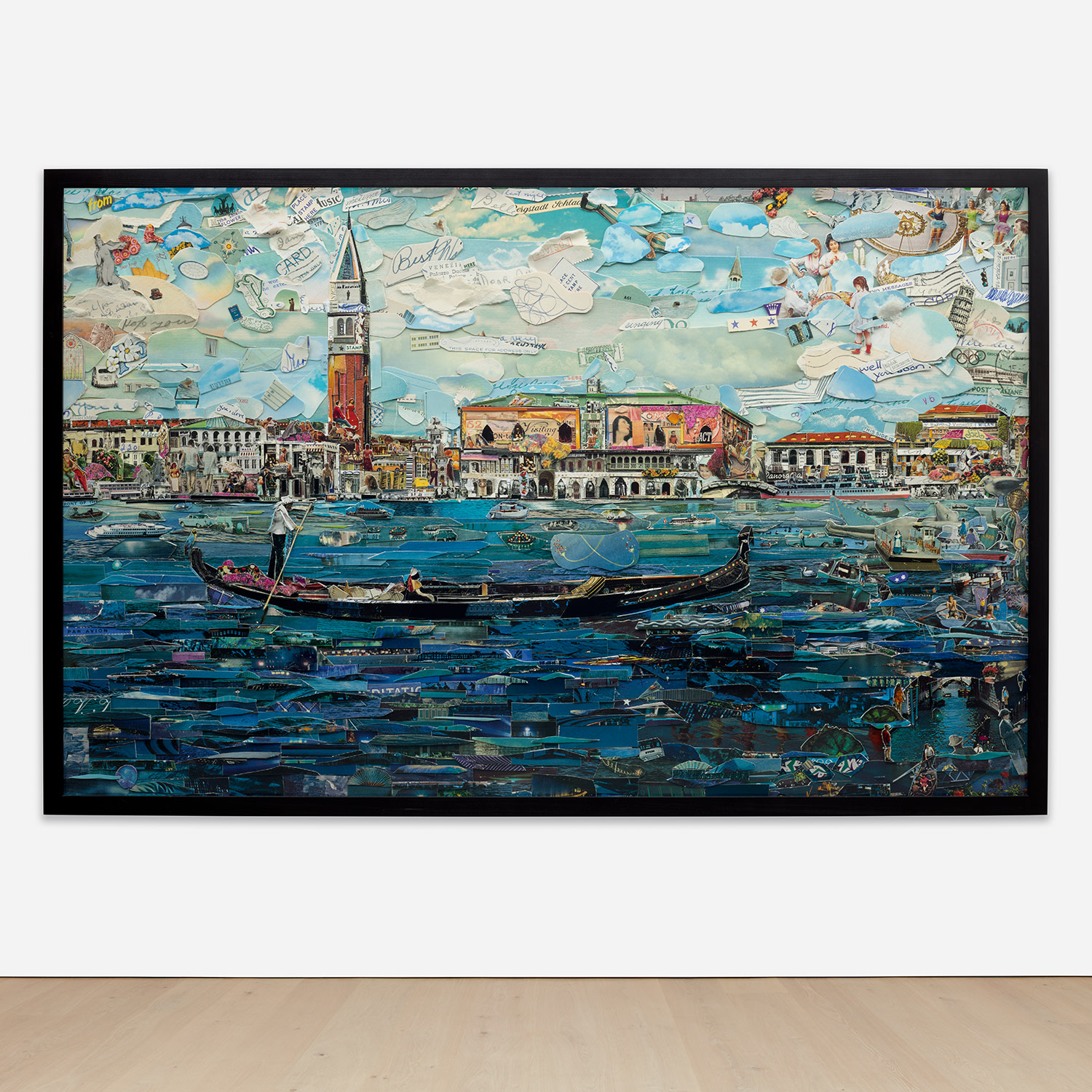
Venice (Postcards from Nowhere), 2014
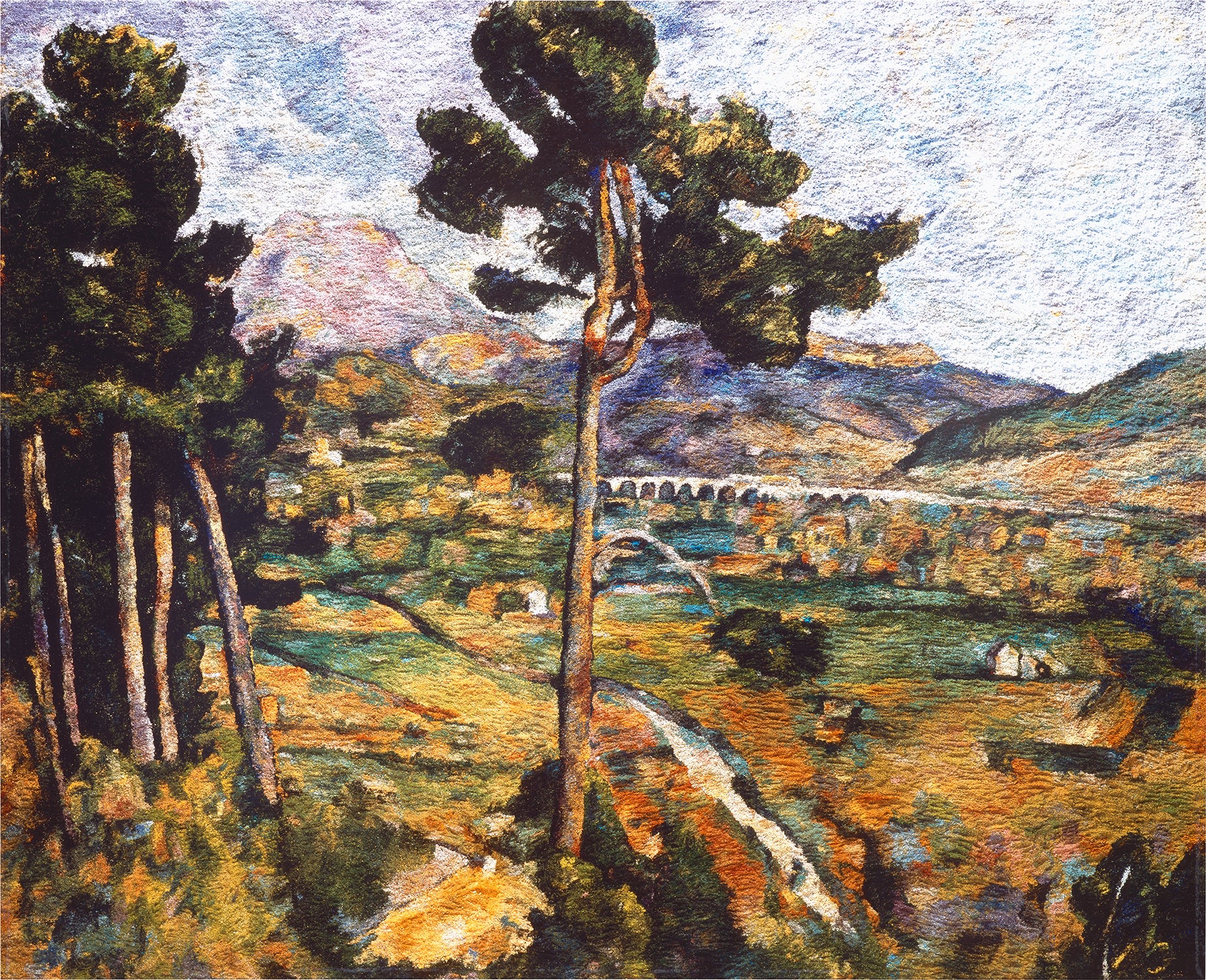
The series of works responding to Western masters, including Poplars After Claude Monet from Pictures of Pigments and Standard Station Night After Ed Ruscha from Pictures of Cars, hold particular appeal for collectors already engaged with the canonical figures Muniz references, offering a way to own a conversation between traditions rather than a single statement. White Flag After Jasper Johns sits comfortably within a lineage of rigorous appropriation art while remaining unmistakably Muniz in its material wit. Muniz belongs to a broader conversation that includes artists such as Gerhard Richter, whose investigations of photography and painting informed a generation, and Glenn Ligon, whose text based works similarly interrogate the slippage between image and meaning. Within Latin American art history, he sits alongside Cildo Meireles and Hélio Oiticica as artists who transformed conceptualism into something warm, bodily, and culturally specific.
His engagement with portraiture and identity connects him to a tradition running from Cindy Sherman's performative self construction to Kara Walker's excavations of historical representation. Yet the comparison that ultimately serves Muniz best is perhaps the one he invites most directly: to the Old Masters themselves, whose techniques and compositions he borrows not to mock but to honor, finding in their formal solutions a vocabulary still vital enough to carry entirely new meanings. What secures Muniz's legacy is precisely the generosity of his project. He is an artist who believes, without sentimentality, that art can change the way people see, and who has built a body of work designed to prove that claim at every scale.
His photographs hang in the collections of the Museum of Modern Art, the Guggenheim, the Whitney, and major private collections across Europe and the Americas. For new collectors approaching his work now, the opportunity is to enter a practice still in full creative motion, one that continues to surprise even as it deepens. In a cultural moment saturated with images that demand nothing of us, Muniz insists that looking carefully remains a radical act.
Explore books about Vik Muniz