Samuel Bourne
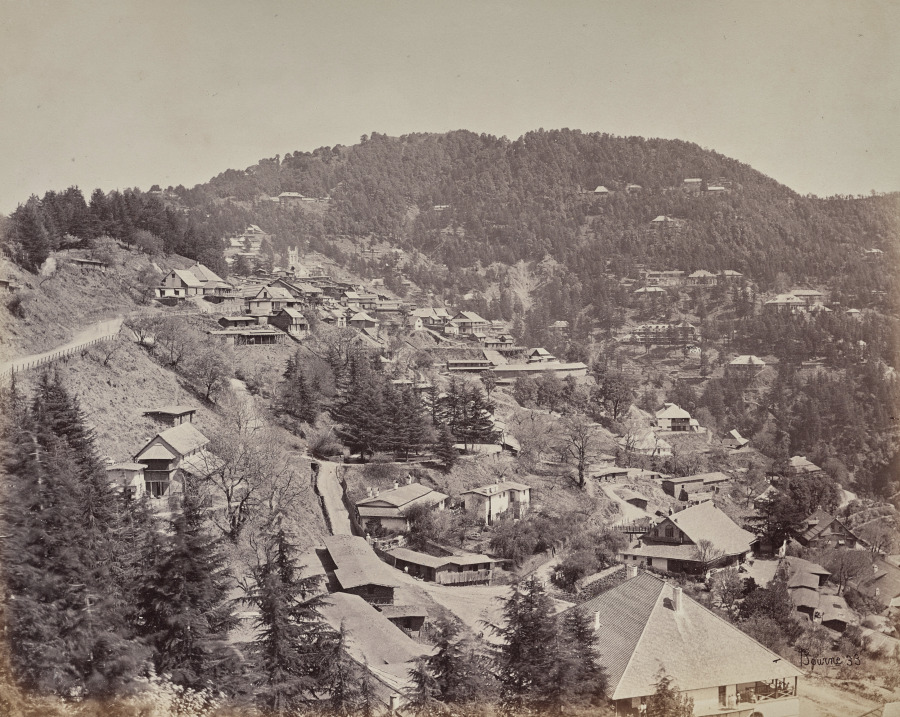
Samuel Bourne Brought the Himalayas Into Focus
Artist Spotlight · The Collection Editorial
“The difficulties of the collodion process in the open air, in a hot climate, are very great and require constant vigilance.”
British Journal of Photography, 1860s
Picture the scene: Simla, 1866, and a young Englishman from Nottingham is directing a caravan of some six hundred porters up treacherous mountain passes, hauling cameras, glass plates, chemicals, and darkroom tents into terrain that had never been photographed. The temperatures are brutal, the logistics almost impossibly complicated, and the wet collodion process he relies upon demands that each glass negative be coated, exposed, and developed within minutes before the chemicals dry. Samuel Bourne is not deterred. He is on his third and most ambitious Himalayan expedition, pushing higher than any photographer had gone before, and the images he carries back down will astonish the world.
Samuel Bourne
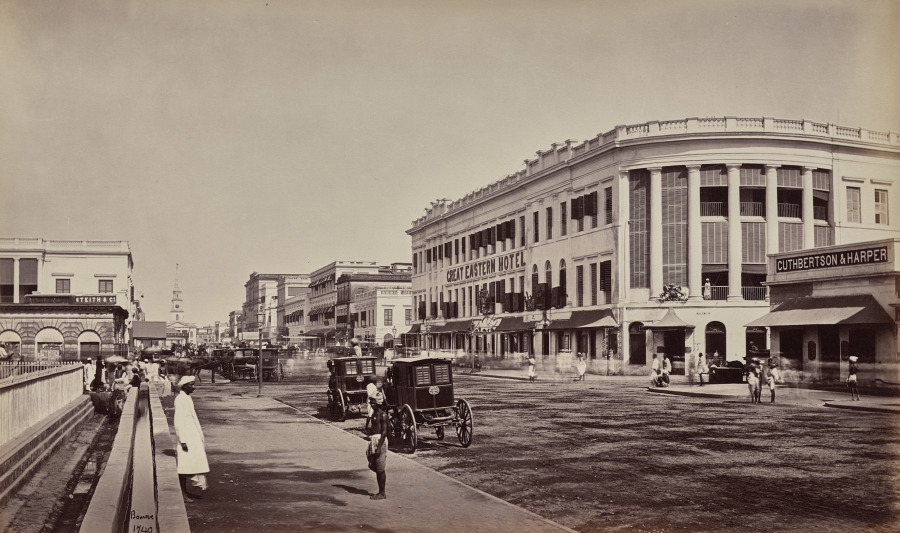
Calcutta. Old Court House Street, 1863
That spirit of focused, almost reckless dedication is precisely what collectors and curators return to again and again when they engage with his work. Bourne was born in 1836 in Mucklestone, Staffordshire, and grew up in the Midlands of England during the great age of Victorian ambition and industrial confidence. He trained as a bank clerk in Nottingham, a profession that could not have been further from the dramatic landscapes that would eventually define his legacy. Photography was his consuming passion from an early age, and he pursued it with a rigor that owed something to his methodical professional training.
He studied the medium seriously, contributing articles to the British Journal of Photography in the early 1860s that revealed a thoughtful, technically sophisticated mind already wrestling with questions of composition, light, and the particular challenges of outdoor work. In 1863, at the age of twenty six, Bourne made the defining decision of his life and sailed for India. The subcontinent was then under British administration following the transition from East India Company rule, and Calcutta was a city of enormous commercial and cultural energy. Bourne quickly established a partnership with the photographer Charles Shepherd, and together they built what would become the most celebrated photographic firm in South Asia.
Samuel Bourne
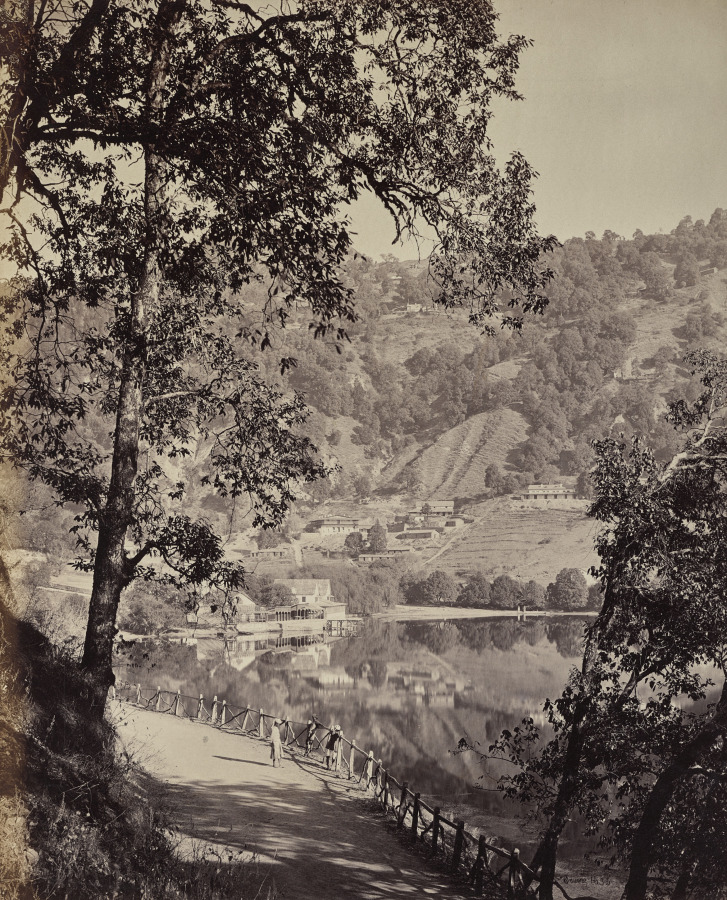
Hyree Lake. Hill Station in the Himmalayahs. View of the Taj Lake with Assembly Rooms, Lhutse, 1863
Bourne and Shepherd, operating from Calcutta and later with studios in Simla and Bombay, produced work that combined documentary ambition with a genuinely refined aesthetic sensibility. The firm would endure in various forms well into the twentieth century, a testament to the foundation Bourne laid. The three Himalayan expeditions of 1863, 1864, and 1866 represent the towering achievement of his career. Working with the wet collodion process under conditions that would challenge any modern photographer equipped with digital tools, Bourne produced images of the mountain landscape that remain among the most beautiful photographs made anywhere in the nineteenth century.
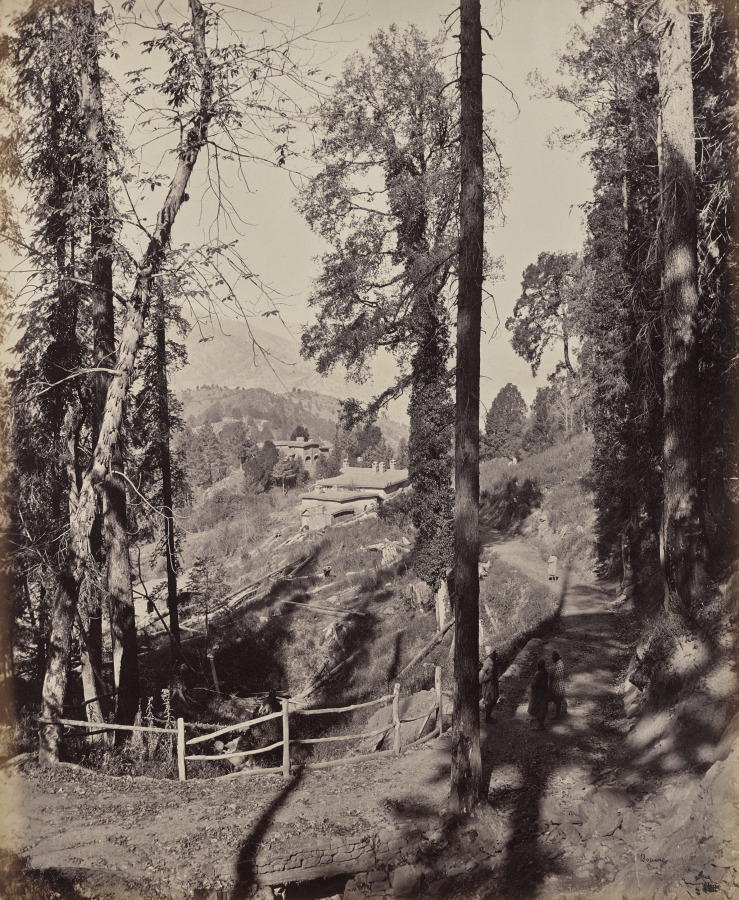
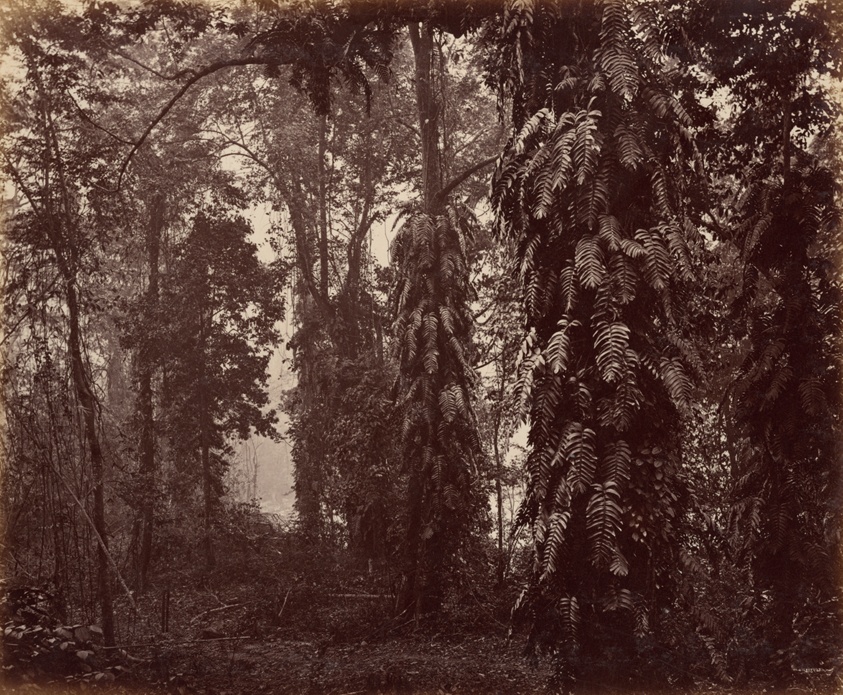
His view of the Srikanta peaks, taken from Fallaldasa on that first expedition, captures something vast and still and humbling in the Himalayan terrain. His forest scenes from Murree possess a quality of filtered light and atmospheric depth that recalls the compositional intelligence of landscape painting. He was clearly looking at painting, absorbing the grammar of the picturesque tradition, and then testing what photography could do with it. Beyond the mountains, his photographs of Indian architecture and urban life constitute an equally vital body of work.
Samuel Bourne
Murree. A Hill Station in the Himmalayahs, View Through the Forest, 1863
His early Calcutta street scene on Old Court House Street, made in 1863, is a masterclass in organizing complex visual information within a single frame. His view of the Taj Mahal from the Yamuna River brings a formal restraint that resists the merely touristic, finding something genuinely meditative in that famous silhouette. The albumen prints of Fatehpur Sikri, of the Qutb Minar at Delhi, and of the temple at Naveshera in Kashmir each demonstrate his ability to approach monuments of immense symbolic weight with patience and compositional precision. What distinguishes Bourne from the many other photographers working in India during this period is exactly that sense of deliberate looking, of choosing where to stand and when to release the shutter as acts freighted with aesthetic intention.
For collectors, Bourne's work occupies a particularly rewarding position in the market for nineteenth century photography. His prints appear regularly at major auction houses including Christie's and Sotheby's, where individual albumen prints and especially album sets attract serious attention from both specialist photography collectors and those building broader collections of Victorian or South Asian material. The albums are especially prized: a complete set of his Indian views, bound and sequenced as he intended, offers an experience of his vision that transcends individual images. Condition is paramount when assessing Bourne's work, as the albumen process is susceptible to fading and silvering out, and well preserved examples command significant premiums.
Samuel Bourne
Darjeeling, India, 1865
Collectors should also look at the tonal richness of a print, since Bourne's finest work achieves a warmth and depth in its mid tones that cheaper or later commercial prints from the same negatives often lack. Bourne's place in the history of photography is best understood alongside contemporaries such as Francis Frith, whose monumental documentation of Egypt and the Near East shares something of Bourne's ambition and his tourist market audience, and Roger Fenton, whose earlier landscape work in Britain established many of the compositional conventions Bourne would carry into the Himalayan wilderness. In the context of Indian photography specifically, he sits alongside Felice Beato, whose coverage of the aftermath of the 1857 uprising gave photography a different and more unsettling kind of documentary power. Together these figures define an era when photography was simultaneously a commercial enterprise, a scientific instrument, and an art form still working out its own possibilities.
Samuel Bourne returned to England in 1870, settling eventually in Nottingham where he returned to the textile business and largely stepped away from photography. He died in 1912, having lived long enough to see the medium he had practiced with such extraordinary ambition transform almost beyond recognition. Yet the photographs he made in India between 1863 and 1870 have not dated in any meaningful sense. They continue to be exhibited, collected, reproduced, and studied precisely because they transcend their documentary occasion.
They are not simply records of places that no longer look quite the same. They are evidence of a particular way of seeing, patient and purposeful and quietly thrilled by the grandeur of the world, and that way of seeing speaks across every change in technology and taste. For collectors who appreciate the longer arc of photographic history, Bourne remains one of its most essential and rewarding voices.
Explore books about Samuel Bourne
Samuel Bourne: Images from India
Perez, Nissan
Samuel Bourne: A Pioneer Photographer in India 1863-1870
Dimond, Frances and Dodson, Mark

The Landscape of India: Photographs by Samuel Bourne
Gutman, Judith Mara
Samuel Bourne and India: The Development of Landscape Photography in India
Thomas, Nicholas