Raymond Pettibon
Raymond Pettibon, America's Most Restless Artistic Voice
Artist Spotlight · The Collection Editorial
“I don't think of my work as illustrating text. The words are as much a part of the drawing as the image.”
Raymond Pettibon, Interview Magazine
When the Museum of Contemporary Art in Los Angeles mounted a major survey of Raymond Pettibon's work, and when the New Museum in New York presented its own landmark retrospective in 2017 titled "A Pen of All Work," the art world was reminded of something collectors had known for decades: Pettibon is not simply an artist who comments on American life. He is one of its most essential and generous interpreters. The New Museum show brought together hundreds of drawings spanning four decades, confirming his place not on the margins of contemporary art where he once provocatively operated, but squarely at its center, beloved by institutions and deeply serious collectors in equal measure. Raymond Pettibon was born Raymond Ginn in 1957 in Tucson, Arizona, and grew up in Hermosa Beach, California, a stretch of the Los Angeles coastline that gave him both the sun soaked freedom and the subcultural electricity that would power his entire career.
Raymond Pettibon
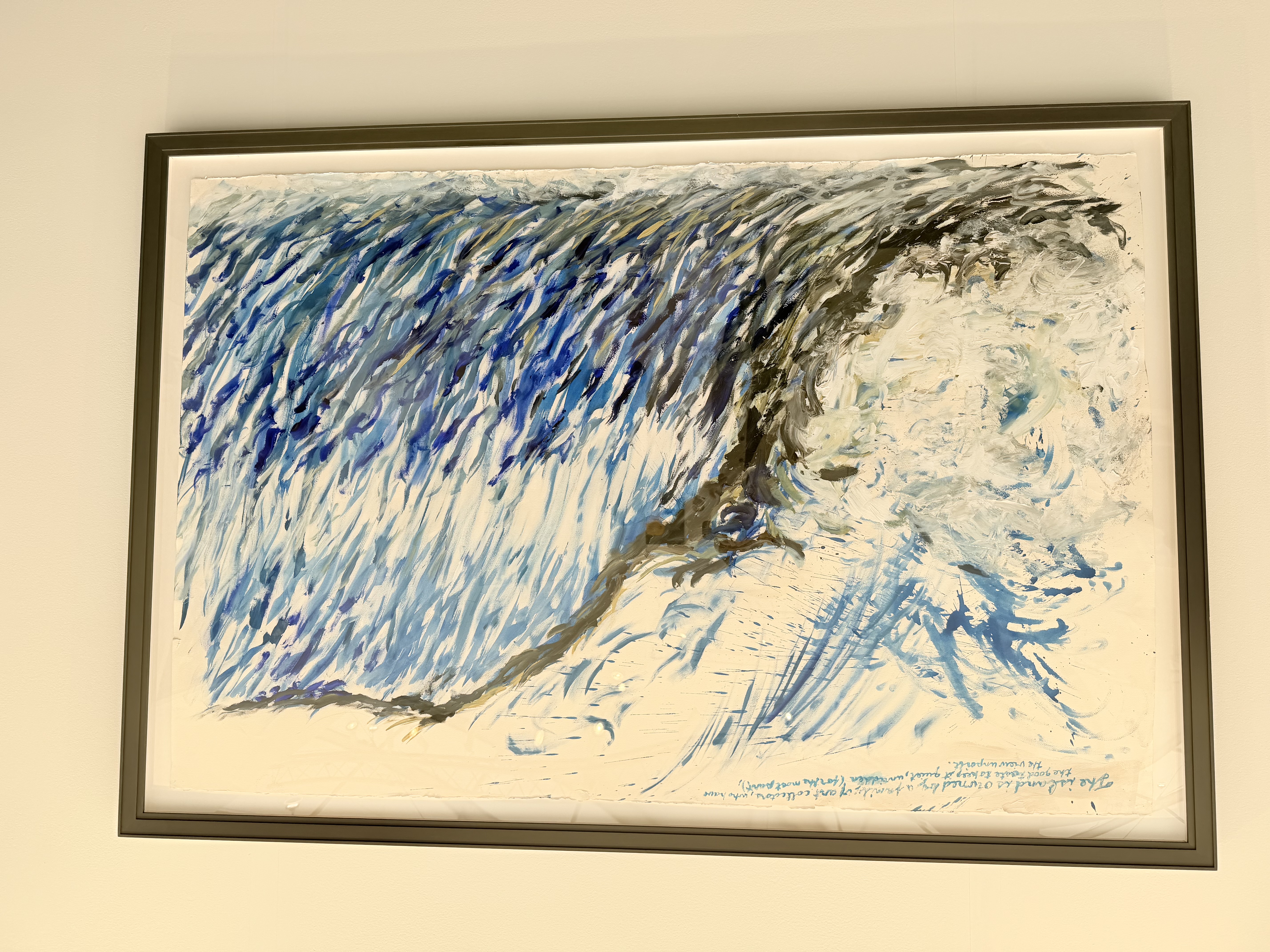
No Title (The island is...), 2011
He later adopted the surname Pettibon, and his childhood proximity to the skateboarding and surf communities of Southern California proved formative in ways that were anything but superficial. His brother Greg Ginn founded the seminal hardcore punk band Black Flag, and Pettibon designed the band's iconic logo as well as album covers and flyers that circulated through the DIY underground of the late 1970s and early 1980s. These were not merely graphic design commissions. They were the first expression of a visual sensibility that fused high literary seriousness with raw, vernacular energy.
Pettibon studied economics at UCLA, graduating in 1977, and that academic background in systems and social structures quietly informed the analytical depth running beneath even his most visceral images. He began self publishing zines in the late 1970s, small photocopied booklets filled with his ink drawings and dense, allusive texts, distributing them at punk shows and through record stores. This mode of production, deliberately outside the gallery system, was both ideological and practical. It allowed him to build a vast, sprawling body of work at remarkable speed and with total creative autonomy.
![Raymond Pettibon — [13 Works]](https://rtwaymdozgnhgluydsys.supabase.co/storage/v1/object/public/artwork-images/auction-lots/N11171-20230309-lot34.jpg)
Raymond Pettibon
[13 Works], 1980
By the mid 1980s, the art world had taken notice. His first significant gallery exhibitions positioned him as a figure who defied easy categorization, drawing equal comparisons to William Blake, Charles Schulz, and the tradition of American editorial cartooning. The practice Pettibon developed across those early years has remained remarkably consistent in its ambitions even as it has grown richer and more technically adventurous. Working primarily in ink on paper, he layers image and text in compositions that resist the usual hierarchy between word and picture.
The text in a Pettibon work is not a caption or an explanation. It is a third element, a kind of pressure applied to the image from one side while the viewer's own associations apply pressure from the other. His subjects move fluidly across the full landscape of American mythology: baseball and surfing, the Book of Revelation, Charles Manson, the Beat poets, the Vietnam War, J. Edgar Hoover, comic book heroes, and the sublime coastlines of California.
Raymond Pettibon
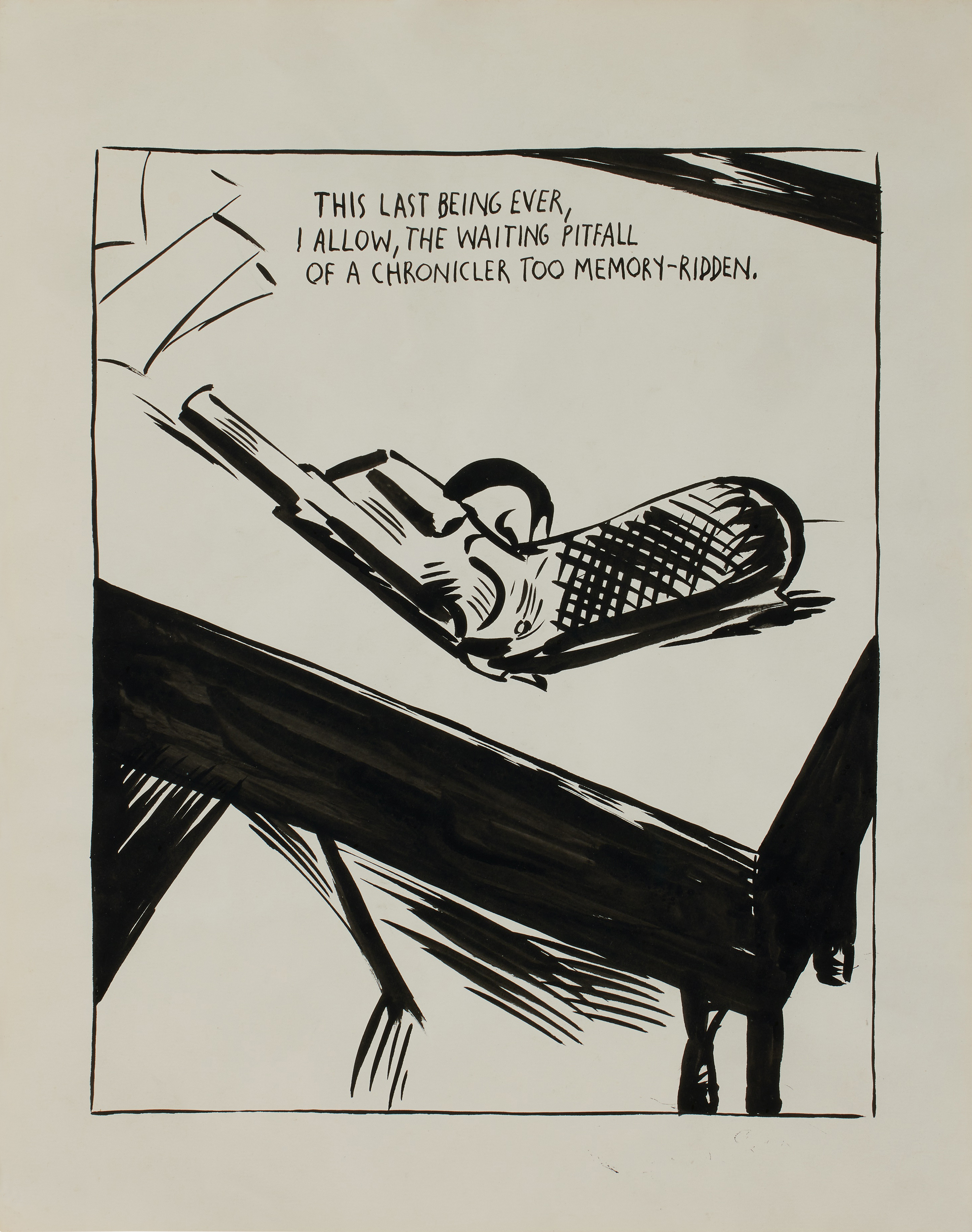
No Title (This last being ever...), 1990
Works like "No Title (Kryptonite kisses)" from 1990 demonstrate how effortlessly he moves between pop iconography and genuine philosophical weight, finding in Superman's vulnerability a meditation on American power and its limits. Among the works that collectors and scholars return to most consistently, the early ink drawings from 1980 hold particular significance. That body of work, produced when Pettibon was operating almost entirely outside commercial structures, has an urgency and a rawness that feels prophetic in retrospect. The 1985 works on paper combining pen, watercolor, and ink show his increasing confidence with color as an emotional register rather than a decorative addition.
And the later large scale works, such as "No Title (The island is...)" from 2011, incorporating acrylic and watercolor alongside ink, reveal an artist who never stopped expanding his technical vocabulary while remaining completely faithful to his essential vision. These are not small, intimate works. They have the ambition of painting and the directness of drawing.
Raymond Pettibon
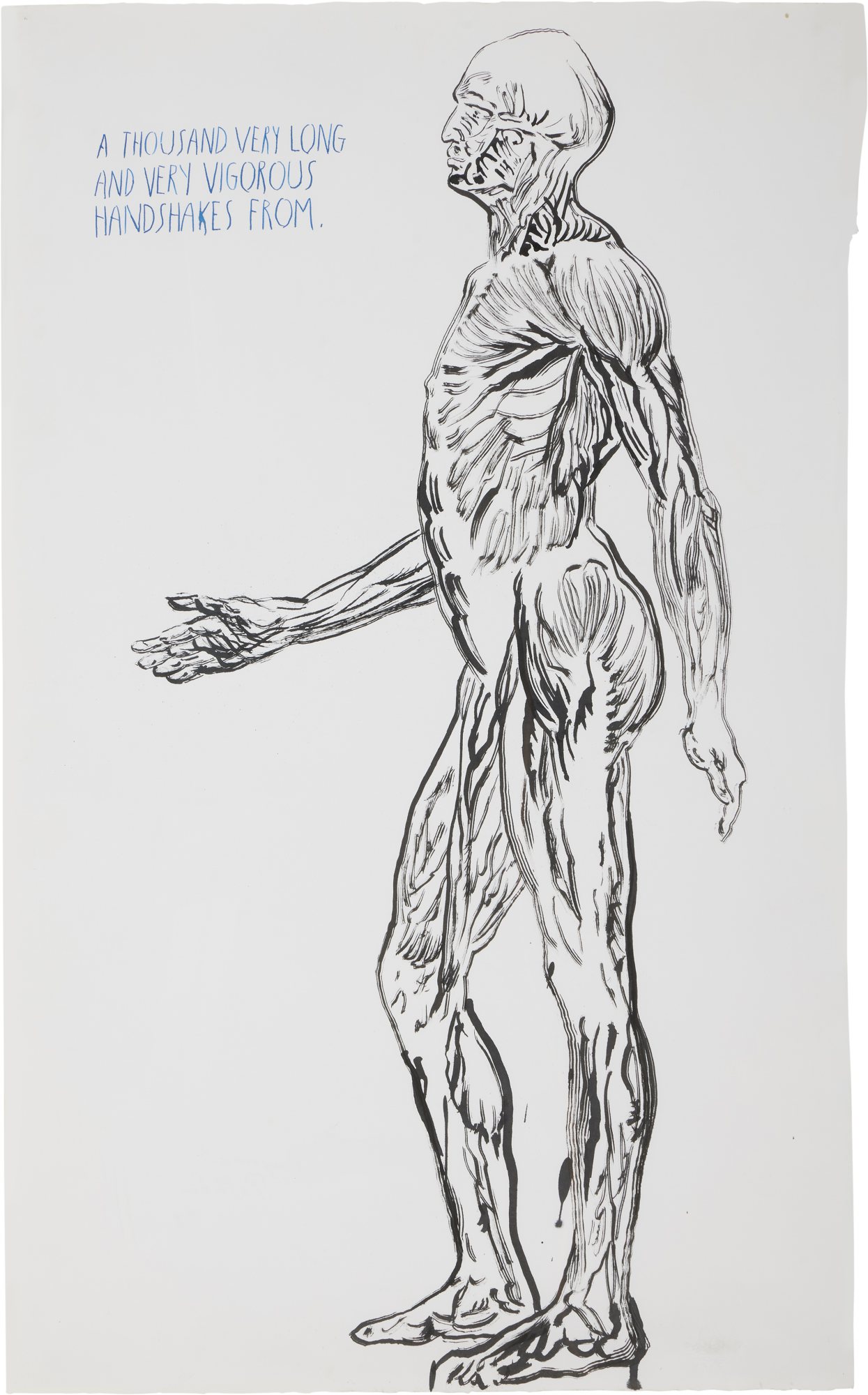
Untitled (A Thousand Very...), 1999
From a collecting perspective, Pettibon represents one of the most compelling propositions in the contemporary market. His work has been acquired by the Museum of Modern Art in New York, the Whitney Museum of American Art, the Hammer Museum, Tate Modern, and the Stedelijk Museum in Amsterdam, among many others. That institutional validation is matched by sustained auction performance, with significant works appearing regularly at Christie's, Sotheby's, and Phillips. What makes collecting Pettibon particularly rewarding is the sheer range of entry points his practice offers.
Works on paper from across his career, including early zines and prints, allow collectors to engage meaningfully without chasing the most celebrated single sheets. The Whitechapel Gallery published edition, "I Am My...; Ought We To...; I Do Not...
; and I Fear The...," produced for his London exhibition and signed and numbered in pencil, is exactly the kind of work that represents both historical significance and genuine accessibility. Collectors who approach his work thematically, following his recurring obsessions through baseball, through surfing, through religious imagery, build collections that tell a coherent story about one of America's greatest artistic minds. Pettibon's artistic lineage is rich and instructive.
He shares with Jean Michel Basquiat a commitment to text as image and a refusal to separate high and low cultural reference, though his approach is more literary and less confessional. He connects to the tradition of Neo Expressionism that included figures such as Georg Baselitz and A.R. Penck in its European manifestations, but Pettibon's work is irreducibly American in its preoccupations and its humor.
His engagement with the graphic and the vernacular places him in productive dialogue with artists like Mike Kelley, with whom he shared the Southern California underground of the 1980s, and with Ed Ruscha, whose own investigations of American language and landscape provide a useful parallel. Among younger generations of artists working with text and image, from Kara Walker to Chris Ofili, Pettibon's influence is profound and freely acknowledged. What makes Raymond Pettibon matter so urgently today is precisely what made him seem eccentric when he began: his insistence that American culture deserves to be looked at with the full force of historical awareness, literary seriousness, and genuine passion. He has never softened his gaze or simplified his references to court a broader audience.
Instead, that audience has grown to meet him, recognizing in his relentless, joyful, sometimes furious output a portrait of a country in all its contradictions and its vitality. To collect Pettibon is to participate in one of the great ongoing projects of American art, an attempt to see clearly, to speak truthfully, and to draw with absolute conviction.
Explore books about Raymond Pettibon
Raymond Pettibon: A Pen of All Work
Hal Foster
Raymond Pettibon: Collected Works
Various contributors

Raymond Pettibon: Notebooks
Raymond Pettibon
Raymond Pettibon:��No Title (As Usual)"
Christopher Rothko

Raymond Pettibon: Plots and Narratives
Merlin James
Raymond Pettibon: Drawings
Rinder, Lawrence