Raoul Dufy
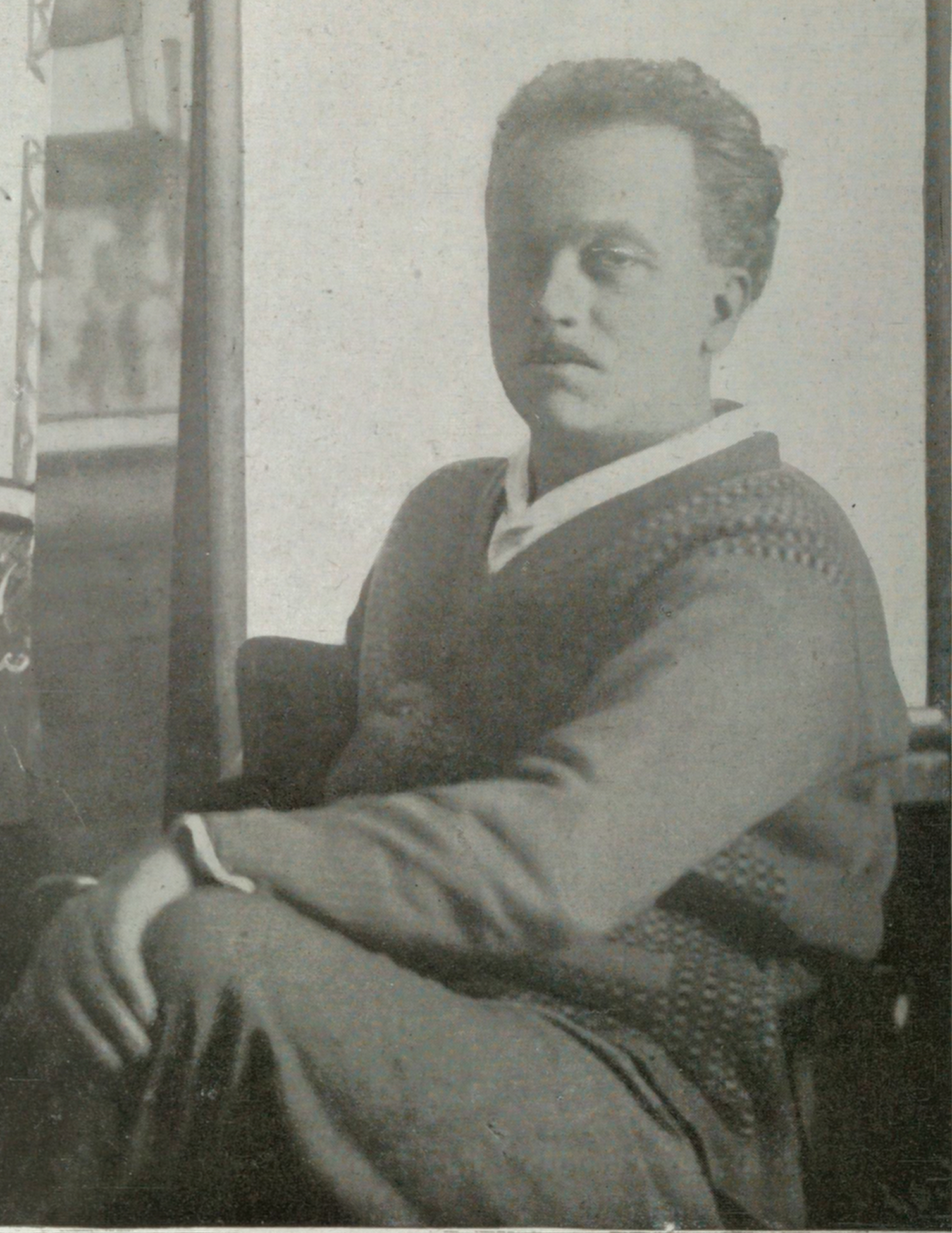
Raoul Dufy: The Joy of Pure Color
Artist Spotlight · The Collection Editorial
“My eyes were made to erase all that is ugly.”
Raoul Dufy
There is a moment, standing before a Raoul Dufy canvas, when the world seems to breathe a little easier. The French master had a singular gift: the ability to distill the pleasure of being alive into line and pigment, to make a regatta on the Normandy coast or an afternoon at Longchamp feel like the most wonderful thing that ever happened. It is no accident that major institutions from the Musée d'Art Moderne de la Ville de Paris to the Museum of Modern Art in New York have returned to Dufy again and again, and that his work continues to command serious attention at auction and in private collections worldwide. In a cultural moment that hungers for beauty without apology, Dufy feels more relevant than ever.
Raoul Dufy
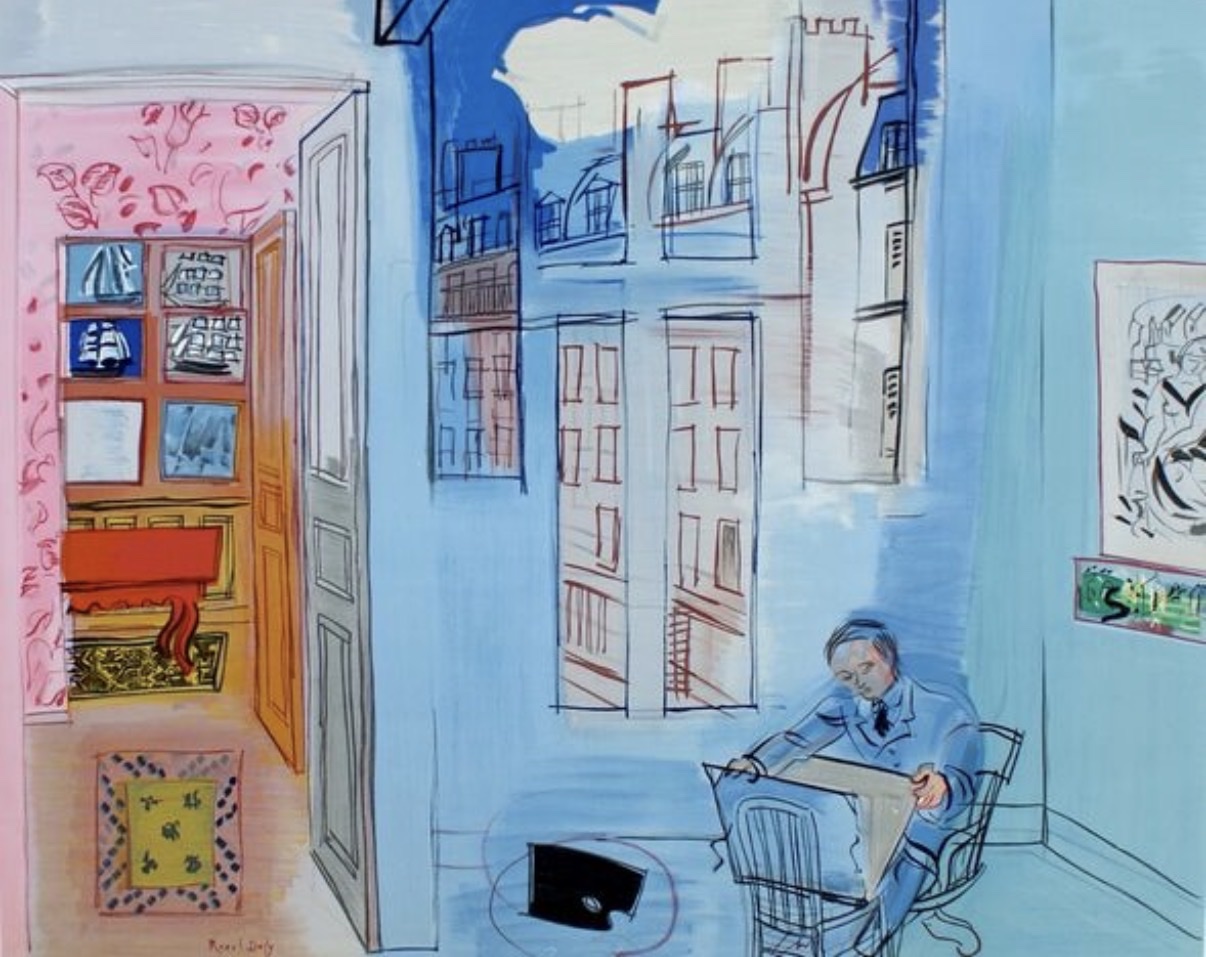
L'atelier de Impasse Guelma, 1969
Raoul Dufy was born in Le Havre in 1877, the third of nine children in a musical, working class family. The port city shaped him profoundly. The light off the English Channel, the rhythm of fishing boats and cargo ships, the democratic pleasure of the seaside promenade: all of it lodged itself in his imagination and never entirely left. He began his formal training at the École des Beaux Arts in Le Havre, where he studied alongside fellow Norman painter Othon Friesz, before earning a scholarship that brought him to Paris and the École Nationale Supérieure des Beaux Arts in 1900.
His early paintings showed a competent, even gifted, engagement with Impressionism, but nothing yet that announced the revolution to come. That revolution arrived in a single, clarifying encounter. At the 1905 Salon des Indépendants, Dufy stood before Henri Matisse's 'Luxe, Calme et Volupté' and felt, by his own account, the entire logic of painting shift beneath him. Here was color used not to describe the world but to express something felt, something emotional and immediate.
Raoul Dufy
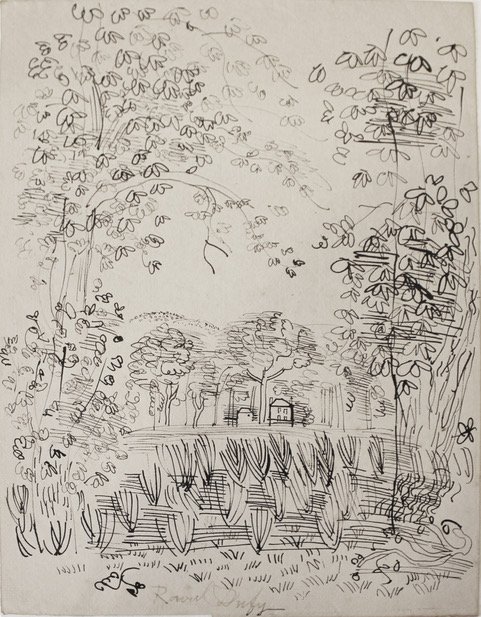
Landscape, 1930
Matisse and the Fauves, along with André Derain and Maurice de Vlaminck, had thrown out the academic rulebook, and Dufy threw himself into their orbit. His Fauvist period produced canvases of blazing, almost confrontational intensity, flags and crowds and harbors rendered in pure, unmodulated hues. Yet even then, Dufy was reaching toward something more personal, something more lyrical than the movement's more aggressive tendencies. The truly defining turn in Dufy's practice came through an unexpected door: textile design.
“Blue is the only color which maintains its own character in all its tones.”
Raoul Dufy
Beginning around 1909 and continuing into the 1920s through his celebrated collaboration with the couturier Paul Poiret and later the silk manufacturer Bianchini Férier in Lyon, Dufy developed the flat, linear, pattern based aesthetic that would come to define his mature painting. Working in woodblock print and fabric gave him an extraordinary fluency with the relationship between line and color field, teaching him to let drawn contours and applied color operate independently of one another, a technique that became his signature. In a Dufy painting, the loose, calligraphic outline of a yacht or a palm tree floats free of the wash of blue or gold beneath it, creating a shimmering, almost musical counterpoint. It is a solution that looks effortless and is, in fact, the product of years of precise, disciplined experimentation.
Raoul Dufy
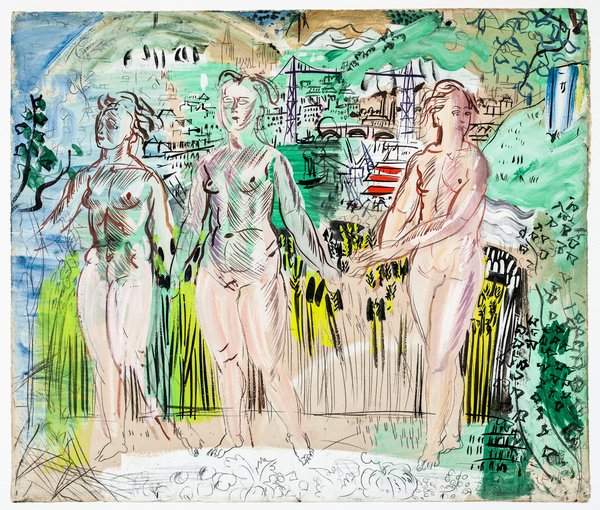
La Seine, l'Oise et la Marne, 1938
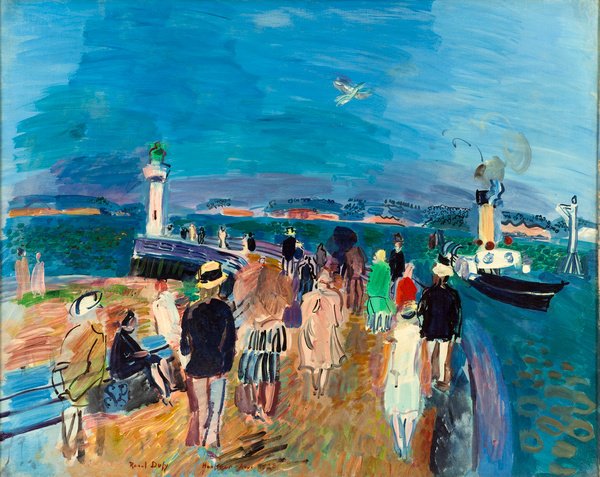
Among the works that best demonstrate this mastery are the magnificent large scale compositions he devoted to water: harbors, rivers, and the beloved Mediterranean coast. 'La jetée de Honfleur,' painted in 1928, captures the salt air and grey luminosity of the Norman coast with a tenderness that is almost autobiographical. 'La Seine, l'Oise et la Marne,' an extraordinary 1938 watercolor, shows Dufy at the height of his draftsmanly confidence, the great rivers of the Île de France rendered in fluid, sure strokes that seem to move across the paper like the water itself. His studio interiors, including the remarkable 'Atelier à la fenêtre' and 'Atelier au torse,' both from 1946, reveal a more introspective Dufy, one conscious of his own place in the tradition of the artist's studio as subject, in conversation with Matisse and Braque.
And 'Hommage à Bach,' also 1946, speaks to the deep connection between Dufy's visual practice and the world of music, a passion that ran through his life and his art with genuine conviction. For collectors, Dufy occupies a particularly appealing position in the market. His work spans an enormous range of media and scale, from intimate pencil sketches and vivid watercolors to large oil paintings and printed textiles, which means there are meaningful points of entry across a wide spectrum of budgets. Watercolors and works on paper such as 'Ruine de l'abbaye de Montmajour' from 1926 offer the chance to own a piece of his most instinctive, unguarded practice at more accessible price points, while major oils represent genuine blue chip holdings.
Raoul Dufy
La jetée de Honfleur, 1928
At auction, Dufy's oils have achieved results well into the millions, with top works at Sotheby's, Christie's, and Bonhams drawing competitive international bidding. Collectors are drawn not only to the decorative brilliance of his surfaces but to the underlying intellectual seriousness of his formal innovations, the sense that this apparently joyful work is the result of hard won thinking about what painting can do. Dufy belongs to a constellation of French modernists whose collective achievement reshaped Western art in the first half of the twentieth century. He shares with Matisse the commitment to color as a primary carrier of feeling, and with Picasso and Braque an interest in the flattening and reordering of pictorial space.
His decorative sensibility links him to painters like Albert Marquet and Kees van Dongen, while his output as a designer and ceramicist places him alongside the generation of artists, from Picasso to Jean Cocteau, who refused the boundaries between fine art and applied craft. Understanding Dufy in this context makes clear that his apparent lightness is not a limitation but a choice, a philosophical and aesthetic commitment to pleasure as a legitimate subject for serious art. Raoul Dufy died in Forcalquier in 1953, having spent his final years largely confined by the severe rheumatoid arthritis that had afflicted him since the late 1930s, a cruel condition for a man whose whole practice depended on the freedom of his hand. That he continued to paint through this period, producing work of undiminished vitality and invention, speaks to a remarkable tenacity beneath the celebrated charm.
His legacy endures not only in museum collections and at auction but in the broader culture, in the way we have learned to see the coastline of the south of France, the shimmer of a race day crowd, the intimate glory of an afternoon in a sun filled studio. To collect Dufy is to collect a particular vision of what the world, at its most generous, can feel like.
Explore books about Raoul Dufy
Raoul Dufy
Charles Kunstler
Raoul Dufy: His Life and Work
Maurice Laffaille
Dufy
Jean Cassou
Raoul Dufy: Catalogue Raisonné of the Printed Works
Jacqueline and Maurice Laffaille
Raoul Dufy 1877-1953
Galerie de Montmorency
The Fauvist Era
Michel Collomb