Pierre Soulages

Pierre Soulages: The Master Who Conquered Light
Artist Spotlight · The Collection Editorial
“Black is not a color. It is, or it is not. And when it is, it opens something.”
Pierre Soulages, interview
When the Musée Soulages opened its doors in Rodez in 2014, it marked one of the most fitting tributes in the history of modern French culture: a purpose built institution dedicated entirely to a living artist, designed by architects Catalan and Almeras to dialogue with the very landscape that shaped him. The museum drew hundreds of thousands of visitors in its first years, confirming what the art world had long understood. Pierre Soulages was not merely a celebrated painter but a national monument, a figure whose work had transcended the gallery system and entered the permanent consciousness of his country. That the building stood in the same city where he was born a century earlier gave the moment a rare and moving circularity.
Pierre Soulages
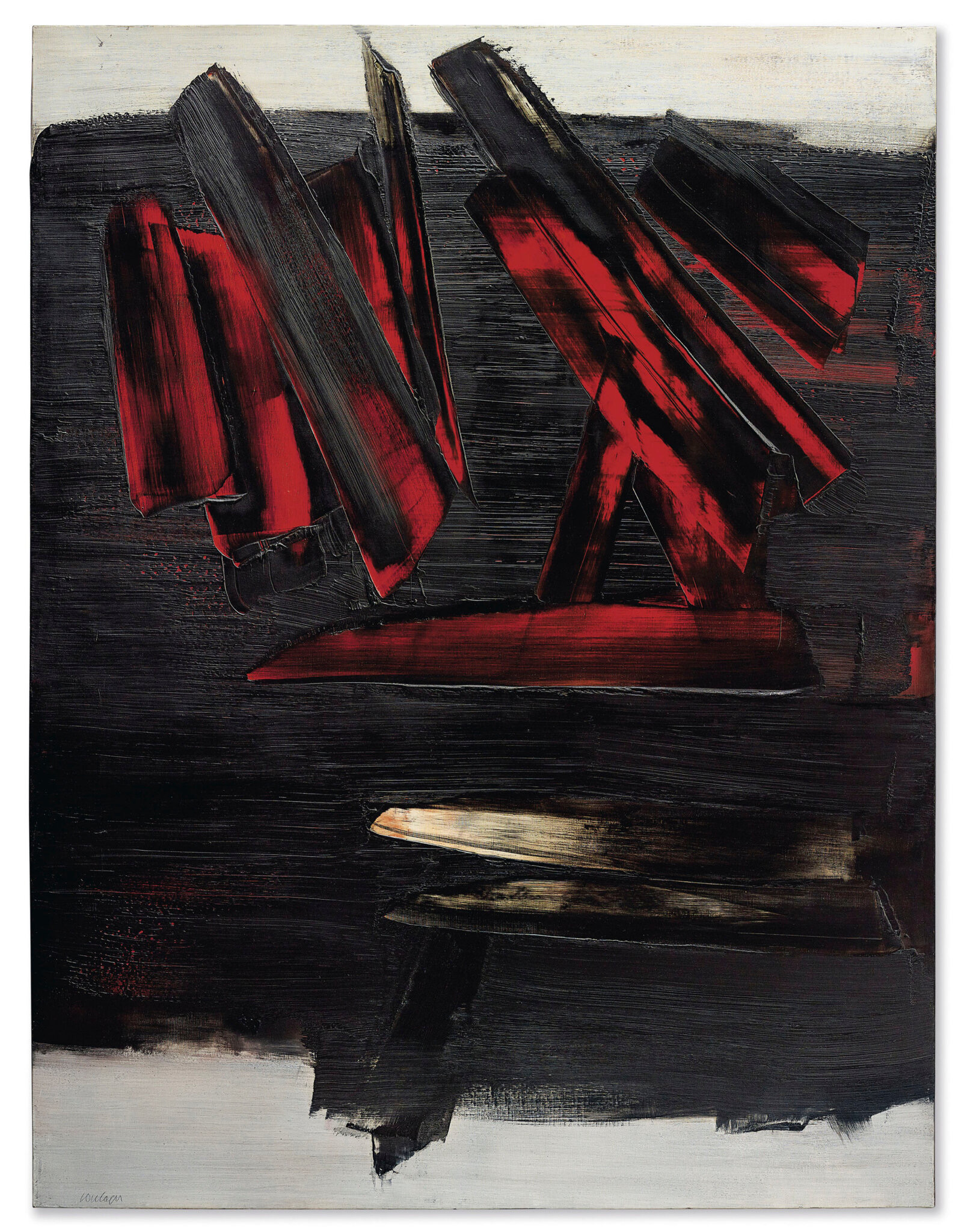
Peinture 186 x 143 cm, 23 Décembre 1959, 1959
Soulages came into the world in Rodez in 1919, in the Aveyron region of southern France, a landscape of granite plateaus and Romanesque architecture that would quietly inform his sensibility for the rest of his long life. He has described being captivated as a child by the dark branches of trees against winter snow, a stark visual drama that seems, in retrospect, almost prophetic. He moved to Paris in 1938 to study at the École des Beaux Arts, but left quickly, unconvinced by its academic conservatism. His real education came through looking, through the prehistoric cave paintings at nearby sites in southern France, through the austere grandeur of Romanesque abbeys, and through the example of artists who trusted instinct over convention.
He returned to Rodez during the Second World War, and it was in those years of restriction and uncertainty that his practice began in earnest. By 1946 he had settled permanently in Paris and was working in a manner already unmistakably his own, using walnut stain and house paint applied with broad implements rather than conventional brushes. His first solo exhibition at Galerie Lydia Conti in Paris in 1949 announced a painter of commanding originality. Within a few years he was showing internationally, participating in the landmark Pittsburgh International exhibitions and building a reputation in the United States that placed him alongside Franz Kline and Robert Motherwell in the postwar conversation about abstraction and the expressive power of dark pigment.
Pierre Soulages
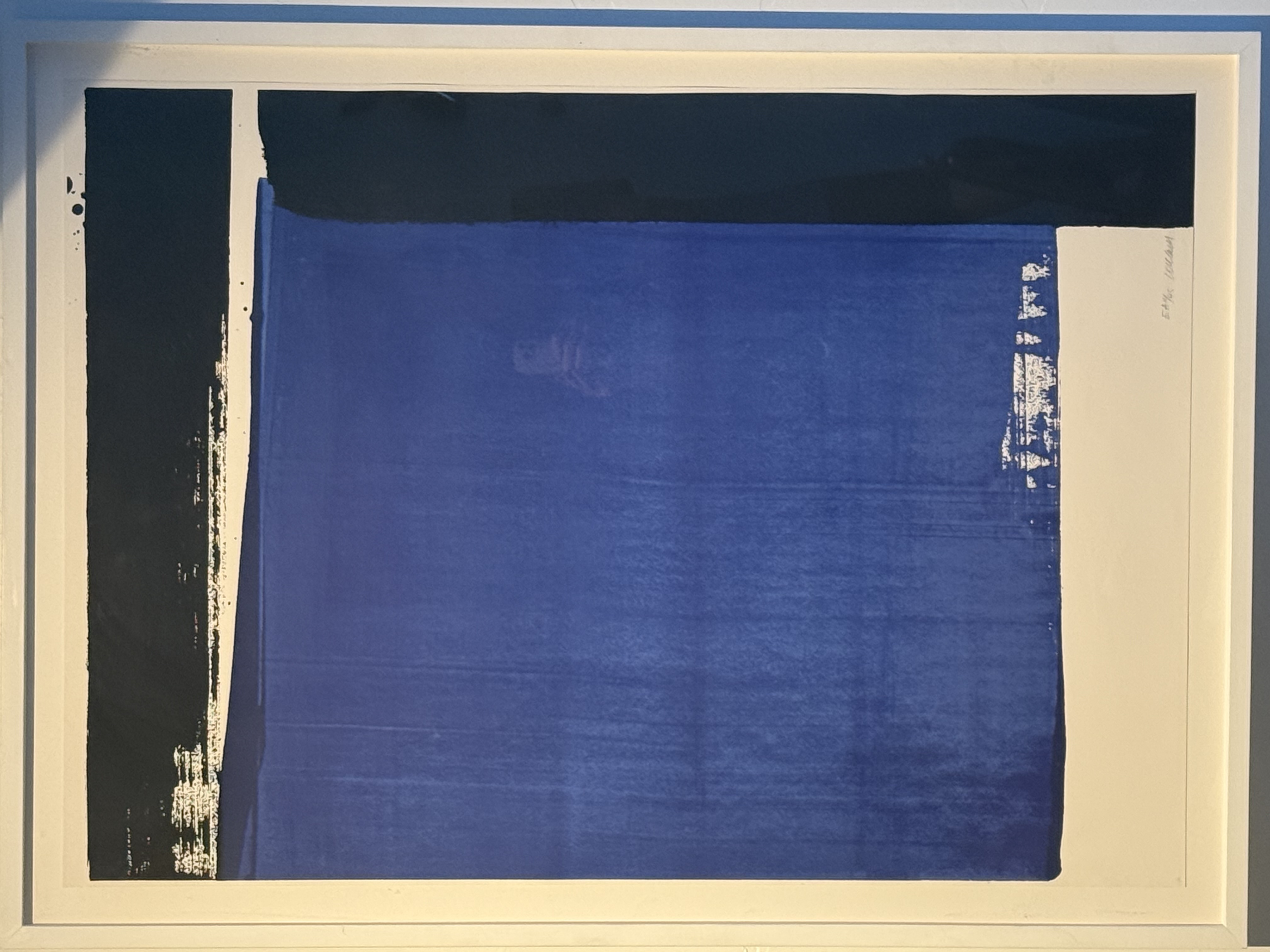
Serigraphie No. 16, 1981
What distinguished Soulages from the start was his refusal to treat black as an absence. Where others saw darkness as the negation of color, he understood it as a surface condition, a material with its own capacity to generate, deflect, and transform light. Through the 1950s and into the 1960s his canvases were marked by sweeping horizontal and vertical bars of black paint laid against warm ochres and raw umbers, works of extraordinary physical confidence. The paintings from this period, including the monumental oils now held by major institutions in Paris, New York, and Houston, demonstrate an artist who understood scale, rhythm, and the architecture of a painted surface with complete authority.
“The light comes from the canvas itself. The painting is a light generator.”
Pierre Soulages, on Outrenoir
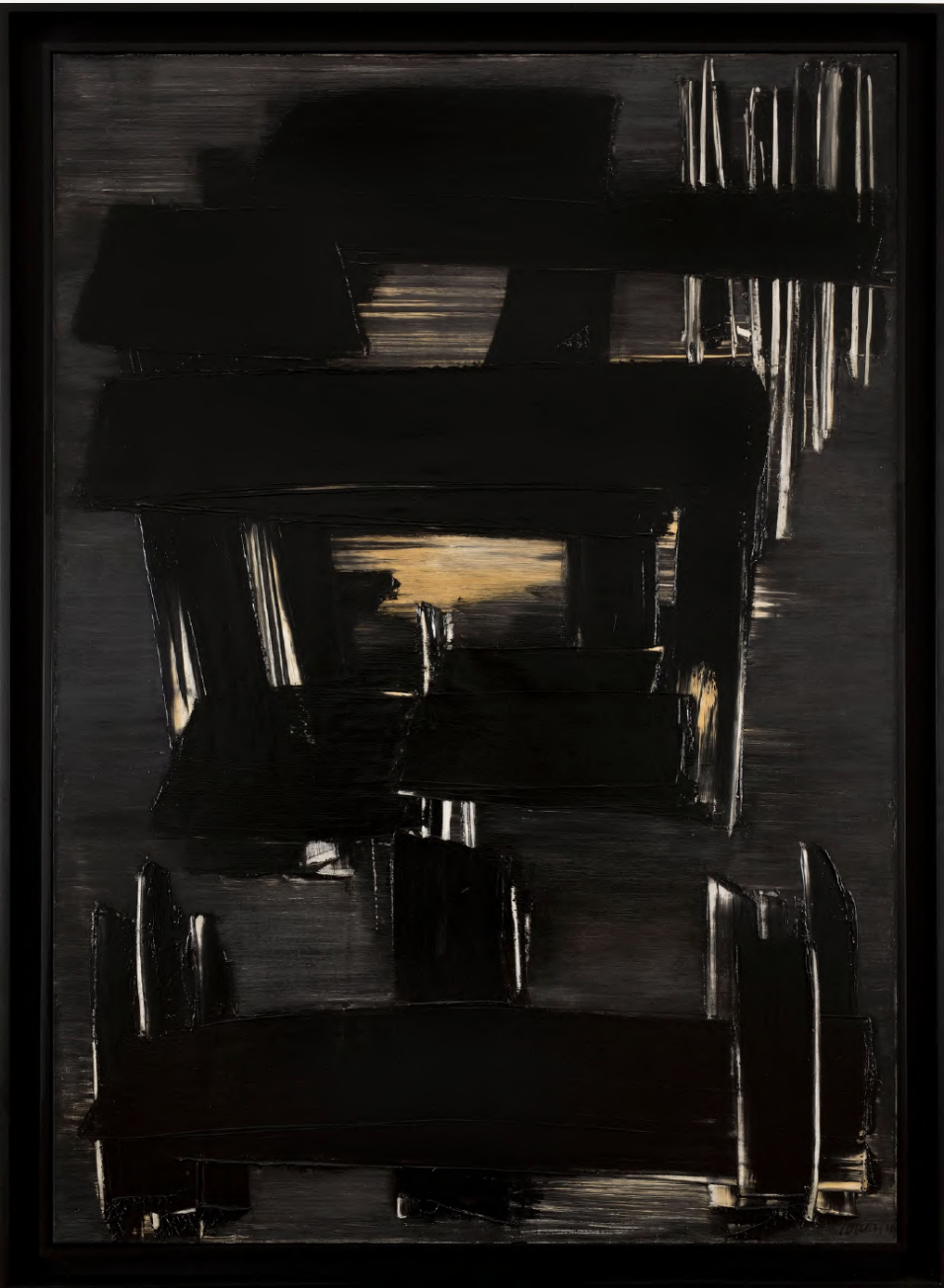
"Peinture 162 x 114 cm, 29 août 1958" is a superb example from this time, its dense black passages vibrating against a luminous ground in a way that rewards sustained looking. The decisive breakthrough came in 1979, when Soulages arrived at what he called Outrenoir, a term he coined to describe a territory beyond black. Working one evening on a canvas that had become entirely covered in black paint, he turned it toward the light and discovered that by altering the texture and orientation of the painted surface he could produce an infinite range of luminous effects from a single noncolor. The canvas was no longer a record of gesture but a physical object that performed differently depending on the viewer's position and the quality of ambient light.
Pierre Soulages
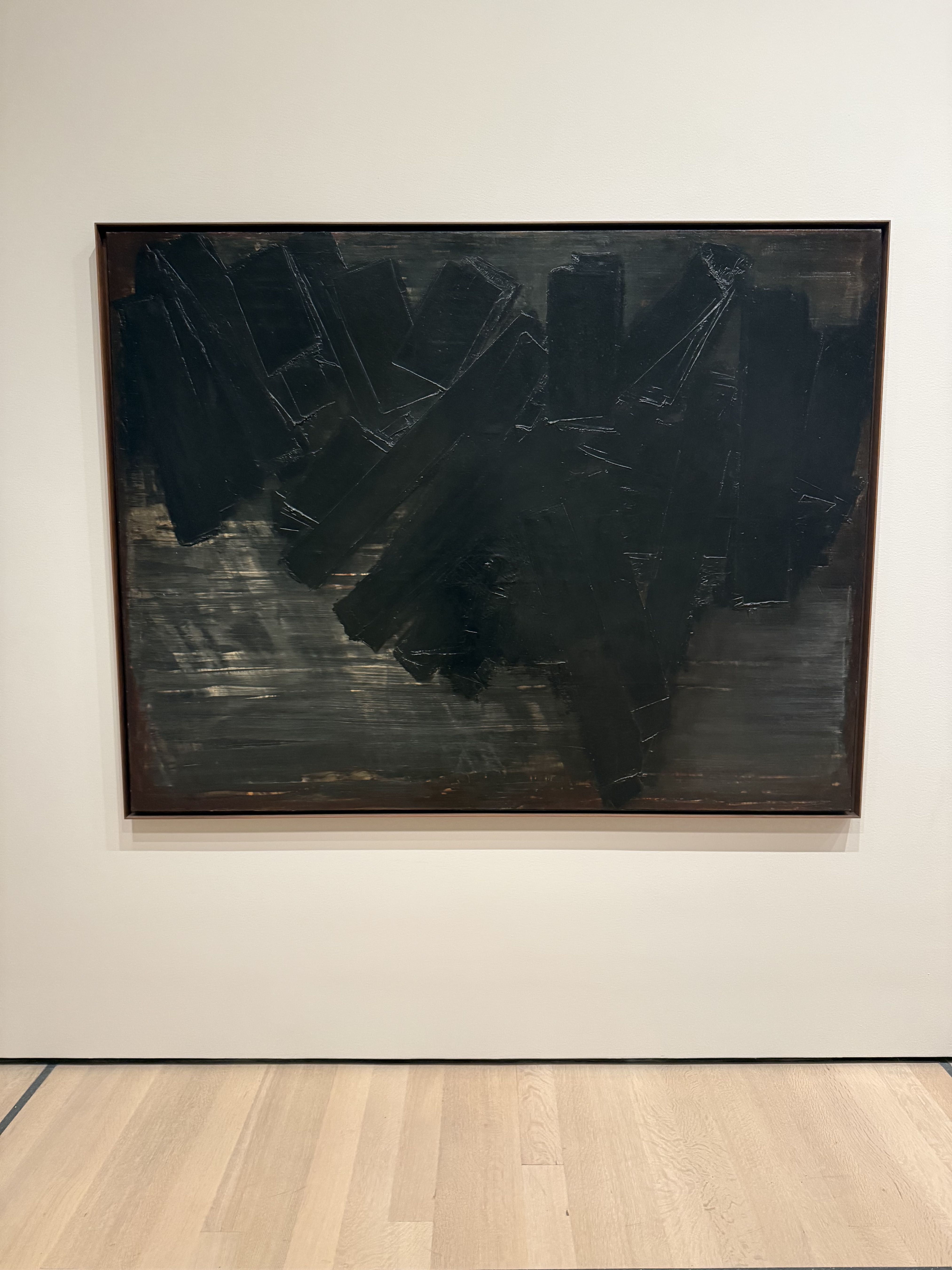
Painting
This revelation redirected the final four decades of his working life, producing paintings of meditative intensity that function almost as light installations, their matte and glossy striations creating a visual experience closer to the sacred than the decorative. His contribution to the stained glass windows of the Abbaye de Conques, completed in 1994, drew directly on this understanding, replacing figurative imagery with abstract planes of pale alabaster glass that flood the interior with a diffuse, otherworldly luminosity. For collectors, the range of Soulages's output offers genuine depth across different price points and media. His prints are among the most distinguished in the postwar canon, and works such as "Eau Forte VI" from 1957 and "Eau forte XXXVI" from 1979 demonstrate that his graphic intelligence was equal to his painterly ambition.
The etchings carry the same structural conviction as the large canvases, compressed into intimate formats that make them ideal entry points to his practice. His gouaches, such as the "Gouache 75 x 54,5 cm, 1973," reveal a looser and more immediate relationship to the mark, offering a glimpse of the hand at work. The large acrylic canvases from his final years, including the triptych "Peinture 263 x 181 cm, 2 juillet 2012," represent the full maturity of the Outrenoir project and rank among the most ambitious works of his career. At auction, major Soulages paintings have achieved prices well into the millions at houses including Christie's and Sotheby's, with his postwar oils and his Outrenoir period canvases commanding the strongest results.
Pierre Soulages
Peinture 162 x 114 cm, 29 août 1958, 1958
To understand Soulages fully it helps to place him within a broader constellation of postwar abstraction. He shares with Franz Kline and Mark Rothko a commitment to the emotional weight of reduced means, and his Outrenoir paintings invite comparison to the monochrome investigations of Yves Klein and Ad Reinhardt, though his surfaces are far more physically active than Reinhardt's and far more materially grounded than Klein's transcendent blues. Within the French tradition he is the towering figure of what came to be called Abstraction Lyrique, a movement that included Hans Hartung, Georges Mathieu, and Gérard Schneider, but his longevity and the radical coherence of his development set him apart from all of them. He did not follow trends.
He created a world and spent a lifetime deepening it. Pierre Soulages died in October 2022 at the age of 102, having worked with concentration and purpose until the very end of his life. The scale of the tributes that followed reflected not only the loss of a major artist but the passing of a figure who had come to embody a particular idea of what seriousness in art could look like: patient, physical, philosophical, and rooted in place. His work now resides in the permanent collections of the Centre Pompidou, the Museum of Modern Art in New York, the Menil Collection in Houston, and more than a hundred other institutions worldwide.
For those who collect with a long view, Soulages represents something genuinely rare: an artist whose reputation was built across a century and whose best work continues to grow in stature the longer and more carefully it is considered.
Explore books about Pierre Soulages
Soulages
François Marquet
Pierre Soulages: Catalogue Raisonné
Pierre Encrevé
Soulages
Françoise Marquet
Pierre Soulages: Black is a Color
Dominique Fourcade
Soulages: The Outrenoir Works
Caroline Bourgeois
Pierre Soulages: A Life of Light and Shadow
Jean Leymarie
Soulages: Peintures 1946-1990
Musée d'Art Moderne et d'Art Contemporain de Liège