Peter Halley
Peter Halley's Bright World Endures
Artist Spotlight · The Collection Editorial
“I see the cell as the fundamental unit of our society, whether it is a room, a prison cell, or a suburban house.”
Peter Halley, interview with Giancarlo Politi, Flash Art, 1986
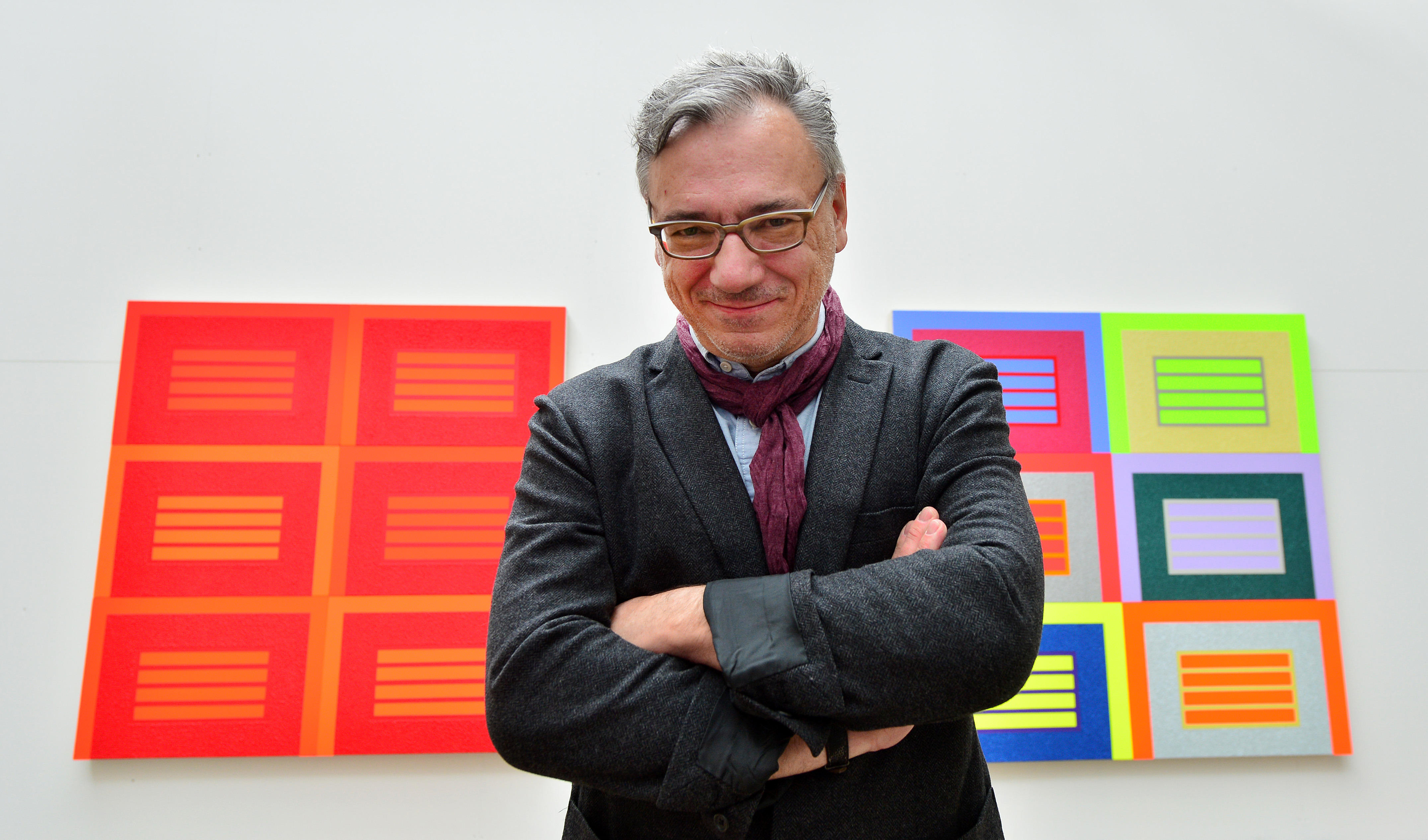
In the spring of 2023, a major survey of works by Peter Halley at Almine Rech in New York reminded a new generation of collectors just how prescient this artist has always been. The gallery walls blazed with fluorescent oranges, acid yellows, and electric pinks, each canvas a tightly organized field of geometric forms that felt simultaneously retro and urgently contemporary. For those who have followed Halley's career across four decades, the show confirmed what his most devoted admirers have long understood: that his singular visual language, forged in the intellectual crucible of 1980s New York, has only grown more resonant with time. Peter Halley was born in New York City in 1953 and came of age in an era when the city was both economically precarious and culturally explosive.
Peter Halley
Untitled
He studied at Yale University, receiving his BA in 1975, before completing his MFA at the University of New Orleans in 1978. Those years of formation exposed him to the rigorous theoretical frameworks of French poststructuralist thought, particularly the writings of Michel Foucault and Jean Baudrillard, whose ideas about power, space, and simulation would become foundational to his mature practice. Returning to New York in the early 1980s, Halley immersed himself in the Lower East Side art scene, where a community of painters, critics, and theorists were actively interrogating the legacy of abstraction. Halley's emergence as a significant figure came in the mid 1980s, precisely when the art world was grappling with questions about whether painting retained any meaningful vitality.
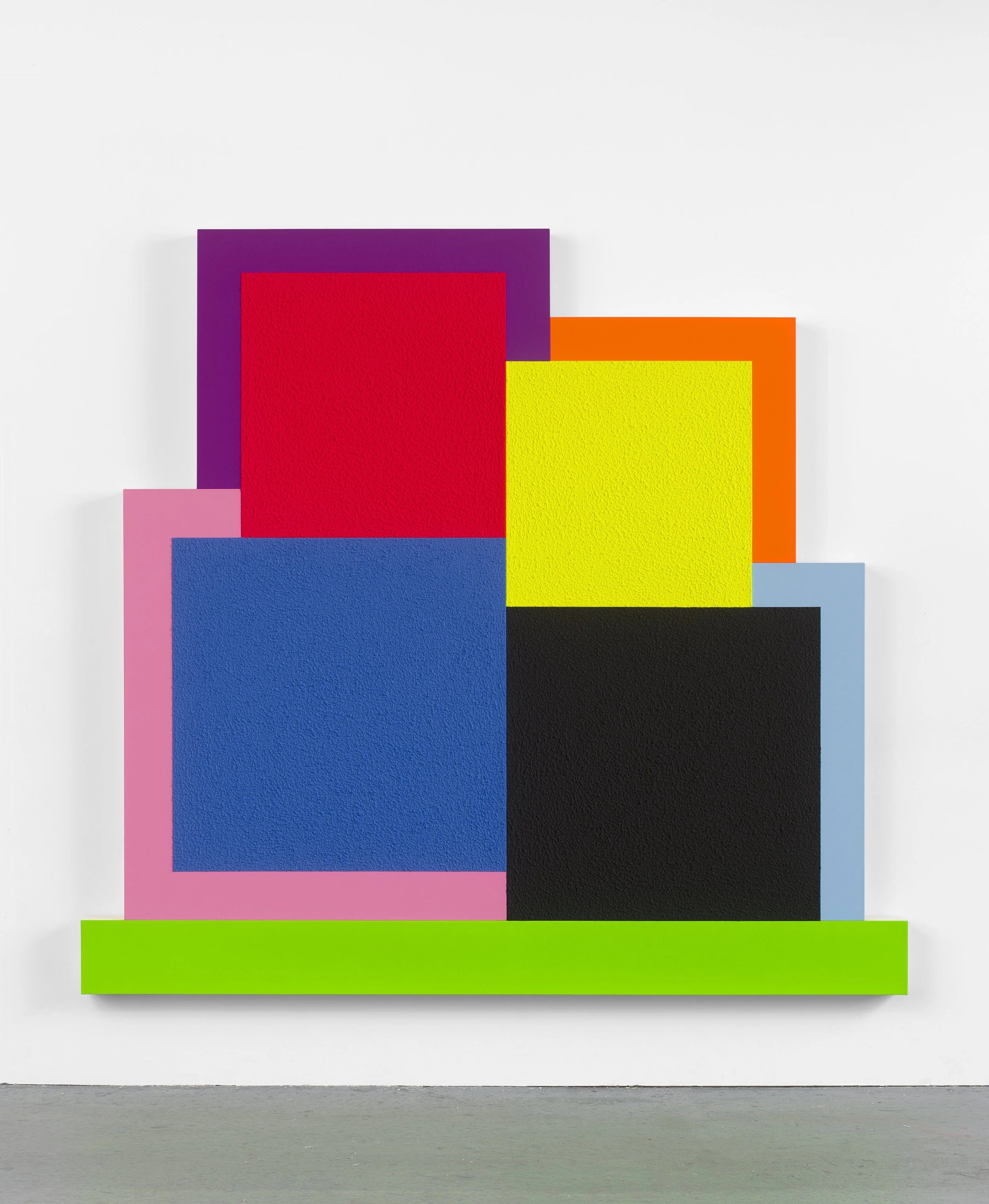
His answer was not to abandon abstraction but to treat it as a kind of cultural artifact worthy of critical examination. Working with acrylic paint, DayGlo pigments, and Roll A Tex, a textured additive that gives his surfaces a gritty, almost industrial quality, he developed a vocabulary of stark geometric forms: squares and rectangles he called cells, connected by narrow bands he called conduits. These were not neutral formal exercises. They were meditations on confinement, circulation, and the invisible architectures of modern life, from prison blocks to electrical grids to the networked flows of capital and information.
Peter Halley
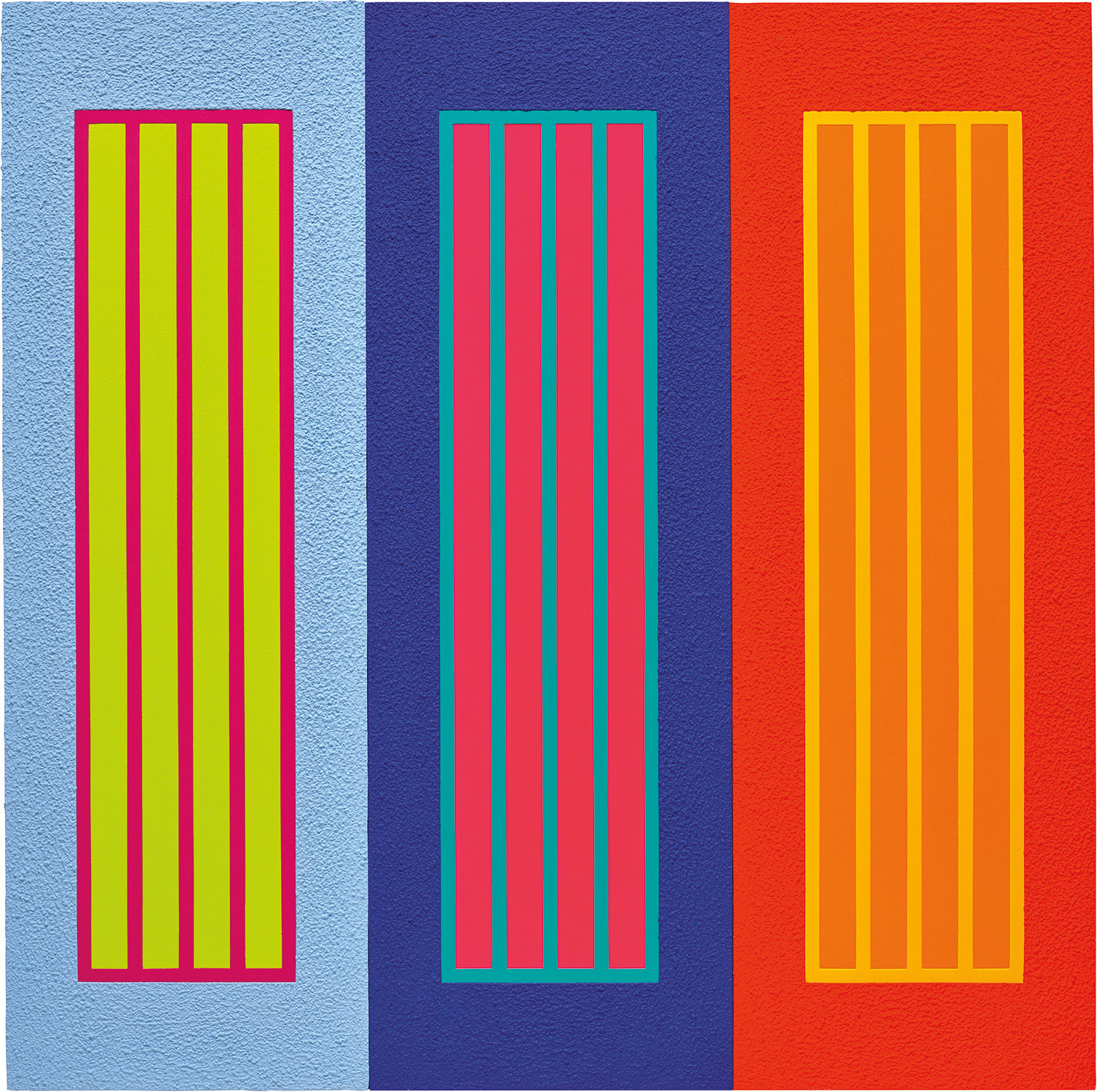
Three Prisons, 2009
By 1986, Halley was exhibiting alongside Jeff Koons, Ashley Bickerton, and Meyer Vaisman at the International with Monument Gallery in New York, a moment that critics would retrospectively identify as the birth of Neo Geo, short for Neo Geometric Conceptualism. This loose grouping of artists shared an interest in appropriating the visual strategies of earlier abstraction, including Minimalism and Color Field painting, and redirecting them through a postmodern lens. Halley's contribution to that conversation was particularly intellectually charged. He published essays and theoretical texts alongside his paintings, positioning himself not just as a maker of images but as a thinker actively working through the cultural logic of late capitalism.
“Geometry is used to confine and control, to mark off property, to define spaces of production and spaces of incarceration.”
Peter Halley, collected essays
His writing appeared in journals including Arts Magazine and later in the influential publication index, which he founded and edited through much of the 1990s. The signature works that define Halley's legacy are those involving his recurring cell and prison imagery. Paintings such as Three Prisons from 2009 and Six Prisons from the same year demonstrate the full power of his approach. Presented across multiple canvases, these works stage an almost architectural experience, the viewer moving along a series of contained geometric forms rendered in colors so intensely saturated they seem to vibrate against one another.
Peter Halley
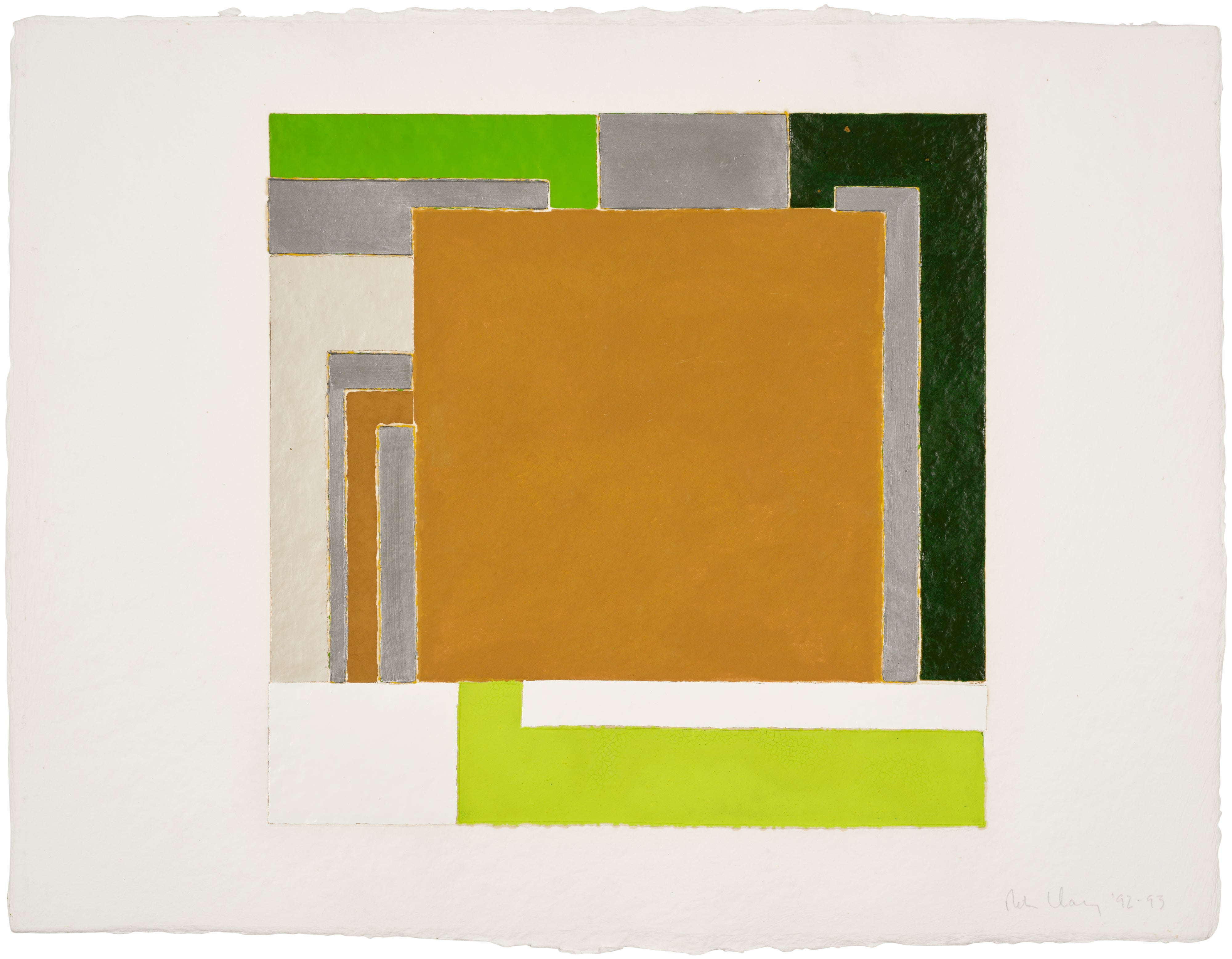
1992-93
The Roll A Tex ground introduces a tactile roughness that counteracts any sense of slick detachment, grounding these images in material reality even as their palette tips toward the synthetic and the hyperreal. Black Prison Above Yellow Prison from 2006 offers a particularly compelling study in chromatic tension, the cold severity of the upper form pressing down upon the luminous warmth below in a relationship that feels almost psychological. Collocation from 2003 and Direction No. 7 from 2014 show how Halley has continued to evolve his formal language, introducing metallic and pearlescent acrylic into his surfaces to catch and reflect ambient light in ways that animate the work across different viewing conditions.
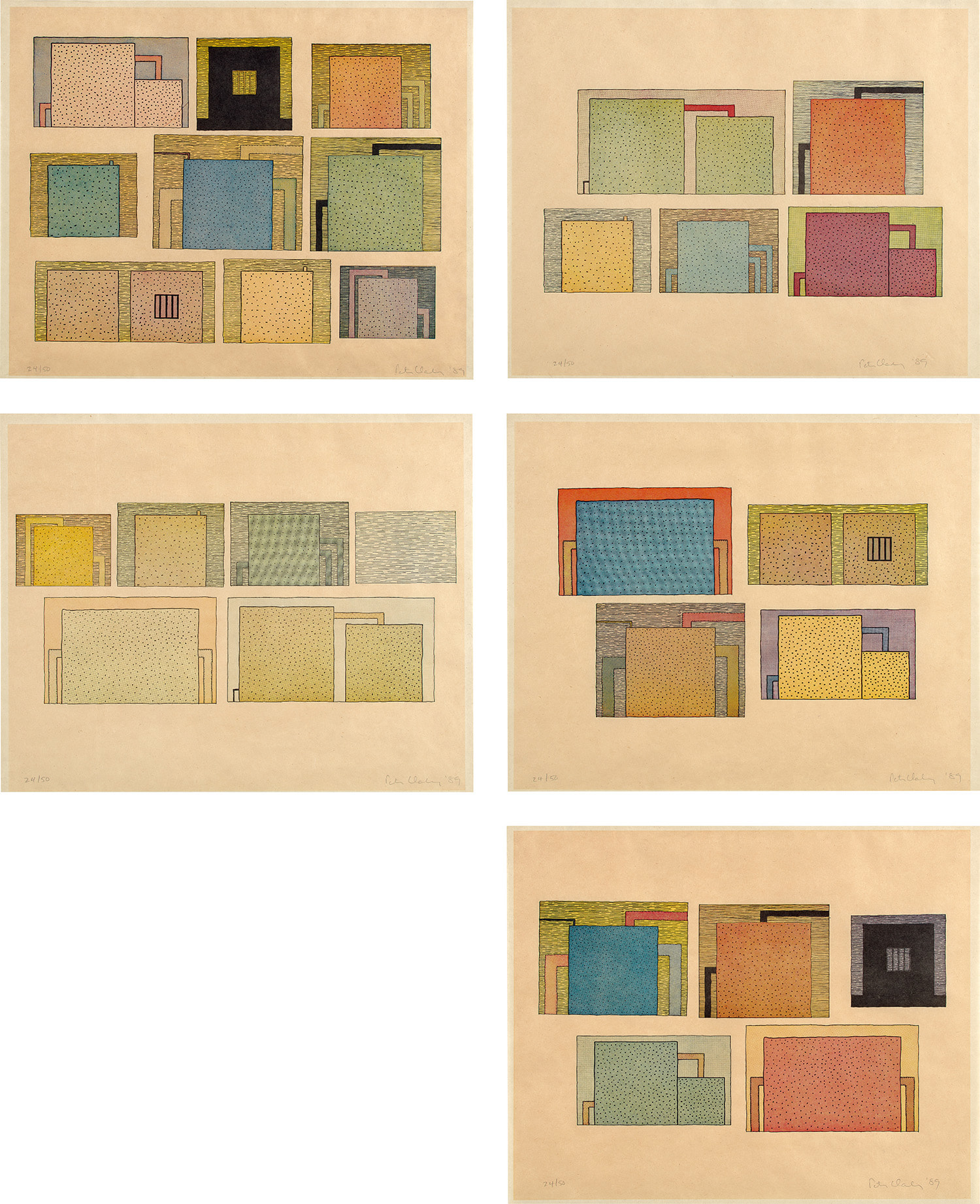
For collectors, Halley's market offers a compelling combination of intellectual depth and visual immediacy. His works have been acquired by major institutional collections including the Museum of Modern Art in New York, the Tate in London, and the Stedelijk Museum in Amsterdam, a breadth of institutional recognition that speaks to his sustained critical standing. At auction, significant canvases from his 1980s and early 1990s peak period command serious attention, particularly multi panel works and those featuring his most concentrated use of fluorescent pigment. The prints, including the edition A Tour of the Monuments of Passaic, New Jersey, co published by Edition Schellmann and Pace Editions, represent an accessible entry point into his practice and carry the added resonance of his engagement with Robert Smithson's conceptual legacy.
Peter Halley
A Tour of the Monuments of Passiac, New Jersey
Collectors drawn to the intersection of rigorous thinking and painterly pleasure consistently find Halley's work deeply satisfying to live with, the formal clarity providing a kind of visual anchor while the theoretical underpinnings reward sustained contemplation. Understanding Halley fully means situating him within a broader constellation of artists who have interrogated the boundaries of abstraction and representation. His dialogue with the legacy of Frank Stella, whose shaped canvases pushed geometric painting toward its structural limits, is evident throughout his career. The cool chromatic intelligence of Ellsworth Kelly hovers in the background, as does the institutional critique embedded in the work of Dan Flavin and Donald Judd.
Among his immediate contemporaries, Halley's practice speaks most directly to artists like Philip Taaffe and Jonathan Lasker, painters who similarly treat abstraction as a living discourse rather than a closed chapter of art history. More recently, his influence can be detected in the work of a younger generation of painters exploring digital aesthetics and networked imagery through the medium of paint. What makes Peter Halley matter today, perhaps more than ever, is the extraordinary accuracy of his original intuition. The cells and conduits he began painting in the early 1980s, metaphors for containment, isolation, and the invisible circulation of power and information, feel less like prophetic commentary now than simple description.
In a world defined by network architectures, surveillance infrastructures, and the cellular geometry of screens, Halley's paintings have become almost documentary in their precision. His continued practice, vibrant and undiminished across more than four decades, stands as a testament to what rigorous visual thinking combined with genuine painterly commitment can achieve. For collectors and institutions fortunate enough to hold his work, that achievement grows only more valuable with time.
Explore books about Peter Halley
Peter Halley: Day-Glo 1982-1987
Hal Foster
Peter Halley
Giancarlo Politi
Peter Halley: Recent Paintings
Various
Peter Halley: The Paintings of Peter Halley
Peter Halley

Peter Halley: Recent Work
Roberta Smith