Ángela de la Cruz
Ángela de la Cruz Gives Painting New Life
Artist Spotlight · The Collection Editorial
“Painting is an object. It has a body. I am interested in that body.”
Ángela de la Cruz
When the Lisson Gallery presented a major survey of Ángela de la Cruz's work in London, something remarkable happened in the viewing rooms: people stopped in their tracks. Not because the paintings were beautiful in any conventional sense, though they are, but because they seemed to be breathing. Canvases slumped against walls, spilled onto floors, and folded inward on themselves like exhausted bodies. The work did not hang so much as inhabit the space, and visitors found themselves moving around it the way you move around another person.
Ángela de la Cruz
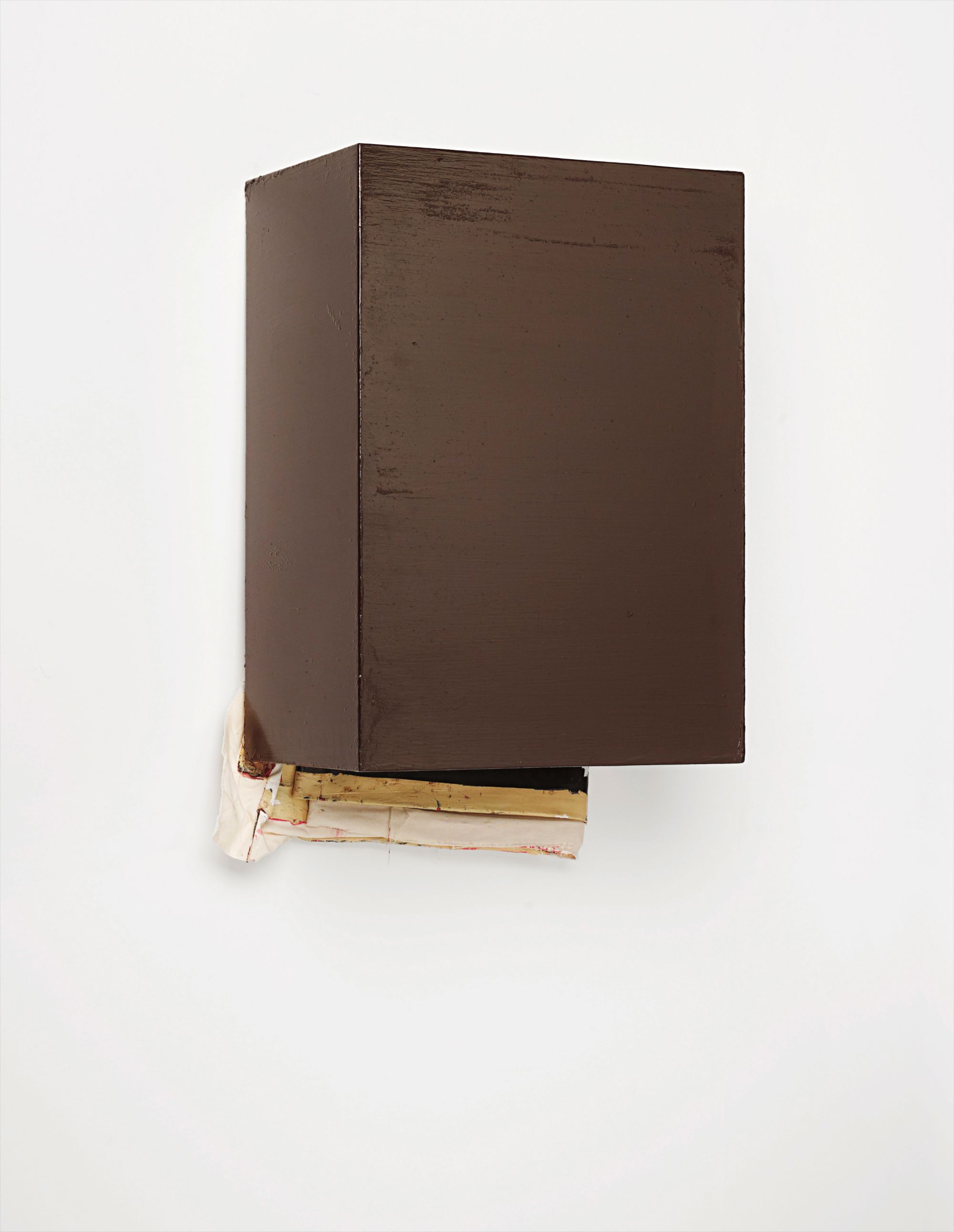
Torso
That quality of physical presence, at once vulnerable and undeniable, is the hallmark of one of the most singular practices in contemporary art. Ángela de la Cruz was born in La Coruña, in the Galicia region of northwestern Spain, in 1965. She moved to London in the late 1980s and studied at the Slade School of Fine Art and then at Goldsmiths, placing herself at the epicentre of one of the most fertile periods in British art. The Goldsmiths generation that emerged in the late 1980s and early 1990s would go on to reshape contemporary art globally, and de la Cruz absorbed that environment of conceptual rigor and material ambition while charting a course that was entirely her own.
Where many of her peers turned toward spectacle and provocation, she turned inward, toward painting itself, asking what it meant to take the most traditional of art forms and push it past its own limits. Her early works already showed an obsession with the physical conditions of painting rather than its pictorial possibilities. De la Cruz was less interested in what a canvas could depict than in what it was: a stretched fabric over a wooden support, an object with weight and tension and a surface that could be stressed, punctured, compressed, and broken. Over the course of the 1990s she developed a practice that treated the act of painting as only the beginning of a process.
Ángela de la Cruz
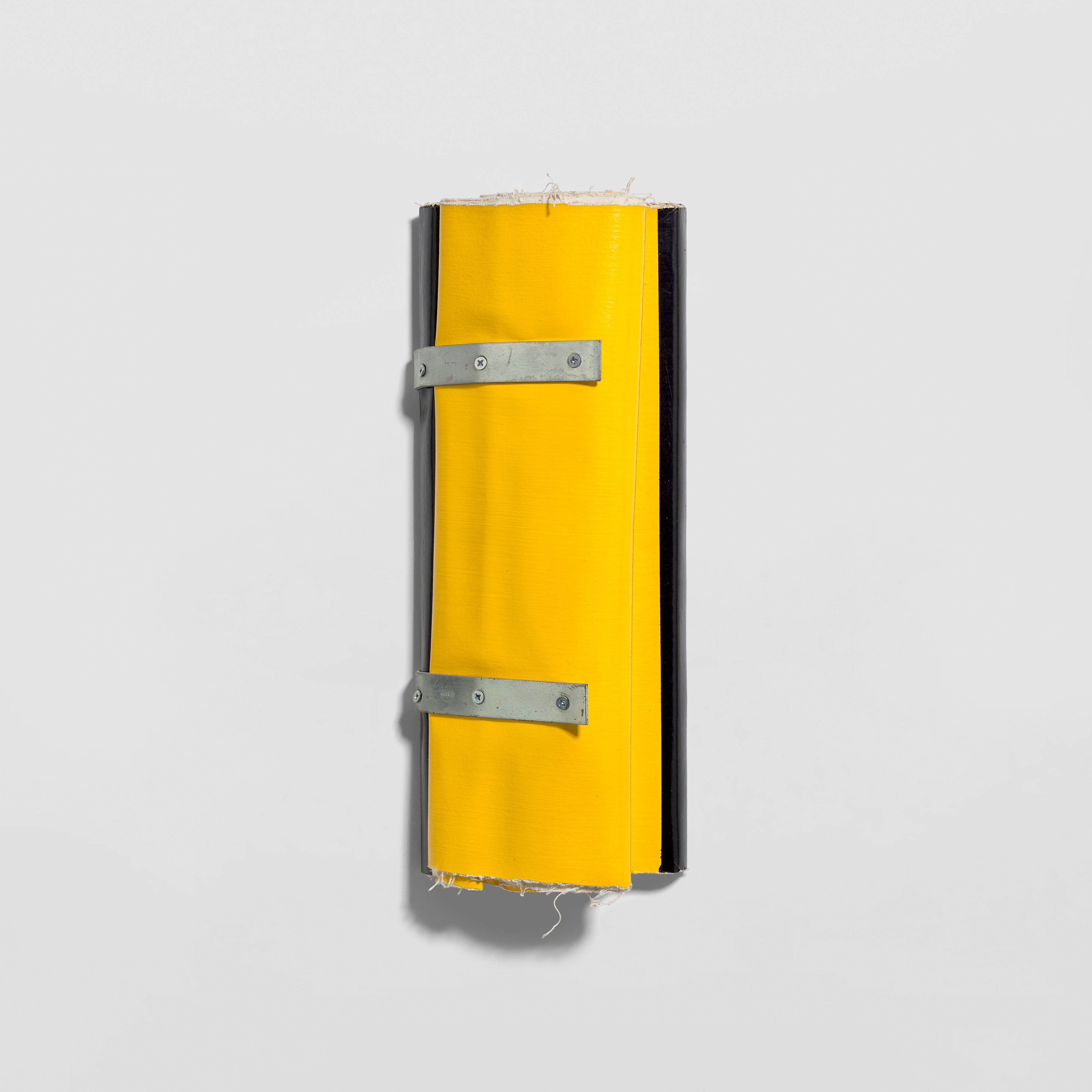
Minimum (Yellow-Dark Blue), 2004
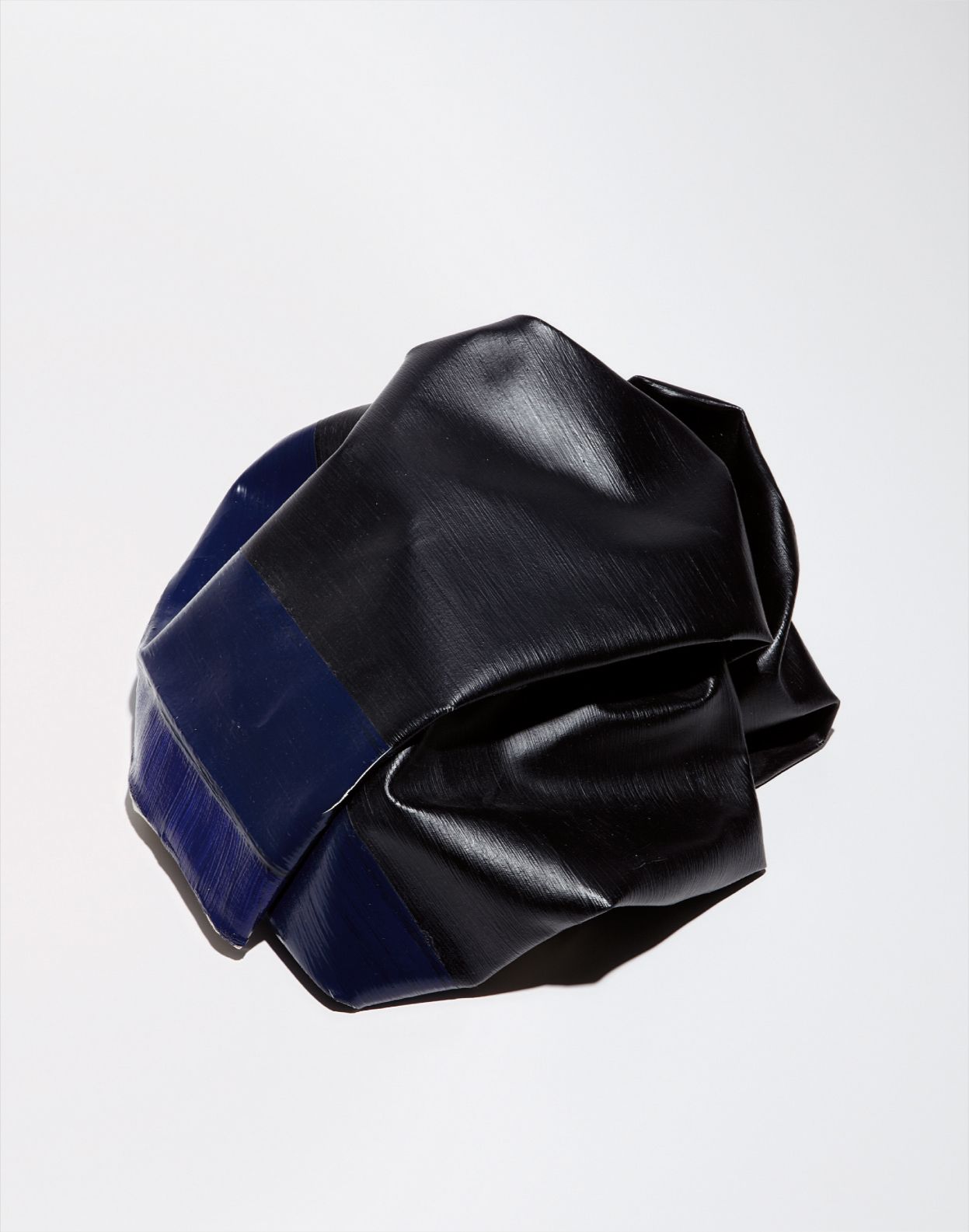
Once the paint was applied, the real work began. She would remove canvases from their stretchers, fold them, crumple them, tear them, and force them back into frames that no longer fit. The result was painting as collapsed architecture, as wounded form, as something that had survived something. The signature works that define her practice carry this logic to its fullest expression.
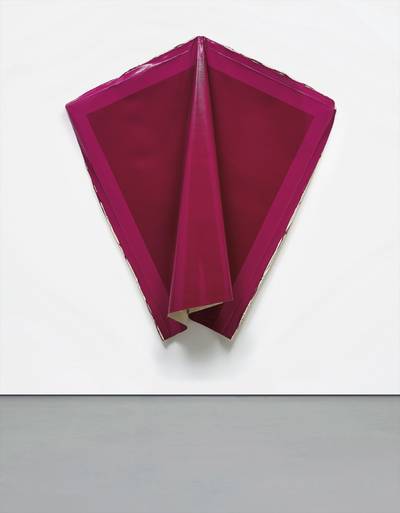
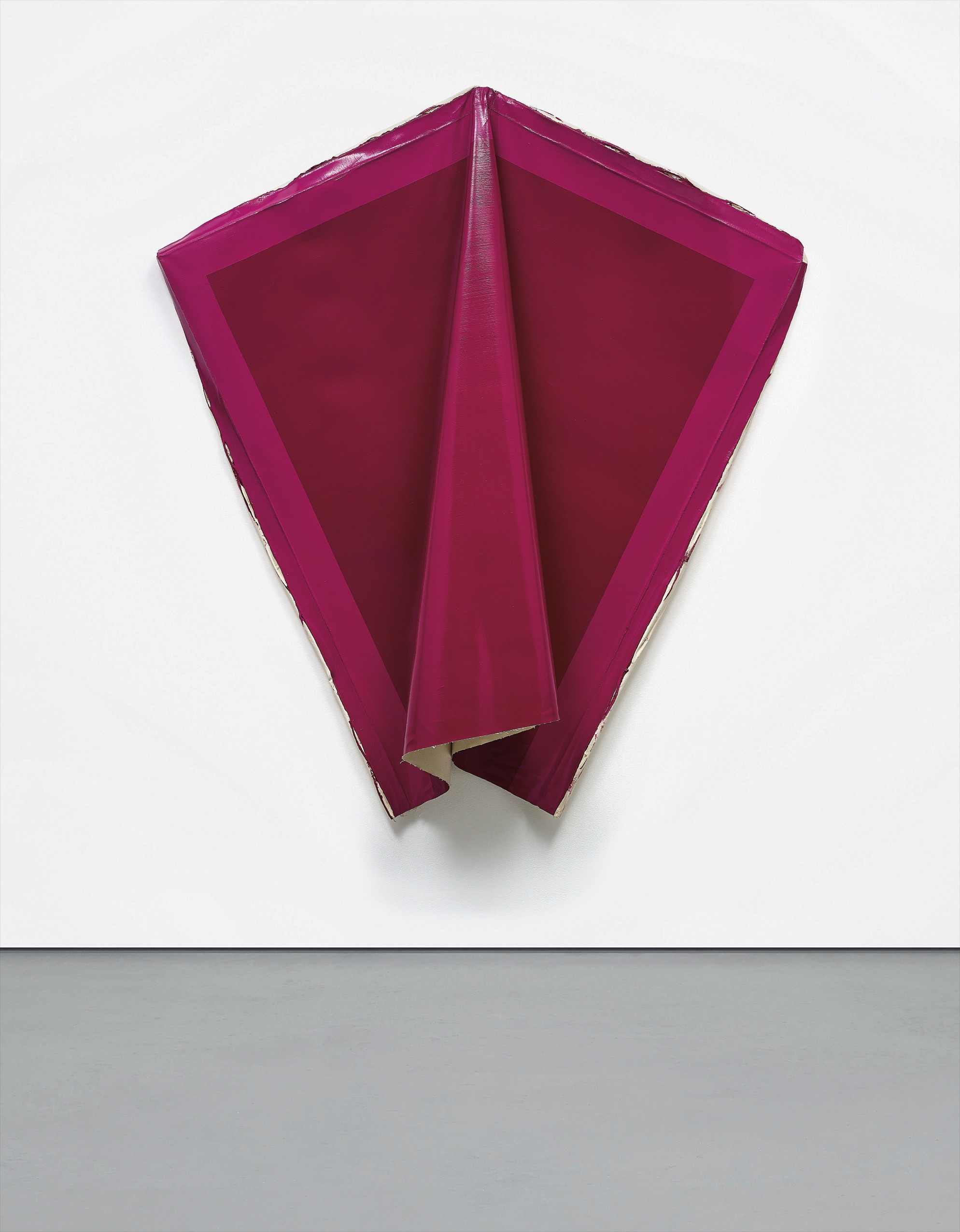
A piece like Deflated (Magenta) from 2010 presents a canvas that has been pressed flat and drained of its volume, the magenta surface gathering into creases and folds that read simultaneously as abstract form and as a record of physical force. Minimum (Yellow Dark Blue), made in 2004 using oil and acrylic on canvas with wood and metal, extends the painting's structure beyond the frame itself, making visible the armature that usually remains hidden. Works from her ongoing Torso series, realised in oil on aluminium and canvas, bring an unmistakably corporeal quality: these are objects that seem to have posture, that lean and sag with something approaching bodily weight. Mini Nothing 13 (Blue2) and Hung (White/Brown) 3 continue this investigation at an intimate scale, proving that the force of her ideas does not depend on monumentality.
Ángela de la Cruz
Deflated (Magenta), 2010
Even the smallest works carry the same compressed energy, the same sense that the painting has been through something and emerged transformed. The critical recognition that has followed her work reflects how seriously the art world has engaged with these questions. De la Cruz was nominated for the Turner Prize, Britain's most prominent contemporary art award, a nomination that brought her practice to a much wider public audience and confirmed her place among the most important artists working in the United Kingdom. Her work is held in the permanent collections of Tate in London and the Museo Reina Sofía in Madrid, two of the most significant institutions in the world, and this institutional confidence is matched by the enthusiasm of private collectors who have followed her practice closely for decades.
That she bridges two great cultural traditions, the Spanish and the British, gives her work a particular resonance in both markets and makes her a genuinely international figure in a field that sometimes mistakes geography for universality. For collectors, the appeal of de la Cruz's work operates on multiple levels. There is the immediate visual and physical impact, the way her pieces command a room and hold their presence against any surrounding work. There is the conceptual clarity of a practice that has remained focused and consistent across three decades without becoming repetitive.
Ángela de la Cruz
Mini Nothing 13 (Blue2)
And there is the art historical weight of an artist who has engaged seriously with the legacies of both painting and sculpture, situating herself in a lineage that includes Lucio Fontana's slashed canvases, the process orientations of Arte Povera, and the post minimalist investigations of artists like Eva Hesse and Franz Erhard Walther. To own a work by de la Cruz is to own a piece of an argument about what painting is and what it can become, and that argument has only grown more relevant as the boundaries between media continue to dissolve. The context of her work within art history rewards close attention. Fontana's Concetti Spaziali established the idea of the canvas as a surface to be attacked rather than adorned, and de la Cruz inherits that tradition while redirecting it.
Where Fontana's cuts are clean and theatrical, her interventions are intimate and prolonged, closer to the accumulation of pressure over time than to a single decisive act. The connection to Eva Hesse's concern with material fragility and bodily metaphor is equally instructive. De la Cruz works at the intersection of these lineages with a voice that is unmistakably her own, one shaped as much by the Atlantic light of Galicia as by the institutional rigor of London. What makes Ángela de la Cruz matter so urgently right now is the emotional directness of her work at a moment when directness is often in short supply.
Her paintings do not illustrate vulnerability or represent exhaustion: they enact these states in the most literal material terms. A deflated canvas is a deflated canvas, and yet it is also, undeniably, something more. That capacity to hold the literal and the metaphorical in perfect tension, without tipping into sentiment or abstraction, is among the rarest qualities in contemporary art. Collectors who have lived with her work for years speak of it with the kind of quiet devotion that the best art inspires, not wonder at a trick but gratitude for a genuine encounter.
That is the measure of a practice that will only continue to grow in stature.
Explore books about Ángela de la Cruz
Ángela de la Cruz: Works 1995-2005
Various contributors
Ángela de la Cruz
Okwui Enwezor
Ángela de la Cruz: New Works
Gallery staff
Ángela de la Cruz: Pintura, Escultura, Instalación
Spanish Museum curators