Mimmo Rotella
Mimmo Rotella: The City Was His Canvas
Artist Spotlight · The Collection Editorial
“The street is my studio. The city gives me everything I need.”
Mimmo Rotella
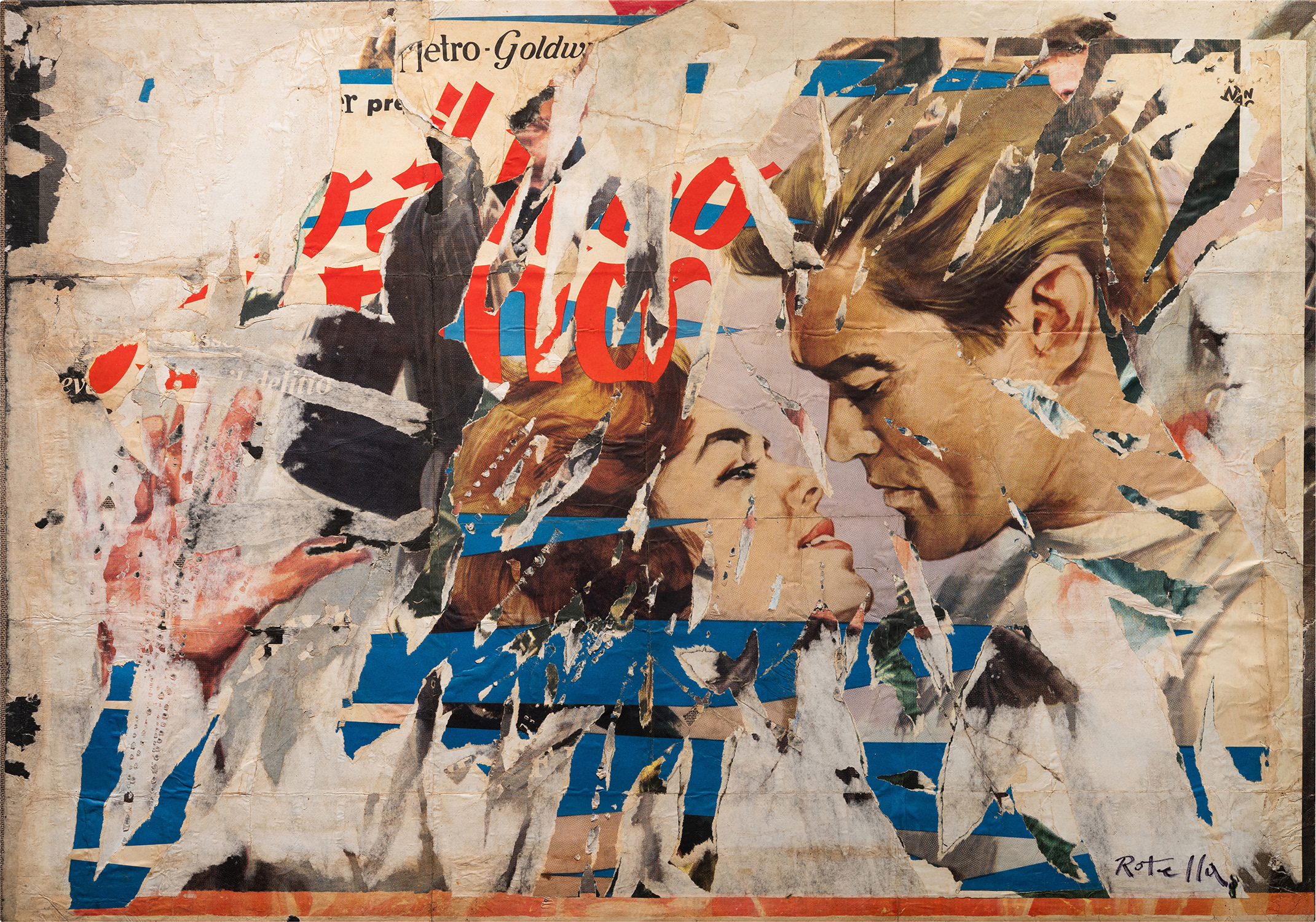
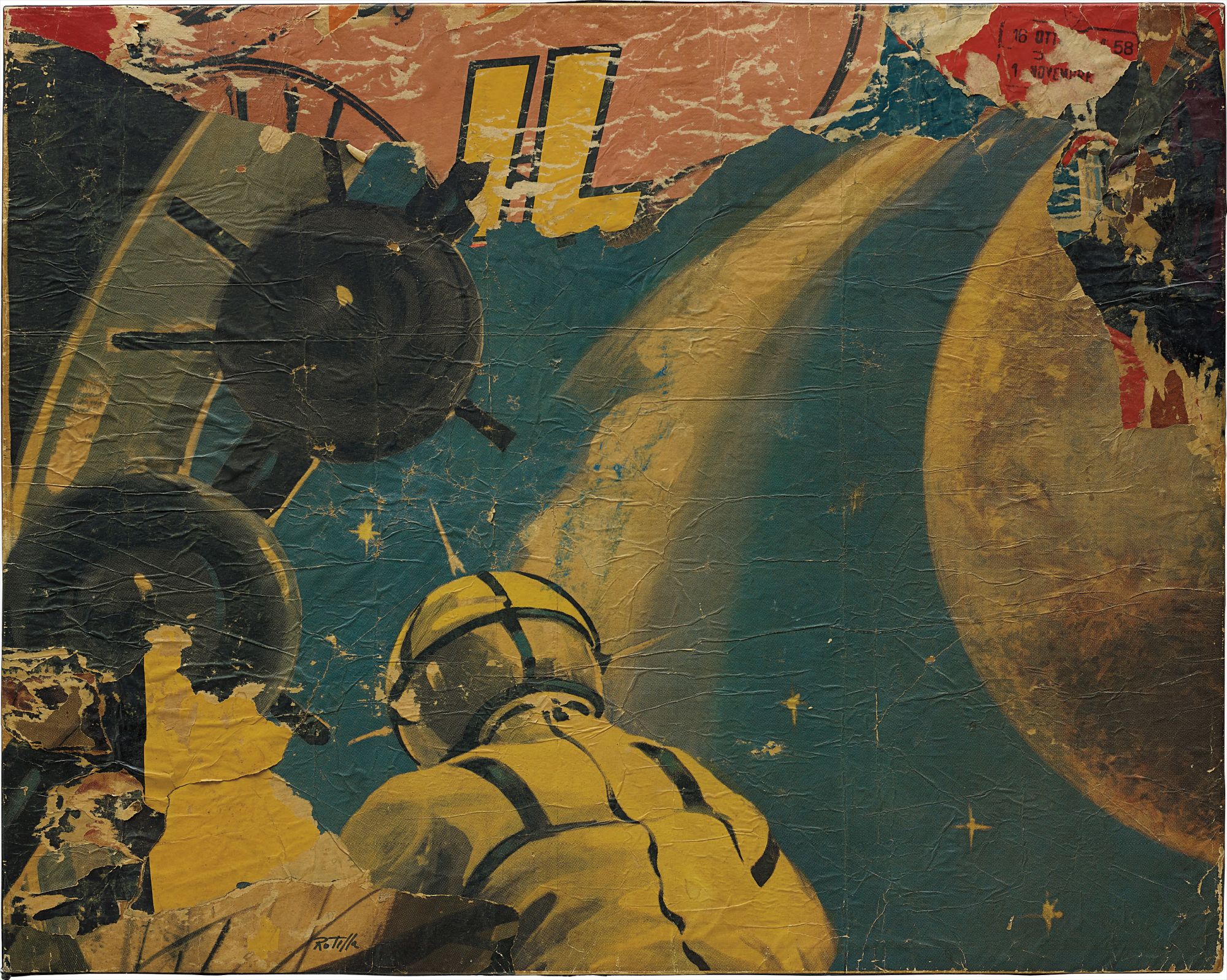
There is a particular kind of magic that happens when you stand before a large Mimmo Rotella décollage from the late 1950s or early 1960s. The surface trembles with energy. Torn edges catch the light. Faces from advertisements emerge and dissolve back into layers of pigment and paper, like memories surfacing through noise.
Mimmo Rotella
Aron
It is no accident that the Centre Pompidou in Paris and the MAXXI in Rome both hold significant examples of his work, institutions that recognise in Rotella one of the essential voices of the postwar European avant garde. As renewed critical attention turns toward the Nouveau Réalisme movement and its profound influence on contemporary art, Rotella's practice feels not merely historical but urgently present. Mimmo Rotella was born in Catanzaro, in the Calabria region of southern Italy, in 1918. He studied at the Accademia di Belle Arti in Naples, and after the Second World War he began working as a painter in Rome, where the rubble of the old world and the garish promise of the new consumer age existed side by side on every street corner.
Rome in the late 1940s and early 1950s was a city rebuilding itself with borrowed images, plastering its walls with film posters and advertising hoardings, and it was this visual cacophony that would become the raw material of Rotella's entire artistic vision. A Fulbright scholarship took him to the University of Kansas City in 1951 and 1952, where his encounter with American popular culture deepened his understanding of mass media as both spectacle and language. When Rotella returned to Rome, he brought with him a sharper awareness of the image as a tool of power and persuasion. He began removing posters from the walls of the city, not to preserve them but to transform them through acts of deliberate and expressive tearing.
Mimmo Rotella
Statistica
This was the birth of his signature technique, the décollage, a process of subtraction rather than addition. Where collage builds up, décollage strips away, and in that stripping Rotella found an aesthetic philosophy entirely his own. By 1960 he had been invited by Pierre Restany to join the Nouveau Réalisme group in Paris, alongside figures such as Yves Klein, Jean Tinguely, Niki de Saint Phalle, and Christo. The group's founding declaration, signed in October 1960, positioned these artists as new realists who engaged directly with the fabric of contemporary life, and Rotella was their poet of the urban wall.
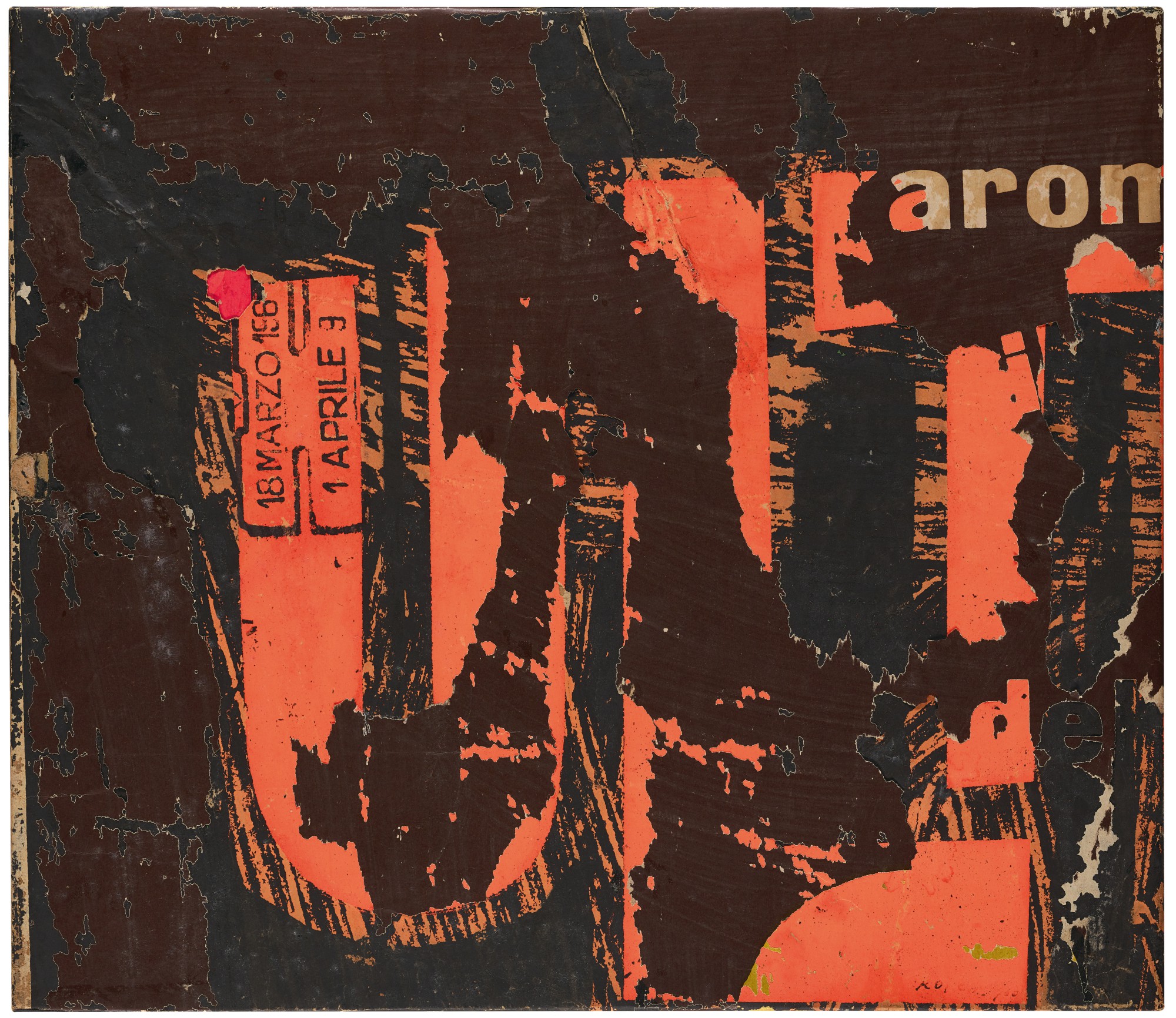
The works Rotella produced during the late 1950s and through the 1960s represent the summit of his achievement and some of the most compelling art made in postwar Europe. Works such as "N.n." from 1959 and "Angoscia" from 1960 demonstrate the full force of his method: layers of commercial imagery torn and folded back to reveal the archaeology of the street.
Mimmo Rotella
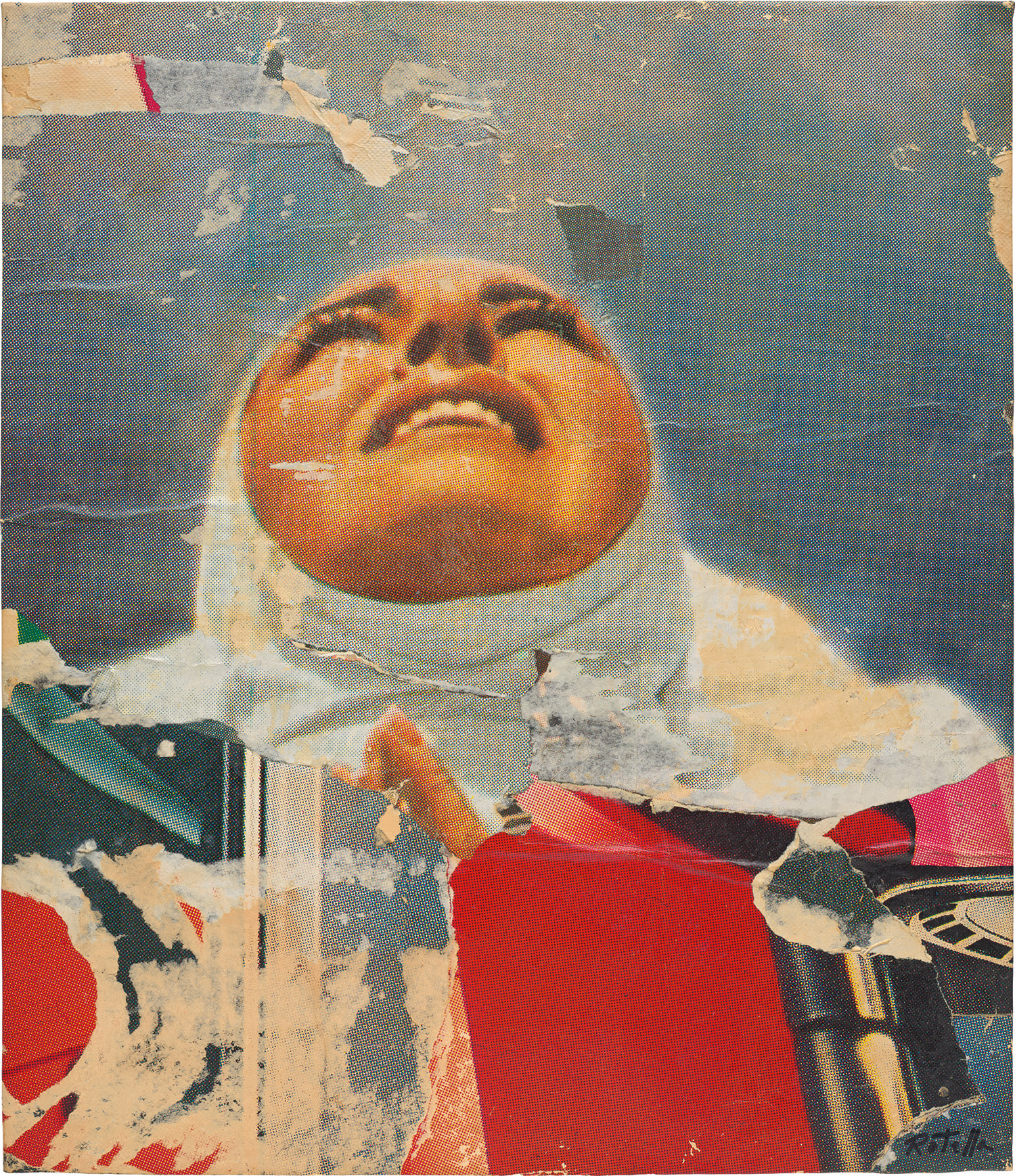
Suor Maria, 1962
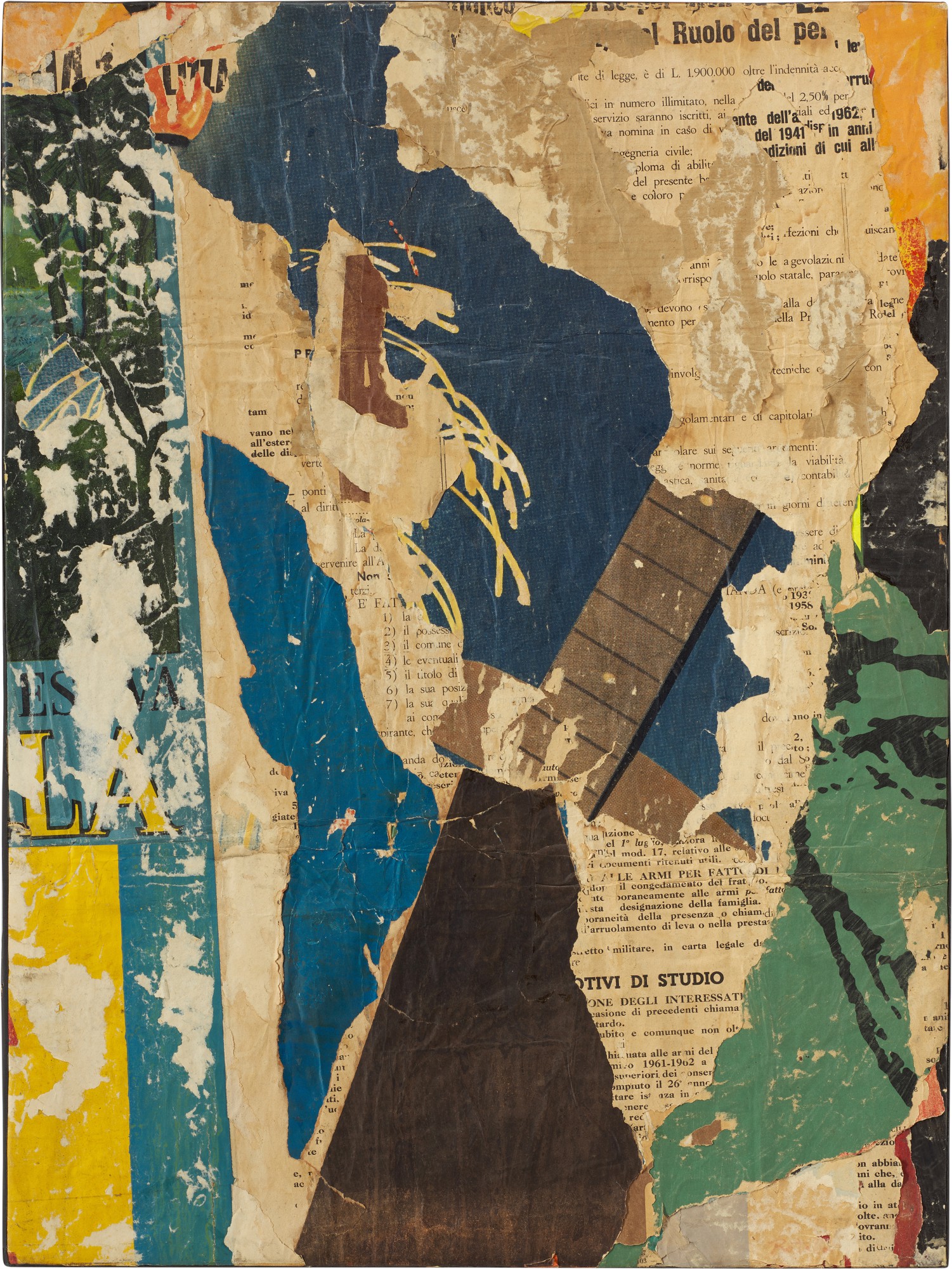
His "Senza Titolo" from 1958 shows the technical refinement and compositional instinct that distinguished his work from mere gesture. In "Suor Maria" from 1962 and "Tre" from 1963, there is a formal confidence, a sense of a mature artist who knows exactly what the tension between revelation and concealment can achieve. His later work, including pieces such as "Innamorati" from 1978 and "Le main de la liberté" from 1991, shows a continuing willingness to evolve, moving fluidly between paper collage and offset lithograph, always keeping one eye on the image culture surrounding him. For collectors, Rotella presents a compelling and layered opportunity.
His position at the intersection of Pop Art and Nouveau Réalisme gives his work an art historical weight that resonates across two of the most studied movements of the twentieth century. American Pop artists such as Robert Rauschenberg and Andy Warhol were working through related questions about the image, the commodity, and the surface of modern life, and placing Rotella in dialogue with those names clarifies both his originality and his importance. Works on canvas from the late 1950s through to the mid 1960s are considered the most sought after by serious collectors and institutions, and the best examples combine strong compositional structure with vivid traces of their source material, film stills, advertising slogans, the faces of cultural icons, all caught in the act of disappearing. The provenance history of individual works can itself be remarkable: one notable work on the platform traces its origins to Constantin Tacou, the Romanian émigré editor of the Cahiers de L'Herne who settled in Paris and built a collection of exceptional discernment, acquiring key works by Lucio Fontana, Alexander Calder, Yves Klein, Tinguely, Christo, and Rotella himself.
Mimmo Rotella
Constantin Tacou emigrated from Romania to France in 1948. There, he became an important and charismatic figure in Bohemian post-war Paris where he worked as the editor of the Cahiers de L'Herne. Tacou not only published Rotella’s biography, Une Vie D’artiste, but he was also an avid collector with an acutely discerning eye, acquiring some outstanding works by Fontana, Calder, Christo, Klein, Tinguely and Rotella.
Works with such provenance carry with them an entire history of serious, passionate collecting. Rotella's relationship to the broader art historical narrative becomes richer the more closely you examine it. His work belongs to a distinctly European lineage that includes the Dadaist tradition of Kurt Schwitters and the readymade logic of Marcel Duchamp, but it reframes those inheritances in the vivid commercial light of postwar modernity. Where Schwitters gathered the humble refuse of everyday life, Rotella harvested the glamorous and insistent imagery of mass culture.
His affinities with Rauschenberg's Combines and with the silkscreen works of Warhol are real, but Rotella arrived at his conclusions through a physically immediate engagement with the city that gives his work a tactile and almost autobiographical quality those American counterparts rarely share. He was not appropriating the image at a remove but pulling it bodily from the wall. Mimmo Rotella died in Milan in 2006, leaving behind a body of work that continues to grow in critical and commercial stature. The Estate has worked to maintain the rigour and visibility of his legacy, ensuring that scholarship and authentication keep pace with market interest.
For collectors approaching his work today, the pleasure is multiple: there is the formal beauty of the surfaces themselves, the art historical resonance of the movement he helped define, and the peculiarly moving experience of encountering the fragments of a vanished urban world, the Rome of Fellini and the Paris of Restany, preserved in torn paper and canvas. Rotella understood before almost anyone that the walls of the modern city were themselves a kind of art, and he gave us the tools to see them.
Explore books about Mimmo Rotella
Mimmo Rotella
Maurizio Fagiolo dell'Arco
Rotella
Pierre Restany
Mimmo Rotella: Catalogo Ragionato dell'Opera Pittorica
Maurizio Fagiolo dell'Arco
Mimmo Rotella: Catalogo Ragionato dei Decollage
Maurizio Fagiolo dell'Arco

Mimmo Rotella: 1918-1997
Various Authors
Mimmo Rotella: The Poetic Materiality of Urban Culture
Pierre Restany