Mary Corse
Mary Corse Makes Light Feel Like Home
Artist Spotlight · The Collection Editorial
“I want the painting to be made of light, not just to reflect it.”
Mary Corse
When the Whitney Museum of American Art mounted its major retrospective of Mary Corse's work in 2018, something remarkable happened. Visitors who had never encountered her paintings before stopped mid stride, confused by the sensation that the canvases were somehow alive. The works glowed and dimmed, pulsed and receded, responding not to any internal mechanism but to the simple act of a body moving through space. That show, spanning five decades of her practice, introduced Corse to a new generation of collectors and confirmed what a devoted circle had long understood: she is one of the most quietly radical painters working in America today.
Mary Corse
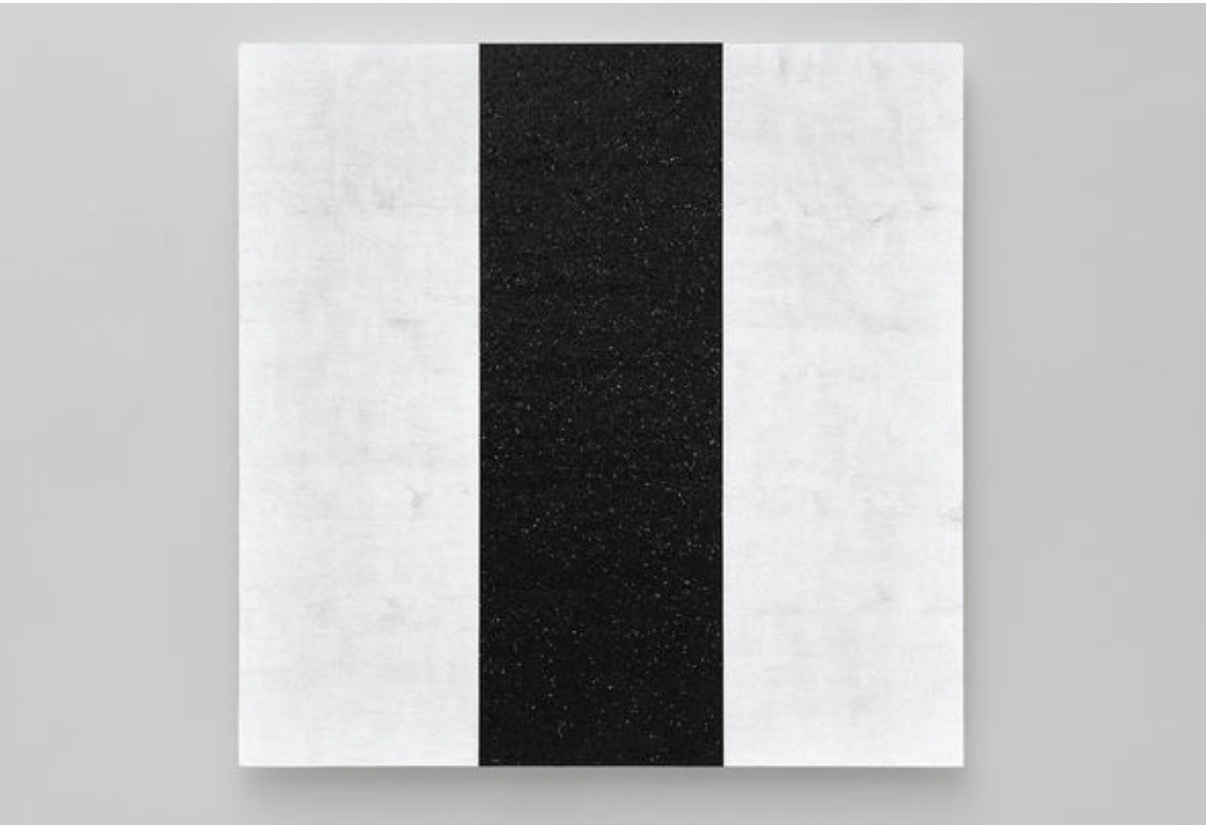
Untitled (White with Black Reflective Inner Band), 2023
Mary Corse was born in 1945 and grew up in California, a place whose particular quality of light, oceanic and diffuse and endlessly shifting, would become the very substance of her life's work. She studied at the Chouinard Art Institute in Los Angeles before completing her training at the California Institute of the Arts, institutions that in the 1960s were fertile ground for artists pushing against the boundaries of painting and sculpture. The cultural atmosphere of Southern California at that moment was electric with possibility. Robert Irwin, James Turrell, and Larry Bell were all grappling with perception, phenomenology, and the nature of visual experience, and Corse entered this conversation as a genuinely independent voice.
From the beginning, Corse was drawn to questions that felt more philosophical than purely aesthetic. How does light behave as it moves across a surface? What is the relationship between a fixed artwork and a viewer who is always in motion? Can painting dissolve the boundary between object and environment?
Mary Corse
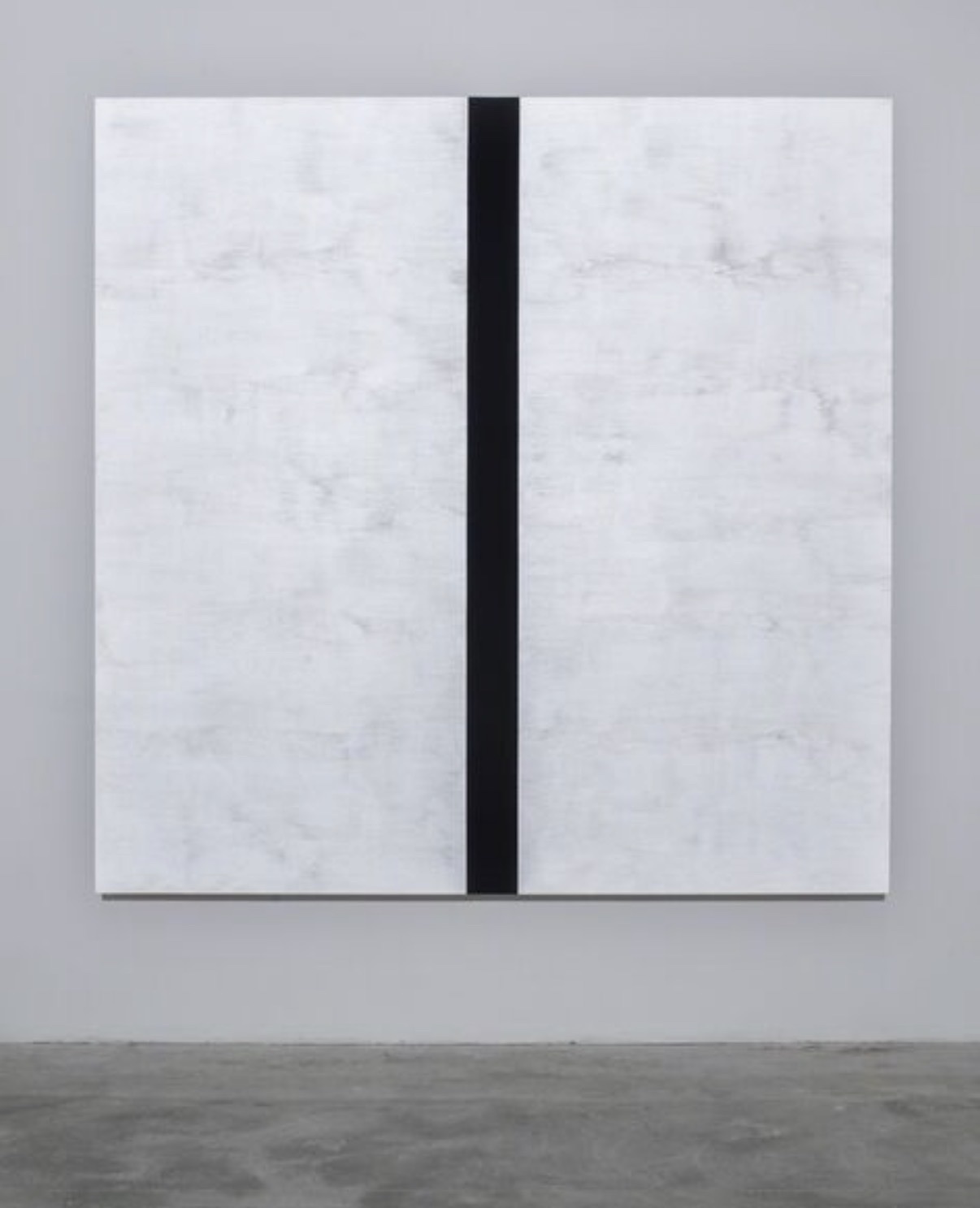
Untitled (White, Black, White), 2016
To pursue these questions with rigor, she did something unusual for a young artist in the late 1960s: she went directly to industrial science. She began working with glass microspheres, the tiny reflective beads used in highway signage to bounce headlight beams back toward drivers at night. The discovery transformed her practice immediately and permanently. Applied to canvas in acrylic, the microspheres behave like an infinitely complex mirror, catching and redirecting ambient light depending on the precise angle of observation.
No two viewers standing in the same room see exactly the same painting. This commitment to optical phenomena as a primary medium placed Corse firmly within the Light and Space movement, a distinctly Californian contribution to postwar art history. Yet where artists like Turrell worked primarily with architectural installations and projected light, Corse remained loyal to the stretched canvas and the handmade surface. Her paintings sit in the tradition of monochrome abstraction while simultaneously subverting it.
Mary Corse
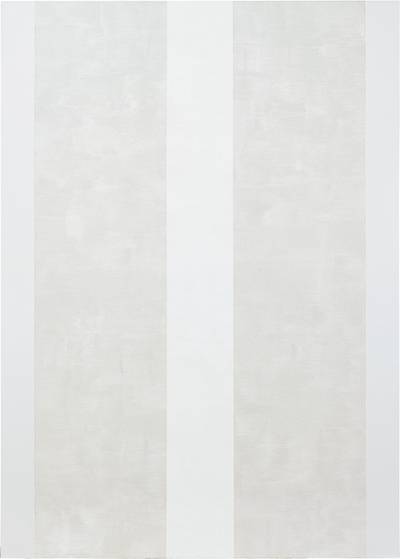
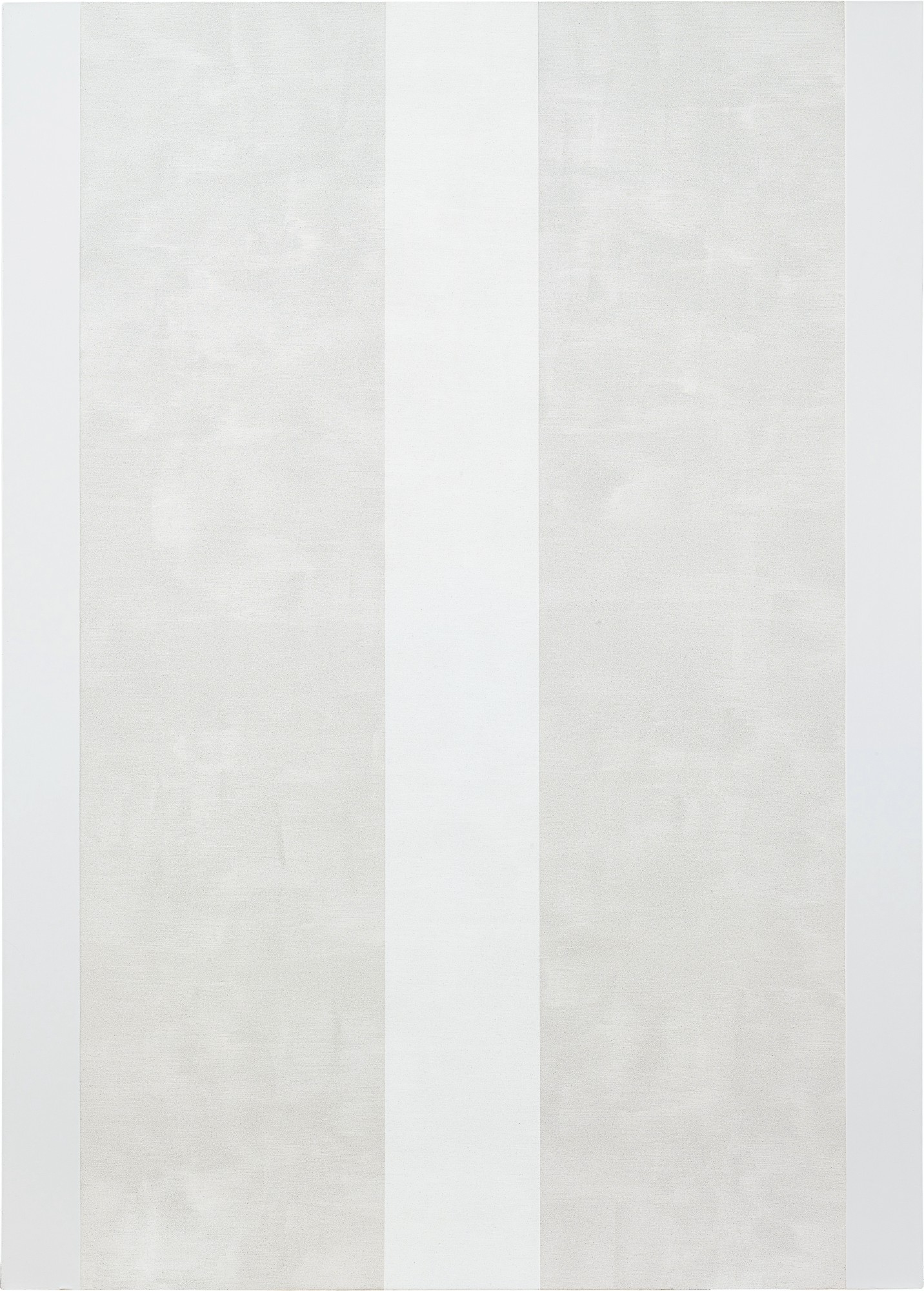
Untitled (White Inner Band with White Sides, Beveled) 無題(白色內帶斜面白色邊)
They look, at first glance, like white paintings in the lineage of Robert Ryman or Agnes Martin. But where those artists sought a kind of still, meditative surface, Corse's canvases are constitutionally incapable of stillness. They are responsive, performative, and in a genuine sense alive to the presence of the person looking at them. Among the works available through The Collection, "Untitled (White with Black Reflective Inner Band)" from 2023 demonstrates how fully Corse has continued to develop her vocabulary into the present decade.
The composition places a band of dark reflective material within a field of luminous white, creating a visual tension that shifts dramatically as the viewer changes position. "Untitled (White, Black, White)" from 2016 similarly deploys the contrast between light gathering and light absorbing zones, organizing the canvas into a quietly architectural rhythm. The bilingual title of another work, "Untitled (White Inner Band with White Sides, Beveled)," presented in both English and Chinese, speaks to the international appetite for her practice and the global reach her work has achieved in recent years. These are paintings that reward sustained attention and reveal new dimensions with every visit.
For collectors, Corse represents something increasingly rare in the contemporary market: an artist of genuine historical importance who remained devoted to her vision through decades when the art world's attention was focused elsewhere. She did not seek out celebrity or court institutional validation through self promotion. Instead she worked steadily in her studio, refining a body of work that is now recognized as foundational to understanding how American art engaged with perception and phenomenology in the second half of the twentieth century. Her market has strengthened considerably since the Whitney retrospective, and collectors who acquired works in the years before 2018 have seen that confidence rewarded.
Works on canvas incorporating glass microspheres, particularly large scale pieces from any period of her career, are considered the strongest representations of her practice. Contextually, Corse belongs to a distinguished lineage of artists who trusted the eye more than the manifesto. She is a peer of Robert Irwin and James Turrell in the Light and Space tradition, and her commitment to the painted surface connects her to the broader history of American abstraction. Collectors drawn to the meditative surfaces of Agnes Martin or the luminous monochromes of Robert Ryman often find that Corse's work offers something those painters do not: the painting changes with them, registers their presence, and creates a relationship that is frankly reciprocal.
That quality distinguishes her from almost anyone else working in the field. What makes Corse's legacy feel so urgent now is precisely the durability of her central insight. We live in a moment saturated with images engineered to capture and hold attention through contrast and noise. Corse's paintings ask for something different.
They ask you to slow down, to become aware of your own position in space, and to notice that the act of looking is itself a kind of collaboration. The painting does not simply present itself to you. It responds to you. In an art world that sometimes prizes spectacle over depth, that quality feels not like a historical footnote but like a genuine alternative, a reminder that the most profound experiences of art are often the quietest ones.
Mary Corse has been offering that reminder for more than fifty years, and the world is finally listening at the volume her work deserves.
Explore books about Mary Corse
