Leonora Carrington
Leonora Carrington, Sorceress of the Canvas
Artist Spotlight · The Collection Editorial
“I didn't have time to be anyone's muse. I was too busy rebelling against my family and learning to be an artist.”
Leonora Carrington, interview
In 2023, Tate Modern mounted one of the most talked about retrospectives in recent memory, bringing together paintings, sculptures, and writings by Leonora Carrington for a generation of collectors and viewers encountering her universe for the first time. The queues stretched along the Thames. Critics reached for the most lavish vocabulary they had. It confirmed what devoted collectors had understood for decades: Carrington is not a footnote in the Surrealist story but one of its supreme architects, a visionary whose work grows stranger, funnier, and more urgently meaningful with every passing year.
Leonora Carrington
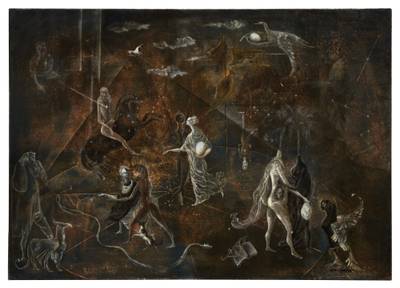
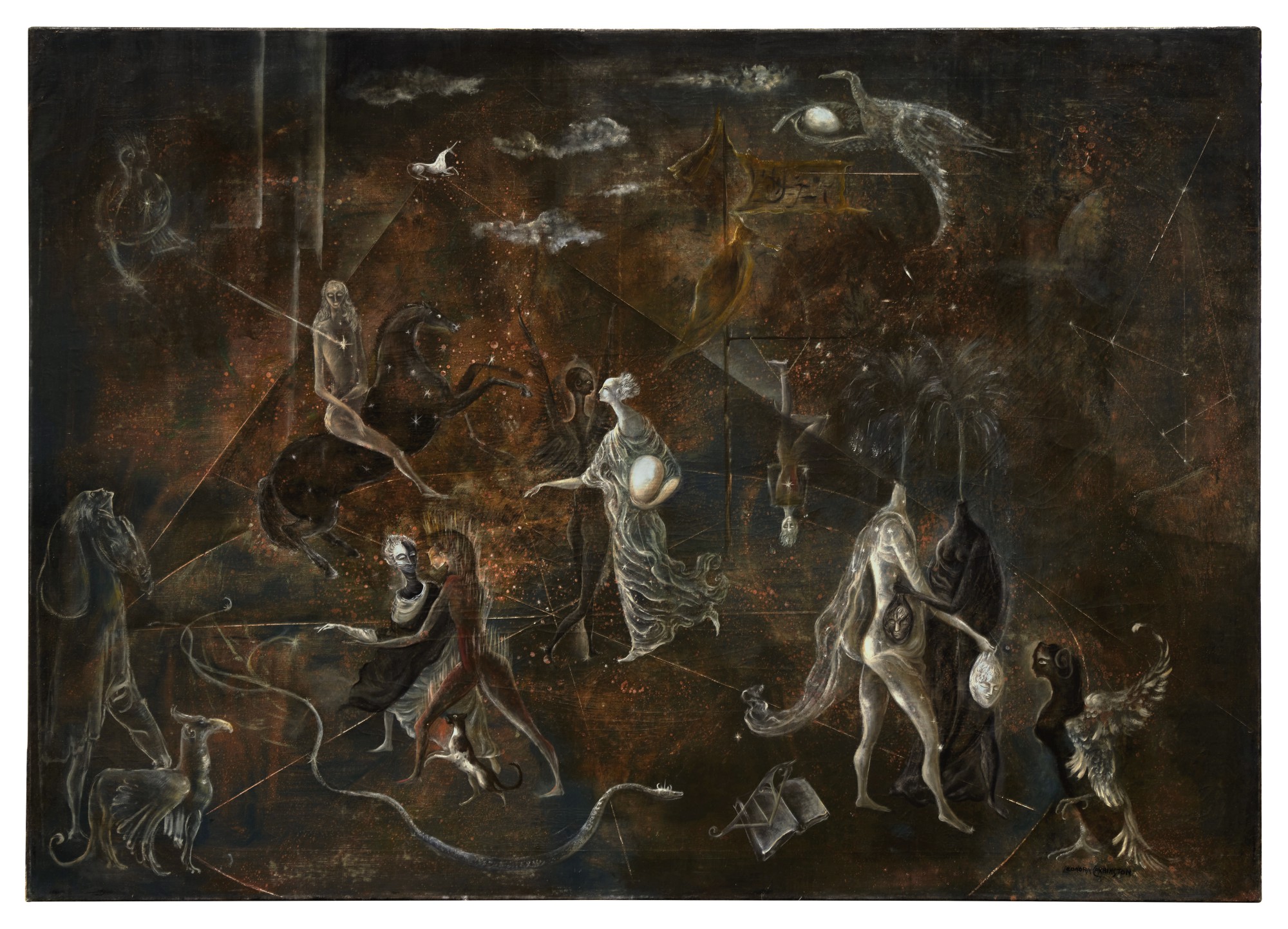
The Garden of Paracelsus, 1957
She was born in 1917 into a wealthy Lancashire family, the daughter of a textile magnate and an Irish mother whose Celtic myths and folklore she would carry for the rest of her life. Her upbringing was privileged but suffocating, punctuated by expulsions from convent schools and a persistent, ungovernable inner life that made her a difficult proposition for the English establishment. She found her first serious artistic training at the Chelsea School of Art and later at Ozenfant Academy in London, but the education that truly remade her came through encounter. In 1937 she met the Surrealist painter Max Ernst at a London dinner party.
She was nineteen. He was forty six. Within months she had left England and the life her family had planned for her, and she would never really return. The years in Paris and then the south of France with Ernst were formative and electrifying.
Leonora Carrington
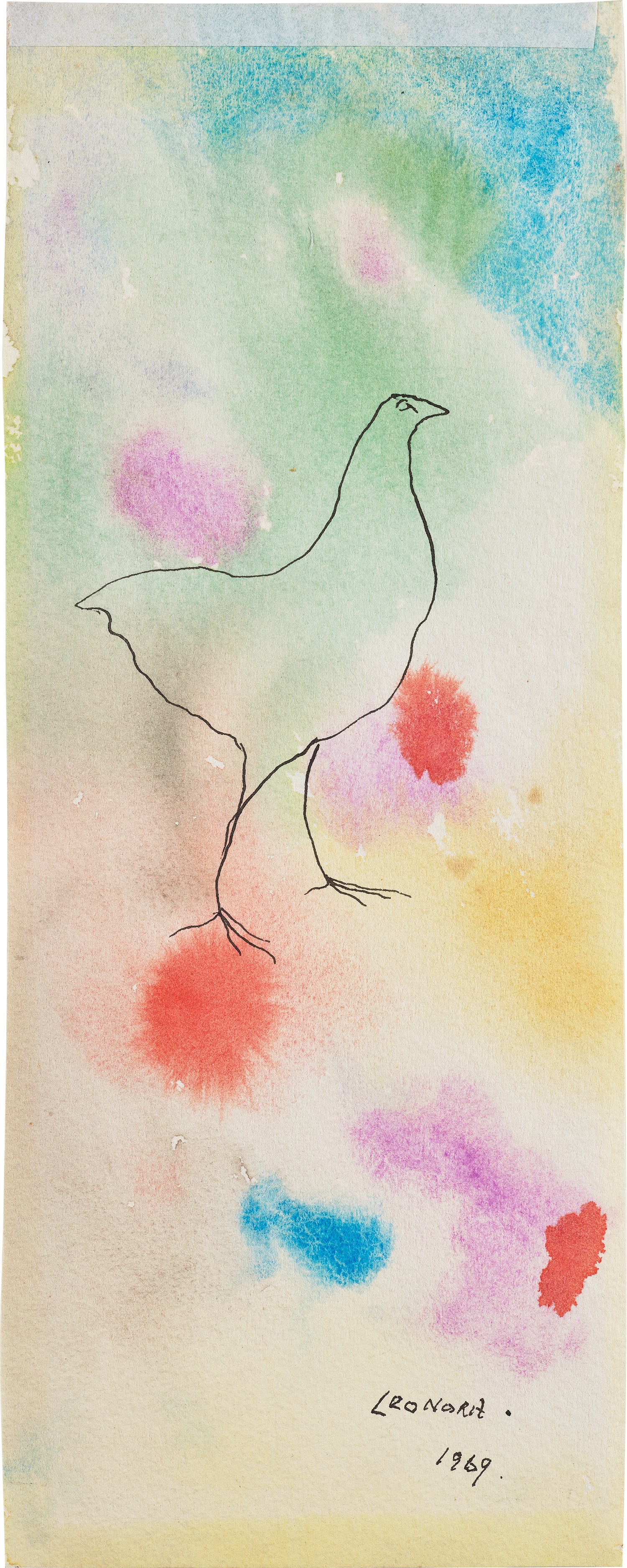
The Transparent Hen
She entered the circle of André Breton, Paul Éluard, and Man Ray, absorbing the movement's preoccupations with dreams, the unconscious, and the irrational, while simultaneously resisting its tendency to treat women as muses rather than makers. Her paintings from this period already show the hallmarks of her singular vision: hybrid creatures, ceremonial interiors, figures caught between animal and human states, narratives that feel both ancient and urgently personal. When the Second World War shattered that world, Ernst was interned as an enemy alien and Carrington suffered a catastrophic psychological breakdown in Spain, an experience she later documented with unflinching precision in her memoir Down Below, published in 1944. The book remains one of the most extraordinary accounts of mental collapse and recovery in the literary canon.
“I never considered myself a Surrealist. They were a group of men who thought women were good for one thing.”
Leonora Carrington
Her true artistic flourishing came after she reached Mexico City in 1942, having escaped Europe via Lisbon with the help of the Mexican poet and diplomat Renato Leduc. Mexico became her permanent home and her great creative engine. She discovered in Mexican culture a living relationship with myth, ritual, and the otherworldly that matched the frequencies of her own imagination. She formed close friendships with Remedios Varo and Kati Horna, and the three women created a remarkable intellectual and artistic community.
Leonora Carrington
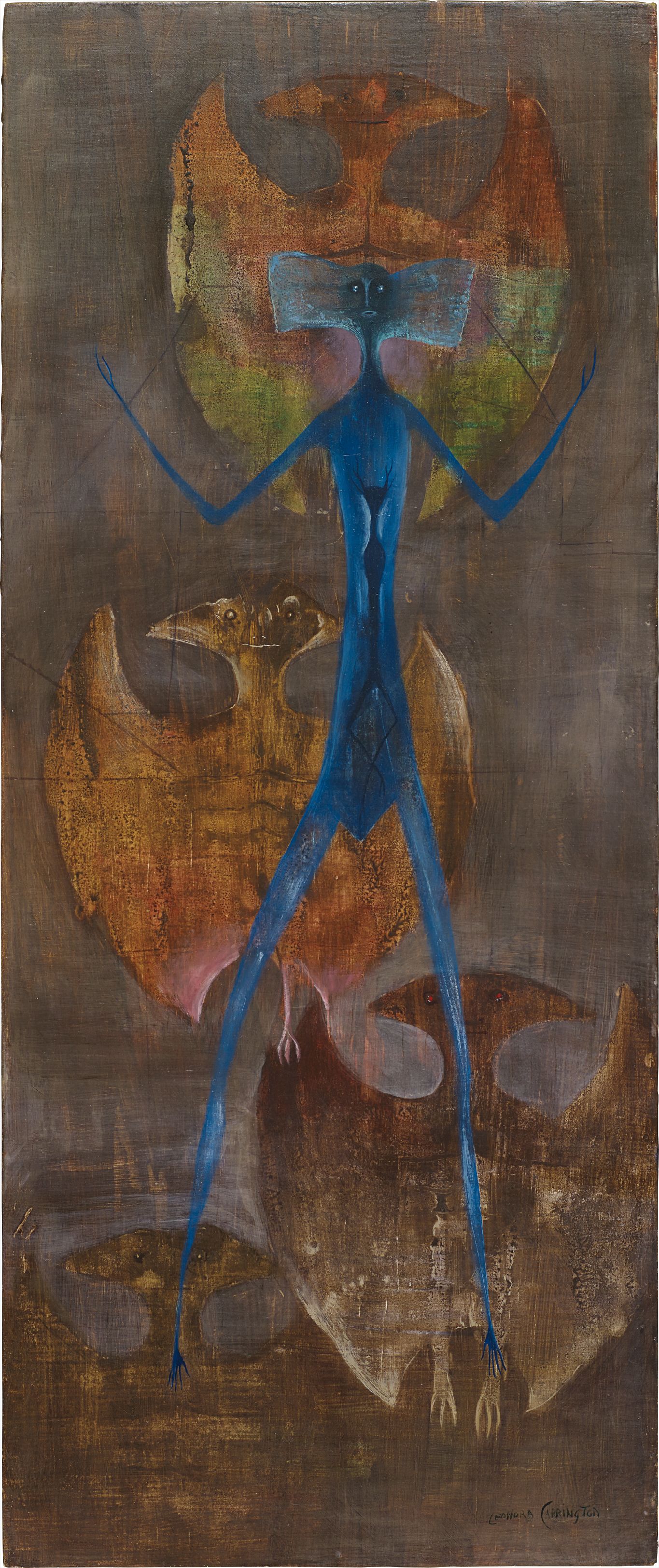
Bat-men (How true my love)
Her canvases from the 1950s and 1960s represent the fullest expression of her powers: densely layered allegorical scenes populated by witches, alchemists, owls, white horses, and presences that hover at the threshold of the visible world. Among the works that define her legacy, The Garden of Paracelsus, painted in 1957 and held in collections of the highest distinction, stands as a masterpiece of alchemical symbolism and feminine spiritual authority. The painting brings together herbalism, transformation, and an almost architectural sense of sacred space, all rendered with a technical refinement that belies the wildness of its subject matter. Equally compelling is the group of works that engage sleep, dreams, and the soul, including Sueño, painted in 1959 on linen, in which the boundary between waking and unconscious dissolves into something luminous and unsettling.
Her works on paper, including rare pencil drawings and watercolor and ink pieces, reveal the speed and confidence of a mind that never stopped generating images. Her three dimensional works and masks, constructed from papier mâché, plaster, metal, and paint, extend her mythology into physical space in ways that feel as contemporary as anything being made today. From a collecting perspective, Carrington represents one of the most compelling propositions in the twentieth century canon. Her market strengthened significantly through the 2010s, with major auction appearances at Sotheby's and Christie's confirming sustained institutional and private demand.
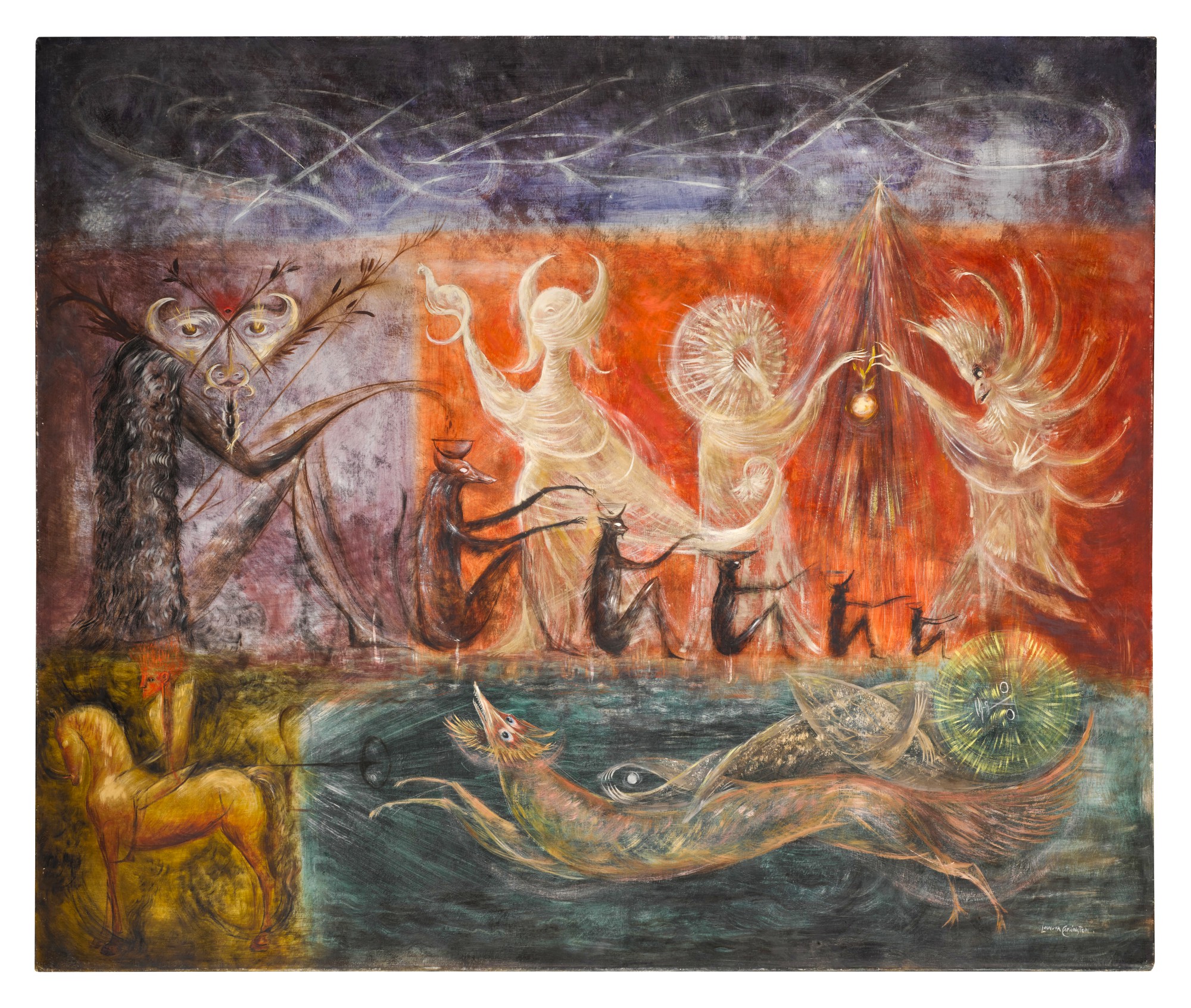
Leonora Carrington
Sueño (Nephesh as the Soul in a State of Sleep) , 1959
Works on paper and smaller panel paintings offer collectors a meaningful point of entry into her universe, while major oils from her peak Mexican decades are among the most sought after works in any category of Surrealist and Latin American art. What collectors respond to, beyond the obvious quality of her hand, is the internal consistency of her world. Every work, whether a lithograph, a gouache, or a large canvas, feels like a dispatch from the same coherent mythological territory, and that sense of a total vision is extraordinarily rare. Carrington belongs to a conversation that includes Remedios Varo, with whom she shared a decade of close collaboration in Mexico City, as well as Dorothea Tanning and Meret Oppenheim, artists who each built distinctive imaginative worlds within and beyond Surrealism.
She can also be fruitfully considered alongside figures such as Frida Kahlo in terms of her place in the intersection of European modernism and Mexican cultural identity, though her work follows its own entirely independent logic. Her influence on subsequent generations of artists working with mythology, feminism, and the occult has been enormous and is only now being fully mapped. Leonora Carrington died in Mexico City in 2011 at the age of ninety four, having continued to paint and write well into her final decades. She never courted the art market, gave few interviews, and maintained a deliberate distance from the celebrity machinery of the contemporary art world.
That refusal has only deepened the aura around her work. To stand in front of a Carrington painting is to feel the pull of a complete alternative cosmology, one built on ancient feminine wisdom, alchemical transformation, humor as dark and bright as moonlight, and an absolute conviction that the imagination is not an escape from reality but its truest form. For collectors who prize not just beauty but genuine strangeness and depth, she remains irreplaceable.
Explore books about Leonora Carrington
Leonora Carrington: A Life
Catherine Wageman

The Surrealism of Leonora Carrington
Whitney Chadwick
Leonora Carrington: The Mexican Years
Salomon Grimm
The Complete Leonora Carrington
Marina Warner
Leonora Carrington: Paintings, Drawings, and Sculptures
Joanne Bernstein
The Alchemy of the Word: Leonora Carrington
Nuria Peist
Leonora Carrington and the International Avant-Garde
Christopher Wagstaff
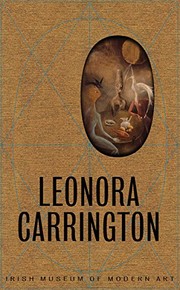
The Surreal World of Leonora Carrington
Susan L. Aberth