Laurie Simmons
Laurie Simmons, America's Most Enchanting Domestic Visionary
Artist Spotlight · The Collection Editorial
“I was drawn to the dollhouse because it was a place where I could control everything, and that felt very much like what photography could do.”
Laurie Simmons, interview with the Brooklyn Museum
When the Museum of Modern Art mounted a survey of Pictures Generation artists and their enduring influence on contemporary image making, Laurie Simmons stood out as one of the movement's most consistently surprising voices. Decades after she first set up dollhouses and tiny domestic stages in her New York studio, her photographs continue to feel both eerily familiar and genuinely strange, as if she has found a way to photograph the inside of a collective American dream. That staying power is no accident. It is the result of a practice built on obsession, wit, and an unusually deep understanding of how desire and femininity get encoded into objects.
Laurie Simmons
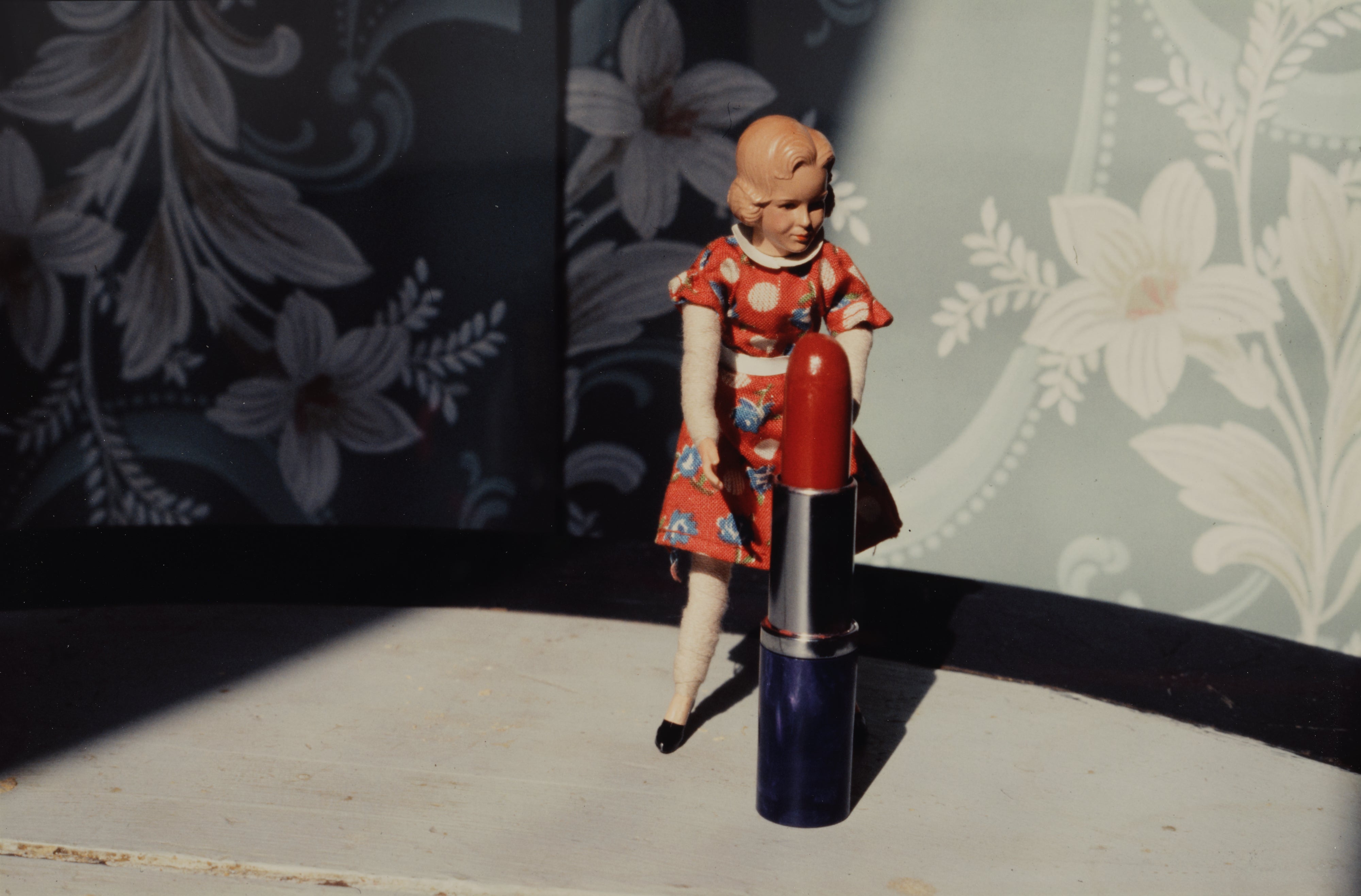
Pushing Lipstick (The Approach)
Simmons was born in 1949 and grew up on Long Island, New York, in a comfortable postwar suburban household that would later become the emotional and aesthetic source material for much of her art. The ranch houses, pastel kitchens, and gleaming appliances of her childhood were not simply backdrop but a kind of visual language she absorbed before she had words for it. She studied at the Tyler School of Art in Philadelphia, graduating in the early 1970s, and then made her way to New York City at a moment when the art world was being reshaped by conceptual practice, feminist theory, and a new skepticism about the authority of images. That environment gave her permission to take seriously the things she had been taught to overlook.
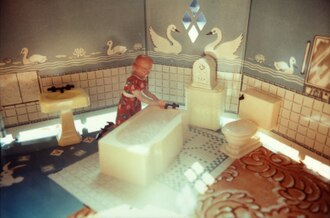
Her earliest major photographic series, made in the late 1970s, placed plastic dollhouse figures inside meticulously constructed miniature domestic interiors. Small rooms. Tiny furniture. Women frozen mid gesture in kitchens and living rooms that looked like the sets of advertisements nobody had quite made yet.
Laurie Simmons
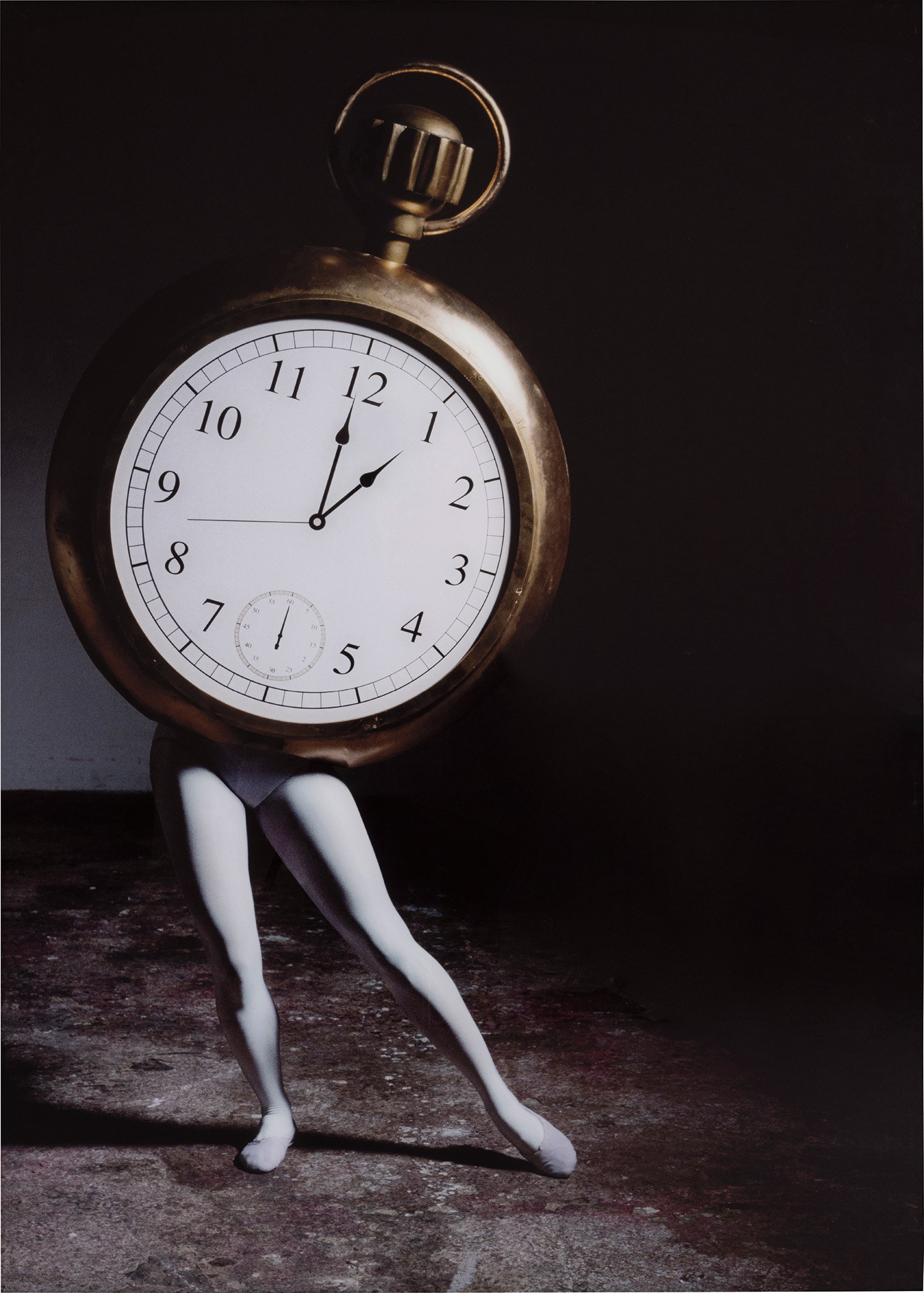
Walking Pocket Watch (color)/ The Music of Regret, 2006
These images, spare and deadpan, were immediately recognized as part of something important. Simmons was exhibiting alongside Cindy Sherman, Richard Prince, Barbara Kruger, and Sherrie Levine, artists who were collectively interrogating the power of mass media and representation. But where some of her peers worked with found imagery, Simmons built her own worlds from scratch, which gave her pictures an unusual quality of tenderness alongside their critique. Through the 1980s and 1990s her practice expanded in ambition and scale.
The Walking Objects series introduced a surrealist logic into her already uncanny domestic universe, placing tiny human legs beneath cameras, houses, guns, and musical instruments so that inanimate objects appeared to stride purposefully through empty space. Works like Walking Pocket Watch (color), made in connection with her project The Music of Regret in 2006, demonstrate how Simmons moves between wit and melancholy with total control. The Music of Regret was itself a remarkable achievement, a feature length film incorporating ventriloquist dummies, Meryl Streep, and a cast of real performers alongside fabricated ones, exploring memory, loss, and the blurry line between the animate and the inanimate with a confidence that announced her as a complete artist working across every medium available to her. Among the works that collectors and curators return to most often, Bending Globe from 1991 stands as a particularly concentrated example of her power.
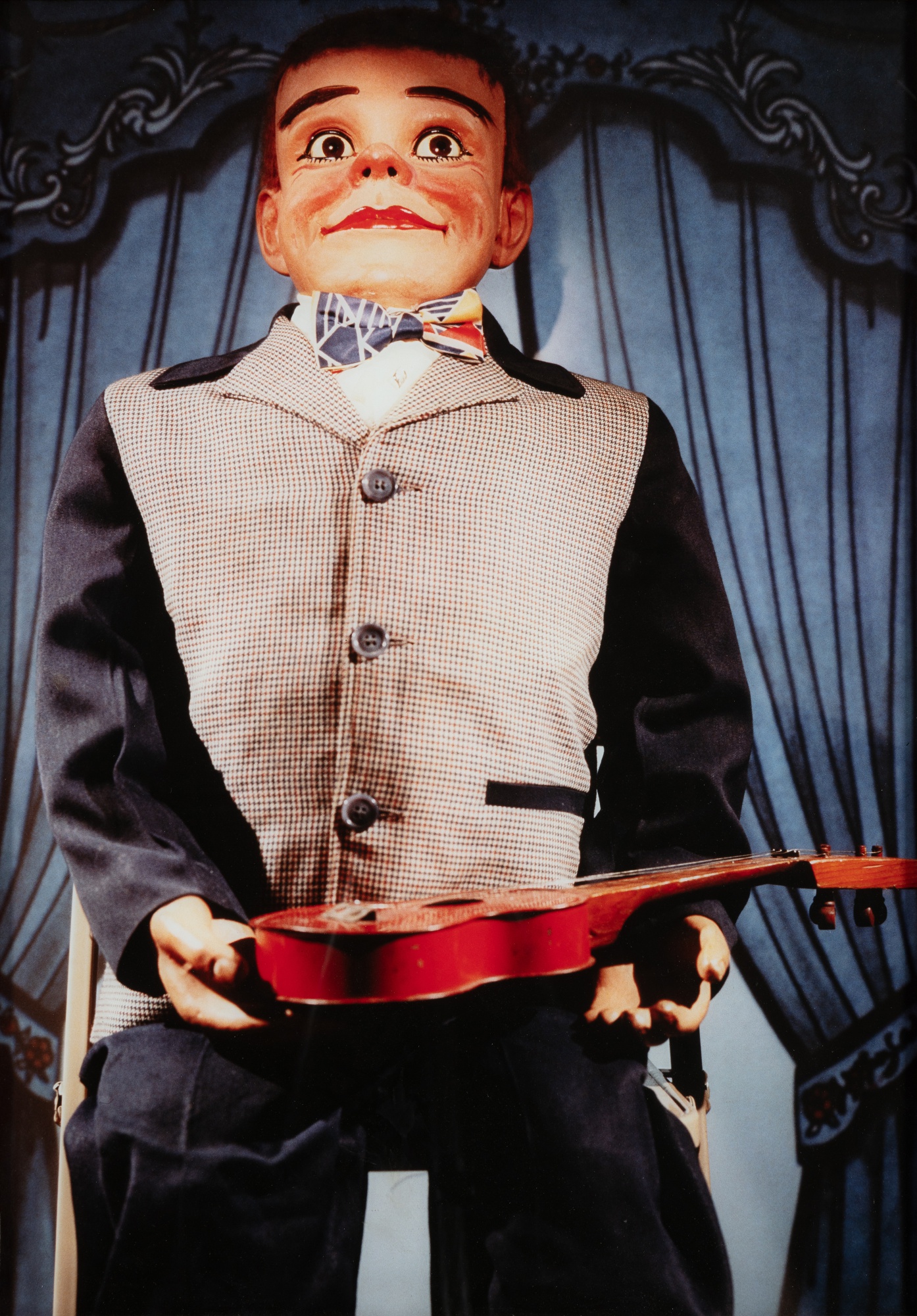
Laurie Simmons
'Ukulele Player'
The image distills her preoccupations into a single frame, a woman or female figure bent in relationship to a globe, the whole scene suffused with a queasy nostalgia that feels both personal and archetypal. Her dye destruction prints, including works from the Pushing Lipstick series and The Long House (Red Bathroom), are prized for their saturated color and the sense of theatrical precision Simmons brings to every element of her constructed scenes. The Instant Decorator series, which staged figures inside rooms drawn from interior design sourcebooks, pushed her engagement with domestic fantasy to a new level of baroque intensity, and those works have become landmark pieces in serious collections. From a collecting perspective, Simmons represents a genuinely compelling proposition.
Her place within the Pictures Generation is historically secure, and institutions including the Museum of Modern Art, the Whitney Museum of American Art, and the Metropolitan Museum of Art hold her work in their permanent collections. Auction results for her most significant photographic editions have reflected growing institutional recognition, with her dye destruction prints and large scale chromogenic works attracting sustained interest from collectors who understand the depth of her contribution. Works on paper, multiples such as the Kaleidoscope House edition in ABS plastic and acrylic, and smaller photographic pieces offer accessible entry points into a practice that rewards long acquaintance. The consistency of her vision across five decades means that early works and recent ones feel part of a coherent and meaningful body of work rather than a series of disconnected experiments.
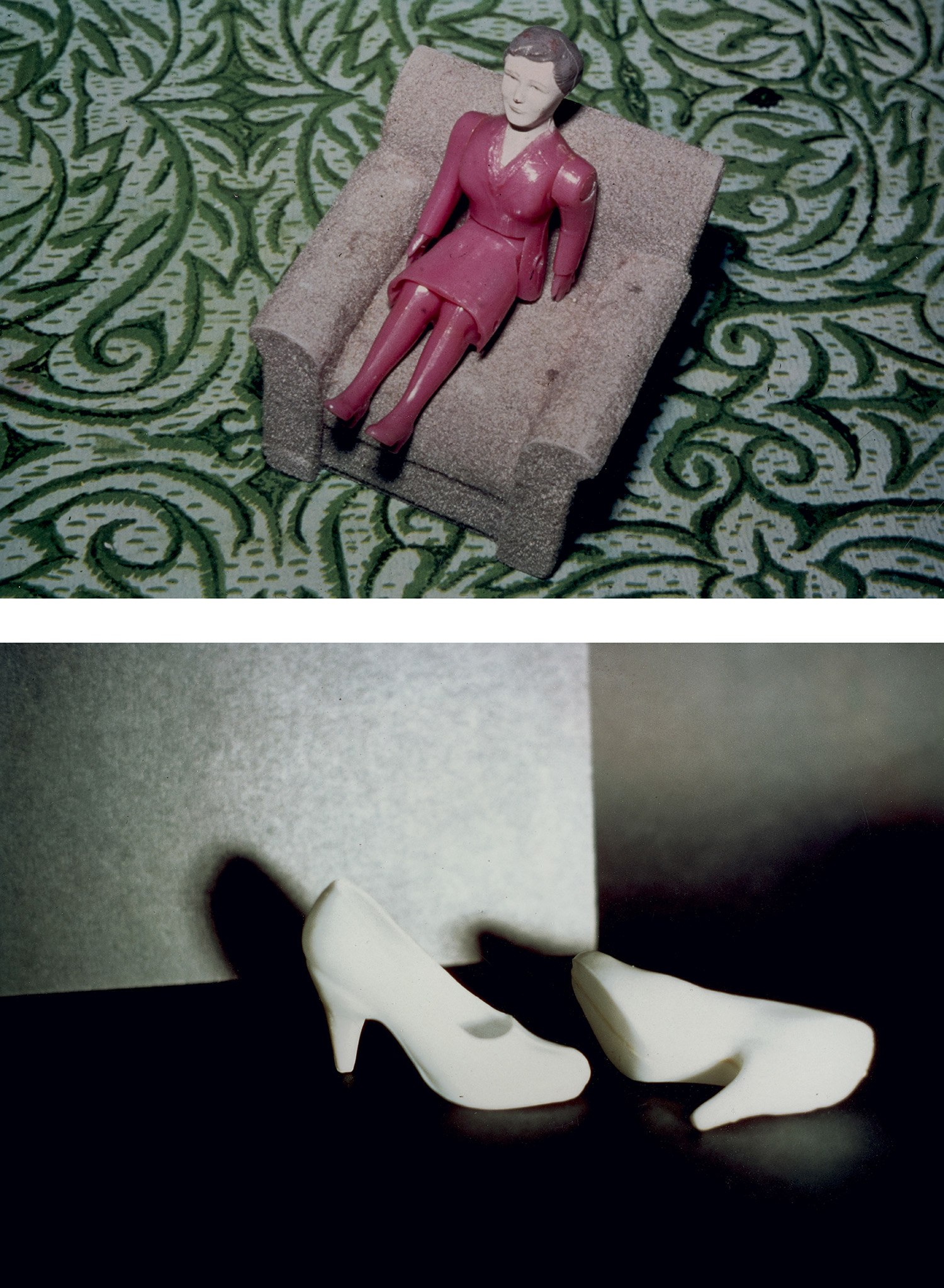
Laurie Simmons
Woman/Gray Chair/Green Rug; White Shoes/Black Room
The artists closest to Simmons in sensibility and historical position include Cindy Sherman, whose investigations of feminine masquerade share a conceptual DNA with Simmons's dollhouse interiors, and Barbara Kruger, whose text based work emerged from the same critical climate. Sandy Skoglund, who also constructs elaborate photographic tableaux, offers another point of comparison, as does Nan Goldin, though Goldin's documentary impulse stands in deliberate contrast to Simmons's fabricated universes. Within the broader history of photography, Simmons invites comparison with Hans Bellmer, whose manipulated doll figures anticipated some of her concerns, and with the surrealist tradition more generally, even as her work remains rooted in a distinctly American vernacular. What makes Simmons matter so urgently today is that the questions her work has always asked have only become more pressing.
In an era saturated with constructed images, with filtered selfies and algorithmically optimized domestic interiors, her decades long investigation of how desire gets shaped by objects and spaces and idealized femininity reads as prophetic. She understood before most that the home was a stage, that the domestic was a performance, and that the objects we surround ourselves with are not neutral but loaded with aspiration and anxiety in equal measure. Her photographs do not moralize about this. They sit with it, they find it strange and beautiful, and they invite the viewer to do the same.
That generosity of vision, combined with her extraordinary technical and aesthetic gifts, is why Laurie Simmons remains one of the essential American artists of her generation.
Explore books about Laurie Simmons