Jim Dine

Jim Dine: A Life Made in Marks
Artist Spotlight · The Collection Editorial
“I use the objects as a vocabulary. They are the grammar of my autobiography.”
Jim Dine
There is a moment in any great artist's career when the world catches up to what they have always known. For Jim Dine, now in his ninth decade and still working with ferocious energy, that moment feels perpetual. Major institutions continue to revisit his legacy with fresh eyes: the Albertina in Vienna, which has long championed his work on paper, has held him as a touchstone of postwar American printmaking, while retrospective surveys across Europe and the United States have reaffirmed his singular place in the canon. His prints, paintings, and sculptures move with confidence through the world's leading auction rooms, and a new generation of collectors is discovering what devoted admirers have long understood: Dine is one of the most emotionally direct and technically adventurous artists of his era.
Jim Dine
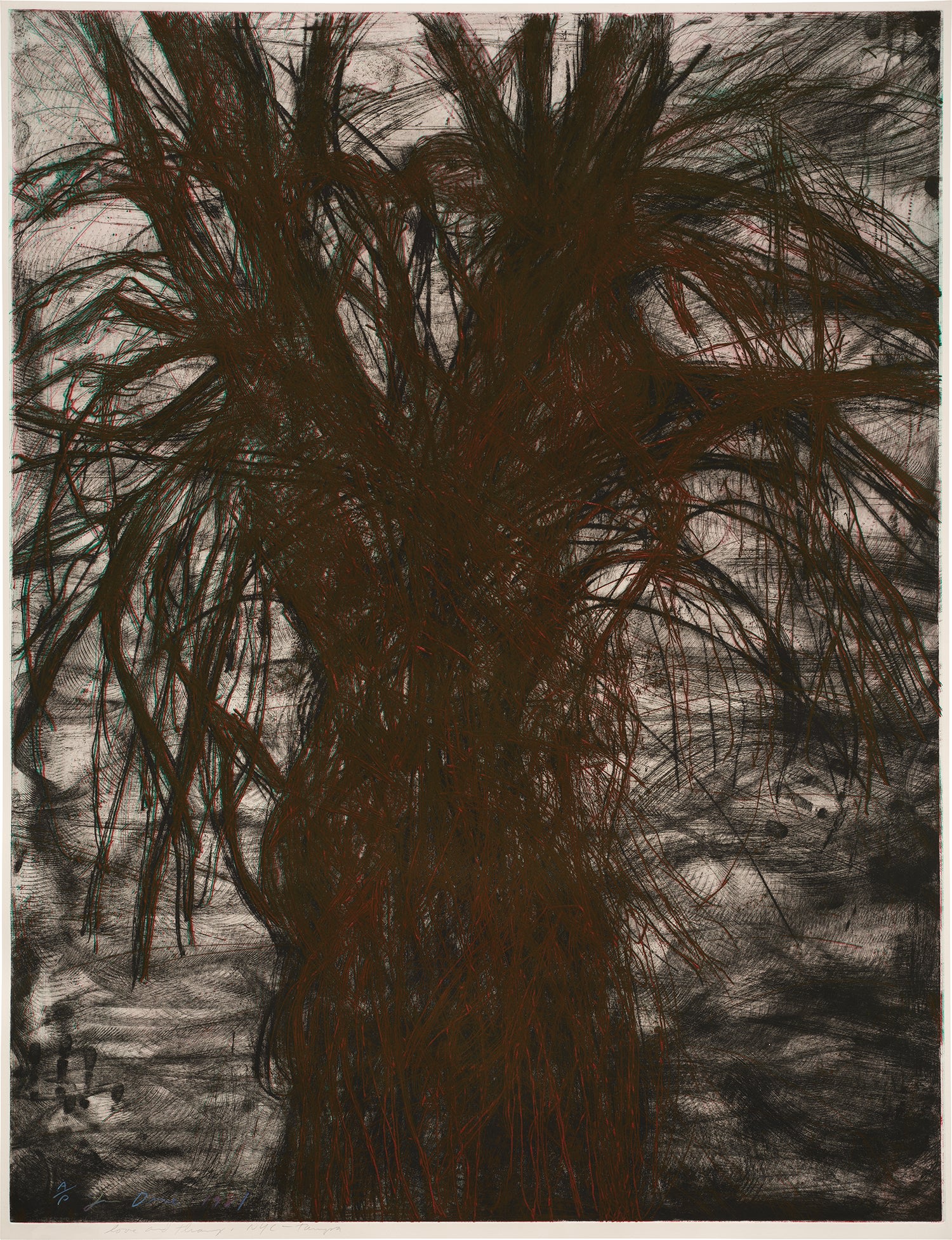
The Tree Covered with Rust (D'O. & F. 83)
Jim Dine was born in Cincinnati, Ohio, in 1935, and his early years were shaped by an intimate relationship with the physical world of making things. His grandfather ran a hardware and plumbing supply store, and it was there, among tools, pipes, and the satisfying weight of useful objects, that Dine first learned to trust the material world. That formative immersion in hardware would echo across his entire career, surfacing in iconic tool paintings and prints that transformed the wrench and the hammer into objects of beauty and psychological weight. He studied at the University of Cincinnati, Ohio University, and the Boston Museum School before arriving in New York in 1958, where the city's electric creative climate would prove decisive.
New York in the late 1950s was a place of collision and possibility. Abstract Expressionism still held court, but younger artists were restless, eager to drag the raw texture of daily life into the studio. Dine threw himself into the Happenings movement alongside Allan Kaprow, Claes Oldenburg, and Red Grooms, staging performances that dissolved the boundary between art and lived experience. His 1960 performance "Car Crash" at the Reuben Gallery became one of the defining events of the New York avant garde, a visceral and unforgettable work that cemented his reputation as an artist willing to go further than comfort allowed.
Jim Dine
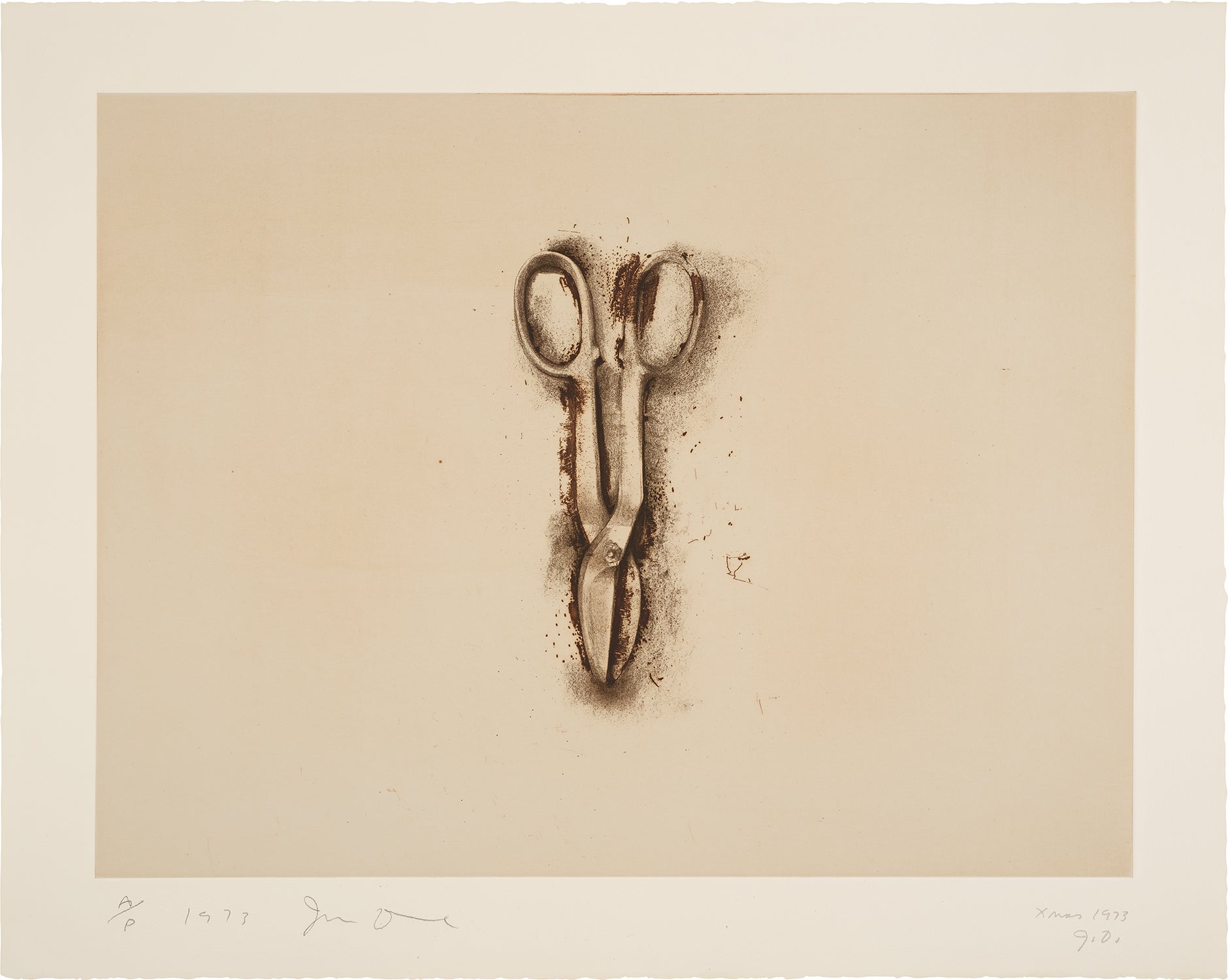
Tinsnip (W. 145)
Yet even as critics placed him under the Pop Art umbrella alongside Jasper Johns and Robert Rauschenberg, Dine always resisted easy categorization. His work was too personal, too emotionally raw, to be content with Pop's cool ironic surfaces. The evolution of Dine's practice over the following decades reveals an artist of remarkable restlessness and discipline in equal measure. Through the 1960s he developed his signature vocabulary: hearts, robes, tools, and self portraiture became recurring motifs that he explored across painting, sculpture, drawing, and an extraordinarily rich body of printmaking.
“Drawing is still basically the same as it has been since prehistoric times. It brings together man and the world.”
Jim Dine
His move to London in 1967 deepened his engagement with European art historical traditions, and his time working with master printers at workshops including Gemini G.E.L. and Petersburg Press elevated his printmaking to a level that few of his contemporaries could match.
Jim Dine
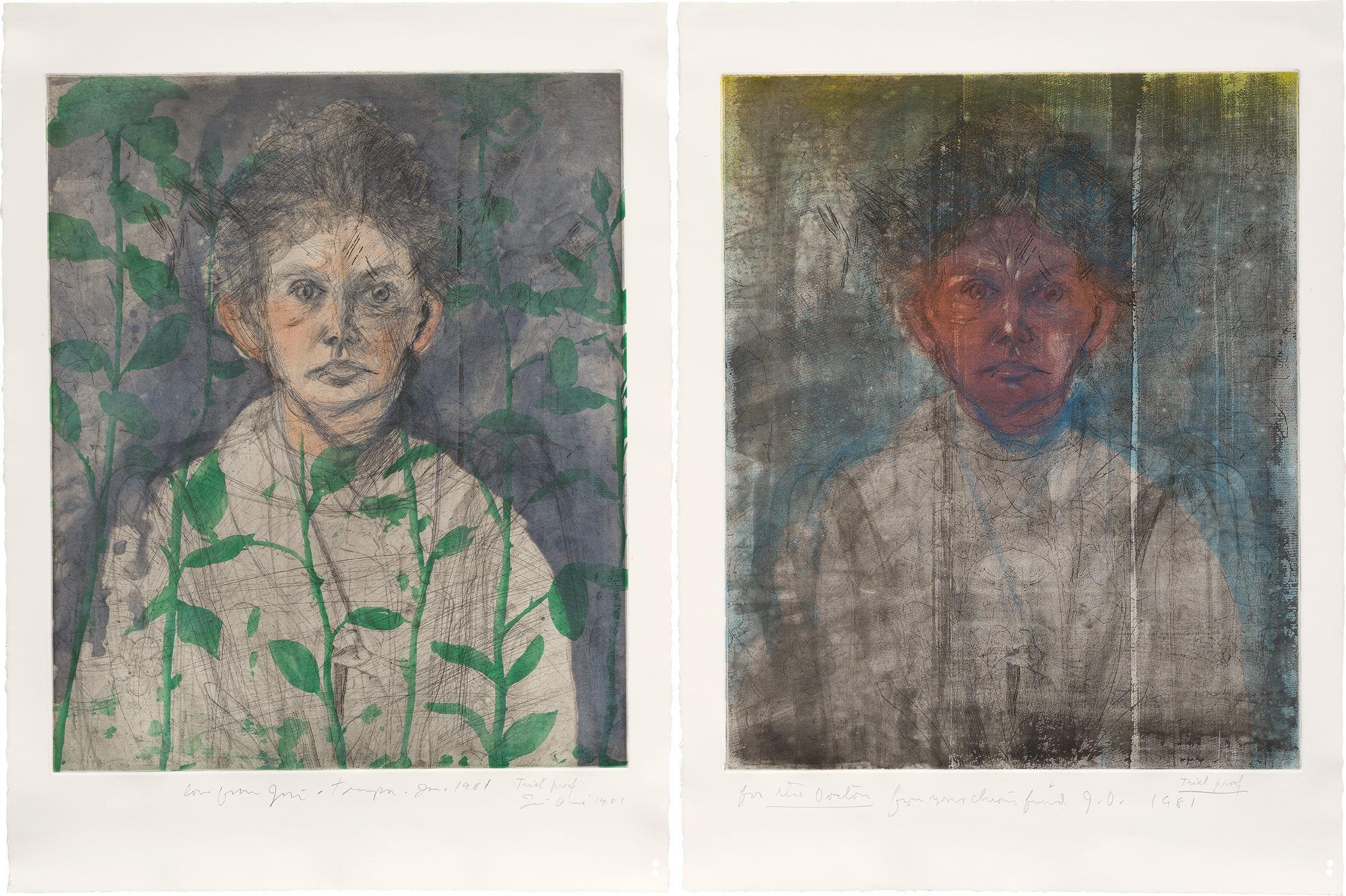
Nancy Outside in July XII: Green Leaves; and Nancy Outside in July XIII: Dissolving in Eden (D'O. & F. 93 & 94)
By the 1980s, as Neo Expressionism surged on both sides of the Atlantic, Dine was recognized as a forerunner of its values: the insistence on personal symbolism, the embrace of gestural mark making, and the willingness to mine autobiography for universal meaning. Among his most celebrated works are the tool prints and lithographs that transform ordinary hand tools into totemic presences. Works such as "Ten Winter Tools" present a suite of lithographs in which everyday implements are rendered with such attentiveness and care that they take on an almost sacred quality. His heart motif, explored across woodcuts, etchings, and paintings for more than sixty years, is perhaps the most recognizable symbol in his oeuvre: not sentimental in any easy sense, but charged with longing, vulnerability, and an insistence on emotional honesty that feels radical in its directness.
Works like "Heart for Film Forum" demonstrate how Dine could take a single woodcut and invest it with the weight of a century of feeling. His robe paintings and prints, which began appearing in the late 1960s, are equally haunting: the garment stands in for the absent body, a ghost of presence that speaks to themes of identity and mortality with quiet eloquence. For collectors, Dine's prints represent one of the great opportunities in the postwar American market. His technical range is extraordinary: he worked fluently in etching, lithograph, woodcut, and aquatint, often combining techniques within a single work and adding hand coloring, electric tool marks, and other interventions that make each impression feel alive and individual.
Jim Dine
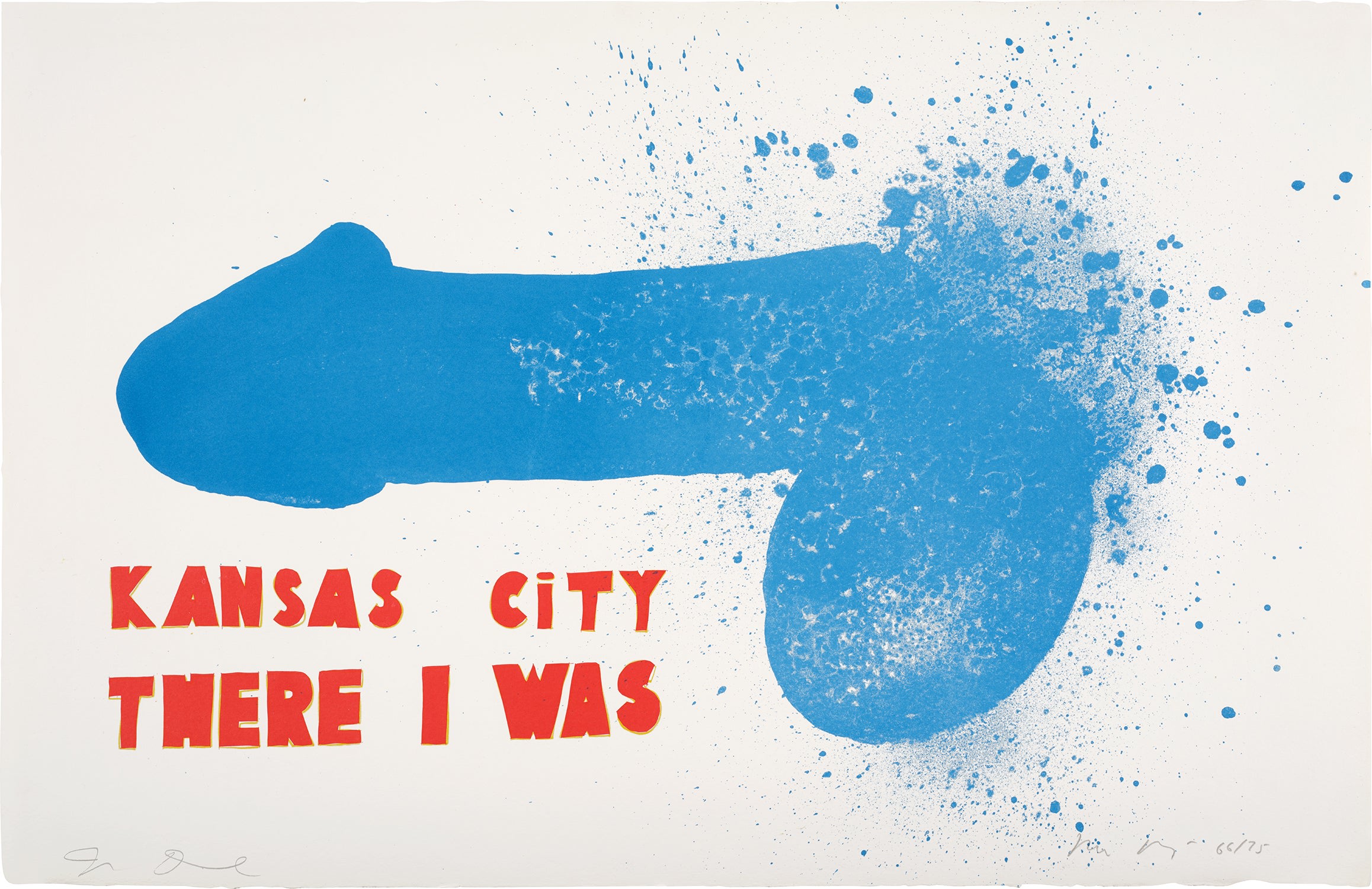
Kansas City There I Was, from Oo La La (with Ron Padgett) (W. 19)
Works such as "The Tree Covered with Rust" and the "Nancy Outside in July" series showcase his mastery of etching with electric tools, a technique that gives his lines an expressive charge unlike anything in conventional printmaking. Oil paintings and mixed media works such as "The Shop in the Middle of my Forehead" demonstrate the same fearless combination of materials that defines his approach across all media. Auction results for Dine's prints and unique works have remained consistently strong, and important works continue to appear at Christie's, Sotheby's, and Phillips, where they attract both seasoned collectors and new buyers drawn by the immediacy of his imagery. To understand Dine fully is to place him in generous conversation with the artists around him.
He shares with Jasper Johns a devotion to recurring motifs and a fascination with the gap between object and image. He shares with Cy Twombly an embrace of the mark as autobiography. His emotional directness connects him to the German Neo Expressionists, particularly Georg Baselitz and Anselm Kiefer, while his roots in the Happenings movement link him permanently to Oldenburg and Kaprow. Yet no single comparison quite contains him.
He is a figure who absorbed the full richness of postwar American and European art and returned it transformed into something unmistakably his own. The lasting significance of Jim Dine lies in his insistence that art can be both personally felt and publicly resonant, that a heart or a hammer can carry the weight of an entire life and speak it plainly to a stranger. In an era when art can sometimes feel sealed behind walls of theory and irony, his work remains bracingly open: it asks to be felt before it is understood, and it rewards that feeling with depth that grows over time. For collectors who live with his work, that quality is not merely aesthetic but genuinely sustaining.
Dine has given us a body of work that is among the most human of his generation, and the world is still, rightly, catching up to it.
Explore books about Jim Dine