Jean-Michel Basquiat
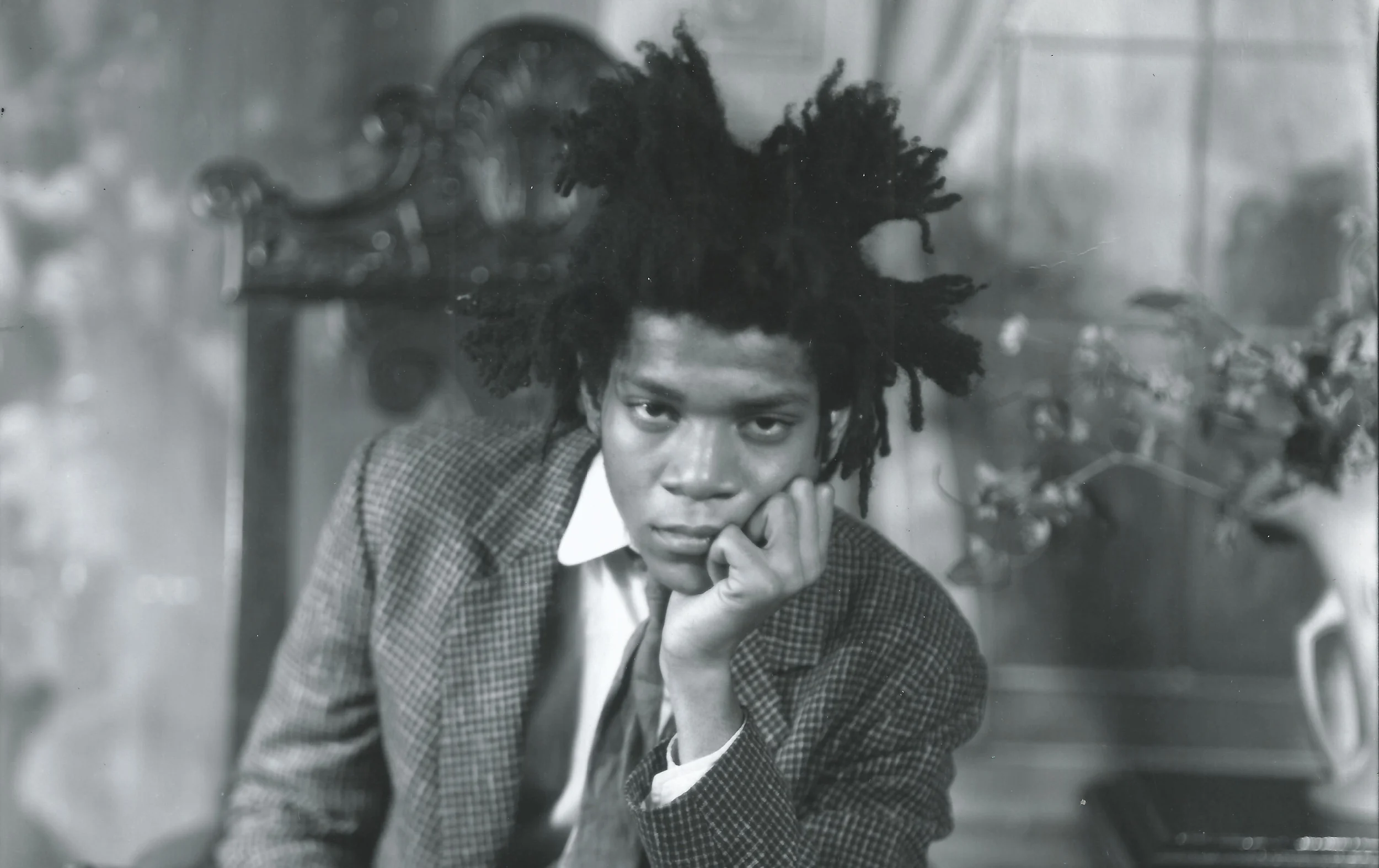
Jean-Michel Basquiat: A Voice That Roars Forever
Artist Spotlight · The Collection Editorial
“I don't think about art when I'm working. I think about life.”
Jean-Michel Basquiat
In May 2017, the art world collectively held its breath as Jean Michel Basquiat's 1982 painting "Untitled" sold at Sotheby's New York for 110.5 million dollars, making him the first Black artist to achieve a nine figure auction result. The buyer was Japanese entrepreneur Yusaku Maezawa, who declared publicly that the work had moved him to tears. That moment crystallized something the art world had long understood but rarely articulated so dramatically: Basquiat is not simply a blue chip market phenomenon.
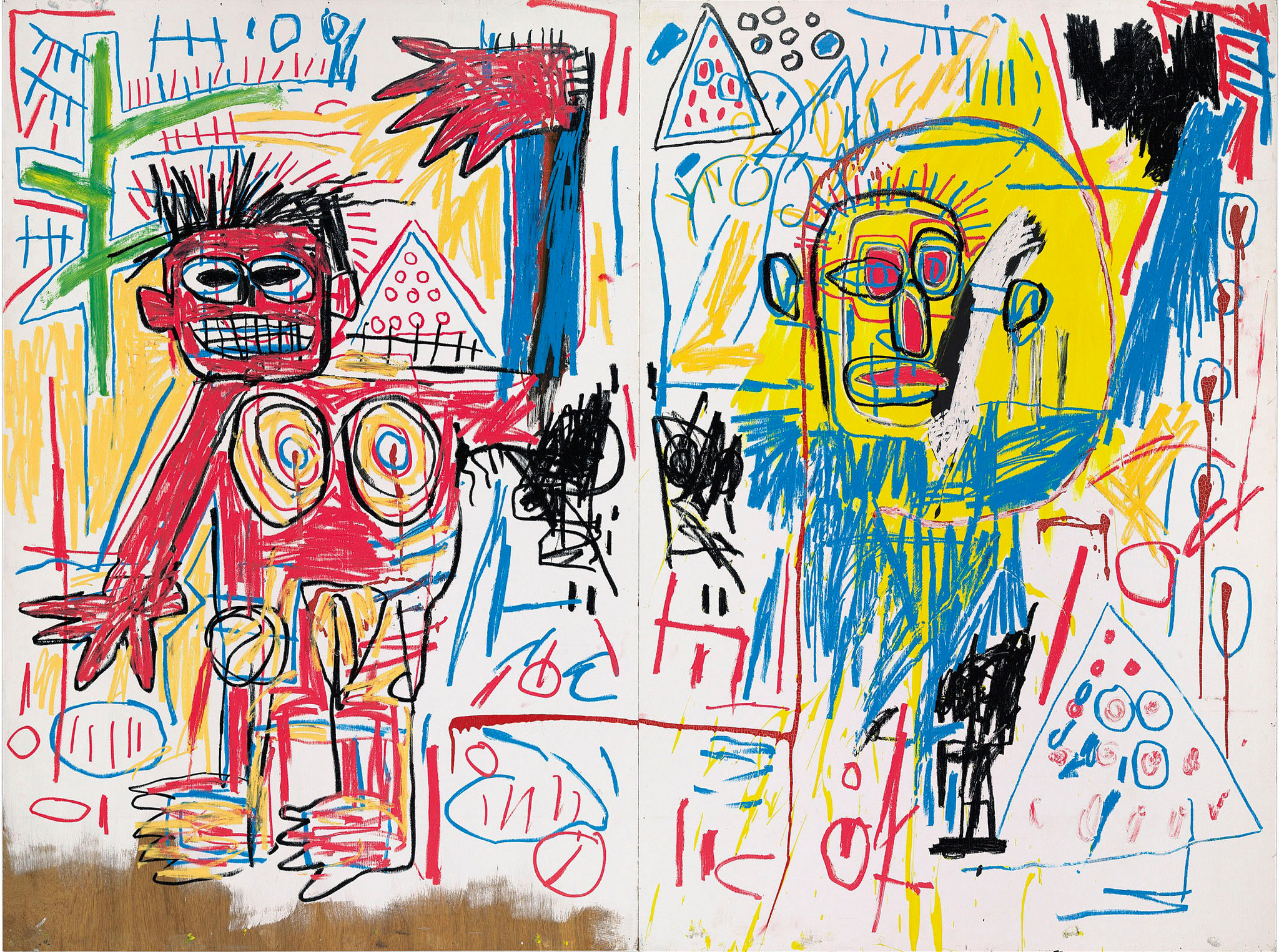
Jean-Michel Basquiat
Scribble
He is a force of cultural reckoning whose urgency feels, if anything, more alive today than it did during his own electric lifetime. Jean Michel Basquiat was born on December 22, 1960, in Brooklyn, New York, to Gerard Basquiat, a Haitian accountant, and Matilde Andrades, a Puerto Rican woman with a deep love of museums and visual culture. His mother took him regularly to the Brooklyn Museum and the Metropolitan Museum of Art, seeding in him an almost encyclopedic appetite for art history that would later surface across his canvases in extraordinary ways. A curious and precocious child, Basquiat was reading at an advanced level by age four and spoke English, French, and Spanish fluently.
When he was around eight years old, he was struck by a car and hospitalized, and his mother brought him a copy of Gray's Anatomy to occupy his recovery. That book would become a lifelong obsession, and its anatomical imagery of bones, organs, and sinew would thread itself through some of his most celebrated work. Basquiat's parents separated when he was a teenager, and he eventually left home at seventeen, making his way to Lower Manhattan at the height of the downtown scene that would forge him. Living rough in Tompkins Square Park and sleeping on cardboard, he immersed himself in the world of music, poetry, and visual art that was erupting across the East Village.
Jean-Michel Basquiat
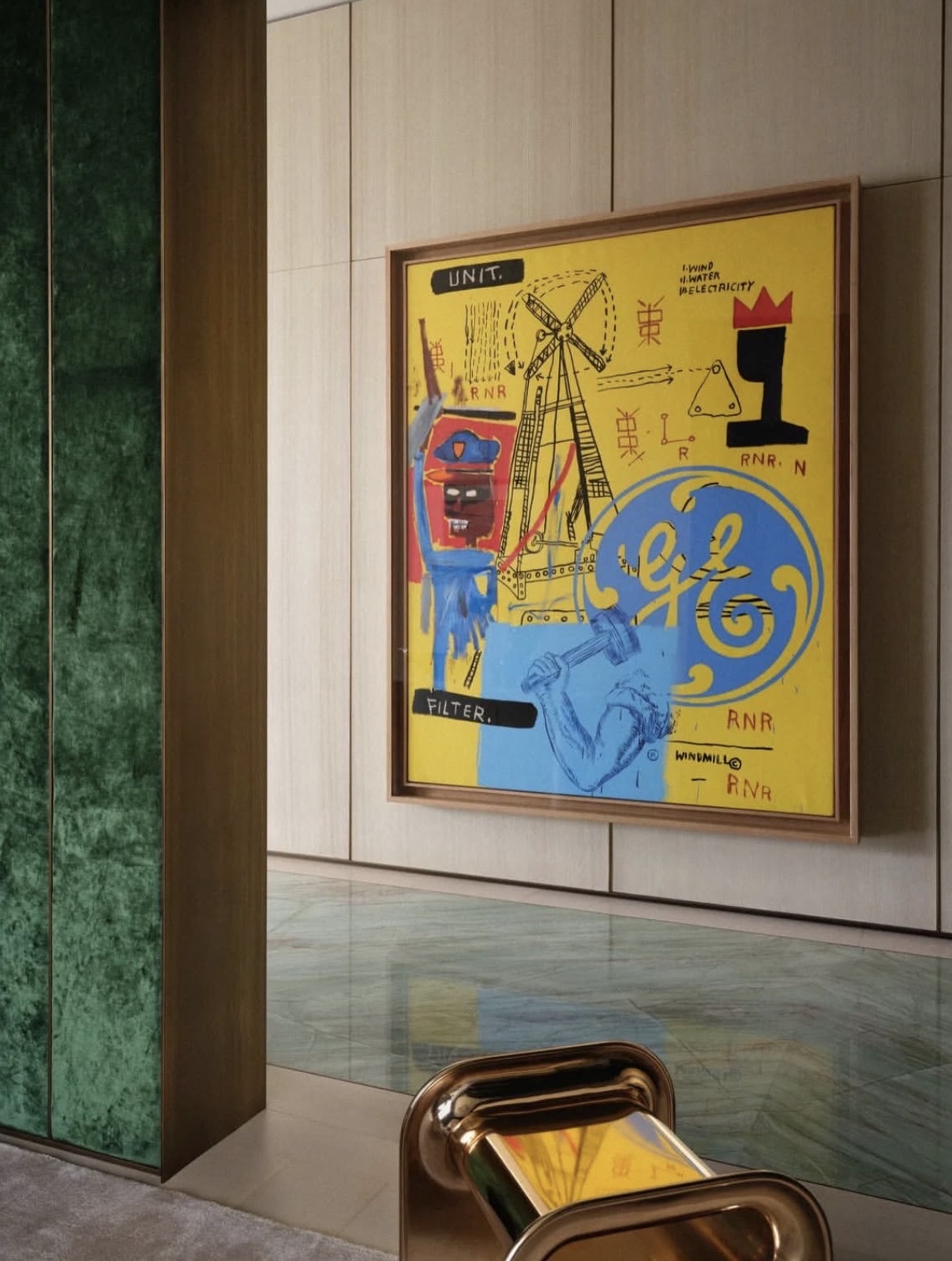
Unit Filter GE, 1984
Under the tag name SAMO, short for "same old shit," Basquiat and his friend Al Diaz began spray painting aphoristic, philosophically charged texts across the walls of SoHo and Lower Manhattan. These were not simply graffiti. They were confrontational literature, provocations designed to make people stop and think. SAMO declared itself dead in 1979 when Basquiat decided the streets were no longer large enough for what he had to say.
“I start a picture and I finish it. I don't think about art while I work.”
Interview, 1985
His transition into the fine art world was swift and spectacular. In 1980, he participated in the landmark group exhibition "Times Square Show," a chaotic, energy saturated event organized by the collective Colab that introduced New York to a generation of artists working outside institutional frameworks. The following year, curator Diego Cortez included him in "New York, New Wave" at P.S.
Jean-Michel Basquiat
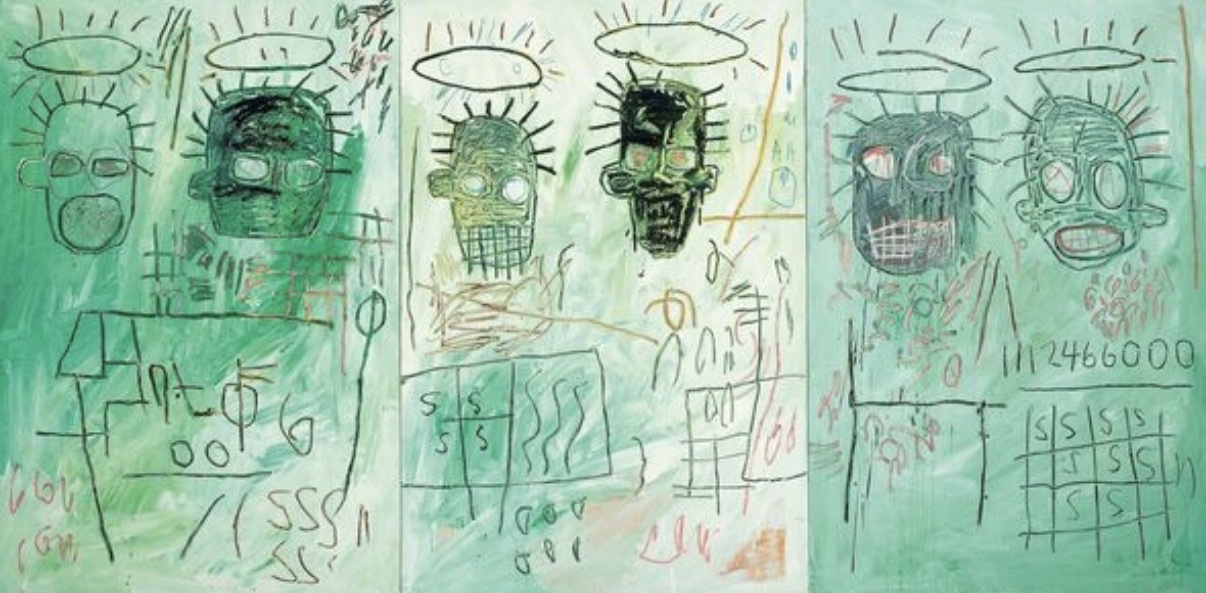
Six Crimee, 1982
1 in Long Island City, and Basquiat, then just twenty years old, began selling works and attracting serious attention. His meeting with Andy Warhol at a downtown restaurant, where a teenage Basquiat reportedly sold him a postcard, blossomed into one of art history's most generative friendships and collaborations. The two began working together formally in 1984, producing a series of collaborative paintings that layered Warhol's commercial fluency with Basquiat's raw, text laden energy. "Unit Filter GE," a 1984 mixed media collaboration between the two, stands as a fascinating document of that partnership, showcasing how their respective visual languages found an unexpected and productive common ground.
“I had some money, I made the best paintings ever. I was completely reclless about it.”
Jean-Michel Basquiat
Basquiat's solo practice, however, was where his singular genius burned most brightly. Working with oil sticks, acrylics, wax crayons, and found materials, he built up surfaces that felt simultaneously ancient and urgent, layered and direct. His compositions were governed by a restless intelligence that drew on African art, Caribbean culture, American jazz and hip hop, comic books, anatomy textbooks, and the Western art historical canon he both revered and interrogated. Works like "Six Crimee" from 1982, executed in acrylic and oil paintstick on masonite, demonstrate his ability to compress maximum emotional and intellectual content into a single image.
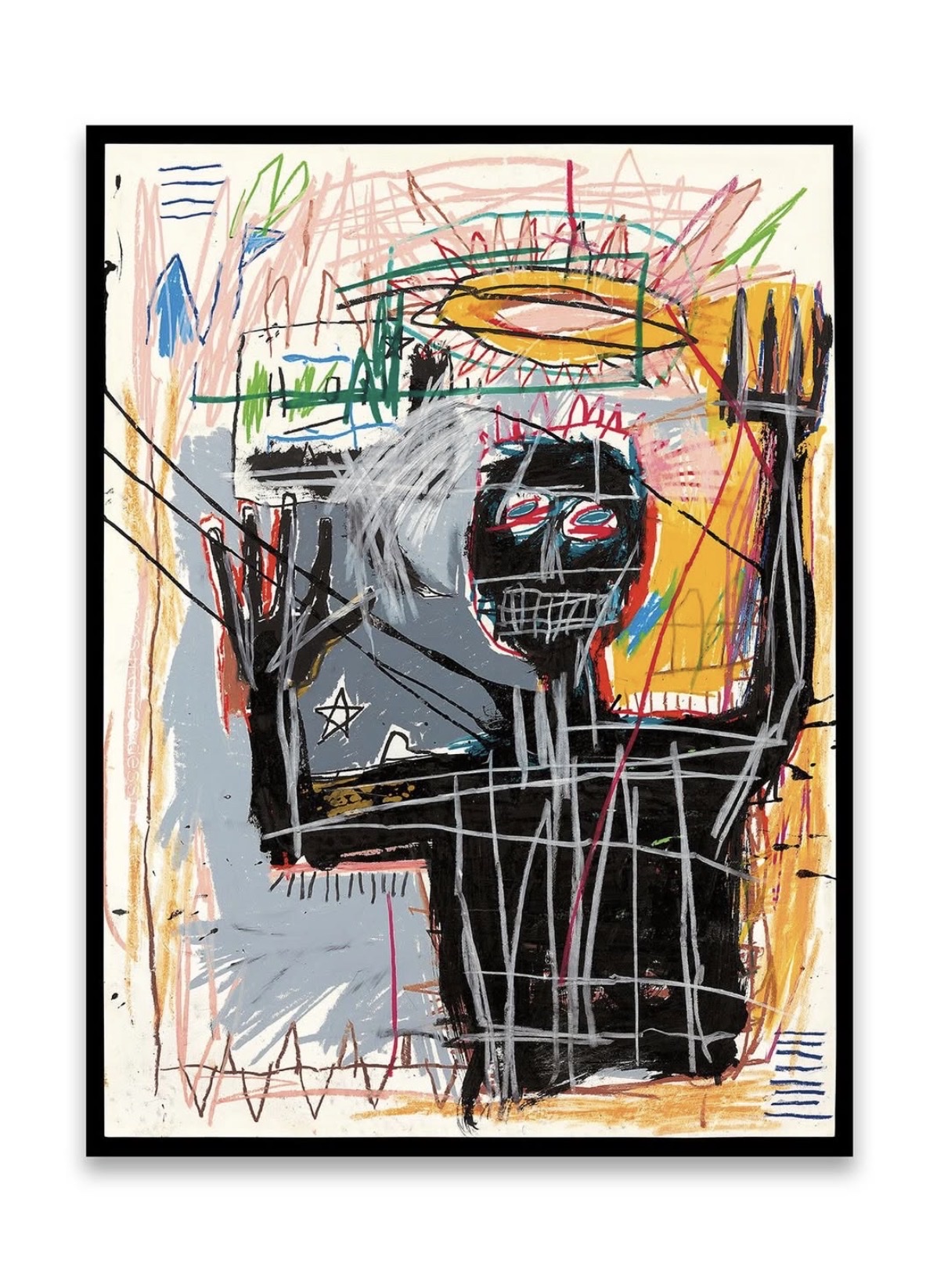
Jean-Michel Basquiat
Furious Man, 1982
"Furious Man" from the same year, rendered in oilstick, acrylic, wax crayon, and ink on paper, shows how his figures pulsed with a kind of anguished vitality that few painters of any era have matched. The repeated crowned skull, his most iconic motif, was not simply a memento mori. It was a declaration: that Black bodies and Black minds carried dignity, royalty, and intellectual authority that a racist society was determined to deny. For collectors, Basquiat represents one of the most compelling propositions in the post war and contemporary market.
Works on paper, including oilstick compositions, screen prints, and drawings, offer meaningful entry points into his universe, and pieces such as "Untitled (Scapula)" from 1983 and the Anatomy series screen prints reveal how profoundly his ideas transferred across mediums. His screenprints, including works from the Superhero Portfolio and the Boxer Rebellion series from 1982, are particularly valued as documents of his conceptual range, and they have shown consistent appreciation at auction. Collectors are advised to look for works from the early 1980s, widely considered his most fertile period, and to pay close attention to provenance, as the Basquiat authentication board dissolved in 2012, making documented exhibition history and gallery records especially important. Reputable institutions and major auction houses including Christie's, Sotheby's, and Phillips have all handled significant Basquiat results in recent years, reflecting the sustained global appetite for his work.
Basquiat occupied a singular space in the art history of his moment, bridging the raw populism of street art with the intellectual ambitions of neo expressionism. His closest artistic relatives included Keith Haring, with whom he shared the downtown scene and a commitment to accessibility, and Julian Schnabel and David Salle, who represented the neo expressionist wave that was reshaping painting in New York at the same moment. But Basquiat's work carried something none of those contemporaries could replicate: a direct, embodied reckoning with race, identity, and power that was rooted in lived experience. He was in conversation with Franz Kline and Cy Twombly on one hand and with Charlie Parker and Muhammad Ali on the other, and that breadth of reference gave his canvases a density and emotional range that continues to reward close looking.
Jean Michel Basquiat died on August 12, 1988, at the age of twenty seven, but the scale of his influence has only grown in the decades since. Major retrospectives at the Brooklyn Museum in 2005 and the Fondation Louis Vuitton in Paris in 2018 introduced his work to new generations of viewers, and his presence in popular culture through film, fashion, and music has made him one of the most recognized artists of the twentieth century. More than that, he remains a touchstone for any serious conversation about the relationship between art and social justice, between genius and marginalization, between the personal and the political. To collect Basquiat is to hold a piece of that ongoing conversation, to participate in a legacy that shows no sign of quieting.
Explore books about Jean-Michel Basquiat
Basquiat: A Life
Jennifer Clement

Jean-Michel Basquiat
Jennifer Clement
Basquiat
Marc Mayer

Jean-Michel Basquiat: The Unknown Notebooks
Jean-Michel Basquiat
Basquiat: Untitled (1981)
Dieter Buchhart
Jean-Michel Basquiat 1981-1991: The Explosive Creativity
Robert Farris Thompson
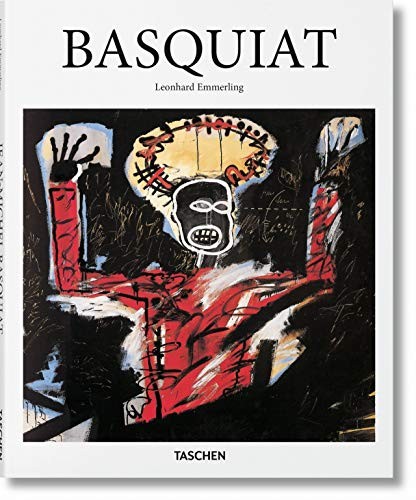
Basquiat
Leonhard Emmerling
Jean-Michel Basquiat: A Retrospective
Klaus Kertess