Gabriel Dawe
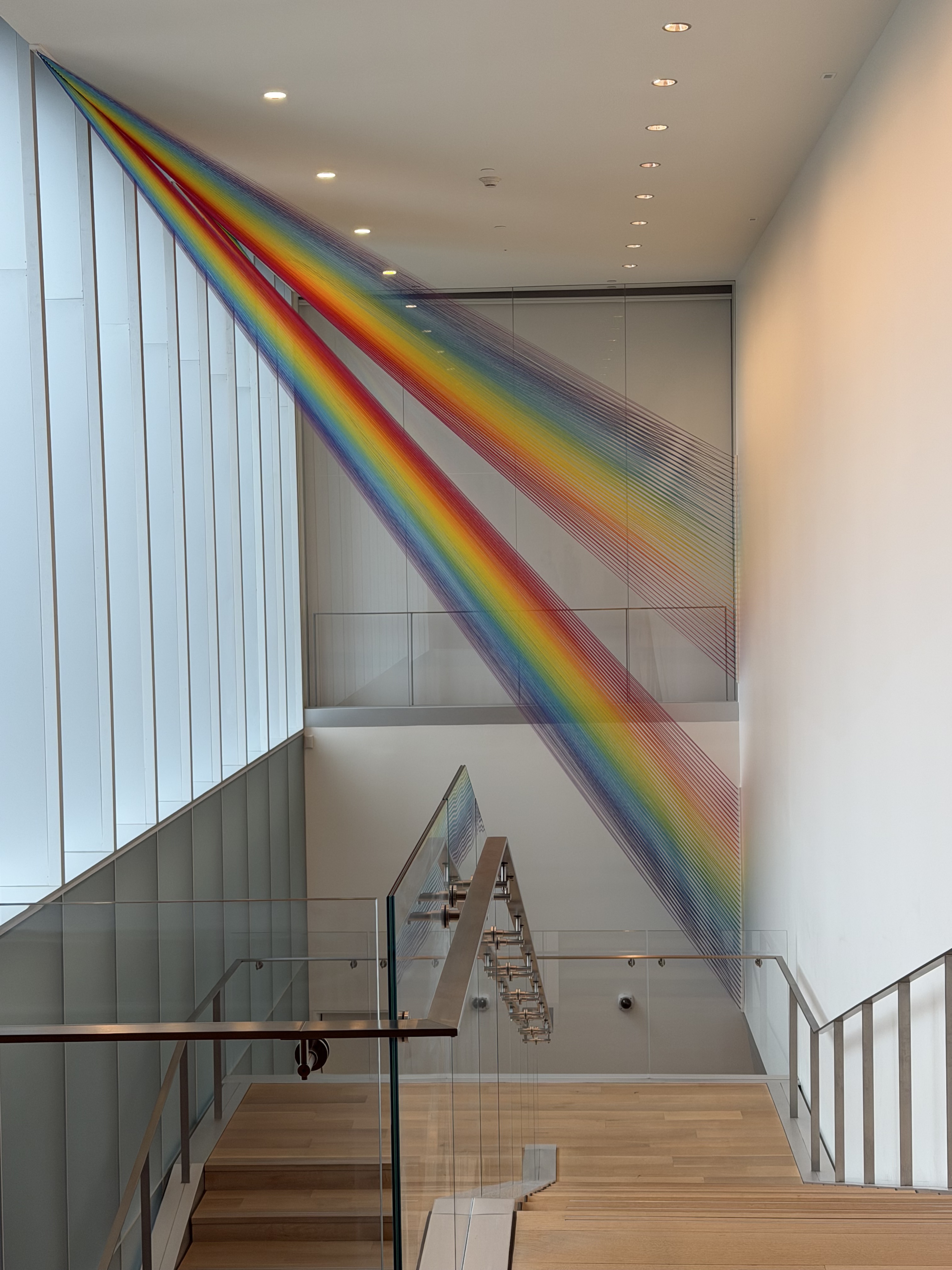
Gabriel Dawe Weaves Light Into Living Architecture
Artist Spotlight · The Collection Editorial
“I grew up seeing women in my family doing embroidery, and I always thought it was beautiful but never considered it art.”
Gabriel Dawe, interview with the Renwick Gallery
When the Smithsonian's Renwick Gallery in Washington, D.C. invited Gabriel Dawe to contribute to its landmark WONDER exhibition in 2015, the Dallas based artist installed Plexus A1, a breathtaking gradient cascade of nearly one million feet of thread that seemed to dissolve solid architecture into pure atmosphere. Visitors stood beneath it the way one stands beneath a summer sky at dusk, neck tilted upward, momentarily uncertain whether they were looking at something made by human hands or conjured by the natural world.
Gabriel Dawe
Plexus no. 43, 2023
That installation traveled through the cultural conversation for years afterward, and it remains one of the most widely shared images of contemporary installation art from the past decade. It announced, definitively, that Dawe was not simply an artist to watch but one already reshaping what immersive art could feel like. Dawe was born in Mexico City in 1974, and the city's layered visual culture left a permanent mark on his sensibility. Growing up in a country where artisanal textile traditions are not museum artifacts but living, daily practices, Dawe developed an early and lasting fascination with thread, weaving, and embroidery.
The intricate needlework practiced by women in his family and community was not considered fine art in any formal sense, yet Dawe recognized in it a sophisticated engagement with color, pattern, and optical rhythm. That recognition would take years to fully articulate, but it planted the essential seed. He pursued formal art education and eventually relocated to the United States, settling in Dallas, Texas, where he has built both his studio practice and his reputation. His artistic development moved through a period of searching that many mid career artists recognize in retrospect as foundational.
Dawe experimented with painting and drawing before arriving at thread as his primary medium, a choice that now feels almost inevitable given his background and his preoccupations. What thread offered him was something neither paint nor digital media could quite replicate: a physical, laborious, time intensive process that produces results of extraordinary optical complexity. Each installation requires careful architectural planning, precise color sequencing, and the physical act of stringing thousands of meters of thread across steel hooks and wooden frames. The work is slow, exacting, and deeply manual, which gives it a quality of devotion that resonates with viewers even when they cannot name what they are responding to.
The breakthrough for Dawe came through his Plexus series, an ongoing body of work that has become his signature contribution to contemporary art. The series takes its name from the Latin word for network or braid, a fitting title for works that are simultaneously structural and ethereal. Each Plexus installation is conceived in response to a specific architectural space, meaning the work cannot simply be reproduced or restaged identically elsewhere. Dawe studies the light conditions, the dimensions, and the architectural character of each venue before determining his color palette and the angle and density of the thread runs.
The resulting gradient effects, in which one color dissolves almost imperceptibly into another across dozens of intermediate tones, draw obvious comparison to the color field paintings of Mark Rothko and the optical investigations of Bridget Riley. But where Rothko worked with pigment on a fixed plane and Riley with printed or painted surfaces, Dawe works in three dimensional space, allowing natural light to animate his installations differently at different times of day and from different vantage points. Within the broader context of art history, Dawe occupies a distinctive position that connects several movements without being reducible to any single one. His affinities with Op Art are clear, as his thread grids produce moiré like effects and a sense of gentle visual vibration that recalls the perceptual experiments of the 1960s.
His interest in light and its interaction with physical material connects him to the Light and Space movement associated with artists like James Turrell and Robert Irwin, California figures who elevated the phenomenology of perception to the central subject of their work. And his deep engagement with craft traditions, particularly Latin American textile heritage, aligns him with a generation of contemporary artists who have insisted on the intellectual and aesthetic legitimacy of practices historically dismissed as decorative or feminine. Dawe has spoken about the embroidery traditions of Mexico as genuine antecedents to abstraction, a reframing that carries real art historical weight. From a collecting perspective, Dawe presents a genuinely compelling case.
His large scale site specific installations are, by their nature, produced for institutional or large scale private contexts, which makes them aspirational acquisitions for major collectors and foundations. However, Plexus no. 43, created in 2023 using thread, painted wood, and steel hooks, represents the kind of resolved, object based work that allows serious collectors to engage with his practice in a more intimate register. Works in this vein carry the full conceptual and visual intelligence of his monumental installations while existing as discrete, acquirable objects.
Collectors drawn to the intersection of craft, abstraction, and experiential art will find in Dawe an artist whose market is still developing relative to the scale of his critical reputation, which is precisely the condition that attentive collectors seek out. His work sits comfortably alongside pieces by Olafur Eliasson, Tara Donovan, and Fred Sandback, artists who similarly transform simple or industrial materials into experiences of genuine wonder. What makes Dawe's practice particularly meaningful in the current cultural moment is its insistence on slowness, handcraft, and the body's relationship to color and space at a time when so much visual culture is instant, digital, and disembodied. His installations demand physical presence.
They reward sustained looking. They connect a pre Columbian textile heritage to the most rigorous traditions of twentieth century abstraction without treating either as a mere reference point. Dawe is doing something genuinely synthetic, bringing together Mexican craft culture, perceptual art theory, architectural site specificity, and a deeply personal color sensibility into a practice that feels both historically grounded and entirely his own. For collectors who believe that the most enduring art is art that knows where it comes from, Gabriel Dawe offers something rare: a vision that is unmistakably contemporary and unmistakably rooted.