Ernest Meissonier
Meissonier: The Master of Magnificent Detail
Artist Spotlight · The Collection Editorial
“Everything should be sacrificed to truth. Truth is the soul of art.”
Ernest Meissonier
In the grand salons of nineteenth century Paris, one painter above all others stopped visitors in their tracks and sent them reaching for magnifying glasses. Ernest Meissonier, whose small yet overwhelming canvases commanded the kind of breathless reverence usually reserved for cathedrals, was the undisputed king of the French academic world for nearly half a century. Today, as private collectors and major institutions alike rediscover the emotional and technical ambition contained within his intimate panels, Meissonier's reputation is undergoing one of the most compelling reassessments in art market history. Jean Louis Ernest Meissonier was born in Lyon on 21 February 1815, the son of a colonial merchant.
Ernest Meissonier
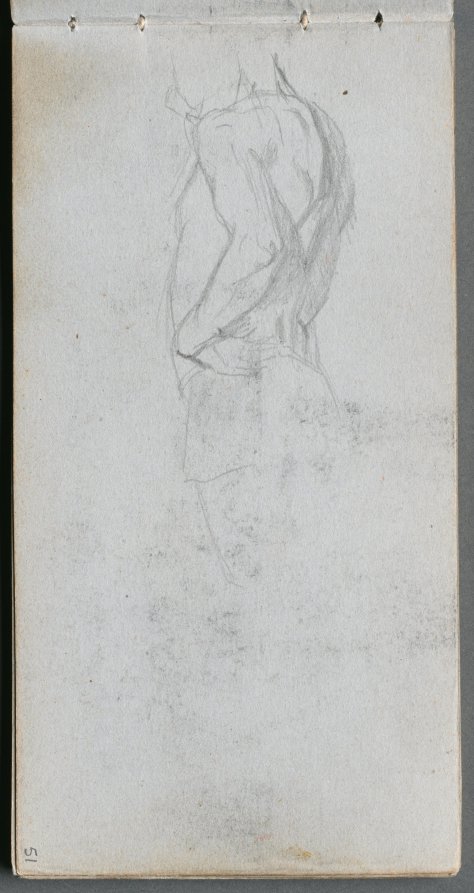
Sketchbook, page 51: Figure Study, 1860
The family relocated to Paris while he was still a child, and the young Meissonier found himself immersed in the cultural ferment of a city reshaping itself in the aftermath of the Napoleonic era. He entered the studio of Léon Cogniet in the mid 1830s, absorbing the rigorous academic training that would become the armature of everything he later achieved. Yet even as a student he resisted easy categorisation, gravitating toward the intimate Dutch and Flemish masters of the seventeenth century, painters like Gerard ter Borch and Pieter de Hooch, whose quiet domestic scenes rewarded prolonged looking with extraordinary revelation. Meissonier's early career found its footing in genre painting, small panels depicting card players, readers, chess matches, and soldiers at rest, scenes drawn from the daily rhythms of middle class and military life.
His debut at the Paris Salon came in 1834, and by the 1840s he had cultivated a devoted following among collectors who prized the almost supernatural precision of his brushwork. The critic Théophile Gautier described standing before a Meissonier as an experience that defied rational explanation, something closer to peering through a window into a perfectly preserved past than viewing a painted surface. This quality, the sense that reality itself had been captured and held still, became the defining characteristic of everything Meissonier touched. The great turning point in Meissonier's practice arrived with his sustained engagement with Napoleonic subject matter, a body of work that would ultimately define him in the public imagination and place him among the most ambitious history painters of his age.
Ernest Meissonier
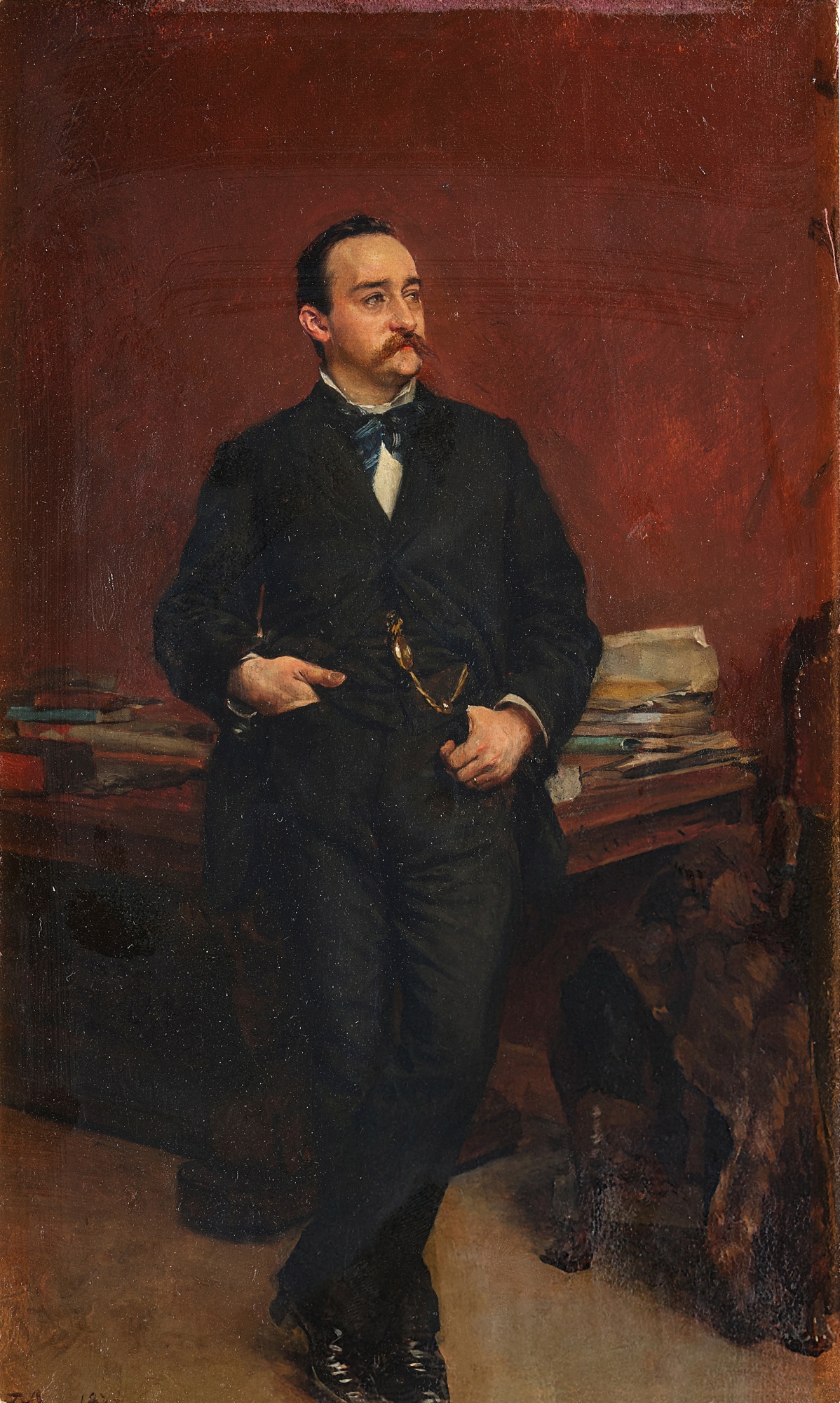
Portrait of the artist Alfred Lachnitt
His monumental canvas known as 1814, La Campagne de France, completed in 1864 and now in the Musée d'Orsay in Paris, depicts Napoleon and his exhausted marshals riding through a bleak winter landscape, the French empire visibly unravelling around them. The painting is staggering not only in its compositional authority but in the granular specificity of every element: the mud on the horses' legs, the hollow resignation on the emperor's face, the grey light pressing down on a column of men who sense the end approaching. Meissonier spent years researching uniforms, weapons, and terrain, famously constructing a narrow gauge railway on his country estate at Poissy so that he could observe horses at full gallop from alongside and below, translating motion into the frozen eloquence of paint. Yet it is perhaps the works on paper that reveal Meissonier most honestly, and The Collection's holdings offer a rare and privileged window into the artist's working mind.
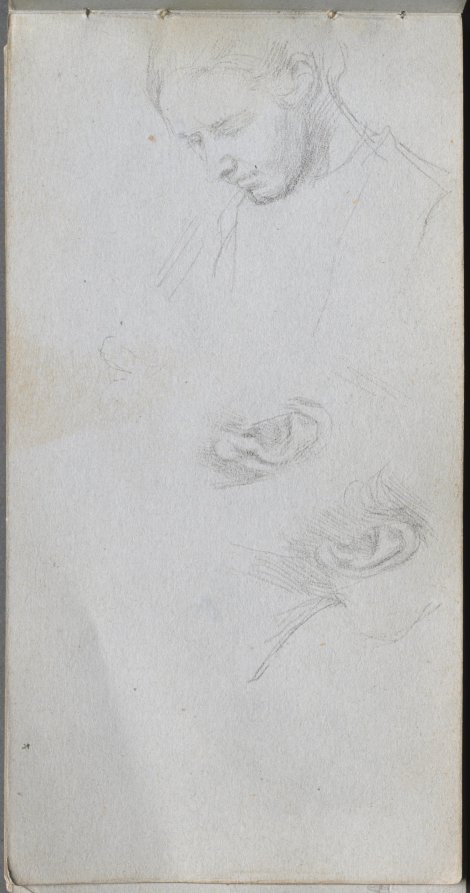
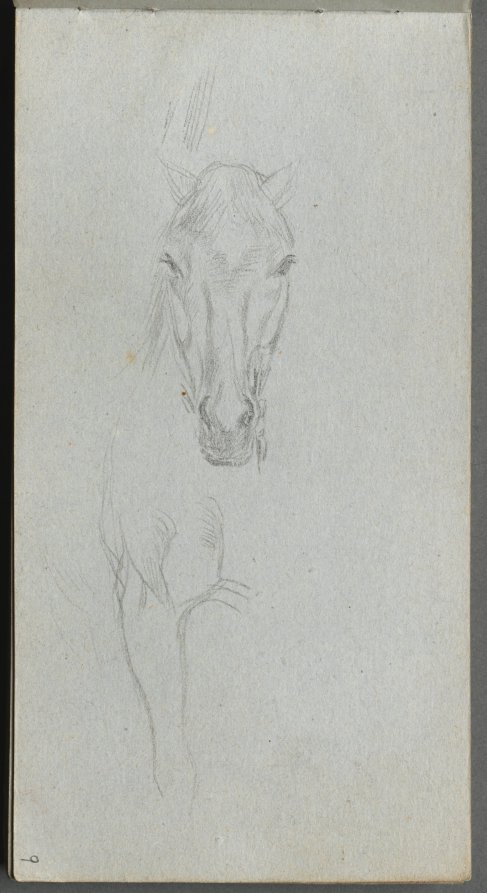
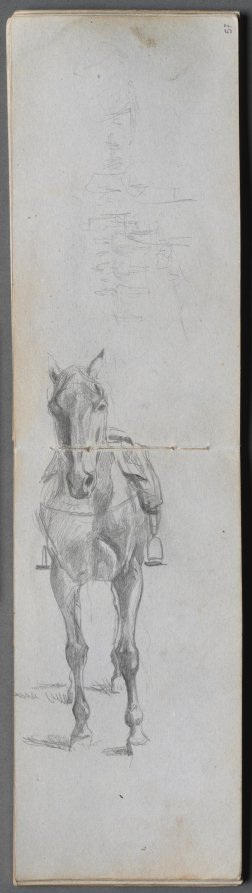
The sketchbook pages from 1860, encompassing figure studies, horse studies, architectural observation, landscape notation, and perspective working, are not preparatory sketches in any diminished sense. They are complete acts of seeing. The graphite study of a seated male figure, the rapid seascape populated with a lone figure, the architectural notation that captures proportion and shadow in equal measure: each of these pages documents the obsessive visual intelligence that underpinned the finished paintings. Collectors who have lived with Meissonier's drawings describe them as uniquely alive, as if the hand were still moving across the page.
Ernest Meissonier
Sketchbook, page 09: Study of a Horse, 1860
The portrait of Alfred Lachnitt in oil on board, intimate in scale and unflinching in its psychological attentiveness, reminds us that Meissonier was also a portraitist of real emotional subtlety, capable of capturing character with the same precision he brought to a cavalry charge. From a market perspective, Meissonier has long occupied a position that confounds easy categorisation. During his lifetime he was arguably the most commercially successful painter in France, with collectors including Napoleon III and wealthy industrialists across Europe competing for his work. Prices at auction declined sharply through much of the twentieth century as modernist taste swept aside the academic tradition, but the current climate has brought renewed and serious attention.
Major sales at Christie's and Sotheby's in recent decades have demonstrated that the finest Meissonier panels, especially those with strong Napoleonic subject matter or impeccable provenance chains extending back to nineteenth century French collections, retain extraordinary appeal. Collectors entering this market are advised to prioritise condition above almost everything else: the density of Meissonier's paint surface means that even minor restoration can disrupt the optical unity that makes his work so remarkable. Works on paper, particularly sketchbook pages with clear subject integrity and documented provenance, represent an accessible and historically significant point of entry for collectors building a serious collection rooted in nineteenth century French draftsmanship. Meissonier's natural peers in art historical terms are the painters who shared his commitment to verifiable truth in the rendering of history and daily life.
Ernest Meissonier
Sketchbook, page 56 & 57: Study of a Horse, 1860
Jean Léon Gérôme brought a comparable obsessiveness to Orientalist and antique subjects, spending months in Egypt and the Levant to authenticate every detail of his canvases. Alphonse de Neuville and Édouard Detaille, both of whom Meissonier mentored and championed, extended the tradition of military painting into the Franco Prussian War with a directness and emotional rawness that owed much to his example. Further afield, the American painter Thomas Eakins shared Meissonier's fascination with photographic analysis of motion, and the two artists' parallel investigations into the mechanics of the moving body stand as one of the fascinating cross currents of late nineteenth century visual culture. Meissonier died in Paris on 31 January 1891, honoured with a state funeral and mourned by a generation of artists, collectors, and critics who understood that something irreplaceable had passed.
His legacy is not simply one of technical virtuosity, though that virtuosity remains without parallel in the history of oil painting. It is the legacy of a man who believed that the past deserved to be remembered with absolute fidelity, that history was not an abstraction but a lived experience recoverable through patient, reverent attention. In an era when scale and spectacle often serve as substitutes for genuine looking, Meissonier's insistence that the smallest detail carries the full weight of meaning feels not merely relevant but urgently necessary.
Explore books about Ernest Meissonier
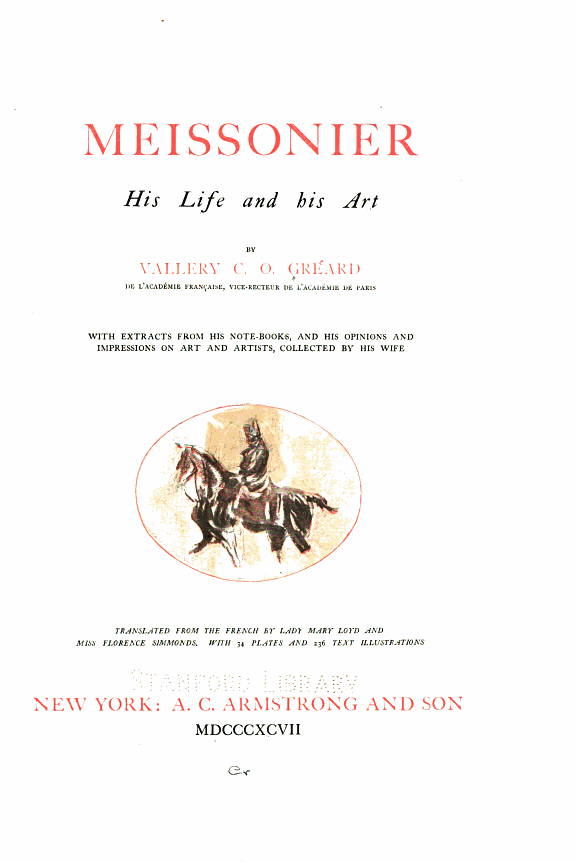
Ernest Meissonier: His Life and His Art
Geraldine Norman

Meissonier: A Life
Donald Wigal
Ernest Meissonier: Master Painter of French Academic Art
Gabriel P. Weisberg
The Life and Times of Ernest Meissonier
Walter Pach

Ernest Meissonier: Catalogue Raisonné
Geneviève and William Brock
Meissonier and French Salon Painting
Michael Levey