Bridget Riley
Bridget Riley: Vision That Moves the World
Artist Spotlight · The Collection Editorial
“I work with two things, what there is to see and what takes place as you look at it.”
Bridget Riley, interview with Robert Kudielka
In 2019, the Hayward Gallery in London mounted a landmark retrospective of Bridget Riley's work that drew tens of thousands of visitors and reminded a new generation why she remains one of the most visually arresting artists alive. The exhibition traced six decades of sustained invention, from her early black and white canvases that seemed to pulse and breathe off the wall to her later explorations of colour so nuanced and joyful they felt almost musical. Standing in those galleries, it was impossible not to feel the profound ambition behind every carefully calibrated stripe and curve. Riley, then in her late eighties, was present at the opening, and the reception she received was nothing short of reverent.
Bridget Riley
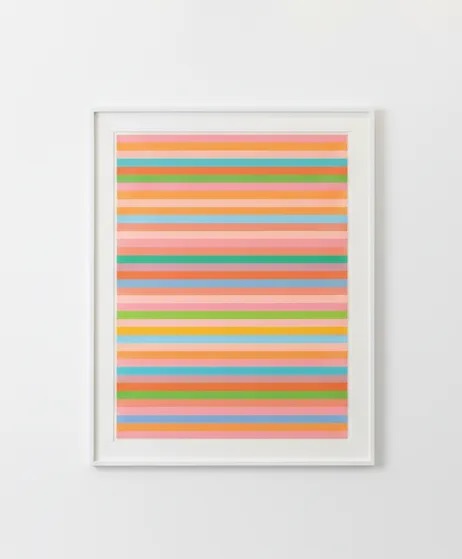
Rose Rose, 2011
Bridget Riley was born in London in 1931, and her early years were shaped by both disruption and discovery. During the Second World War, her family moved to Cornwall, where the quality of light and the rhythms of the natural landscape made a deep impression on the young Riley. She would later describe the experience of looking at the sea and the fields as formative, a lesson in how perception itself can be active and alive. She went on to study at Goldsmiths College in the early 1950s and then at the Royal College of Art, where she absorbed the discipline and rigour that would define her practice.
A transformative trip to Italy in 1960, during which she made a meticulous copy of Georges Seurat's "Bridge at Courbevoie", crystallised her understanding of how small units of colour and tone could be orchestrated to produce sensation at scale. The early 1960s saw Riley develop the bold black and white works that would bring her international recognition almost overnight. Paintings such as "Movement in Squares" (1961) and "Blaze" (1964) confronted viewers with optical phenomena that seemed to defy the flatness of the picture plane entirely. The surfaces appeared to ripple, to contract, to shimmer with an energy that had no obvious source.
Bridget Riley
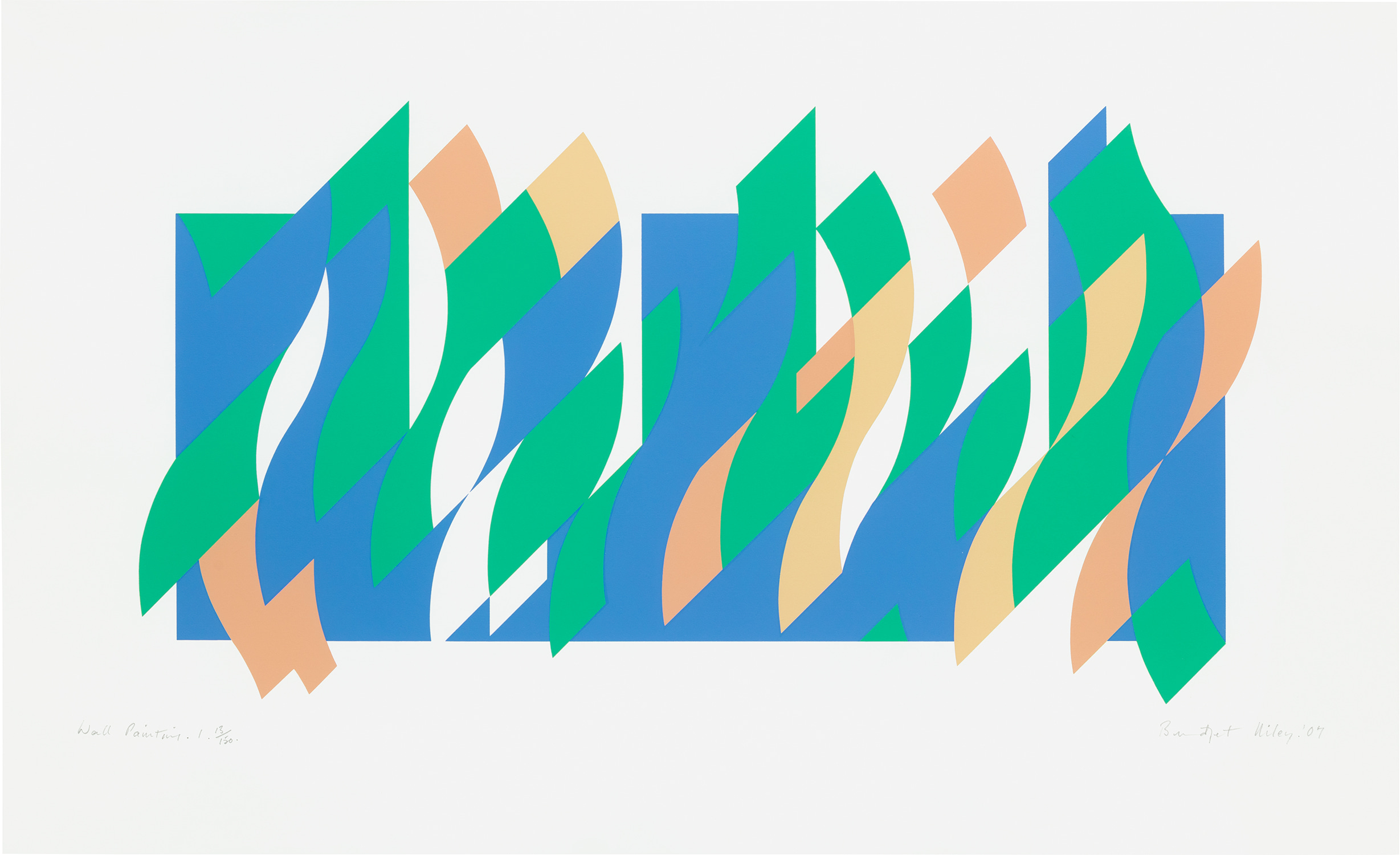
Wall Painting 1 (print) (S. 66)
These were not illusions in any cheap sense. They were precise investigations into the mechanics of human vision, carried out with the patience and exactitude of a scientist and the intuition of a poet. When the Museum of Modern Art in New York included her in its landmark 1965 exhibition "The Responsive Eye", curated by William Seitz, Riley became a central figure in the global conversation about perception, abstraction, and what painting could still do in the age of photography and film. In the late 1960s, Riley made the move into colour, and it proved to be a second act of equal power.
“Painting is a means of making what is invisible in nature visible through colour and form.”
Bridget Riley
Working initially with muted, closely related tones and then with increasingly bold contrasts, she developed a body of work in which colour relationships produce sensations of warmth, coolness, depth, and movement simultaneously. Her stripe paintings of the 1970s and 1980s, made in close collaboration with her studio assistants using exacting preparatory studies, explored how the eye blends and separates adjacent hues in real time. Works such as "Gaillard 2" (1989), painted in oil on linen, exemplify this period at its most confident: long diagonal bands of colour that seem to travel across the surface in opposing currents, creating a visual experience that changes as the viewer moves. Her printmaking practice, developed with equal seriousness over many decades, brought these investigations to a wider audience and stands as a significant body of work in its own right.
Bridget Riley
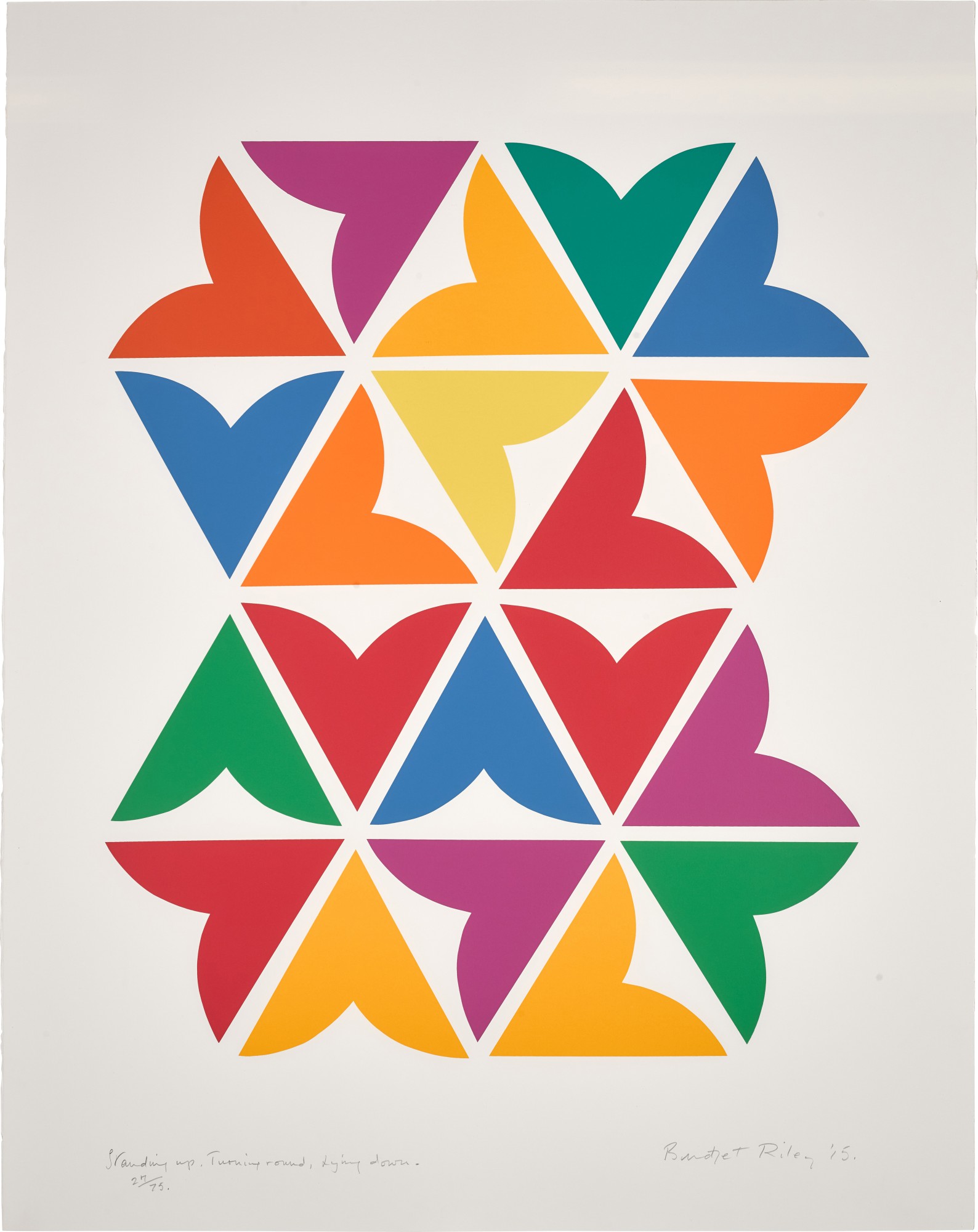
Standing Up, Turning Round, Lying Down (Not in Schubert)
For collectors, Riley's prints represent one of the most compelling entry points into her world. Screenprints such as "Rose Rose" (2011), "Wall Painting 1", and the magnificent "Composition with Circles 5" demonstrate the full range of her thinking in editions that have been produced with the same uncompromising attention to quality as her paintings. These are not reproductions of paintings but independent works conceived specifically for the medium, with colour and form calibrated to the particular properties of ink on paper. Her prints have performed consistently well at auction, with strong results at Christie's, Sotheby's, and Bonhams confirming sustained collector demand across markets.
Gouache and pencil studies such as "Scale Study (Blue Red Green Twist)" (1971) offer a rare and intimate view of her working process, showing how each finished work emerges from an elaborate choreography of drawn and painted tests. Riley's position within art history is both singular and richly connected. She belongs to a tradition of European abstraction that includes Victor Vasarely, whose interest in optical phenomena parallels her own, and Josef Albers, whose systematic explorations of colour interaction in "Homage to the Square" provided an important precedent. The legacy of Seurat and the Neo Impressionists runs through her thinking as a constant undercurrent.
Bridget Riley
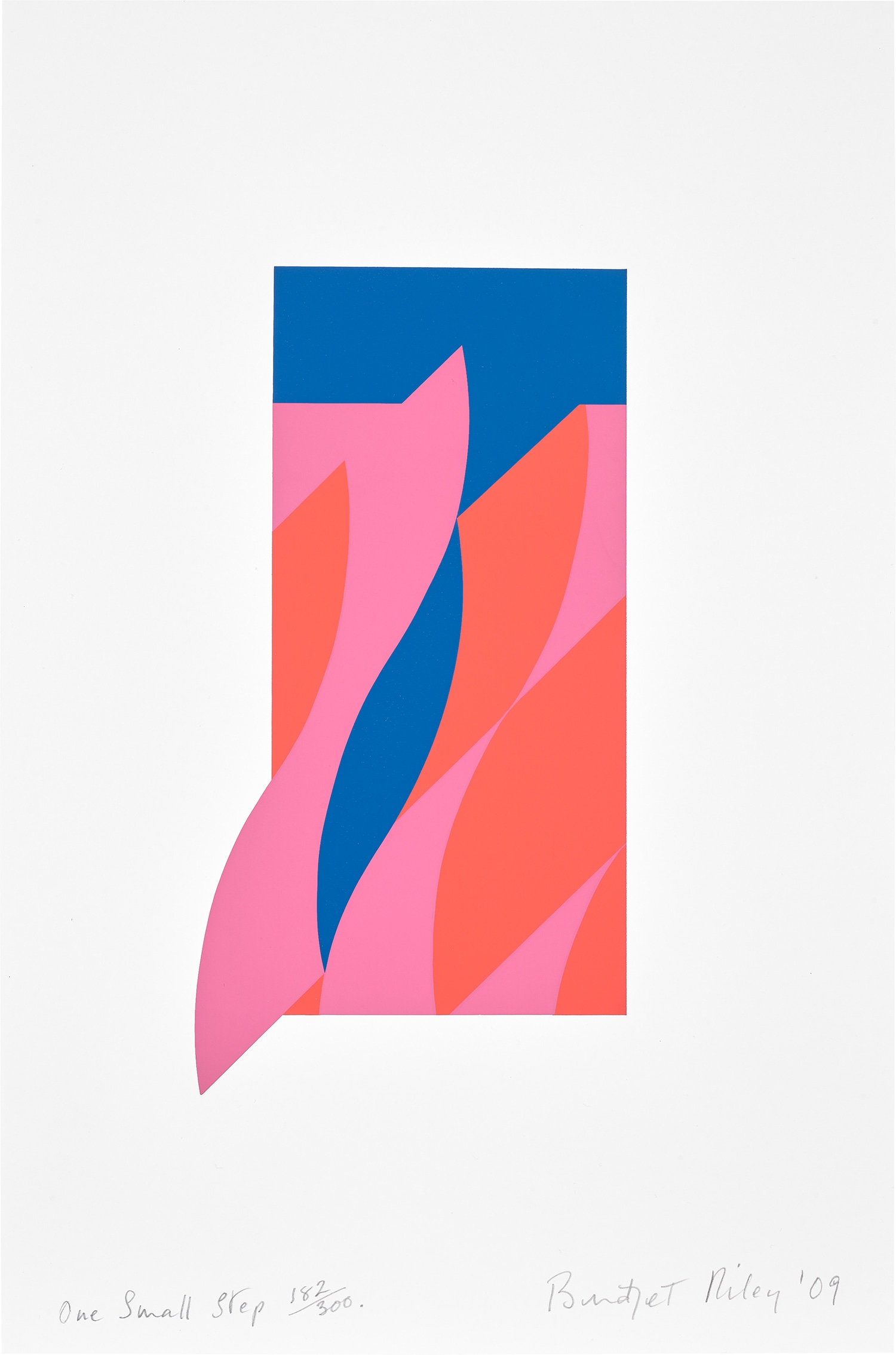
One Small Step (S. 70)
Yet Riley has always resisted easy categorisation. She has spoken at length about her debt to the Old Masters, to Rubens and to the study of classical painting, and her work carries a sense of pictorial intelligence that connects it to a much longer history than the Op Art label alone might suggest. Collectors who understand this context understand that they are acquiring not a period piece but a work of enduring visual intelligence. What makes Bridget Riley matter today, more than six decades into her career, is precisely the quality of sustained attention she brings to a set of questions that remain as open and as urgent as ever.
How do we see? What does vision feel like from the inside? How can a flat surface generate genuine sensation? In an era saturated with images designed to be consumed and forgotten in seconds, her work demands a different kind of engagement, one that rewards stillness, patience, and curiosity.
Institutions from Tate Modern to the National Gallery have collected her work, and her influence on successive generations of painters and designers is incalculable. To live with a Riley, whether a monumental canvas or a beautifully printed edition, is to live with a work that never quite settles, that continues to offer something new each time you look. That is a rare and precious quality in any art, and in Riley's hands it feels like both a gift and a challenge.
Explore books about Bridget Riley

Bridget Riley: A Retrospective
Robert Kudielka
Bridget Riley
Maurice de Sausmarez
Bridget Riley: Works 1959-1978
Robert Kudielka

Bridget Riley: Paintings 1961-2003
Robert Kudielka

Bridget Riley: The Stripe Paintings 1961-1970
Various
Bridget Riley: Dialogues
Robert Kudielka
Bridget Riley: Paintings and Drawings 1961-1999
Robert Kudielka