Arne Jacobsen
Arne Jacobsen, The Dane Who Shaped Everything
Artist Spotlight · The Collection Editorial
“Form must derive from the task it has to fulfill. No more, no less.”
Arne Jacobsen
There is a chair in almost every corner of the modern world, and there is a good chance Arne Jacobsen designed it. The Series 7 chair, introduced in 1955, has sold more than five million units and continues to appear in boardrooms, dining rooms, and design museums with equal authority. When the Victoria and Albert Museum mounted its major survey of Scandinavian design, Jacobsen's work anchored the conversation as it always does, not as a relic of postwar optimism but as a living argument for the idea that great design belongs to no single era. To encounter a Jacobsen object today is to understand why collectors and institutions alike keep returning to him: his work does not age because it was never really of its time to begin with.
Arne Jacobsen
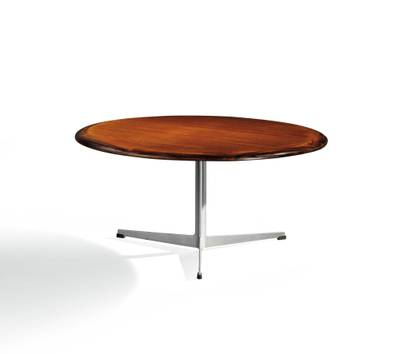
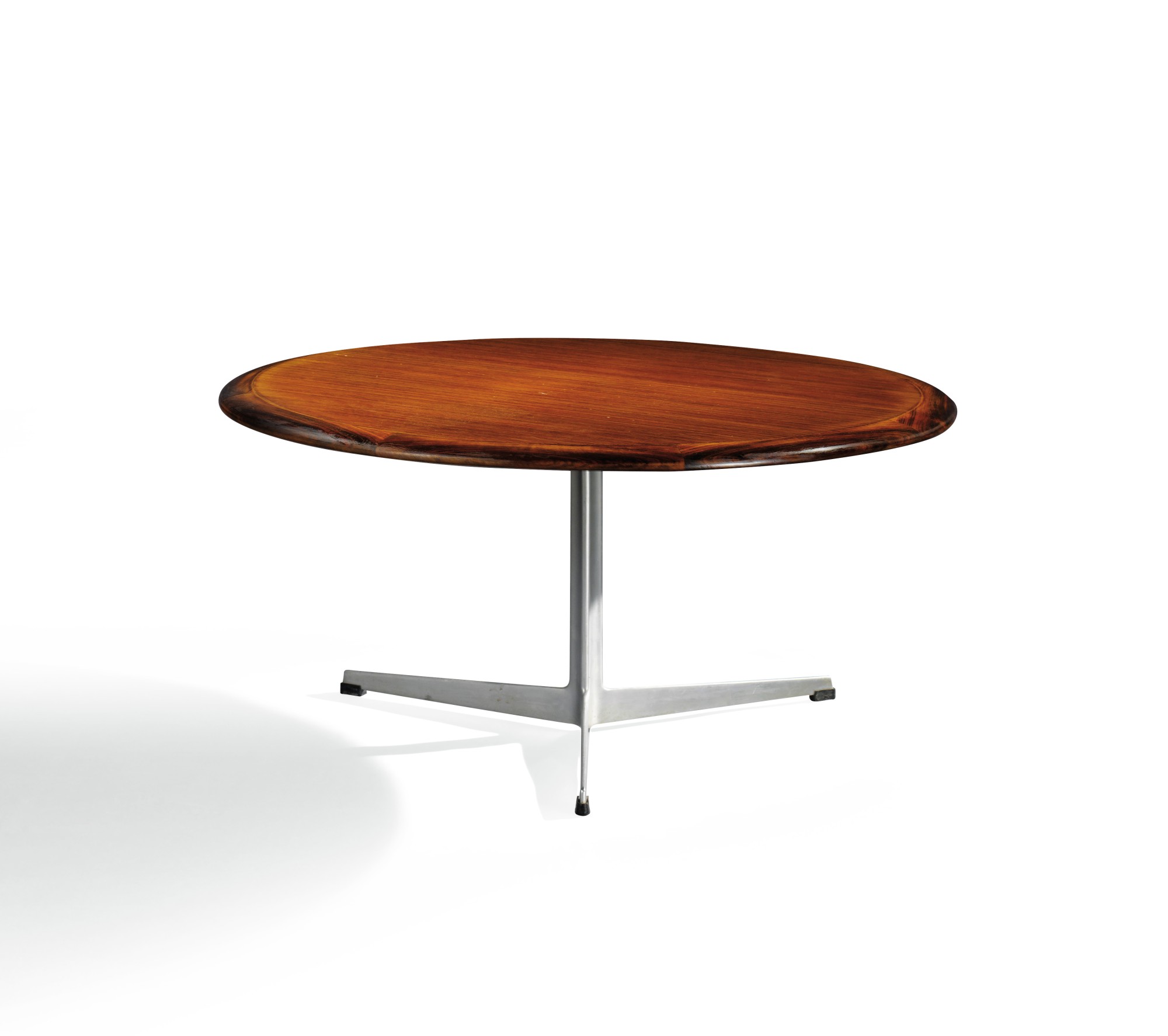
Low table, circa 1960
Arne Jacobsen was born in Copenhagen in 1902, the son of a wholesale merchant, and grew up in a city that took craftsmanship seriously but had not yet found its modernist voice. He trained at the Royal Danish Academy of Fine Arts, where he graduated in architecture in 1927, though his sensibility was always broader than any single discipline. A formative trip to the Paris Exposition Internationale des Arts Décoratifs in 1925 brought him face to face with Le Corbusier's Pavilion de L'Esprit Nouveau, and the encounter was transformative. He returned to Copenhagen carrying the conviction that architecture and the objects within it should speak a unified language, a belief that would define every project he undertook for the rest of his career.
His early architectural commissions, including the Bellavista housing estate in Klampenborg completed in 1934, announced a designer who could absorb the lessons of the International Style and inflect them with something warmer and more particular. Jacobsen was never a dogmatist. Where the strictest modernists pursued abstraction at the expense of comfort, he pursued both simultaneously, understanding that the human body is not a theoretical proposition but a physical fact that design must accommodate and delight. Through the 1940s and into the 1950s, working sometimes under the difficult conditions of the German occupation of Denmark, he refined a practice that moved fluidly between the scales of city planning and cutlery design.
Arne Jacobsen
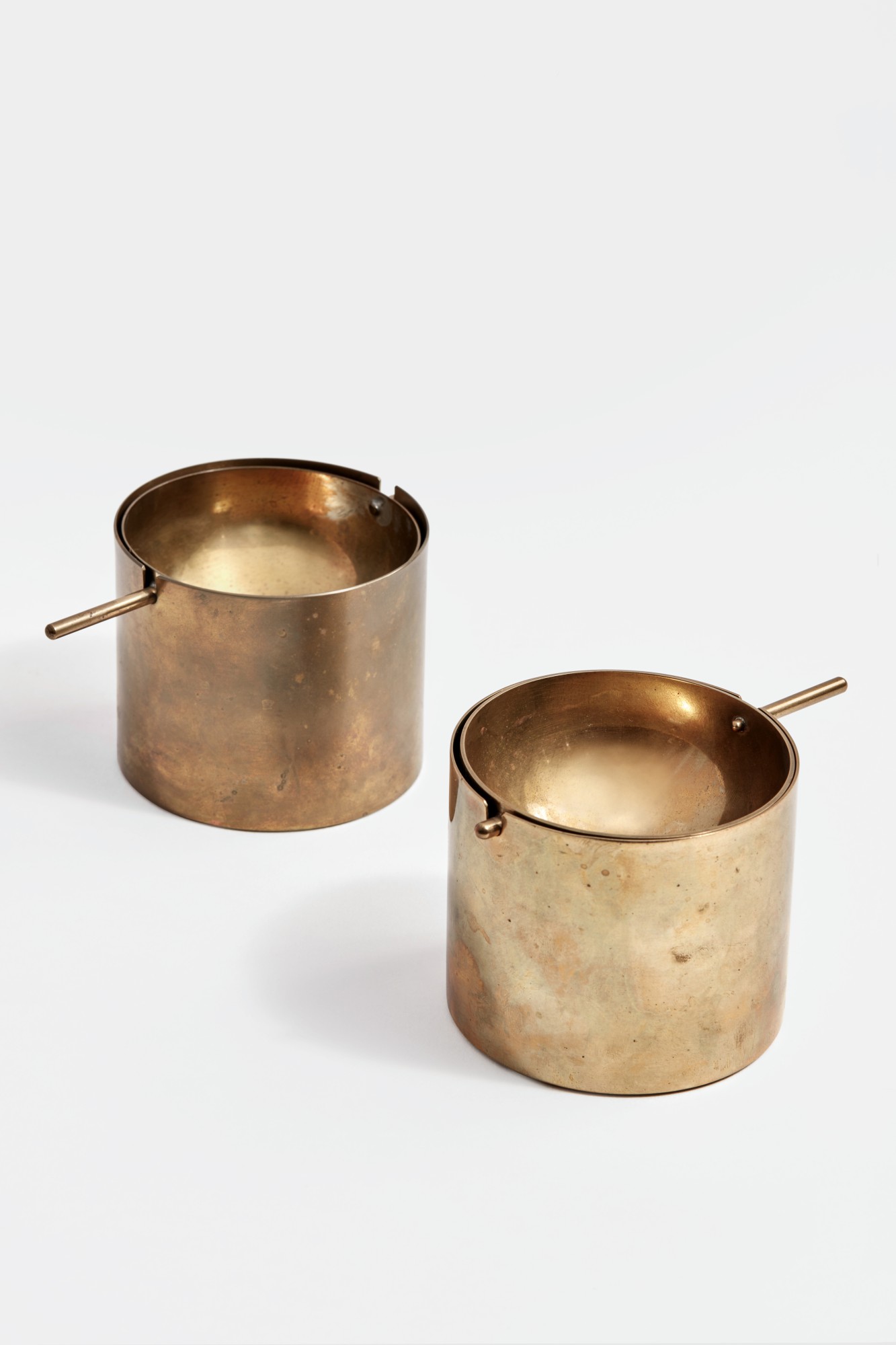
Pair of "Cylinda" Ashtrays
The late 1950s represent the summit of his creative achievement in the eyes of many collectors and historians. The commission for the SAS Royal Hotel in Copenhagen, completed in 1960, gave Jacobsen the opportunity he had always sought: total creative control over an environment from the ground to the ceiling and every object in between. He designed the building's curtain wall facade, its interiors, and a complete family of furniture to populate them, including the Egg Chair and the Swan Chair, both introduced in 1958. These two pieces, produced by Fritz Hansen and still in production today, are among the most recognized works of twentieth century design.
The Egg in particular, with its enveloping organic shell and precise swivel base, achieved something genuinely rare: a sculptural object that functions as furniture and a functional object that reads as sculpture. The works available through The Collection offer collectors a meaningful opportunity to engage with Jacobsen across different registers of his practice. The low table in teak and aluminum from circa 1960 speaks directly to the SAS Hotel period, when Jacobsen was synthesizing warm natural materials with cool industrial forms in a way that felt wholly original. The Pair of Cylinda ashtrays, part of the celebrated Cylinda Line produced by Stelton from 1967 onward, demonstrates his mastery at the intimate scale of the everyday object: pure geometric volumes resolved with an almost mathematical elegance.
Arne Jacobsen
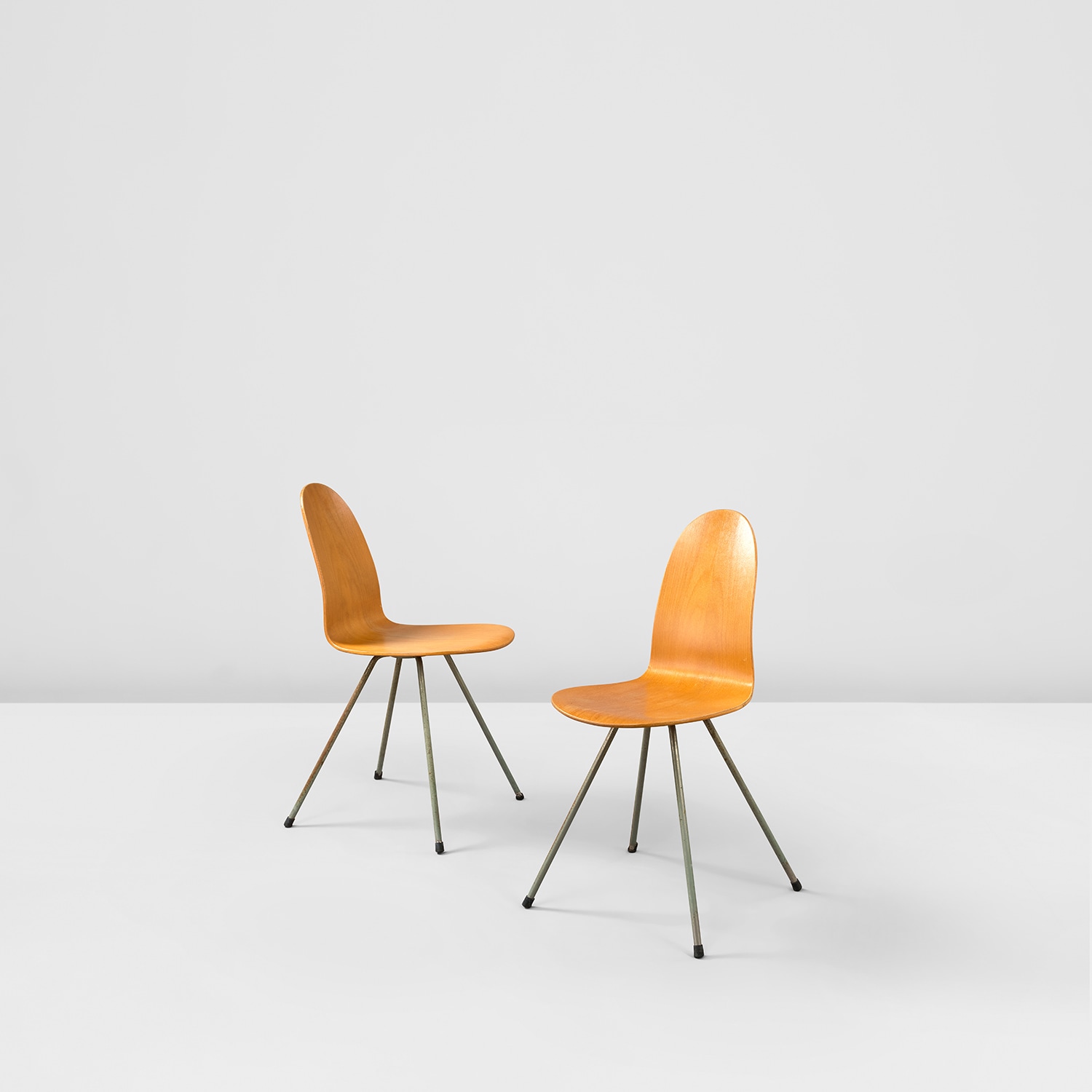
Pair of 'Tongue' chairs, model no. 3106
The Pair of Tongue chairs, model number 3106, designed in 1955, round out a picture of a designer who could move from the monumental to the domestic without losing his grip on proportion or purpose. Each of these works rewards close attention and rewards the collector who understands that Jacobsen's objects are not accessories to a lifestyle but positions within a very particular and very serious design philosophy. On the secondary market, Jacobsen's furniture and decorative objects have commanded consistent and growing interest. Rare early production examples of the Egg and Swan chairs routinely achieve strong results at the major Scandinavian design sales held at Wright in Chicago and at Bruun Rasmussen in Copenhagen.
The Cylinda Line, designed in the final years of his career, has attracted particular attention from collectors who appreciate the way it distills a lifetime of thinking about form into objects you can hold in your hand. Condition and provenance matter enormously, as they do with any great designer, and original Fritz Hansen labels or Stelton markings significantly enhance desirability. Collectors new to Jacobsen are often advised to begin with his smaller works precisely because they offer such concentrated access to his thinking. To place Jacobsen within the broader landscape of twentieth century design is to understand him as the central figure in a Scandinavian tradition that includes Hans Wegner, Finn Juhl, and Poul Henningsen, contemporaries and friendly rivals who collectively invented what the world came to call Danish Modern.
Where Wegner pursued an almost spiritual refinement of the chair as form, and Henningsen devoted himself to the philosophy of light, Jacobsen worked across every category simultaneously, which gives his legacy an unusual comprehensiveness. His dialogue with the European modernism of Mies van der Rohe and Alvar Aalto was direct and conscious, and he absorbed from both without becoming a follower of either. That independence of vision is precisely what collectors find so compelling. Arne Jacobsen died in Copenhagen in 1971, leaving behind a body of work that spans buildings, bridges, furniture, textiles, cutlery, and light fittings, all of it coherent, all of it unmistakably his.
The decades since have only clarified his importance. His furniture remains in continuous production, his buildings are protected landmarks, and his smallest objects are sought by collectors on every continent. The reason is not nostalgia. It is recognition: the recognition that some designers locate something true about the relationship between form and human life, and that once found, that truth does not expire.
Jacobsen found it, and the work proves it every time someone sits down, pours a drink, or simply pauses to admire a table standing quietly in a room.
Explore books about Arne Jacobsen