Alighiero Boetti
Alighiero Boetti: Order, Chaos, and Wonder
Artist Spotlight · The Collection Editorial
“I did nothing for the embroideries. I chose the theme and then other people made them. Two people doing something, neither one nor two.”
Alighiero Boetti, interview, 1993
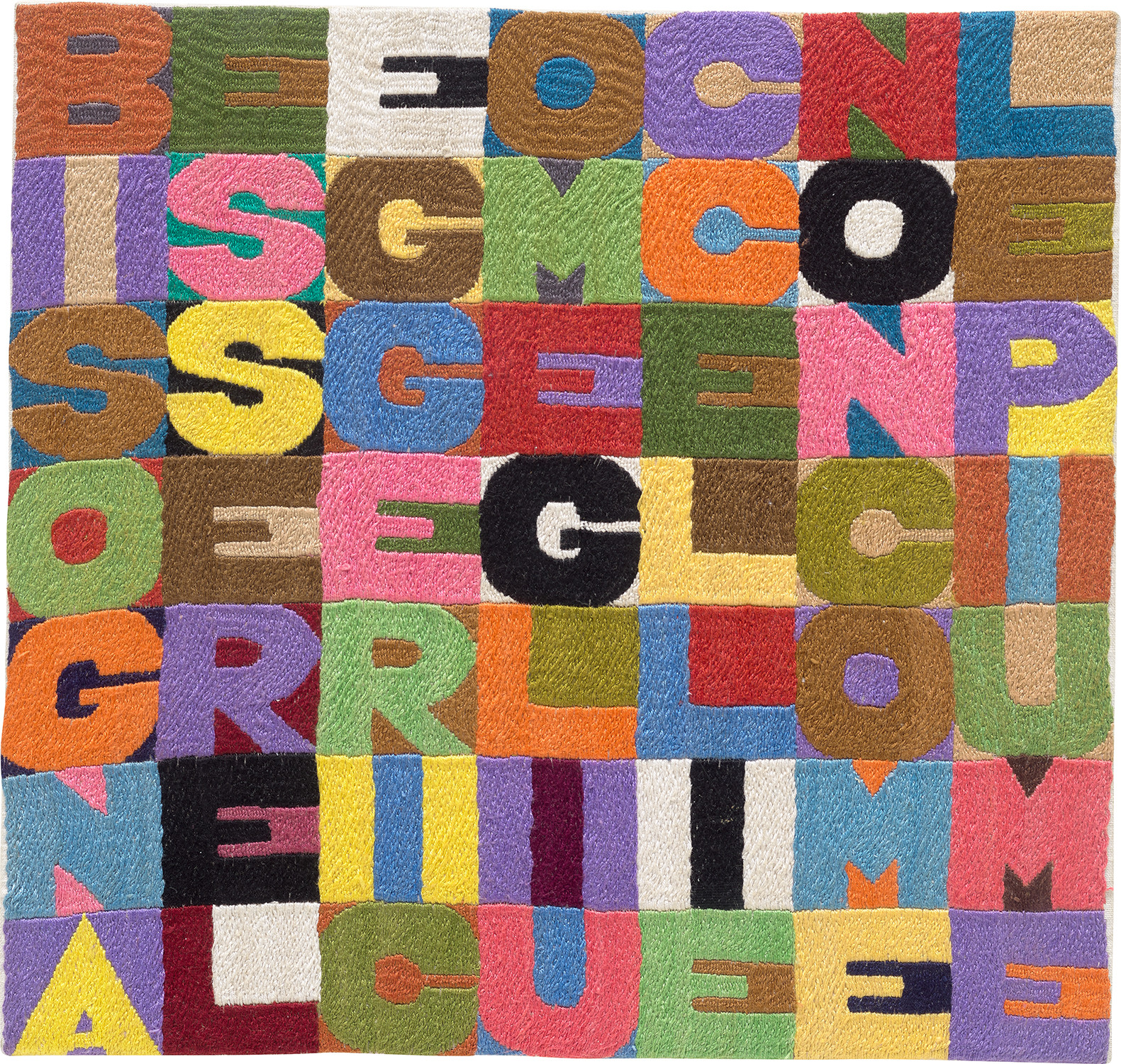
There is a moment, standing before one of Alighiero Boetti's great embroidered maps, when the world seems to reorganize itself. The flags of every nation bloom across a field of hand stitched color, the work at once a geopolitical document, a meditation on time, and a collaboration stretched across continents. That feeling, of being simultaneously grounded and unmoored, is precisely what Boetti intended, and it is why institutions from the Museum of Modern Art in New York to the Tate Modern in London have returned to his work again and again. A major retrospective organized by MoMA in 2012 introduced his practice to a new generation, and the appetite for his work among serious collectors has only intensified in the years since.
Alighiero Boetti
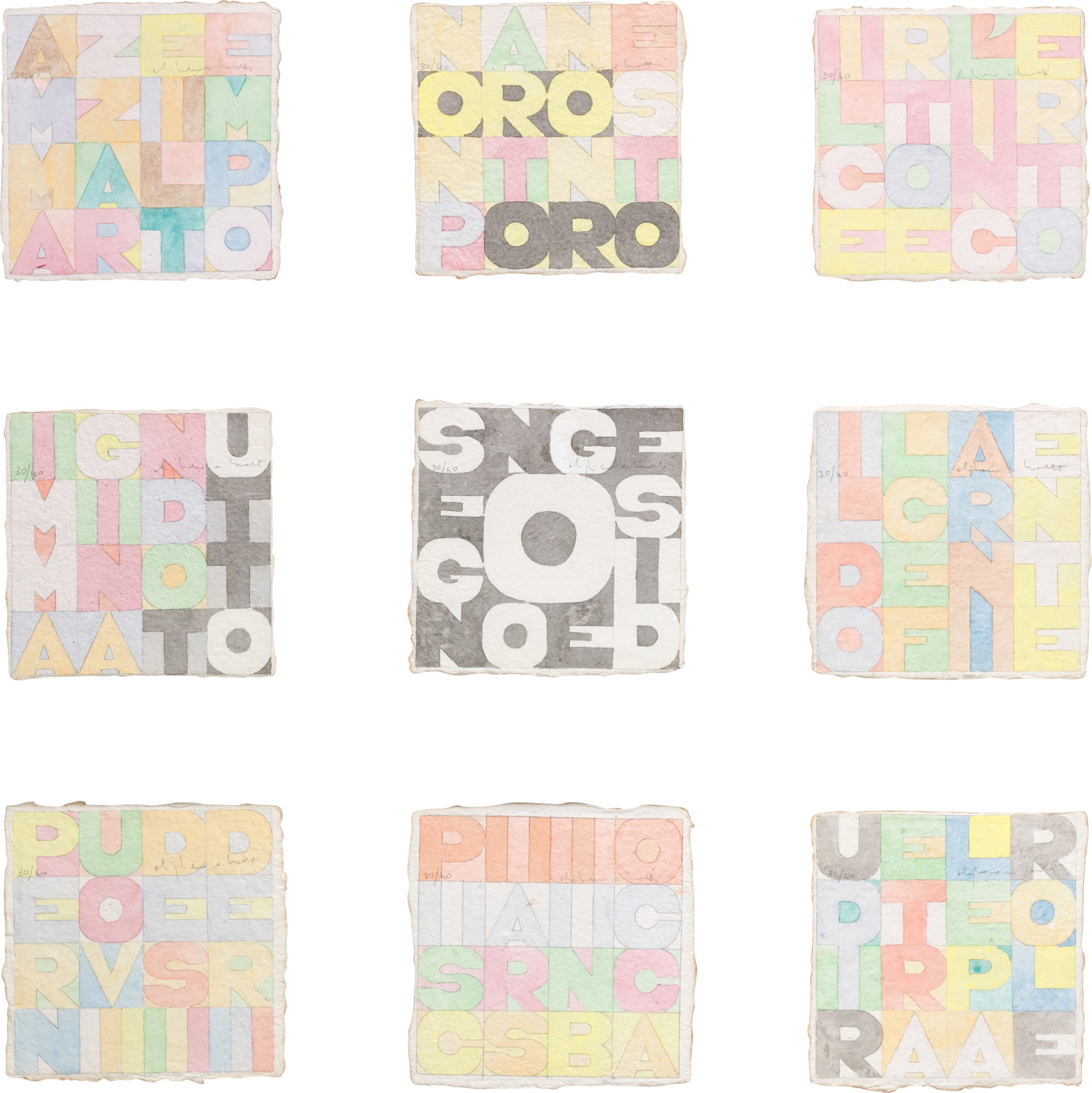
Nove quadrati, 1979
Boetti was born in Turin in 1940, a city whose industrial precision and philosophical ambition would leave a lasting mark on him. He came of age surrounded by the cool geometry of postwar Italian design and the restless intellectual culture of a city that also produced figures like Michelangelo Pistoletto and Mario Merz. Turin in the 1960s was a crucible for Arte Povera, the movement that would define Italian avant garde practice for a generation, and Boetti was drawn immediately into its orbit. Yet even within that context, his sensibility was distinct, warmer and more playful, alive to paradox and wordplay in ways that set him apart from the beginning.
His early friendships with the Arte Povera circle, particularly his association with the gallerist Gian Enzo Sperone, gave him a platform and a community. But Boetti was never content to stay within a single set of ideas. By the late 1960s he had begun to explore what he called systems, structures that could generate art through their own internal logic. He famously adopted the double name Alighiero e Boetti, splitting his identity into two to explore ideas of duality and selfhood.
Alighiero Boetti
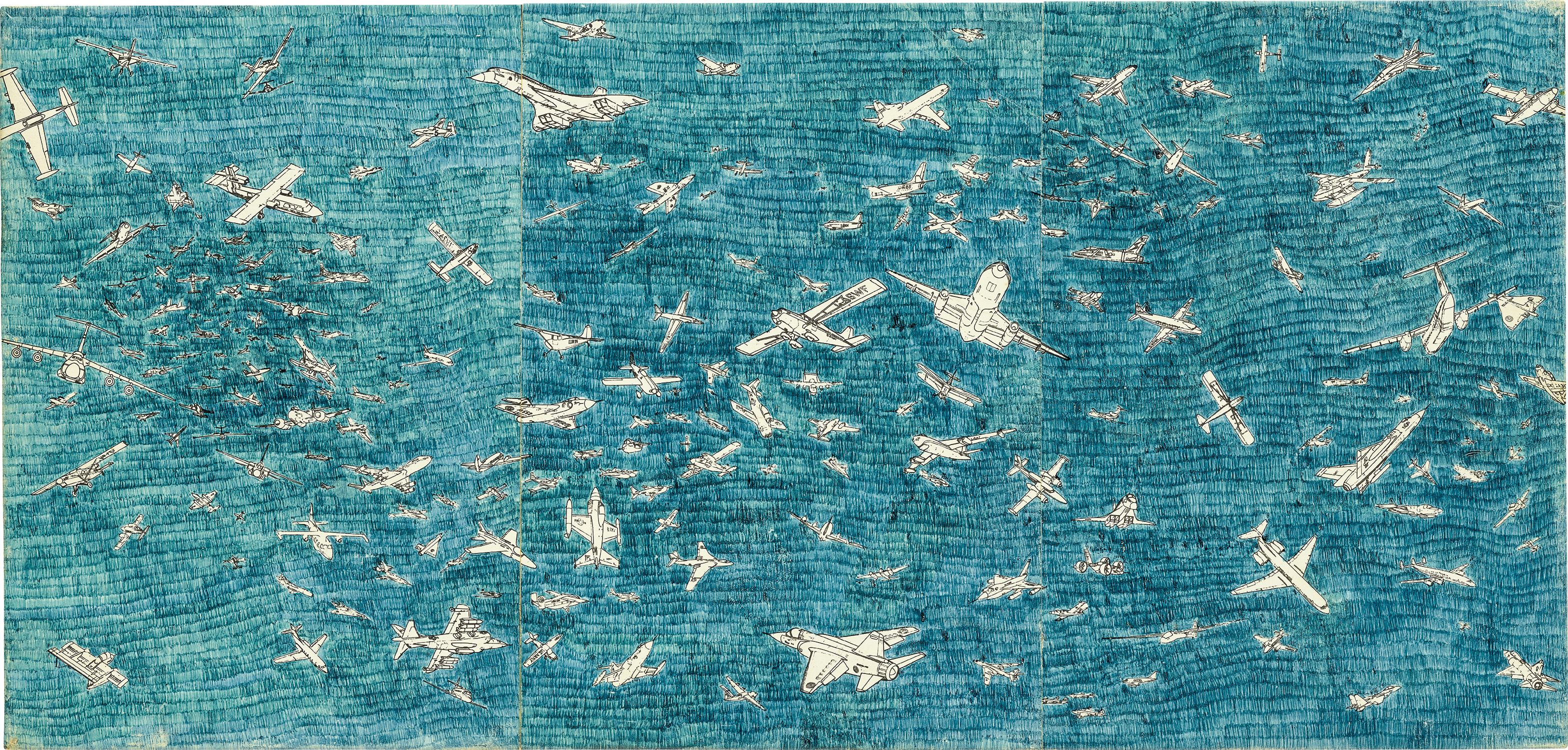
Aerei, 1983
This was not mere provocation. It was a rigorous philosophical proposition, the kind of conceptual move that aligned him with international contemporaries like Sol LeWitt and Lawrence Weiner while remaining entirely his own. The journey that defined his mature practice began in 1971 when Boetti first traveled to Afghanistan. He fell in love with Kabul, eventually opening a small hotel called the One Hotel, and forged deep relationships with Afghan embroiderers and weavers.
“Order and disorder, the one and the many, the simple and the complex. These are the poles between which everything happens.”
Alighiero Boetti
Over the following two decades, until the Soviet invasion made travel impossible, he collaborated with these artisans on the great woven maps, the Mappa series, as well as countless embroidered works that combined language, geometry, and color into something entirely new. The maps tracked the changing borders of nations, each edition a record of a world in flux, stitched by hands in Kabul and Peshawar in silk thread so dense it seemed to vibrate with light. The collaboration was genuine and profound, a meeting of conceptual ambition and extraordinary craft. Among his most celebrated works are the Aerei series, in which military aircraft are rendered in intricate ballpoint pen drawings that accumulate into vast, obsessive fields of mark making.
Alighiero Boetti
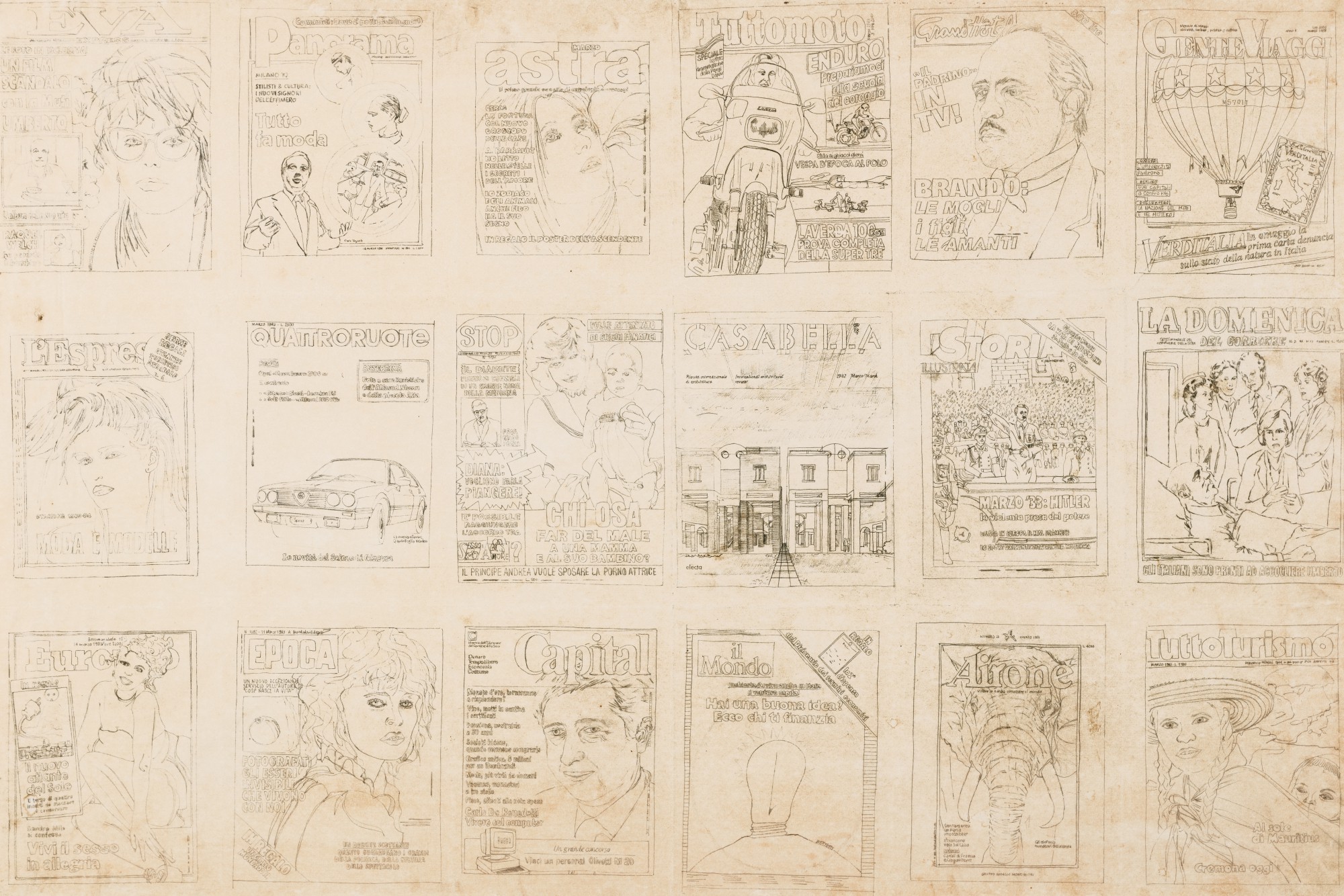
Copertine Marzo 1983, 1983
The 1983 work Aerei in the platform's collection exemplifies this perfectly, the repetition of the airplane form becoming almost meditative, a kind of systems art that also quietly interrogates the machinery of power. His works on paper, including the ballpoint and acrylic Ogni lettera un suono from 1982, show his fascination with language as visual material, each letter a sound, each sound a shape, the whole dissolving the boundary between writing and drawing. The nine watercolors of Nove quadrati from 1979 demonstrate his command of geometric abstraction, each unique and yet part of a coherent, rule bound whole. This tension between the systematic and the handmade runs through everything he touched.
For collectors, Boetti represents one of the great pleasures of the postwar Italian market: a body of work that is intellectually rigorous and visually ravishing in equal measure. His embroidered pieces, including works like Attirare l'Attenzione with its combination of embroidery and ink on fabric, command serious attention at auction, with major works regularly achieving seven figures at Sotheby's and Christie's. Works on paper, including his ballpoint pen drawings and pencil compositions such as Copertine Marzo 1983, offer a more accessible entry point without sacrificing depth. Collectors who have followed his market know that early works and pieces tied directly to his Afghan collaborations carry particular historical significance.
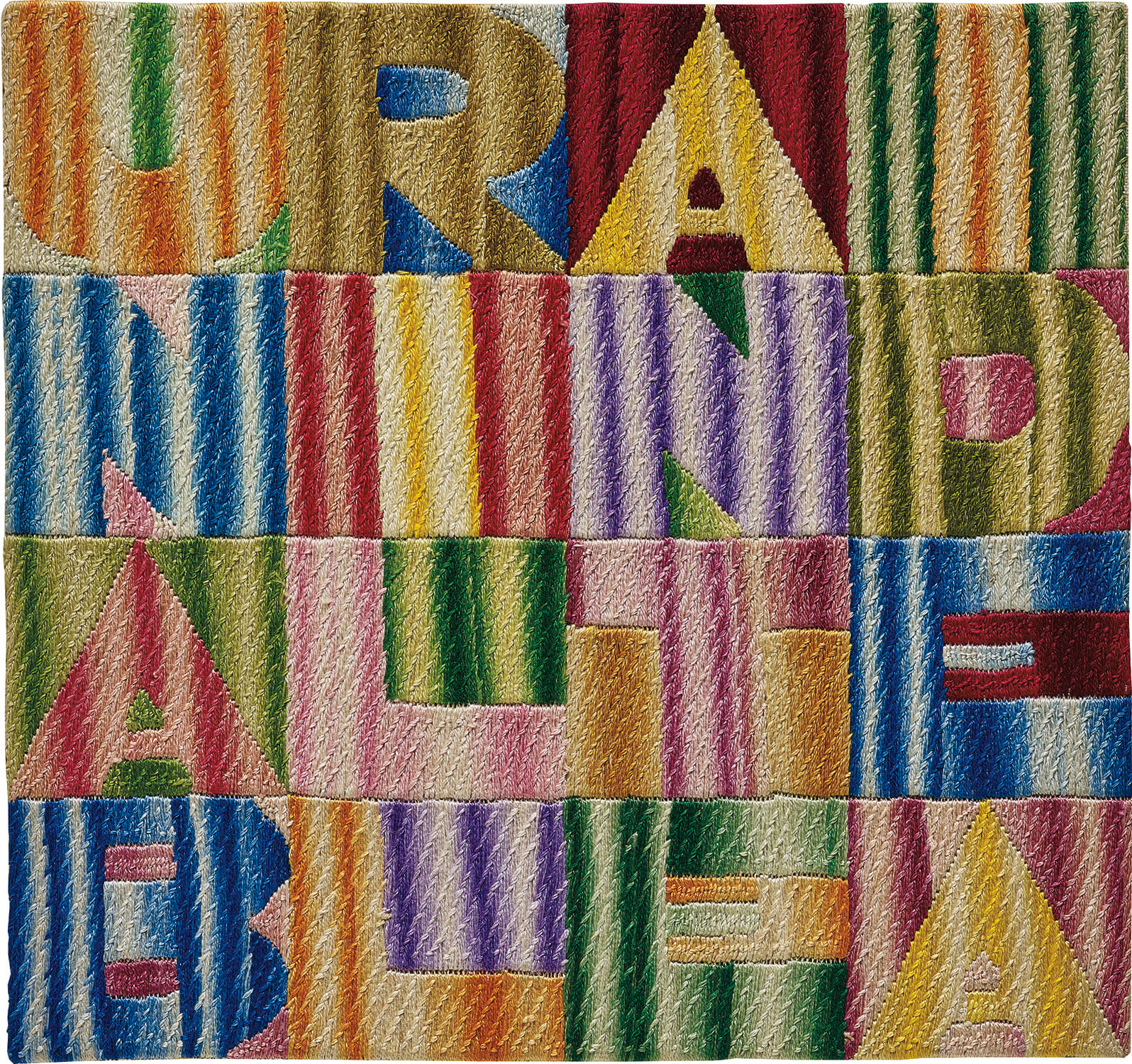
Alighiero Boetti
Una brillante idea, 1992
The variety within his practice, across watercolor, embroidery, ballpoint pen, photography, and installation, means there is genuinely something for every serious collector to pursue. Boetti belongs to a generation of artists whose thinking intersected with figures as varied as Joseph Kosuth in his conceptual rigor, Agnes Martin in his meditative use of repetition and grid, and his Arte Povera peers Pistoletto and Merz in his embrace of process and systems. Yet he is also productively compared to artists working in craft and collaboration, anticipating conversations about authorship and collective making that feel urgently contemporary today. His work on language and visual systems has influenced generations of younger Italian and European artists, and his maps have become reference points for anyone thinking about geopolitics, globalization, and the politics of representation.
Boetti died in Rome in 1994 at the age of fifty three, leaving behind a body of work whose full dimensions are still being understood. The Fondazione Alighiero e Boetti works to preserve and extend knowledge of his practice, and major institutions continue to acquire and exhibit his work with genuine enthusiasm. What endures is his extraordinary faith in the generative power of constraints, his belief that by setting up a system, by agreeing to rules, beauty and meaning could emerge in ways no single controlling hand could predict. In an era when collaboration, process, and the ethics of making are central to contemporary discourse, Boetti feels not like an artist of the past but a brilliant and enduring presence.
Explore books about Alighiero Boetti
Alighiero Boetti
Achille Bonito Oliva
Alighiero Boetti: A Retrospective
Germano Celant

Boetti
Luigi Carluccio
Alighiero Boetti: A Life of Transformation
Carolyn Christov-Bakargiev

Alighiero Boetti
Joan Kinder

One Million Rooms of Boetti
Germano Celant