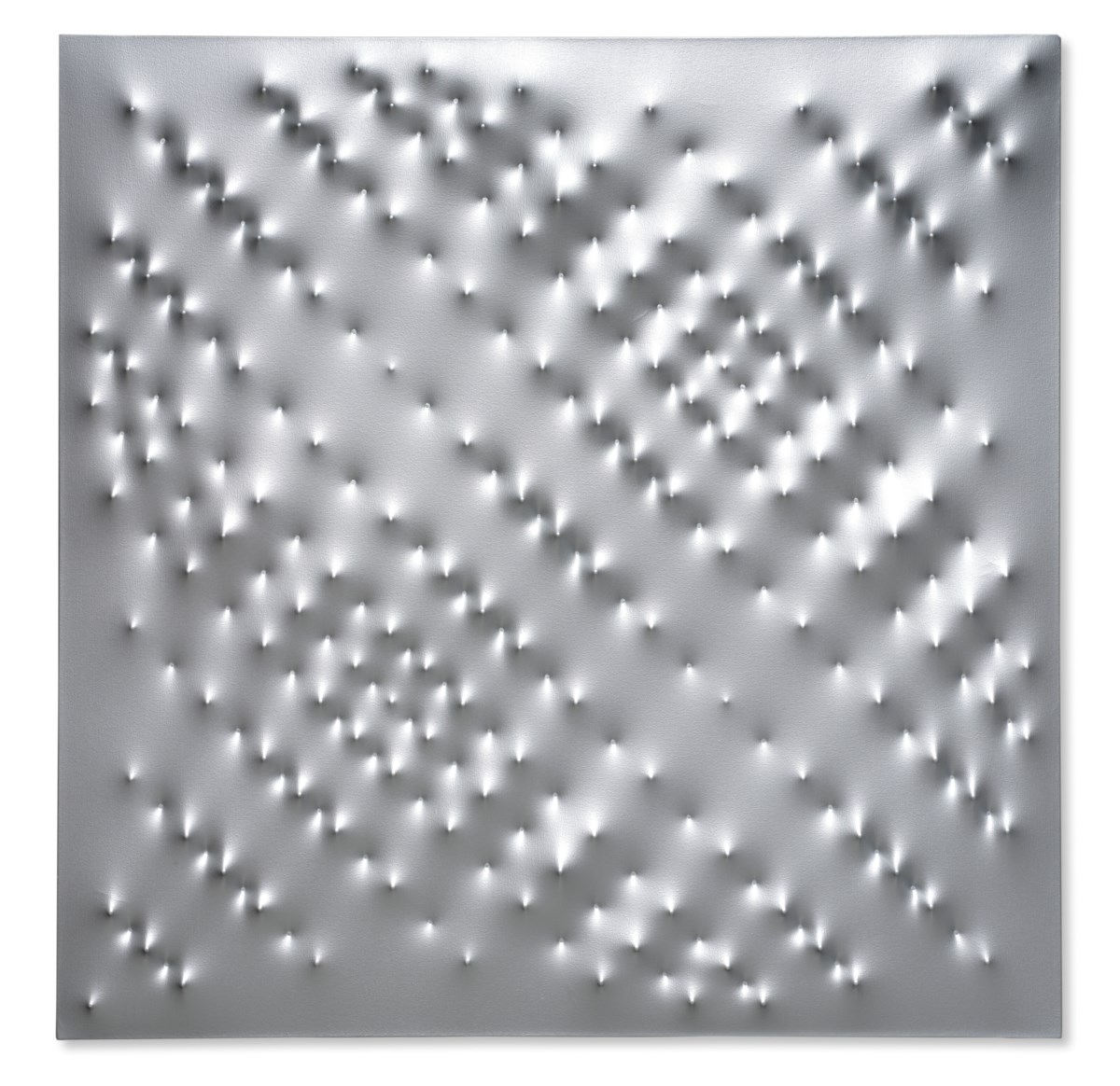
Superficie Alluminio
2001
Enrico Castellani's *Superficie Alluminio* is a shaped canvas work executed in metallic acrylic, its surface animated by a rhythmic pattern of protruding and receding points that create a dynamic interplay of light and shadow. Castellani's signature technique of stretching the canvas over a system of nails transforms the picture plane into a sculptural relief, dissolving the boundary between painting and three-dimensional object. The cool, reflective aluminum tonality amplifies the work's subtle topography, shifting in appearance as light conditions change.
- Medium
- acrylic on shaped canvas
- Dimensions
- Signed
- Yes
- Spotted At
- Auction House · Christie's
Notes
LITERATURE R. Wirz, F. Sardella, Enrico Castellani. Catalogo ragionato. Tomo secondo. Opere 1955-2005, Milan, 2012, No. 902 (illustré p. 560). EXHIBITED Bergame, Galleria Fumagalli, Enrico Castellani, octobre-novembre 2001 (illustré au catalogue d'exposition p. 140). Milan, Galica Arte Contemporanea, Obsession, décembre 2003-février 2004. FURTHER DETAILS Cette œuvre est enregistrée à la Fondation Enrico Castellani, Milan, sous le No. 01-006. Conditions of sale Brought to you by Elisabetta Vitullo Junior Specialist, Head of Day Sale EVITULLO@CHRISTIES.COM +33 (0)1 40 76 85 68 LOT ESSAY Skip to main content FRANÇAIS ENGLISH Je pense qu’il serait illégitime et présomptueux de vouloir déformer l’espace de manière définitive et irréversible avec, de surcroît, la présomption de modifier la réalité : il s’agirait, dans le meilleur des cas, d’une opération parfaitement inutile. On peut, au mieux, se permettre de le structurer de façon à le rendre lisible et accessible aux sens ; l’espace, au fond, ne nous touche et ne nous préoccupe que dans la mesure où il nous contient. Extraits du catalogue de l’exposition Lo spazio dell'immagine (« l’espace de l’image ») de 1967, ces mots d’Enrico Castellani mettent en lumière la problématique centrale autour de laquelle s’articule l’ensemble de sa production artistique. Castellani se tourne à partir de 1959 vers une expression essentiellement composée de reliefs monochromes, que Carla Lonzi qualifie de « lieux de contemplation possible » et que l’artiste définit lui-même comme des surfaces « les plus immatérielles possibles, façonnées par une double courbure et des éléments répétés » : une succession de saillies et de creux qui viennent dénaturer, bousculer la surface traditionnellement lisse de la toile tendue. Ainsi transformé, le support devient le théâtre d’un huis clos entre les vides et les pleins, le concave et le convexe, le positif et le négatif, l’ombre et la lumière, appelés à dialoguer, s’attirer et se repousser dans un même élan. À travers ce procédé, Castellani met au point un système signature, une véritable méthode de travail, efficace et singulière, qu’il décline d’œuvre en œuvre jusque sur le support métallique de cette Superficie alluminio. Exécutée en 2001, elle est présentée la même année à la galerie Fumagalli de Bergame puis, en 2003, à la galerie Galica Arte Contemporanea, à Milan. I believe it is illegitimate and presumptuous to want to deform space in a definitive and irreversible way, with the presumption, moreover, of wanting to have an impact on reality: at best, it is a useless operation. At most, it is permissible to structure it in such a way as to make it perceptible and sensorially accessible; space, after all, concerns and troubles us insofar as it contains us. Taken from the catalogue of the exhibition Lo spazio dell'immagine (The Space of the Image), 1967, these words by Enrico Castellani clearly highlight the main issue around which the artist’s entire body of work has always revolved. Starting in 1959, Castellani created predominantly monochrome relief surfaces, defined by Carla Lonzi as “places of possible contemplation” and described by Castellani himself as “as immaterial as possible, shaped with double curvature and repeated elements”—a succession of protrusions and recesses that alter the classic tension of the canvas, within which full and empty, concave and convex, light and shadow, positive and negative converse, attract, repel, and coexist. In doing so, he initiated a working method, a true system, effective and recognizable even in the work Superficie alluminio, executed in 2001, exhibited in Bergamo at the Galleria Fumagalli that same year, and later on the occasion of the exhibition Obsession, held in Milan in 2003. READ MORE OF THE LOT ESSAY
🔨 Auction Lot
Art Contemporain
Lot 263
More by Enrico Castellani
Start the Discussion
Request access to join the discussion