Zao Wou-Ki
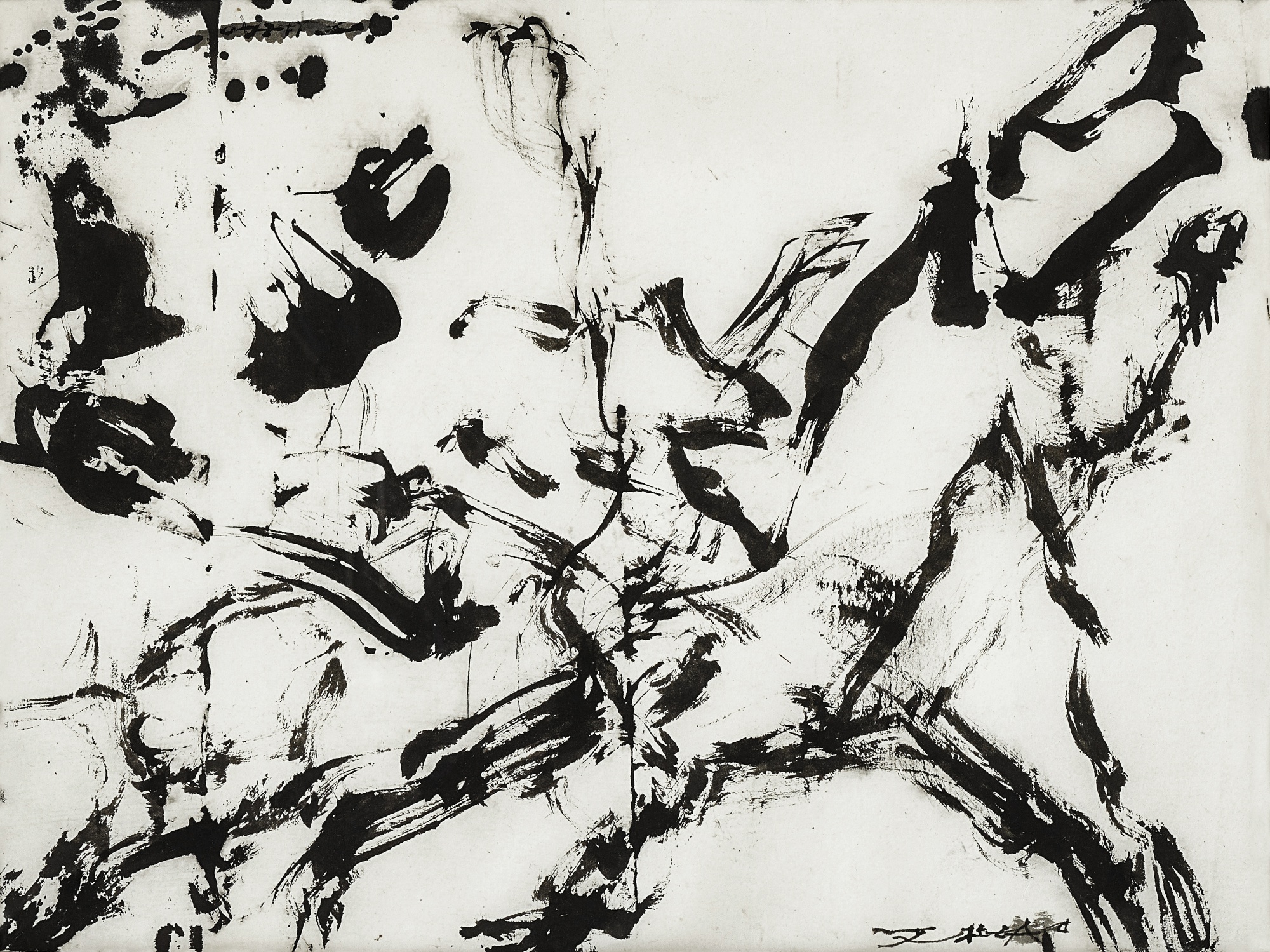
Zao Wou-Ki: Where Two Worlds Become One
Artist Spotlight · The Collection Editorial
“I want my painting to give off light, to be like a source of light.”
Zao Wou-Ki, interview with Claude Roy
In November 2018, a single canvas by Zao Wou Ki shattered expectations at Sotheby's Hong Kong, when his monumental triptych 'Juin Octobre 1985' sold for HK$510 million, equivalent to roughly US$65 million, making it the most expensive work ever sold by an Asian artist at auction at that time. The room, by all accounts, was electric. It was a moment that confirmed what devoted collectors and museum curators had known for decades: that Zao Wou Ki occupies a singular, irreplaceable position in the history of modern art. His work belongs to no single country and no single tradition.
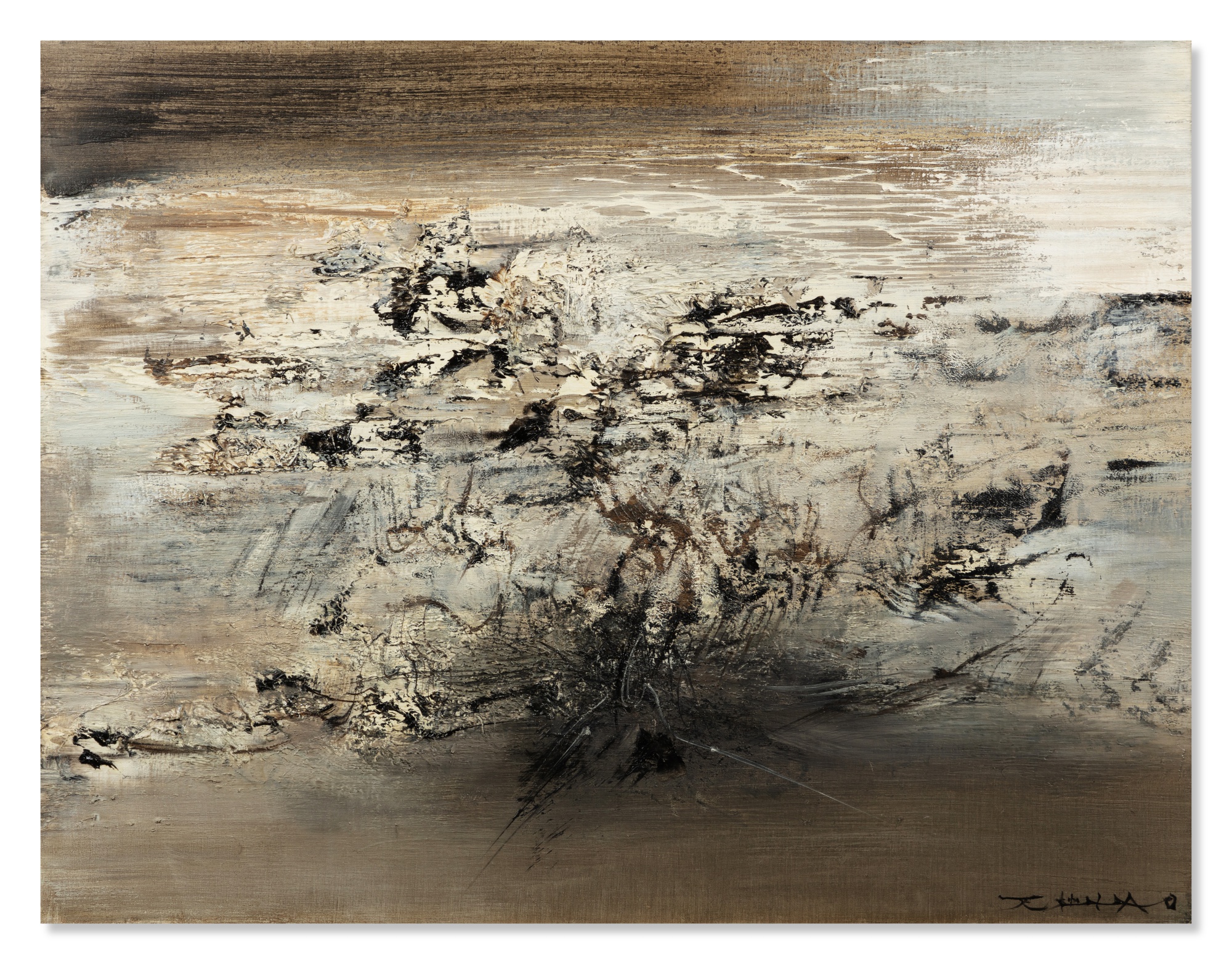
Zao Wou-Ki
25.10.61
It belongs, quite simply, to the world. Zao Wou Ki was born in Beijing in 1920 into a scholarly and cultivated family with deep roots in Chinese literati culture. His grandfather and father were both painters, and from an early age he was immersed in the classical traditions of ink, brushwork, and the studied observation of the natural world. He enrolled at the Hangzhou School of Fine Arts at the age of fourteen, where he studied under Lin Fengmian, a visionary educator who encouraged his students to look seriously at Western modernism alongside their Chinese inheritance.
Lin Fengmian was himself a rare figure, a painter who had trained in France and who believed that the synthesis of East and West was not a compromise but a possibility. That belief would become the animating force of Zao Wou Ki's entire career. In 1948, Zao Wou Ki made the decision that would define his life: he left China for Paris. He arrived in a city still humming with the energy of the postwar avant garde, where Pablo Picasso, Henri Matisse, and Alberto Giacometti moved through the same arrondissements and the same conversations.
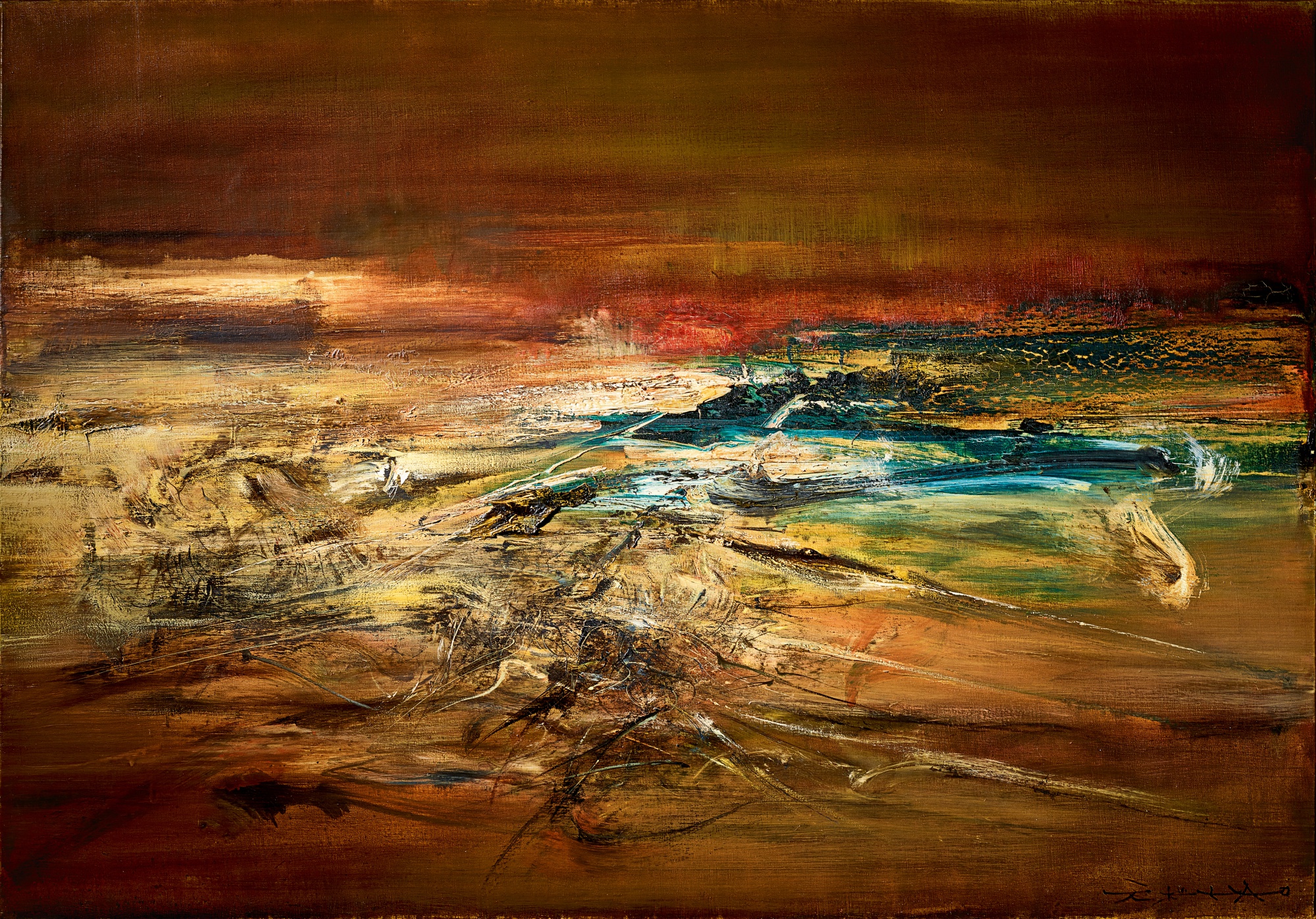
Zao Wou-Ki
05.11.62
Zao settled in Montparnasse and fell quickly into the city's artistic community, befriending the Swiss sculptor Alberto Giacometti and the Spanish French painter Joan Miró, whose playful, symbol laden canvases made a strong early impression on him. He also formed a lasting friendship with the poet Henri Michaux, a relationship that would sharpen his understanding of the relationship between the written mark and the painted gesture. Paris in those years was the perfect laboratory for someone determined to dissolve the boundary between two visual cultures. Through the early 1950s, Zao's paintings still carried legible references: figures, landscapes, architectural forms rendered with a Klee like tenderness.
“I left China to find myself, and I found myself by going back to China through painting.”
Zao Wou-Ki
But by the mid 1950s something more radical began to emerge. His calligraphic training, with its emphasis on the energy of the individual stroke, the weight of the brush, the breath behind the mark, began to fuse with the expansive ambitions of Abstract Expressionism, the American movement centered on artists like Franz Kline and Mark Rothko whose work Zao encountered and absorbed without imitation. What resulted was entirely his own: vast, atmospheric fields of color in which light seemed to gather, dissipate, and gather again, like weather systems observed from a great height. The paintings breathed.
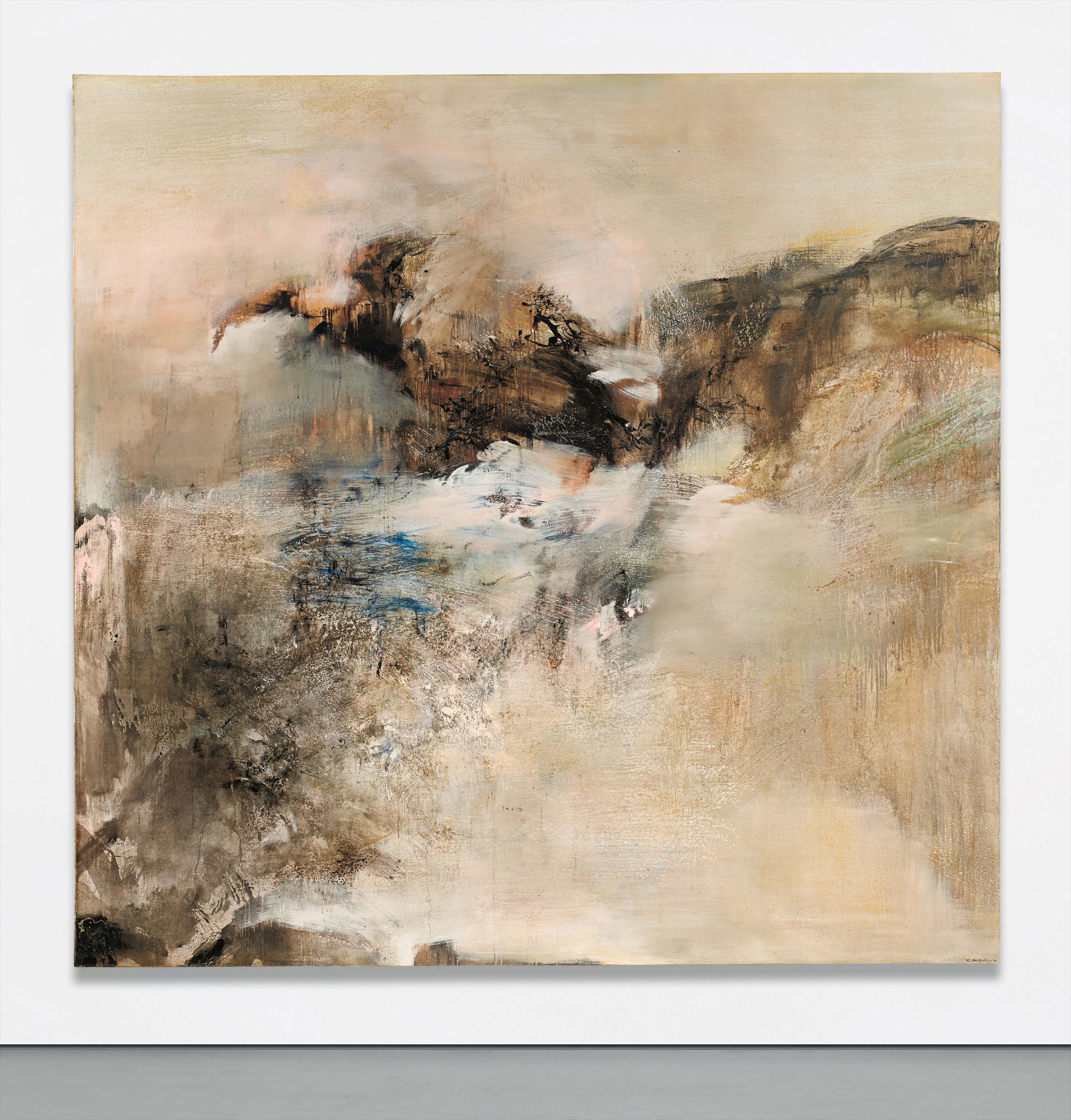
Zao Wou-Ki
04.01.79, 1979
They moved. They held within them the memory of mountains and rivers without depicting any of them. His practice of dating his canvases rather than titling them, a habit he adopted in the early 1950s, was both a statement and an invitation. Works such as '25.
10.61,' '05.11.62,' and '20.
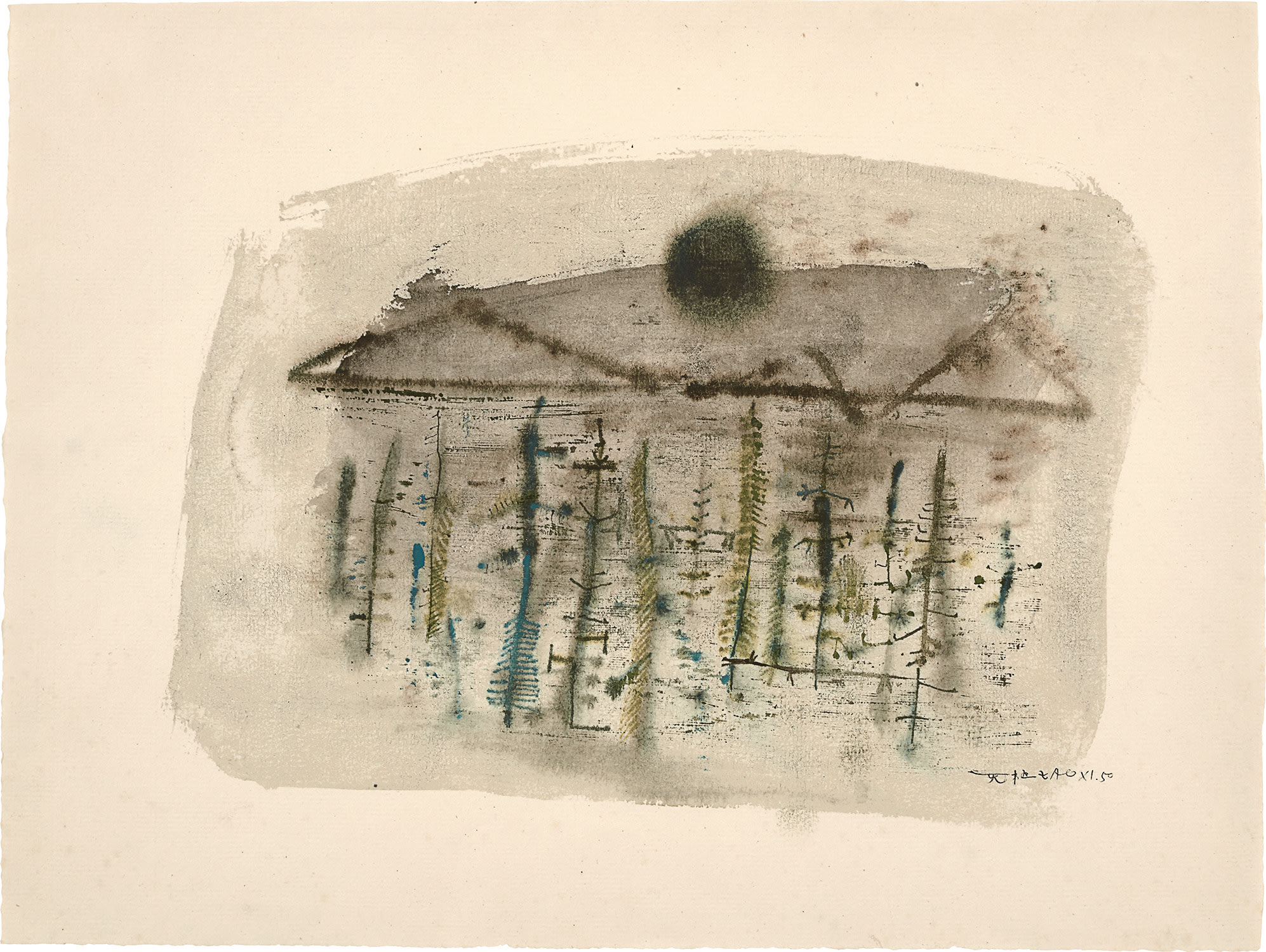
Zao Wou-Ki
Executed in November 1950, this work is accompanied by a certificate of authenticity issued by the Fondation Zao Wou-Ki.
3.64' carry their dates the way a diary entry carries a date: as a marker of lived experience rather than a label of subject matter. The date tells you when the encounter between the artist and the canvas took place, and leaves the interpretation entirely open. It is a profoundly generous gesture toward the viewer, and it is also a deeply Chinese one, rooted in the Daoist understanding that meaning arises from relationship rather than from fixed definition.
Collectors who live with these works frequently speak of how they seem to change from morning to afternoon, from winter to summer, as though the painting is responding to the same atmosphere it depicts. On paper, Zao was equally commanding. His lithographs, among them the delicate and luminous 'Les poissons' from 1953 and the lyrical 'Jardin le nuit,' demonstrate a printmaker's sensitivity to the grain of a surface, the resistance of a material, the difference between what is pressed and what is allowed to breathe. His collaborative artist's books, including 'À la gloire de l'image et art poétique,' made with poets and published in limited editions, place him within a distinguished French tradition of livre d'artiste that runs from Vollard's early Picasso editions through the mid century collaborations of the School of Paris.
These works are rarer and more intimate than the large oils, and for a certain kind of collector they represent the most direct encounter with the artist's intelligence. For collectors approaching the market, Zao Wou Ki's work rewards careful looking and patient acquisition. The oils from the late 1950s through the 1970s are broadly considered the most significant period, the years when his synthesis was most fully achieved and his formal invention most assured. Works on paper, including ink and gouache compositions accompanied by certificates from the Fondation Zao Wou Ki, offer an accessible entry point into his practice while demonstrating the same qualities of mark and atmosphere that define the canvases.
The Fondation, established to steward his legacy, maintains a rigorous catalogue raisonné and is an important resource for authentication. Provenance, condition, and catalogue documentation matter enormously in this market, and the presence of a certificate from the Fondation significantly supports both confidence and value. Art historically, Zao Wou Ki is best understood in the company of artists who refused easy categorization. He shares a poetic sensibility with Mark Rothko, a calligraphic energy with Franz Kline, and a meditative relationship with landscape that connects him to the great Song dynasty painters he studied as a boy.
Within the broader conversation about Asian modernism, he stands alongside figures such as Chu Teh Chun, his friend and fellow Hangzhou alumnus who also settled in Paris, and Sanyu, the Chinese French painter whose elegant Western inflected figuration found its own singular voice in the French capital. These artists collectively represent one of the most fertile and underappreciated crossings in twentieth century art history. Zao Wou Ki died in Nyon, Switzerland, in April 2013, at the age of ninety two. He had lived long enough to see his work enter the permanent collections of the Musée National d'Art Moderne at the Centre Pompidou in Paris, the Museum of Modern Art in New York, and major institutions across Asia.
He had received the Grand Prix National de Peinture in France in 1994, and was elected to the Académie des beaux arts in 2002, a recognition of the degree to which France had genuinely claimed him as its own. His legacy today is that of an artist who never chose between his inheritances but instead expanded both of them, who painted not from one tradition or another but from the place where they meet, luminous, open, and entirely alive.
Explore books about Zao Wou-Ki
Zao Wou-Ki
François Marquet
Zao Wou-Ki: Catalogue Raisonné
François Marquet
Zao Wou-Ki: Autoportrait
Zao Wou-Ki
Zao Wou-Ki
Jean Leymarie
Zao Wou-Ki: Peintures et Estampes
Georges Duby
Zao Wou-Ki: Lumière et Matière
Michel Tapié
Zao Wou-Ki
Charles Estienne